Binance Square

verifiablecomputing

閲覧回数 675
14人が討論中
Crypto Creator1
·
--
翻訳参照
Fabric Protocol The Trust Layer for the Future of Robotics.For a long time, I kept hearing about robots AI systems, public ledgers, and something called verifiable computing. Honestly, it all sounded too technical and far away from real life. I thought it was only for engineers or big tech companies. But the day I truly understood what Fabric Protocol is trying to do, everything became simple. I realized it is not just about robots. It is about trust. It is about safety. It is about how humans and machines can work together without fear. In this article I will explain Fabric Protocol in very simple English from a beginner’s point of view. I will share what the project is, how it works, and why it could change the way we build and control robots in the future. What Is Fabric Protocol. Fabric Protocol is a global open network. It is supported by a non profit organization called the Fabric Foundation. The main goal of this network is to help people build, manage, and improve general purpose robots in a safe and transparent way. When we say general purpose robots, we mean robots that can do many different tasks. Not just one small job in a factory, but robots that can move, learn, adapt, and work in the real world with humans. Fabric Protocol gives developers a shared system where they can coordinate data, computing power, and rules. All of this is recorded on a public ledger. A public ledger is like a shared digital notebook that everyone can see and verify. It helps make sure nothing is hidden or secretly changed. So in simple words, Fabric Protocol is a system that helps people build smart robots together, while making sure everything is safe, fair, and transparent. Why Do We Even Need Something Like This At first, I used to think robots are already smart enough. We see videos online of robots walking, talking, and even doing simple tasks. But when I started reading more, I understood the real problem. Robots and AI systems can make mistakes. They can misunderstand instructions. They can act in unexpected ways. If a robot is working in a hospital, a home, or on the road, even a small mistake can become dangerous. If different companies build robots in closed systems, there is no shared standard for safety and governance. If something goes wrong, it becomes hard to check what happened and who is responsible. This is where Fabric Protocol becomes important. It tries to create a common infrastructure. It connects robots and systems through a public ledger. This means actions, data, and decisions can be verified. If something happens, we can trace it back and understand it. We are seeing a world where robots are slowly moving from labs into daily life. If we do not build trust now, it will become harder later. What Is Verifiable Computing in Simple Words Verifiable computing sounds complex, but when I finally understood it, it felt very logical. Normally, when a machine does a calculation or makes a decision, we just trust it. We assume it did the right thing. But what if we could mathematically prove that the result is correct? Verifiable computing allows a system to show proof that its computation was done correctly. It is like showing your full working in a math exam instead of only writing the final answer. In Fabric Protocol, this idea is very important. Robots and AI agents can prove that their actions or decisions followed certain rules. If they say they checked a safety condition, there is proof. If they say they followed a regulation, there is proof. This builds trust not only between humans and machines, but also between different machines. What Does Agent Native Infrastructure Mean When I first heard the term agent native infrastructure, I was confused. But then I thought about it differently. Today, most digital systems are built for humans. We click buttons. We log in. We send messages. But in the future, AI agents and robots will also interact directly with digital systems. Agent native infrastructure means the system is designed from the start for AI agents and robots. They can communicate, make agreements, share data, and follow rules automatically. If a robot needs to access certain data, it can do it through the network in a secure and verified way. If it needs permission, it can check rules recorded on the ledger. It becomes a world where machines are not just tools, but active participants in a digital ecosystem. How Governance Works in Fabric Protocol Governance simply means who makes the rules and how decisions are made. Fabric Protocol uses a public ledger to coordinate regulation. This means rules can be written into the system. They are visible. They are transparent. They cannot be secretly changed. The Fabric Foundation supports the development of the network, but the idea of an open protocol means that many people and organizations can participate. If we think about the future, robots might work in public spaces, homes, hospitals, and factories. We need shared rules. We need a way to update those rules as technology evolves. If governance is built into the infrastructure itself, it becomes easier to adapt safely. Why This Matters for Beginners Like Us When I first looked at Fabric Protocol, I thought it was only for developers. But then I realized something important. If robots become part of daily life, this affects all of us. It affects how safe our workplaces are. It affects how our data is used. It affects how decisions are made around us. Understanding projects like Fabric Protocol helps us see the bigger picture. We are not just watching technology grow. We are part of a society that must decide how it grows. If systems are built with transparency and verifiable proofs, it becomes easier to trust them. And trust is the foundation of any new technology. A Simple Example to Imagine Imagine a robot working in a hospital. It delivers medicine to patients. Without a system like Fabric Protocol, we only hope the robot follows the correct instructions. If something goes wrong, it may be hard to check what happened. With a verifiable and ledger based system, every step can be recorded. The robot can prove it received the right instruction. It can prove it checked the correct patient ID. It can prove it followed safety rules. If there is a mistake, we can trace it clearly. If everything works well, we have confidence. This is how human machine collaboration becomes safer and more reliable. The Bigger Vision When I step back and look at the full picture, I see that Fabric Protocol is not just about robots. It is about building an open and shared infrastructure for the next generation of intelligent machines. It connects data, computation, and regulation in one coordinated system. It uses a public ledger to create transparency. It supports modular infrastructure so developers can build flexible and adaptable robots. We are slowly moving toward a world where machines will not only assist us but also act independently in many situations. If we want that world to be safe, we need strong foundations. Fabric Protocol is trying to build that foundation. Conclusion The day I finally understood Fabric Protocol, I stopped seeing it as a complicated technical idea. I started seeing it as a trust layer for robots. It is a global open network supported by the Fabric Foundation. It enables the construction, governance, and evolution of general purpose robots. It uses verifiable computing and a public ledger to coordinate data, computation, and regulation. In simple words, it helps humans and machines work together safely. If we are entering a future where robots are everywhere, then systems like Fabric Protocol are not optional. They are necessary. Now I am not just watching this space with confusion. I am watching it with curiosity and hope. If you are new to this topic, take your time, read slowly, and ask questions. The future of robotics is not only for engineers. It is for all of us. Let us learn together and stay informed as this technology evolves. @FabricFND #Mira #RoboticsFuture #VerifiableComputing #OpenInfrastructure $ROBO

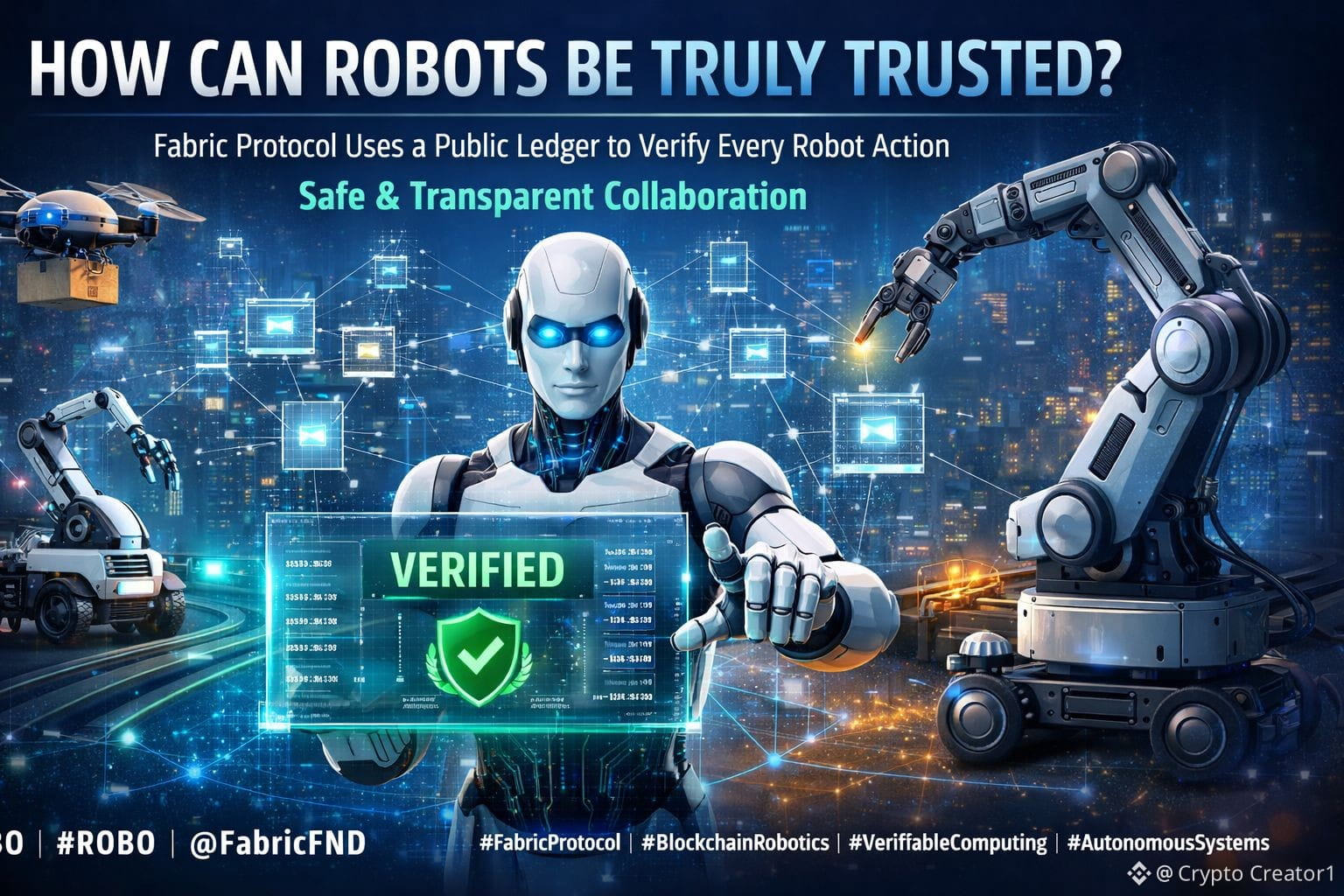
Fabric Protocol The Trust Layer for the Future of Robotics.

For a long time, I kept hearing about robots AI systems, public ledgers, and something called verifiable computing. Honestly, it all sounded too technical and far away from real life. I thought it was only for engineers or big tech companies. But the day I truly understood what Fabric Protocol is trying to do, everything became simple. I realized it is not just about robots. It is about trust. It is about safety. It is about how humans and machines can work together without fear.

In this article I will explain Fabric Protocol in very simple English from a beginner’s point of view. I will share what the project is, how it works, and why it could change the way we build and control robots in the future.

What Is Fabric Protocol.

Fabric Protocol is a global open network. It is supported by a non profit organization called the Fabric Foundation. The main goal of this network is to help people build, manage, and improve general purpose robots in a safe and transparent way.

When we say general purpose robots, we mean robots that can do many different tasks. Not just one small job in a factory, but robots that can move, learn, adapt, and work in the real world with humans.

Fabric Protocol gives developers a shared system where they can coordinate data, computing power, and rules. All of this is recorded on a public ledger. A public ledger is like a shared digital notebook that everyone can see and verify. It helps make sure nothing is hidden or secretly changed.

So in simple words, Fabric Protocol is a system that helps people build smart robots together, while making sure everything is safe, fair, and transparent.

Why Do We Even Need Something Like This

At first, I used to think robots are already smart enough. We see videos online of robots walking, talking, and even doing simple tasks. But when I started reading more, I understood the real problem.

Robots and AI systems can make mistakes. They can misunderstand instructions. They can act in unexpected ways. If a robot is working in a hospital, a home, or on the road, even a small mistake can become dangerous.

If different companies build robots in closed systems, there is no shared standard for safety and governance. If something goes wrong, it becomes hard to check what happened and who is responsible.

This is where Fabric Protocol becomes important. It tries to create a common infrastructure. It connects robots and systems through a public ledger. This means actions, data, and decisions can be verified. If something happens, we can trace it back and understand it.

We are seeing a world where robots are slowly moving from labs into daily life. If we do not build trust now, it will become harder later.

What Is Verifiable Computing in Simple Words

Verifiable computing sounds complex, but when I finally understood it, it felt very logical.

Normally, when a machine does a calculation or makes a decision, we just trust it. We assume it did the right thing. But what if we could mathematically prove that the result is correct?

Verifiable computing allows a system to show proof that its computation was done correctly. It is like showing your full working in a math exam instead of only writing the final answer.

In Fabric Protocol, this idea is very important. Robots and AI agents can prove that their actions or decisions followed certain rules. If they say they checked a safety condition, there is proof. If they say they followed a regulation, there is proof.

This builds trust not only between humans and machines, but also between different machines.

What Does Agent Native Infrastructure Mean

When I first heard the term agent native infrastructure, I was confused. But then I thought about it differently.

Today, most digital systems are built for humans. We click buttons. We log in. We send messages. But in the future, AI agents and robots will also interact directly with digital systems.

Agent native infrastructure means the system is designed from the start for AI agents and robots. They can communicate, make agreements, share data, and follow rules automatically.

If a robot needs to access certain data, it can do it through the network in a secure and verified way. If it needs permission, it can check rules recorded on the ledger.

It becomes a world where machines are not just tools, but active participants in a digital ecosystem.

How Governance Works in Fabric Protocol

Governance simply means who makes the rules and how decisions are made.

Fabric Protocol uses a public ledger to coordinate regulation. This means rules can be written into the system. They are visible. They are transparent. They cannot be secretly changed.

The Fabric Foundation supports the development of the network, but the idea of an open protocol means that many people and organizations can participate.

If we think about the future, robots might work in public spaces, homes, hospitals, and factories. We need shared rules. We need a way to update those rules as technology evolves.

If governance is built into the infrastructure itself, it becomes easier to adapt safely.

Why This Matters for Beginners Like Us

When I first looked at Fabric Protocol, I thought it was only for developers. But then I realized something important.

If robots become part of daily life, this affects all of us. It affects how safe our workplaces are. It affects how our data is used. It affects how decisions are made around us.

Understanding projects like Fabric Protocol helps us see the bigger picture. We are not just watching technology grow. We are part of a society that must decide how it grows.

If systems are built with transparency and verifiable proofs, it becomes easier to trust them. And trust is the foundation of any new technology.

A Simple Example to Imagine

Imagine a robot working in a hospital. It delivers medicine to patients.

Without a system like Fabric Protocol, we only hope the robot follows the correct instructions. If something goes wrong, it may be hard to check what happened.

With a verifiable and ledger based system, every step can be recorded. The robot can prove it received the right instruction. It can prove it checked the correct patient ID. It can prove it followed safety rules.

If there is a mistake, we can trace it clearly. If everything works well, we have confidence.

This is how human machine collaboration becomes safer and more reliable.

The Bigger Vision

When I step back and look at the full picture, I see that Fabric Protocol is not just about robots. It is about building an open and shared infrastructure for the next generation of intelligent machines.

It connects data, computation, and regulation in one coordinated system. It uses a public ledger to create transparency. It supports modular infrastructure so developers can build flexible and adaptable robots.

We are slowly moving toward a world where machines will not only assist us but also act independently in many situations. If we want that world to be safe, we need strong foundations.

Fabric Protocol is trying to build that foundation.

Conclusion

The day I finally understood Fabric Protocol, I stopped seeing it as a complicated technical idea. I started seeing it as a trust layer for robots.

It is a global open network supported by the Fabric Foundation. It enables the construction, governance, and evolution of general purpose robots. It uses verifiable computing and a public ledger to coordinate data, computation, and regulation.

In simple words, it helps humans and machines work together safely.

If we are entering a future where robots are everywhere, then systems like Fabric Protocol are not optional. They are necessary.

Now I am not just watching this space with confusion. I am watching it with curiosity and hope.

If you are new to this topic, take your time, read slowly, and ask questions. The future of robotics is not only for engineers. It is for all of us.

Let us learn together and stay informed as this technology evolves.
@Fabric Foundation
#Mira
#RoboticsFuture
#VerifiableComputing
#OpenInfrastructure
$ROBO
Brenwick:
excellent openion
翻訳参照
Fabric Protocol: Rethinking Trust in the Age of Autonomous Machines.#ROBO @FabricFND $ROBO Introduction We are entering an era in which machines are no longer confined to factory lines or research labs. They are beginning to move among us — assisting in hospitals, navigating warehouses, supporting infrastructure, and even entering our homes. As robotics becomes more autonomous and more integrated into daily life, a quiet but profound question emerges: Can we truly trust the systems we are building? Fabric Foundation proposes an answer through Fabric Protocol, a global open network designed to coordinate the construction, governance, and collaborative evolution of general-purpose robots. Rather than treating trust as an afterthought, the protocol attempts to embed it directly into infrastructure — through verifiable computing, public ledger coordination, and agent-native systems. This article reflects on what that means — not only technically, but philosophically and socially — as we design the foundations of human-machine collaboration. 1. The Quiet Shift: From Intelligence to Accountability For years, innovation in robotics has focused on intelligence better models, better sensors, better autonomy. Yet intelligence alone does not guarantee safety or alignment. In fact, as systems grow more capable, opacity grows alongside them. Fabric Protocol reframes the problem. It asks: What if the true bottleneck is not intelligence but accountability? By introducing verifiable computing and transparent coordination mechanisms, the protocol suggests that robotic systems should be auditable, governable, and continuously aligned with shared standards. It shifts the emphasis from what robots can do to how their actions can be verified. This shift feels subtle yet it may prove foundational. 2. Architecture as a Philosophy of Trust When we look at Fabric Protocol’s architecture, we see more than technical layers. We see a philosophy expressed in infrastructure. Verifiable Computing Instead of asking society to trust opaque algorithms, the protocol enables computations to be cryptographically proven. In doing so, it replaces assumption with evidence. Public Ledger Coordination By coordinating data, computation, and regulation through a public ledger, the system creates a shared record of robotic identity, updates, and compliance. It introduces institutional memory — something autonomous systems will increasingly require. Modular Governance Governance is not imposed; it is structured to evolve. Communities, regulators, and contributors can adapt standards as technology advances, without compromising safety. Together, these layers suggest a broader insight: Trust is not a feature it is an architecture. 3. Agent-Native Infrastructure: Machines as Participants Traditionally, infrastructure has been designed for humans. Machines were tools endpoints in a system built around people. Fabric Protocol introduces the idea of agent-native infrastructure, where robots possess identity, follow enforceable rules, and participate directly in coordination frameworks. This is a meaningful evolution. It suggests a future where machines are not merely controlled but are integrated into structured ecosystems of accountability. A robot is not just a device; it becomes a network participant governed by transparent protocols. That shift carries both promise and responsibility. 4. Governance in a Fragmented World One of the most pressing challenges in robotics is regulatory fragmentation. Standards differ across industries and nations. Innovation moves quickly; policy moves carefully. Fabric Protocol attempts to bridge this divide by embedding compliance and governance mechanisms into a shared coordination layer. Instead of treating regulation as an external constraint, it becomes part of the system’s design. This approach raises a thoughtful possibility: What if governance could evolve at the speed of software without sacrificing rigor? In that sense, the protocol does not merely support robots; it supports the institutions that must oversee them. 5. Human-Machine Collaboration: Safety by Construction. As robots work alongside humans in warehouses, hospitals, or public spaces collaboration must be predictable. Not just technically functional, but socially acceptable. Through verifiable constraints, transparent updates, and shared behavioral standards, Fabric Protocol attempts to make safety intrinsic rather than reactive. It acknowledges a reality we often overlook: Trust is built slowly, but it can be broken quickly. Embedding accountability at the protocol level may help ensure that as robotic capabilities expand, public confidence does not erode. Conclusion: Engineering Trust for the Long Term. Fabric Protocol represents more than a technological proposal. It represents a perspective on the future of autonomy. By combining: Verifiable computation Public ledger coordination Modular governance Agent-native infrastructure it frames robotics not just as a field of innovation, but as a domain requiring durable trust systems. As we reflect on the accelerating pace of automation, one thing becomes clear: intelligence alone will not define the next era. Infrastructure will. Governance will. Transparency will. If robotics is to become truly general-purpose and globally integrated, then the foundations must be as thoughtful as the machines themselves. Fabric Protocol invites us to consider that trust is not something we grant to technology it is something we must deliberately design into it. Support technologies that build trust through transparency and accountability. The future of robotics depends on responsible infrastructure — and informed voices like yours. #ROBO #FabricProtocol #RoboticsGovernance #VerifiableComputing

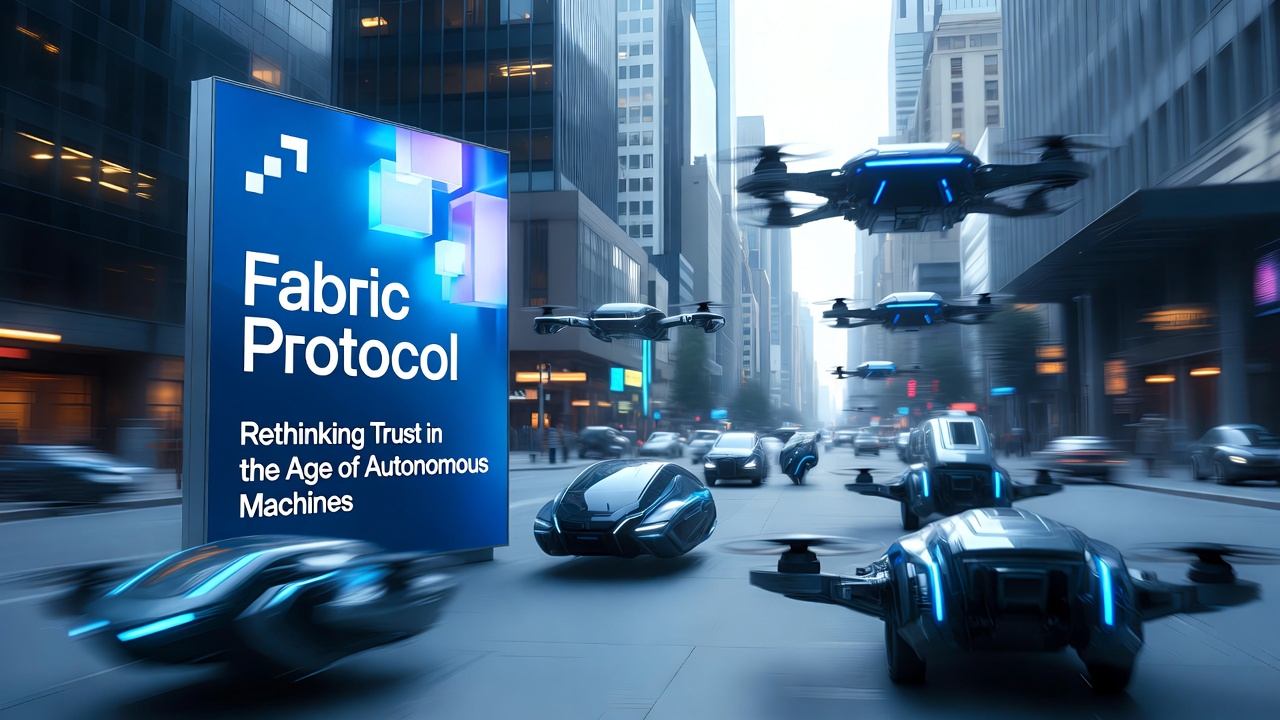
Fabric Protocol: Rethinking Trust in the Age of Autonomous Machines.

#ROBO @Fabric Foundation $ROBO
Introduction

We are entering an era in which machines are no longer confined to factory lines or research labs. They are beginning to move among us — assisting in hospitals, navigating warehouses, supporting infrastructure, and even entering our homes. As robotics becomes more autonomous and more integrated into daily life, a quiet but profound question emerges:

Can we truly trust the systems we are building?

Fabric Foundation proposes an answer through Fabric Protocol, a global open network designed to coordinate the construction, governance, and collaborative evolution of general-purpose robots. Rather than treating trust as an afterthought, the protocol attempts to embed it directly into infrastructure — through verifiable computing, public ledger coordination, and agent-native systems.

This article reflects on what that means — not only technically, but philosophically and socially — as we design the foundations of human-machine collaboration.

1. The Quiet Shift: From Intelligence to Accountability

For years, innovation in robotics has focused on intelligence better models, better sensors, better autonomy. Yet intelligence alone does not guarantee safety or alignment. In fact, as systems grow more capable, opacity grows alongside them.

Fabric Protocol reframes the problem. It asks:

What if the true bottleneck is not intelligence but accountability?

By introducing verifiable computing and transparent coordination mechanisms, the protocol suggests that robotic systems should be auditable, governable, and continuously aligned with shared standards. It shifts the emphasis from what robots can do to how their actions can be verified.

This shift feels subtle yet it may prove foundational.

2. Architecture as a Philosophy of Trust

When we look at Fabric Protocol’s architecture, we see more than technical layers. We see a philosophy expressed in infrastructure.

Verifiable Computing

Instead of asking society to trust opaque algorithms, the protocol enables computations to be cryptographically proven. In doing so, it replaces assumption with evidence.

Public Ledger Coordination

By coordinating data, computation, and regulation through a public ledger, the system creates a shared record of robotic identity, updates, and compliance. It introduces institutional memory — something autonomous systems will increasingly require.

Modular Governance

Governance is not imposed; it is structured to evolve. Communities, regulators, and contributors can adapt standards as technology advances, without compromising safety.

Together, these layers suggest a broader insight:
Trust is not a feature it is an architecture.

3. Agent-Native Infrastructure: Machines as Participants

Traditionally, infrastructure has been designed for humans. Machines were tools endpoints in a system built around people.

Fabric Protocol introduces the idea of agent-native infrastructure, where robots possess identity, follow enforceable rules, and participate directly in coordination frameworks.

This is a meaningful evolution.

It suggests a future where machines are not merely controlled but are integrated into structured ecosystems of accountability. A robot is not just a device; it becomes a network participant governed by transparent protocols.

That shift carries both promise and responsibility.

4. Governance in a Fragmented World

One of the most pressing challenges in robotics is regulatory fragmentation. Standards differ across industries and nations. Innovation moves quickly; policy moves carefully.

Fabric Protocol attempts to bridge this divide by embedding compliance and governance mechanisms into a shared coordination layer. Instead of treating regulation as an external constraint, it becomes part of the system’s design.

This approach raises a thoughtful possibility:

What if governance could evolve at the speed of software without sacrificing rigor?

In that sense, the protocol does not merely support robots; it supports the institutions that must oversee them.

5. Human-Machine Collaboration: Safety by Construction.

As robots work alongside humans in warehouses, hospitals, or public spaces collaboration must be predictable. Not just technically functional, but socially acceptable.

Through verifiable constraints, transparent updates, and shared behavioral standards, Fabric Protocol attempts to make safety intrinsic rather than reactive.

It acknowledges a reality we often overlook:
Trust is built slowly, but it can be broken quickly.

Embedding accountability at the protocol level may help ensure that as robotic capabilities expand, public confidence does not erode.

Conclusion: Engineering Trust for the Long Term.

Fabric Protocol represents more than a technological proposal. It represents a perspective on the future of autonomy.

By combining:

Verifiable computation

Public ledger coordination

Modular governance

Agent-native infrastructure

it frames robotics not just as a field of innovation, but as a domain requiring durable trust systems.

As we reflect on the accelerating pace of automation, one thing becomes clear: intelligence alone will not define the next era. Infrastructure will. Governance will. Transparency will.

If robotics is to become truly general-purpose and globally integrated, then the foundations must be as thoughtful as the machines themselves.

Fabric Protocol invites us to consider that trust is not something we grant to technology it is something we must deliberately design into it.
Support technologies that build trust through transparency and accountability.
The future of robotics depends on responsible infrastructure — and informed voices like yours.

#ROBO
#FabricProtocol
#RoboticsGovernance
#VerifiableComputing
Waheed_9:
Fabric Protocol invites us to consider that trust is not something we grant to technology it is something we must deliberately design into it.
翻訳参照
Verifiable Computing Meets Robotics: Inside Fabric Protocol’s Vision @fabric $ROBO #ROBOThe first time I watched a warehouse robot freeze mid-task because its internal model misread a barcode, I felt something most people in tech rarely admit. Not awe. Not excitement. Unease. The machine had done exactly what it was programmed to do, but there was no way to verify why it had made that specific decision in that specific moment. That quiet gap between action and proof is where trust begins to fray. And that gap is exactly what Fabric Protocol is trying to close. On the surface, the idea behind Fabric and its $ROBO token looks simple. Robots generate data. Artificial intelligence models interpret that data. Fabric introduces verifiable computing so that the output of those models can be mathematically proven to be correct without exposing all of the underlying information. In plain language, a robot does something, and you can independently check that its decision followed agreed rules. Underneath, it becomes more technical. Verifiable computing uses cryptographic proofs to confirm that a computation was performed correctly. Instead of replaying every step, you check a compact proof that guarantees the result matches the input and code. That may sound abstract, but its implications are concrete. If a delivery drone reroutes itself, or an industrial arm adjusts torque levels, a proof can confirm that its choice aligns with its programmed constraints. Understanding that helps explain why this matters. Robotics is moving from controlled factory floors into open environments. Warehouses alone are expected to surpass 4 million active robots globally within a few years, and that figure matters not because it is large, but because each additional machine introduces more independent decision points. More decisions mean more opportunities for silent failure. Fabric’s thesis is that those decisions should not be taken on faith. What is happening on the surface is a protocol that anchors robotic computations to a decentralized ledger. Each critical computation produces a proof. That proof is recorded and can be validated by anyone participating in the network. What is happening underneath is a shift in where trust lives. Instead of trusting a single manufacturer’s firmware, stakeholders can verify that a robot followed agreed logic. That momentum creates another effect. If computations can be verified, they can also be monetized with greater confidence. Imagine autonomous agricultural equipment optimizing fertilizer use. If the optimization model produces a yield increase of 12 percent, that number only matters if it can be trusted. Twelve percent is not impressive on its own. It becomes meaningful when you realize that in a farm operating on thin 5 percent profit margins, a verified 12 percent efficiency gain changes survival math. Fabric’s structure allows that claim to be backed by proof rather than marketing. Meanwhile, the $$ROBO oken functions as an incentive layer. Participants who generate proofs, validate them, or provide computational resources are rewarded. Tokens are not interesting because they exist. They are interesting because they align incentives across hardware manufacturers, AI developers, and validators. Without alignment, each actor optimizes locally. With alignment, there is a shared reason to maintain accuracy. When I first looked at this model, I wondered whether robotics really needs blockchain involvement. It is a fair question. Centralized logging systems already exist. Cloud providers offer audit trails. But centralized systems assume a single trusted operator. In multi-stakeholder environments, such as cross-border logistics or shared robot fleets, that assumption breaks down. Verifiable computing reduces the need to trust a single party. The layering becomes clearer in real-world scenarios. On the surface, a delivery robot navigates city streets. Underneath, it runs a neural network interpreting camera feeds in milliseconds. What this enables is dynamic routing around obstacles. What it introduces, however, is opacity. Neural networks are not easily explainable. By generating proofs of constraint adherence, Fabric does not explain the neural network’s reasoning in human language. Instead, it proves that the output respected safety and operational boundaries. That distinction matters. It acknowledges that we may never fully interpret complex models, but we can still constrain them. If a robot is limited to certain geofenced zones and speed thresholds, a proof can confirm compliance without revealing proprietary model details. That balance between privacy and verification is subtle but important. There are trade-offs. Generating cryptographic proofs consumes computational resources. If a robot must produce a proof for every micro-decision, latency increases. In high-speed environments, even a delay of 50 milliseconds is not trivial. Fifty milliseconds is the difference between smooth motion and jitter in certain industrial tasks. Fabric’s challenge is deciding which computations require proofs and which can remain local. Too many proofs and performance suffers. Too few and trust erodes. Fabric’s vision sits at the intersection of these pressures. Robotics demands autonomy. Society demands accountability. Verifiable computing attempts to reconcile those demands without stalling innovation. Instead of slowing robots down with constant human oversight, it provides a mathematical audit trail. What struck me most is how understated the shift feels. There is no dramatic redesign of the robot itself. Motors spin. Sensors scan. Code executes. The difference lies in the proof attached afterward. That proof becomes a kind of digital receipt, quietly anchoring physical action to mathematical certainty. Whether Fabric and $R$ROBO n scale this vision depends on adoption. Protocols do not matter in isolation. They matter when integrated into manufacturing pipelines and AI toolkits. Meanwhile, the robotics sector is moving steadily toward distributed intelligence. Swarms of machines coordinating in real time introduce compounded risk. Still, the trajectory is difficult to ignore. As machines gain autonomy, the demand for verifiable action grows in parallel. Trust in robotics will not be built on polished demos. It will be built on steady, provable behavior over time. And perhaps that is the deeper point. In a world increasingly shaped by autonomous systems, the quiet proof attached to each action may matter more than the action itself. #ROBO #FabricProtocol #VerifiableComputing #RoboticsAI #BlockchainInfrastructure @FabricFND #ROBO

Verifiable Computing Meets Robotics: Inside Fabric Protocol’s Vision @fabric $ROBO #ROBO

The first time I watched a warehouse robot freeze mid-task because its internal model misread a barcode, I felt something most people in tech rarely admit. Not awe. Not excitement. Unease. The machine had done exactly what it was programmed to do, but there was no way to verify why it had made that specific decision in that specific moment. That quiet gap between action and proof is where trust begins to fray. And that gap is exactly what Fabric Protocol is trying to close.
On the surface, the idea behind Fabric and its $ROBO token looks simple. Robots generate data. Artificial intelligence models interpret that data. Fabric introduces verifiable computing so that the output of those models can be mathematically proven to be correct without exposing all of the underlying information. In plain language, a robot does something, and you can independently check that its decision followed agreed rules.
Underneath, it becomes more technical. Verifiable computing uses cryptographic proofs to confirm that a computation was performed correctly. Instead of replaying every step, you check a compact proof that guarantees the result matches the input and code. That may sound abstract, but its implications are concrete. If a delivery drone reroutes itself, or an industrial arm adjusts torque levels, a proof can confirm that its choice aligns with its programmed constraints.
Understanding that helps explain why this matters. Robotics is moving from controlled factory floors into open environments. Warehouses alone are expected to surpass 4 million active robots globally within a few years, and that figure matters not because it is large, but because each additional machine introduces more independent decision points. More decisions mean more opportunities for silent failure. Fabric’s thesis is that those decisions should not be taken on faith.
What is happening on the surface is a protocol that anchors robotic computations to a decentralized ledger. Each critical computation produces a proof. That proof is recorded and can be validated by anyone participating in the network. What is happening underneath is a shift in where trust lives. Instead of trusting a single manufacturer’s firmware, stakeholders can verify that a robot followed agreed logic.
That momentum creates another effect. If computations can be verified, they can also be monetized with greater confidence. Imagine autonomous agricultural equipment optimizing fertilizer use. If the optimization model produces a yield increase of 12 percent, that number only matters if it can be trusted. Twelve percent is not impressive on its own. It becomes meaningful when you realize that in a farm operating on thin 5 percent profit margins, a verified 12 percent efficiency gain changes survival math. Fabric’s structure allows that claim to be backed by proof rather than marketing.
Meanwhile, the $$ROBO oken functions as an incentive layer. Participants who generate proofs, validate them, or provide computational resources are rewarded. Tokens are not interesting because they exist. They are interesting because they align incentives across hardware manufacturers, AI developers, and validators. Without alignment, each actor optimizes locally. With alignment, there is a shared reason to maintain accuracy.
When I first looked at this model, I wondered whether robotics really needs blockchain involvement. It is a fair question. Centralized logging systems already exist. Cloud providers offer audit trails. But centralized systems assume a single trusted operator. In multi-stakeholder environments, such as cross-border logistics or shared robot fleets, that assumption breaks down. Verifiable computing reduces the need to trust a single party.
The layering becomes clearer in real-world scenarios. On the surface, a delivery robot navigates city streets. Underneath, it runs a neural network interpreting camera feeds in milliseconds. What this enables is dynamic routing around obstacles. What it introduces, however, is opacity. Neural networks are not easily explainable. By generating proofs of constraint adherence, Fabric does not explain the neural network’s reasoning in human language. Instead, it proves that the output respected safety and operational boundaries.
That distinction matters. It acknowledges that we may never fully interpret complex models, but we can still constrain them. If a robot is limited to certain geofenced zones and speed thresholds, a proof can confirm compliance without revealing proprietary model details. That balance between privacy and verification is subtle but important.
There are trade-offs. Generating cryptographic proofs consumes computational resources. If a robot must produce a proof for every micro-decision, latency increases. In high-speed environments, even a delay of 50 milliseconds is not trivial. Fifty milliseconds is the difference between smooth motion and jitter in certain industrial tasks. Fabric’s challenge is deciding which computations require proofs and which can remain local. Too many proofs and performance suffers. Too few and trust erodes.
Fabric’s vision sits at the intersection of these pressures. Robotics demands autonomy. Society demands accountability. Verifiable computing attempts to reconcile those demands without stalling innovation. Instead of slowing robots down with constant human oversight, it provides a mathematical audit trail.
What struck me most is how understated the shift feels. There is no dramatic redesign of the robot itself. Motors spin. Sensors scan. Code executes. The difference lies in the proof attached afterward. That proof becomes a kind of digital receipt, quietly anchoring physical action to mathematical certainty.
Whether Fabric and $R$ROBO n scale this vision depends on adoption. Protocols do not matter in isolation. They matter when integrated into manufacturing pipelines and AI toolkits. Meanwhile, the robotics sector is moving steadily toward distributed intelligence. Swarms of machines coordinating in real time introduce compounded risk.
Still, the trajectory is difficult to ignore. As machines gain autonomy, the demand for verifiable action grows in parallel. Trust in robotics will not be built on polished demos. It will be built on steady, provable behavior over time.
And perhaps that is the deeper point. In a world increasingly shaped by autonomous systems, the quiet proof attached to each action may matter more than the action itself.
#ROBO #FabricProtocol #VerifiableComputing #RoboticsAI #BlockchainInfrastructure @Fabric Foundation #ROBO
翻訳参照
Fabric Protocol is redefining the future of robotics through a decentralized and transparent infrastructure. By integrating verifiable computing with agent-based systems, it ensures that every robotic action is secure, auditable, and trustworthy. This innovative network empowers developers and organizations to collaboratively build and govern intelligent machines. As human-robot interaction evolves, Fabric Protocol sets a new standard for safe, scalable, and ethical automation worldwide #robo $ROBO @FabricFND #FabricProtocol #Robotics #ArtificialIntelligence #VerifiableComputing
Fabric Protocol is redefining the future of robotics through a decentralized and transparent infrastructure. By integrating verifiable computing with agent-based systems, it ensures that every robotic action is secure, auditable, and trustworthy. This innovative network empowers developers and organizations to collaboratively build and govern intelligent machines. As human-robot interaction evolves, Fabric Protocol sets a new standard for safe, scalable, and ethical automation worldwide

#robo $ROBO @Fabric Foundation
#FabricProtocol #Robotics #ArtificialIntelligence
#VerifiableComputing
翻訳参照
I once watched a warehouse robot pause mid-task - not because it was broken, but because it had no shared context. It could see. It could calculate. But it could not coordinate beyond its own silo. That gap between movement and meaning is where Fabric Protocol quietly fits. Fabric is building a public ledger layer for robotics - not to control machines in real time, but to coordinate them. On the surface, it looks like blockchain infrastructure. Underneath, it functions more like a shared cortex. Robots and AI agents have identities, submit verifiable proofs of what they’ve done, and interact through programmable rules. That matters because robotics at scale creates trust problems. If 1,000 delivery robots claim 98 percent success, what does that really mean? Fabric anchors those claims to cryptographic proof. The number gains context. It becomes earned. Real-time decisions still happen locally. The ledger does not steer motors or process camera frames. Instead, it records commitments, verifies outcomes, and enforces governance after execution. That separation keeps systems fast while making them accountable. The deeper shift is economic. Agents can own keys, stake collateral, build reputation, and even transact for data or computation. Robots stop being isolated tools and start behaving like networked actors. That changes how fleets collaborate, how models improve, and how regulation is enforced. If this model holds, robotics moves from isolated intelligence to shared memory. From code running on a device to cognition distributed across a protocol. And once machines can prove, coordinate, and learn together, autonomy stops being individual - it becomes collective. #FabricProtocol #AgentNative #Robotics #VerifiableComputing #DecentralizedAI @FabricFND $ROBO {future}(ROBOUSDT) #ROBO
I once watched a warehouse robot pause mid-task - not because it was broken, but because it had no shared context. It could see. It could calculate. But it could not coordinate beyond its own silo. That gap between movement and meaning is where Fabric Protocol quietly fits.
Fabric is building a public ledger layer for robotics - not to control machines in real time, but to coordinate them. On the surface, it looks like blockchain infrastructure. Underneath, it functions more like a shared cortex. Robots and AI agents have identities, submit verifiable proofs of what they’ve done, and interact through programmable rules.
That matters because robotics at scale creates trust problems. If 1,000 delivery robots claim 98 percent success, what does that really mean? Fabric anchors those claims to cryptographic proof. The number gains context. It becomes earned.
Real-time decisions still happen locally. The ledger does not steer motors or process camera frames. Instead, it records commitments, verifies outcomes, and enforces governance after execution. That separation keeps systems fast while making them accountable.
The deeper shift is economic. Agents can own keys, stake collateral, build reputation, and even transact for data or computation. Robots stop being isolated tools and start behaving like networked actors. That changes how fleets collaborate, how models improve, and how regulation is enforced.
If this model holds, robotics moves from isolated intelligence to shared memory. From code running on a device to cognition distributed across a protocol.
And once machines can prove, coordinate, and learn together, autonomy stops being individual - it becomes collective.
#FabricProtocol #AgentNative #Robotics #VerifiableComputing #DecentralizedAI @Fabric Foundation $ROBO
#ROBO
翻訳参照
From Code to Cortex: How Fabric Protocol Powers Agent-Native RoboticsI still remember the first time I watched a warehouse robot hesitate. It was a subtle pause - a mechanical arm hovering over a bin, camera scanning, processor cycling, waiting for a signal from somewhere else. The code was correct. The sensors were calibrated. And yet, underneath the surface, something felt incomplete. The machine could move, but it could not truly coordinate. It had logic, but no shared memory of the world. That tension between movement and meaning is exactly where Fabric Protocol begins. From code to cortex is not just a metaphor. It is a shift in where intelligence lives and how it is organized. Traditional robotics stacks separate perception, planning, and control. Data flows upward from sensors, decisions flow downward to actuators. On the surface, this works. Underneath, it creates silos. Each robot becomes an island, trained on its own data, executing tasks within tightly scoped environments. Fabric Protocol changes that structure by introducing a public ledger as a coordination layer for machines. At a glance, it looks like another blockchain infrastructure. But the deeper layer is different. It is built to coordinate data, computation, and governance for general purpose robots through verifiable computing and agent-native infrastructure. That phrase sounds abstract until you unpack it. On the surface, verifiable computing means that when a robot claims it performed a task or trained on a dataset, there is cryptographic proof attached. Underneath, it means the robot’s internal state transitions can be audited without exposing raw data. That matters because robotics is messy. Sensors generate noisy streams. Models drift. Hardware fails. If a fleet of 1,000 delivery robots reports 98 percent task success, the number means little without context. Fabric’s ledger anchors that 98 percent to proofs of execution and environmental conditions, so the metric carries texture. Understanding that helps explain why agent-native infrastructure is central. In most deployments today, robots are tools controlled by centralized servers. The intelligence lives in the cloud, the body executes commands. Fabric flips this orientation. Agents - the robots or software entities controlling them - have identities on the network. They can own keys, submit proofs, request computation, and participate in governance. What struck me when I first looked at this architecture is that it treats robots less like appliances and more like economic actors. An inspection drone can publish environmental data to the ledger. A training cluster can verify that it fine-tuned a model using that data. A regulator can audit both without direct access to proprietary datasets. The public ledger becomes a shared cortex, a coordination brain that sits above individual bodies. That shared layer solves a quiet but persistent problem in robotics: trust across boundaries. When multiple organizations collaborate - say a logistics firm, a municipal authority, and a hardware manufacturer - each has incentives that do not perfectly align. Fabric introduces programmable regulation at the protocol level. Policies are encoded and enforced through smart contracts. On the surface, this looks like automated compliance. Underneath, it is a way to align incentives without relying entirely on legal contracts or centralized oversight. Take a real scenario. Imagine a network of agricultural robots monitoring soil health across regions. Each unit collects gigabytes of sensor data per day. Multiply that by 500 units and you quickly reach terabytes weekly. Raw data sharing is impractical. Fabric allows these agents to generate zero knowledge proofs that confirm certain conditions - moisture thresholds met, pesticide usage within limits - without exposing underlying proprietary data. The surface outcome is regulatory reporting. The deeper effect is collaborative optimization. Farmers can benchmark performance across regions without revealing competitive details. Of course, skepticism is healthy here. Public ledgers are often criticized for latency and scalability. Robotics, especially in dynamic environments, demands millisecond level responsiveness. Fabric does not route real time control through the ledger. That would be inefficient. Instead, real time decisions happen locally. The ledger records commitments, proofs, and coordination signals asynchronously. In other words, the cortex does not micromanage muscle movement. It tracks intent, verifies outcomes, and enforces rules after the fact. That layered approach creates another effect. It allows robots to participate in markets for data and computation. An autonomous vehicle can sell anonymized road condition insights. A training provider can offer verified model upgrades. Because transactions are tied to cryptographic identity, reputation accumulates over time. A robot with a long record of accurate reporting earns higher trust scores. That reputation becomes an asset. There is risk here. Economic incentives can distort behavior. If a robot earns tokens for data contributions, what prevents it from flooding the network with low quality signals? Fabric addresses this through staking and slashing mechanisms. Agents post collateral that can be reduced if proofs are invalid or malicious. On the surface, this resembles typical crypto economics. Underneath, it introduces accountability into machine behavior, something traditional robotics lacks at scale. Meanwhile, the governance dimension may be the most underestimated piece. Fabric is supported by a non profit foundation, but protocol changes are subject to community coordination. Developers, operators, and even large fleet owners can propose upgrades. This matters because robotics standards evolve. Sensor modalities shift. Safety requirements tighten. Embedding governance into the network allows the system to adapt without fragmenting into incompatible silos. When you layer all this together, the architecture begins to look less like infrastructure and more like a social layer for machines. Code defines capabilities. The ledger defines relationships. The result is a network where robots are not just executing instructions but negotiating, proving, and evolving collaboratively. Early signs suggest this model fits particularly well with general purpose robotics. Unlike single task industrial arms, general purpose robots must adapt to unpredictable environments. That adaptability depends on shared learning. If one household robot learns a safer way to navigate stairs, that knowledge should propagate. Fabric enables verified model updates across fleets, reducing the lag between local learning and global improvement. If this holds, we are watching a subtle shift. Intelligence is no longer confined to the device or the cloud provider. It is distributed across a protocol that coordinates bodies, data, and rules. That distribution changes power dynamics. It reduces reliance on single vendors. It increases transparency. It also introduces complexity that operators must manage carefully. Zooming out, this aligns with a broader pattern in technology. The first wave digitized information. The second connected people. Now we are connecting autonomous agents. Each wave required a new foundation. For humans, it was social networks and identity layers. For machines, it may be something like Fabric - a steady coordination fabric that gives structure to distributed cognition. I go back to that warehouse robot in my mind. Its pause was not a failure of hardware. It was a sign of isolation. Fabric suggests a future where that hesitation is replaced by shared context - where a robot’s decision is informed not only by its own sensors but by a network of verified experiences. From code to cortex is really about building that shared memory. And once machines can remember together, the quiet foundation of robotics starts to feel less mechanical and more collective. #FabricProtocol #AgentNative #RoboticsInfrastructure #VerifiableComputing #DecentralizedAI @FabricFND $ROBO #ROBO

From Code to Cortex: How Fabric Protocol Powers Agent-Native Robotics

I still remember the first time I watched a warehouse robot hesitate.
It was a subtle pause - a mechanical arm hovering over a bin, camera scanning, processor cycling, waiting for a signal from somewhere else. The code was correct. The sensors were calibrated. And yet, underneath the surface, something felt incomplete. The machine could move, but it could not truly coordinate. It had logic, but no shared memory of the world. That tension between movement and meaning is exactly where Fabric Protocol begins.
From code to cortex is not just a metaphor. It is a shift in where intelligence lives and how it is organized. Traditional robotics stacks separate perception, planning, and control. Data flows upward from sensors, decisions flow downward to actuators. On the surface, this works. Underneath, it creates silos. Each robot becomes an island, trained on its own data, executing tasks within tightly scoped environments.
Fabric Protocol changes that structure by introducing a public ledger as a coordination layer for machines. At a glance, it looks like another blockchain infrastructure. But the deeper layer is different. It is built to coordinate data, computation, and governance for general purpose robots through verifiable computing and agent-native infrastructure. That phrase sounds abstract until you unpack it.
On the surface, verifiable computing means that when a robot claims it performed a task or trained on a dataset, there is cryptographic proof attached. Underneath, it means the robot’s internal state transitions can be audited without exposing raw data. That matters because robotics is messy. Sensors generate noisy streams. Models drift. Hardware fails. If a fleet of 1,000 delivery robots reports 98 percent task success, the number means little without context. Fabric’s ledger anchors that 98 percent to proofs of execution and environmental conditions, so the metric carries texture.
Understanding that helps explain why agent-native infrastructure is central. In most deployments today, robots are tools controlled by centralized servers. The intelligence lives in the cloud, the body executes commands. Fabric flips this orientation. Agents - the robots or software entities controlling them - have identities on the network. They can own keys, submit proofs, request computation, and participate in governance.
What struck me when I first looked at this architecture is that it treats robots less like appliances and more like economic actors. An inspection drone can publish environmental data to the ledger. A training cluster can verify that it fine-tuned a model using that data. A regulator can audit both without direct access to proprietary datasets. The public ledger becomes a shared cortex, a coordination brain that sits above individual bodies.
That shared layer solves a quiet but persistent problem in robotics: trust across boundaries. When multiple organizations collaborate - say a logistics firm, a municipal authority, and a hardware manufacturer - each has incentives that do not perfectly align. Fabric introduces programmable regulation at the protocol level. Policies are encoded and enforced through smart contracts. On the surface, this looks like automated compliance. Underneath, it is a way to align incentives without relying entirely on legal contracts or centralized oversight.
Take a real scenario. Imagine a network of agricultural robots monitoring soil health across regions. Each unit collects gigabytes of sensor data per day. Multiply that by 500 units and you quickly reach terabytes weekly. Raw data sharing is impractical. Fabric allows these agents to generate zero knowledge proofs that confirm certain conditions - moisture thresholds met, pesticide usage within limits - without exposing underlying proprietary data. The surface outcome is regulatory reporting. The deeper effect is collaborative optimization. Farmers can benchmark performance across regions without revealing competitive details.
Of course, skepticism is healthy here. Public ledgers are often criticized for latency and scalability. Robotics, especially in dynamic environments, demands millisecond level responsiveness. Fabric does not route real time control through the ledger. That would be inefficient. Instead, real time decisions happen locally. The ledger records commitments, proofs, and coordination signals asynchronously. In other words, the cortex does not micromanage muscle movement. It tracks intent, verifies outcomes, and enforces rules after the fact.
That layered approach creates another effect. It allows robots to participate in markets for data and computation. An autonomous vehicle can sell anonymized road condition insights. A training provider can offer verified model upgrades. Because transactions are tied to cryptographic identity, reputation accumulates over time. A robot with a long record of accurate reporting earns higher trust scores. That reputation becomes an asset.
There is risk here. Economic incentives can distort behavior. If a robot earns tokens for data contributions, what prevents it from flooding the network with low quality signals? Fabric addresses this through staking and slashing mechanisms. Agents post collateral that can be reduced if proofs are invalid or malicious. On the surface, this resembles typical crypto economics. Underneath, it introduces accountability into machine behavior, something traditional robotics lacks at scale.
Meanwhile, the governance dimension may be the most underestimated piece. Fabric is supported by a non profit foundation, but protocol changes are subject to community coordination. Developers, operators, and even large fleet owners can propose upgrades. This matters because robotics standards evolve. Sensor modalities shift. Safety requirements tighten. Embedding governance into the network allows the system to adapt without fragmenting into incompatible silos.
When you layer all this together, the architecture begins to look less like infrastructure and more like a social layer for machines. Code defines capabilities. The ledger defines relationships. The result is a network where robots are not just executing instructions but negotiating, proving, and evolving collaboratively.
Early signs suggest this model fits particularly well with general purpose robotics. Unlike single task industrial arms, general purpose robots must adapt to unpredictable environments. That adaptability depends on shared learning. If one household robot learns a safer way to navigate stairs, that knowledge should propagate. Fabric enables verified model updates across fleets, reducing the lag between local learning and global improvement.
If this holds, we are watching a subtle shift. Intelligence is no longer confined to the device or the cloud provider. It is distributed across a protocol that coordinates bodies, data, and rules. That distribution changes power dynamics. It reduces reliance on single vendors. It increases transparency. It also introduces complexity that operators must manage carefully.
Zooming out, this aligns with a broader pattern in technology. The first wave digitized information. The second connected people. Now we are connecting autonomous agents. Each wave required a new foundation. For humans, it was social networks and identity layers. For machines, it may be something like Fabric - a steady coordination fabric that gives structure to distributed cognition.
I go back to that warehouse robot in my mind. Its pause was not a failure of hardware. It was a sign of isolation. Fabric suggests a future where that hesitation is replaced by shared context - where a robot’s decision is informed not only by its own sensors but by a network of verified experiences.
From code to cortex is really about building that shared memory. And once machines can remember together, the quiet foundation of robotics starts to feel less mechanical and more collective.
#FabricProtocol #AgentNative #RoboticsInfrastructure #VerifiableComputing #DecentralizedAI @Fabric Foundation $ROBO #ROBO
PROVE by Succinct: 検証可能なコンピューティングの時代を支えるブロックチェーンは、決済やトークン化をはるかに超えて進化しました。今や、信頼を必要とせずに真実を確立することに焦点を当てています。それが$PROVE by @Succinctのビジョンであり、最初の分散型証明者ネットワークです。より速く、安価で、よりアクセスしやすいゼロ知識証明(ZKP)を提供することで、PROVEはイーサリアムがスケーラブルで検証可能なコンピューティングへと進む旅における転換点を示しています。 --- ゼロ知識を実用化する 🌐 ゼロ知識証明は、スケーラビリティとプライバシーの聖杯としばしば呼ばれます。しかし、コスト、複雑さ、および限られたツールのため、採用は遅れてきました。Succinctの答えはSP1 zkVMであり、オープンソースでRustベースの証明システムであり、高度な暗号技術の知識がなくても証明を生成できるようにします。SP1を使えば、開発者はzkEVM、ロールアップ、オンチェーンコプロセッサをより簡単に構築できます。これにより、ZK技術はついに使いやすく、実用的で、開発者に優しいものになります。

PROVE by Succinct: 検証可能なコンピューティングの時代を支える

ブロックチェーンは、決済やトークン化をはるかに超えて進化しました。今や、信頼を必要とせずに真実を確立することに焦点を当てています。それが$PROVE by @Succinctのビジョンであり、最初の分散型証明者ネットワークです。より速く、安価で、よりアクセスしやすいゼロ知識証明(ZKP)を提供することで、PROVEはイーサリアムがスケーラブルで検証可能なコンピューティングへと進む旅における転換点を示しています。
---
ゼロ知識を実用化する 🌐
ゼロ知識証明は、スケーラビリティとプライバシーの聖杯としばしば呼ばれます。しかし、コスト、複雑さ、および限られたツールのため、採用は遅れてきました。Succinctの答えはSP1 zkVMであり、オープンソースでRustベースの証明システムであり、高度な暗号技術の知識がなくても証明を生成できるようにします。SP1を使えば、開発者はzkEVM、ロールアップ、オンチェーンコプロセッサをより簡単に構築できます。これにより、ZK技術はついに使いやすく、実用的で、開発者に優しいものになります。
·
--
ブリッシュ
🚀 $LA by @lagrangedev は、Web3における検証可能なコンピューティングのコアエンジンとして急速に台頭しています。 ネイティブなゼロ知識(ZK)技術とシームレスなクロスチェーン互換性を備えた$LA は、信頼、スピード、スケーラビリティの新しい時代を切り開いています。 🔐 LAが可能にすること: ✔️ 検証可能なデータ入力を使用したAI統合 ✔️ 安全で構成可能なDeFiアプリケーション ✔️ 妥協することなくスケールする次世代オンチェーンツール ⸻ Web3インフラストラクチャがますます進化する中、LAは物事を迅速で信頼でき、未来に耐えられるものに保ちます。 これは単なるトークンではありません — Web3ビルダーが賭けているインフラストラクチャレイヤーです。 ⸻ #LA #ラグランジュ #ZKTech #Web3Infra #DeFi #VerifiableComputing
🚀 $LA by @Lagrange Official は、Web3における検証可能なコンピューティングのコアエンジンとして急速に台頭しています。

ネイティブなゼロ知識(ZK)技術とシームレスなクロスチェーン互換性を備えた$LA は、信頼、スピード、スケーラビリティの新しい時代を切り開いています。

🔐 LAが可能にすること:

✔️ 検証可能なデータ入力を使用したAI統合
✔️ 安全で構成可能なDeFiアプリケーション
✔️ 妥協することなくスケールする次世代オンチェーンツール


Web3インフラストラクチャがますます進化する中、LAは物事を迅速で信頼でき、未来に耐えられるものに保ちます。

これは単なるトークンではありません —
Web3ビルダーが賭けているインフラストラクチャレイヤーです。


#LA #ラグランジュ #ZKTech #Web3Infra #DeFi #VerifiableComputing
責任のないAIの知能は、単なるスケーリングされた失敗に過ぎない 🚨 よりスマートなAIへの執着は、本質を捉えていない:検証可能な責任のない知能は、単なる危険な自動化にすぎない。WalrusはAIを「よりスマート」にするのではなく、AIに責任を持たせるためのものである。 すべての行動には監査可能な記録が、すべての意思決定にはその入力への追跡が求められる。この検証可能な記憶こそが、人々が恐れるAIと、人々が自律的に運用できると信頼するAIとの違いを生み出す。未来は、行動後に自身を説明できるAIを求める。Walrusはその信頼の層を提供する。 #Aİ #DeFi #VerifiableComputing 🧠
責任のないAIの知能は、単なるスケーリングされた失敗に過ぎない 🚨

よりスマートなAIへの執着は、本質を捉えていない:検証可能な責任のない知能は、単なる危険な自動化にすぎない。WalrusはAIを「よりスマート」にするのではなく、AIに責任を持たせるためのものである。

すべての行動には監査可能な記録が、すべての意思決定にはその入力への追跡が求められる。この検証可能な記憶こそが、人々が恐れるAIと、人々が自律的に運用できると信頼するAIとの違いを生み出す。未来は、行動後に自身を説明できるAIを求める。Walrusはその信頼の層を提供する。

#Aİ #DeFi #VerifiableComputing 🧠
責任のないAIインテリジェンスはただのスケーリングされた失敗にすぎない 🚨 よりスマートなAIへの執着は本質を捉えていない:検証可能な責任のない知能は、ただ危険な自動化にすぎない。WalrusはAIを「よりスマート」にすることではなく、AIに責任を持たせることに焦点を当てている。 すべての行動には追跡可能な記録があり、すべての意思決定はその入力に遡れるべきである。この検証可能な記憶こそが、人々が恐れるAIと、人々が自律的に運用を信頼できるAIとの違いを生み出す鍵である。将来の要求は、行動後に自分自身を説明できるAIである。Walrusはその基盤を提供する。 #Aİ #DeFi #VerifiableComputing 🧠
責任のないAIインテリジェンスはただのスケーリングされた失敗にすぎない 🚨

よりスマートなAIへの執着は本質を捉えていない:検証可能な責任のない知能は、ただ危険な自動化にすぎない。WalrusはAIを「よりスマート」にすることではなく、AIに責任を持たせることに焦点を当てている。

すべての行動には追跡可能な記録があり、すべての意思決定はその入力に遡れるべきである。この検証可能な記憶こそが、人々が恐れるAIと、人々が自律的に運用を信頼できるAIとの違いを生み出す鍵である。将来の要求は、行動後に自分自身を説明できるAIである。Walrusはその基盤を提供する。

#Aİ #DeFi #VerifiableComputing 🧠
なぜ@SuccinctLabs はゼロ知識証明でブロックチェーンの信頼を再構築しているのか SuccinctLabsは普通のインフラプロジェクトではありません——それは分散型証明者ネットワークを構築し、従来の信頼モデルを暗号的真実に置き換えています。ゼロ知識証明のサプライチェーンを統合することで、開発者はRollup、協処理装置、dAppのスケール用にZK証明を生成し、コストを大幅に削減し、検証可能な安全性を強化できます。 そのSP1 zkVMは、証明の生成を従来の計算のようにシームレスにし、証明者ネットワークはスケール効果を通じて効率をさらに最適化します。@ParadigmやRobot Venturesなどの機関からの5500万ドルの投資を受けて、@SuccinctLabsはZK技術の民主化を目指しています。 未来のビジョン?すべてのブロックチェーンの相互作用が仲介者ではなく数学によって裏付けられる時代🚀 #SuccinctLabs #ZKProofs #VerifiableComputing $PROVE
なぜ@Succinct はゼロ知識証明でブロックチェーンの信頼を再構築しているのか
SuccinctLabsは普通のインフラプロジェクトではありません——それは分散型証明者ネットワークを構築し、従来の信頼モデルを暗号的真実に置き換えています。ゼロ知識証明のサプライチェーンを統合することで、開発者はRollup、協処理装置、dAppのスケール用にZK証明を生成し、コストを大幅に削減し、検証可能な安全性を強化できます。
そのSP1 zkVMは、証明の生成を従来の計算のようにシームレスにし、証明者ネットワークはスケール効果を通じて効率をさらに最適化します。@ParadigmやRobot Venturesなどの機関からの5500万ドルの投資を受けて、@SuccinctLabsはZK技術の民主化を目指しています。
未来のビジョン?すべてのブロックチェーンの相互作用が仲介者ではなく数学によって裏付けられる時代🚀
#SuccinctLabs #ZKProofs #VerifiableComputing $PROVE
Brevis: 検証可能なコンピューティングでブロックチェーンを無限にスケーリングする 🚀 | $BREV {future}(BREVUSDT) ブロックチェーンは小さいままでいることを意図していなかったが、信頼を損なわずスケーリングすることは常に課題であった。 そこで登場するのがBrevisだ。 Brevisは検証可能なコンピューティングを導入し、セキュリティや分散性を損なうことなく、現在の限界を超えてブロックチェーンをスケーリング可能にする。オンチェーンにすべての計算を押し付けるのではなく、暗号学的証明により、複雑なオフチェーン計算を検証する——高速で効率的かつ信頼最小化された方法だ。 なぜこれが重要なのか 👇 • 高いスケーラビリティを実現しながら、ガスコストの膨張を回避 • オフチェーンデータの信頼できない検証 • DeFi、AI、ゲーム、データ集約型dAppsに対する強力なサポート • 次世代のモジュール型ブロックチェーンに最適化 $BREV を活用することで、Brevisは開発者が自由に構築できる未来、ユーザーがスムーズな体験を得られる未来、ブロックチェーンが安全に無限にスケーリングする未来を切り開いている。 スケーラビリティとはスピードのことではない。 それは、大規模な規模で検証可能な真実を実現することだ。 #Brevis #BREV #VerifiableComputing
Brevis: 検証可能なコンピューティングでブロックチェーンを無限にスケーリングする 🚀 | $BREV

ブロックチェーンは小さいままでいることを意図していなかったが、信頼を損なわずスケーリングすることは常に課題であった。
そこで登場するのがBrevisだ。

Brevisは検証可能なコンピューティングを導入し、セキュリティや分散性を損なうことなく、現在の限界を超えてブロックチェーンをスケーリング可能にする。オンチェーンにすべての計算を押し付けるのではなく、暗号学的証明により、複雑なオフチェーン計算を検証する——高速で効率的かつ信頼最小化された方法だ。

なぜこれが重要なのか 👇
• 高いスケーラビリティを実現しながら、ガスコストの膨張を回避
• オフチェーンデータの信頼できない検証
• DeFi、AI、ゲーム、データ集約型dAppsに対する強力なサポート
• 次世代のモジュール型ブロックチェーンに最適化

$BREV を活用することで、Brevisは開発者が自由に構築できる未来、ユーザーがスムーズな体験を得られる未来、ブロックチェーンが安全に無限にスケーリングする未来を切り開いている。

スケーラビリティとはスピードのことではない。
それは、大規模な規模で検証可能な真実を実現することだ。

#Brevis #BREV #VerifiableComputing
さらにコンテンツを探すには、ログインしてください
暗号資産関連最新ニュース総まとめ
⚡️ 暗号資産に関する最新のディスカッションに参加
💬 お気に入りのクリエイターと交流
👍 興味のあるコンテンツがきっと見つかります
メール / 電話番号