
#riskmanagement
riskmanagement
閲覧回数 17M
59,060人が討論中
注目
最新

$XAU | GOLD TRADING RULE
XAUUSDに入る前に、自分の考えがどこで間違っているのかを正確に把握しましょう。
明確な無効化がなければ、明確な取引はありません。
ストップロスは単に損失から身を守るためのものではありません。あなたのアイデアのリスクを定義します。利益を計画する前に、撤退(出口)を計画してください。
#XAUUSD #GoldTrading #RiskManagement #tradingpsychology #BinanceSquare
{future}(XAUUSDT)
$XAU | GOLD TRADING RULE
XAUUSDに入る前に、自分の考えがどこで間違っているのかを正確に把握しましょう。
明確な無効化がなければ、明確な取引はありません。
ストップロスは単に損失から身を守るためのものではありません。あなたのアイデアのリスクを定義します。利益を計画する前に、撤退(出口)を計画してください。
#XAUUSD #GoldTrading #RiskManagement #tradingpsychology #BinanceSquare
XAUUSDに入る前に、自分の考えがどこで間違っているのかを正確に把握しましょう。
明確な無効化がなければ、明確な取引はありません。
ストップロスは単に損失から身を守るためのものではありません。あなたのアイデアのリスクを定義します。利益を計画する前に、撤退(出口)を計画してください。
#XAUUSD #GoldTrading #RiskManagement #tradingpsychology #BinanceSquare
103
翻訳参照
The Market Reality Check (Slightly More Analytical)
Text:
Looking at the charts today like... 👁️👄👁️
Standard crypto risk assessment:
❌ Technical indicators: Mixed signals
❌ Macro conditions: Volatile
✅ Pure chaotic energy: 100%
When technical analysis stops making sense, sticking to your risk limits is the only thing that keeps you grounded. Don't trade on impulse when the market gets weird!
What coin has you feeling like this today? Let's discuss in the comments. 💬
$BTC $SOL $BNB
#BinanceSquareTalks #CryptoMarket #RiskManagement #Altcoins #tradingtips
The Market Reality Check (Slightly More Analytical)
Text:
Looking at the charts today like... 👁️👄👁️
Standard crypto risk assessment:
❌ Technical indicators: Mixed signals
❌ Macro conditions: Volatile
✅ Pure chaotic energy: 100%
When technical analysis stops making sense, sticking to your risk limits is the only thing that keeps you grounded. Don't trade on impulse when the market gets weird!
What coin has you feeling like this today? Let's discuss in the comments. 💬
$BTC $SOL $BNB
#BinanceSquareTalks #CryptoMarket #RiskManagement #Altcoins #tradingtips
Text:
Looking at the charts today like... 👁️👄👁️
Standard crypto risk assessment:
❌ Technical indicators: Mixed signals
❌ Macro conditions: Volatile
✅ Pure chaotic energy: 100%
When technical analysis stops making sense, sticking to your risk limits is the only thing that keeps you grounded. Don't trade on impulse when the market gets weird!
What coin has you feeling like this today? Let's discuss in the comments. 💬
$BTC $SOL $BNB
#BinanceSquareTalks #CryptoMarket #RiskManagement #Altcoins #tradingtips

13

翻訳参照
$LTC — The position is now being reduced under a controlled exit.
A disciplined system retires stale assumptions.
Normal grid accumulation has ended for this cycle.
The position is now handled through a controlled reduction path.
Not a recommendation.
No financial advice.
$LTC #GridTrading #RiskManagement #GridCore
$LTC — The position is now being reduced under a controlled exit.
A disciplined system retires stale assumptions.
Normal grid accumulation has ended for this cycle.
The position is now handled through a controlled reduction path.
Not a recommendation.
No financial advice.
$LTC #GridTrading #RiskManagement #GridCore
A disciplined system retires stale assumptions.
Normal grid accumulation has ended for this cycle.
The position is now handled through a controlled reduction path.
Not a recommendation.
No financial advice.
$LTC #GridTrading #RiskManagement #GridCore
26
翻訳参照
🚨 $BNB P2P ORDER BLUNDER ALERT – WATCH YOUR INPUTS! 💥
📊 A trader just hit “buy” at 9.5 M VND and the platform logged 95 M VND – a ten‑fold slip that could have shredded a small account. The top‑tier exchange stepped in, brokered a settlement, and closed the case, but the lesson is crystal clear: double‑check every digit before you lock in. ⚡ Smart money never leaves a typo to the market; they lock in levels with a 📌 glance and a calm mind.
💬 How tight are your order‑entry rituals before you hit that confirm button? 👇
⚠️ Not financial advice. Always manage your risk. 🛡️
🏷️ #BNB #P2P #RiskManagement #Crypto
🔥 💎
🚨 $BNB P2P ORDER BLUNDER ALERT – WATCH YOUR INPUTS! 💥
📊 A trader just hit “buy” at 9.5 M VND and the platform logged 95 M VND – a ten‑fold slip that could have shredded a small account. The top‑tier exchange stepped in, brokered a settlement, and closed the case, but the lesson is crystal clear: double‑check every digit before you lock in. ⚡ Smart money never leaves a typo to the market; they lock in levels with a 📌 glance and a calm mind.
💬 How tight are your order‑entry rituals before you hit that confirm button? 👇
⚠️ Not financial advice. Always manage your risk. 🛡️
🏷️ #BNB #P2P #RiskManagement #Crypto
🔥 💎
📊 A trader just hit “buy” at 9.5 M VND and the platform logged 95 M VND – a ten‑fold slip that could have shredded a small account. The top‑tier exchange stepped in, brokered a settlement, and closed the case, but the lesson is crystal clear: double‑check every digit before you lock in. ⚡ Smart money never leaves a typo to the market; they lock in levels with a 📌 glance and a calm mind.
💬 How tight are your order‑entry rituals before you hit that confirm button? 👇
⚠️ Not financial advice. Always manage your risk. 🛡️
🏷️ #BNB #P2P #RiskManagement #Crypto
🔥 💎


6

·
--
翻訳参照
The Liquidity Illusion That Traps Crypto Traders
Most crypto risk frameworks measure exposure in dollar terms. That's the wrong unit.
The real risk isn't how much you have deployed. It's how much you can actually extract when everyone else is trying to exit at the same time.
Visible liquidity is a calm-market phenomenon. $BTC order books look deep at noon on a Tuesday. They look completely different during a Saturday night cascade when every venue is pulling bids simultaneously.
Here's the structural problem: on-chain AMMs and DEX pools show continuous TVL numbers that suggest constant exit availability. But liquidity provision is discretionary. LPs pull range during volatility. Bridges throttle. CEX pairs widen. The exit door shrinks exactly when the crowd needs it most.
The traders who survive stress events aren't the ones with the best entries. They're the ones who pre-modeled their exit under worst-case spread conditions, not midpoint prices.
Three practical adjustments:
1. Discount visible depth by 40-60% when sizing positions for stress scenarios
2. Split exit venues across CEX, DEX, and OTC — correlation between venue liquidity approaches 1 during stress
3. Track bid-depth decay rates, not just bid-ask spread — a 2bp spread with vanishing size is worse than a 20bp spread with real depth
$BTC $ETH $BNB taught this lesson in every cycle. The question is whether you've internalized it before the next test.
#RiskManagement #CryptoTrading #LiquidityRisk #DeFi #Bitcoin
The Liquidity Illusion That Traps Crypto Traders
Most crypto risk frameworks measure exposure in dollar terms. That's the wrong unit.
The real risk isn't how much you have deployed. It's how much you can actually extract when everyone else is trying to exit at the same time.
Visible liquidity is a calm-market phenomenon. $BTC order books look deep at noon on a Tuesday. They look completely different during a Saturday night cascade when every venue is pulling bids simultaneously.
Here's the structural problem: on-chain AMMs and DEX pools show continuous TVL numbers that suggest constant exit availability. But liquidity provision is discretionary. LPs pull range during volatility. Bridges throttle. CEX pairs widen. The exit door shrinks exactly when the crowd needs it most.
The traders who survive stress events aren't the ones with the best entries. They're the ones who pre-modeled their exit under worst-case spread conditions, not midpoint prices.
Three practical adjustments:
1. Discount visible depth by 40-60% when sizing positions for stress scenarios
2. Split exit venues across CEX, DEX, and OTC — correlation between venue liquidity approaches 1 during stress
3. Track bid-depth decay rates, not just bid-ask spread — a 2bp spread with vanishing size is worse than a 20bp spread with real depth
$BTC $ETH $BNB taught this lesson in every cycle. The question is whether you've internalized it before the next test.
#RiskManagement #CryptoTrading #LiquidityRisk #DeFi #Bitcoin
Most crypto risk frameworks measure exposure in dollar terms. That's the wrong unit.
The real risk isn't how much you have deployed. It's how much you can actually extract when everyone else is trying to exit at the same time.
Visible liquidity is a calm-market phenomenon. $BTC order books look deep at noon on a Tuesday. They look completely different during a Saturday night cascade when every venue is pulling bids simultaneously.
Here's the structural problem: on-chain AMMs and DEX pools show continuous TVL numbers that suggest constant exit availability. But liquidity provision is discretionary. LPs pull range during volatility. Bridges throttle. CEX pairs widen. The exit door shrinks exactly when the crowd needs it most.
The traders who survive stress events aren't the ones with the best entries. They're the ones who pre-modeled their exit under worst-case spread conditions, not midpoint prices.
Three practical adjustments:
1. Discount visible depth by 40-60% when sizing positions for stress scenarios
2. Split exit venues across CEX, DEX, and OTC — correlation between venue liquidity approaches 1 during stress
3. Track bid-depth decay rates, not just bid-ask spread — a 2bp spread with vanishing size is worse than a 20bp spread with real depth
$BTC $ETH $BNB taught this lesson in every cycle. The question is whether you've internalized it before the next test.
#RiskManagement #CryptoTrading #LiquidityRisk #DeFi #Bitcoin
46

·
--
翻訳参照
$LSK is up 28% today and I’m not touching it. One number says why.
The 1h ATR is 9.7% of price. any stop tighter than that gets shaken out by noise alone.
Price is already 4.3% off the last hourly high at $0.57100.
Tap $LSK and look at the last 24 hourly candles, the level is right there.
It could keep running without you. Missing it costs nothing. Bad entry costs everything.
Chasing $LSK here, or waiting for $0.34120?
📒 My log, last 7d: 14 calls closed, 3 hit a target, 11 stopped. Net -3.8R, losses included.
Binance data as of 16 Sep 09:30 UTC. Not financial advice.
#LSK #RiskManagement
$LSK is up 28% today and I’m not touching it. One number says why.
The 1h ATR is 9.7% of price. any stop tighter than that gets shaken out by noise alone.
Price is already 4.3% off the last hourly high at $0.57100.
Tap $LSK and look at the last 24 hourly candles, the level is right there.
It could keep running without you. Missing it costs nothing. Bad entry costs everything.
Chasing $LSK here, or waiting for $0.34120?
📒 My log, last 7d: 14 calls closed, 3 hit a target, 11 stopped. Net -3.8R, losses included.
Binance data as of 16 Sep 09:30 UTC. Not financial advice.
#LSK #RiskManagement
The 1h ATR is 9.7% of price. any stop tighter than that gets shaken out by noise alone.
Price is already 4.3% off the last hourly high at $0.57100.
Tap $LSK and look at the last 24 hourly candles, the level is right there.
It could keep running without you. Missing it costs nothing. Bad entry costs everything.
Chasing $LSK here, or waiting for $0.34120?
📒 My log, last 7d: 14 calls closed, 3 hit a target, 11 stopped. Net -3.8R, losses included.
Binance data as of 16 Sep 09:30 UTC. Not financial advice.
#LSK #RiskManagement
98

·
--
翻訳参照
If you are still buying tokens based on influencer green emojis without checking the chart, stop now.
Nothing hurts more than FOMO buying into a supposed rally only to find yourself holding an instant loss while callers celebrate phantom wins.
The recent noise around $AIN is a textbook case. Feeds were flooded with celebratory profit posts even as the token plummeted -84.43%, leaving retail buyers completely trapped at the bottom. It is wild seeing victory posts on timelines when the underlying chart is in free fall.
This looks remarkably similar to past blowups like $FTT or speculative low-cap pumps where loud euphoria was engineered simply to dump on late buyers. When social sentiment completely detaches from price reality, the crowd always ends up paying the bill.
How do you filter out manufactured hype before taking a position?
#CryptoTrading #Altcoins #RiskManagement
If you are still buying tokens based on influencer green emojis without checking the chart, stop now.
Nothing hurts more than FOMO buying into a supposed rally only to find yourself holding an instant loss while callers celebrate phantom wins.
The recent noise around $AIN is a textbook case. Feeds were flooded with celebratory profit posts even as the token plummeted -84.43%, leaving retail buyers completely trapped at the bottom. It is wild seeing victory posts on timelines when the underlying chart is in free fall.
This looks remarkably similar to past blowups like $FTT or speculative low-cap pumps where loud euphoria was engineered simply to dump on late buyers. When social sentiment completely detaches from price reality, the crowd always ends up paying the bill.
How do you filter out manufactured hype before taking a position?
#CryptoTrading #Altcoins #RiskManagement
Nothing hurts more than FOMO buying into a supposed rally only to find yourself holding an instant loss while callers celebrate phantom wins.
The recent noise around $AIN is a textbook case. Feeds were flooded with celebratory profit posts even as the token plummeted -84.43%, leaving retail buyers completely trapped at the bottom. It is wild seeing victory posts on timelines when the underlying chart is in free fall.
This looks remarkably similar to past blowups like $FTT or speculative low-cap pumps where loud euphoria was engineered simply to dump on late buyers. When social sentiment completely detaches from price reality, the crowd always ends up paying the bill.
How do you filter out manufactured hype before taking a position?
#CryptoTrading #Altcoins #RiskManagement

132

翻訳参照
Most retail traders lose capital not during prolonged bear markets, but during the deceptive relief rallies of a crash. Seeing green candles after weeks of bleeding triggers instant FOMO, pushing investors to blindly copy trades and chase quick profits. Watching your portfolio bleed dry simply because you entered at the peak of a dead-cat bounce is a painful lesson every newcomer faces.
I have seen this exact dynamic play out across multiple market cycles with tokens like $AIN. A caller posts celebrating quick gains, yet the chart remains down 84.43 percent from its local peak, using the illusion of a green candle to generate exit liquidity for early buyers. When the temporary pump runs out of steam, late entrants end up holding the bag while disciplined capital flows back into $BTC and cash reserves.
Real longevity in this market comes from understanding basic math: a 50 percent rebound on an asset down over 80 percent still leaves it deep in the red. True trading discipline means ignoring emotional hype and waiting for structural market confirmations across major assets like $SOL rather than chasing high-risk volatility.
How do you usually manage risk when you see a sudden pump on a heavily beaten-down token?
#CryptoTrading #RiskManagement #BinanceSquare
Most retail traders lose capital not during prolonged bear markets, but during the deceptive relief rallies of a crash. Seeing green candles after weeks of bleeding triggers instant FOMO, pushing investors to blindly copy trades and chase quick profits. Watching your portfolio bleed dry simply because you entered at the peak of a dead-cat bounce is a painful lesson every newcomer faces.
I have seen this exact dynamic play out across multiple market cycles with tokens like $AIN . A caller posts celebrating quick gains, yet the chart remains down 84.43 percent from its local peak, using the illusion of a green candle to generate exit liquidity for early buyers. When the temporary pump runs out of steam, late entrants end up holding the bag while disciplined capital flows back into $BTC and cash reserves.
Real longevity in this market comes from understanding basic math: a 50 percent rebound on an asset down over 80 percent still leaves it deep in the red. True trading discipline means ignoring emotional hype and waiting for structural market confirmations across major assets like $SOL rather than chasing high-risk volatility.
How do you usually manage risk when you see a sudden pump on a heavily beaten-down token?
#CryptoTrading #RiskManagement #BinanceSquare
I have seen this exact dynamic play out across multiple market cycles with tokens like $AIN . A caller posts celebrating quick gains, yet the chart remains down 84.43 percent from its local peak, using the illusion of a green candle to generate exit liquidity for early buyers. When the temporary pump runs out of steam, late entrants end up holding the bag while disciplined capital flows back into $BTC and cash reserves.
Real longevity in this market comes from understanding basic math: a 50 percent rebound on an asset down over 80 percent still leaves it deep in the red. True trading discipline means ignoring emotional hype and waiting for structural market confirmations across major assets like $SOL rather than chasing high-risk volatility.
How do you usually manage risk when you see a sudden pump on a heavily beaten-down token?
#CryptoTrading #RiskManagement #BinanceSquare

119

なぜ誰も、トレーダーがいかに簡単に「死んだネコの戻り(デッド・キャット・バウンス)」を正当なブレイクアウトと取り違えてしまうのかについて話さないのでしょうか?多くの個人投資家は、地域的な高値で誇大広告を買って罠にかかり、勢いが変わる前に退出(エグジット)の手当てをどう確保するかを知らないために、ただポートフォリオがじわじわと出血するのを見ているだけです。
たとえば「$AIN 」が-84.43%下落したような局面で、ヘッジ戦略が明確でないまま短期のグリーン・キャンドルを祝うのは、破滅へのレシピです。高ボラティリティの局面では、流動性がすぐに枯渇します。もし、$SOLのような「$BTC or $SOL」など主要銘柄でリスク管理する代わりに、ボラの高いアルトコインのリリーフ・ラリーを掴みに行っているのなら、上昇の途中で持ち続けて地面に突き刺さるのではなく、無効化ライン(インバリデーション)を定義し、計画的に利確する必要があります。
トレーリング・ストップ(追随型損切り)を設定し、出来高の枯渇を追跡し、資産が急激な逆行(カウンター・トレンド)の値動きを見せているたびに利益を確定させましょう。市場の下落局面を生き残るには、より大きなトレンドが強さを確認するまで、あらゆる激しい戻り(ボラの高いリバウンド)を「退出のための流動性」として扱うことが必要です。
急な下げ局面で、あなたは通常どのようにリスクを管理していますか?
#CryptoTrading #RiskManagement #Altcoins
なぜ誰も、トレーダーがいかに簡単に「死んだネコの戻り(デッド・キャット・バウンス)」を正当なブレイクアウトと取り違えてしまうのかについて話さないのでしょうか?多くの個人投資家は、地域的な高値で誇大広告を買って罠にかかり、勢いが変わる前に退出(エグジット)の手当てをどう確保するかを知らないために、ただポートフォリオがじわじわと出血するのを見ているだけです。
たとえば「$AIN 」が-84.43%下落したような局面で、ヘッジ戦略が明確でないまま短期のグリーン・キャンドルを祝うのは、破滅へのレシピです。高ボラティリティの局面では、流動性がすぐに枯渇します。もし、$SOL のような「$BTC or $SOL 」など主要銘柄でリスク管理する代わりに、ボラの高いアルトコインのリリーフ・ラリーを掴みに行っているのなら、上昇の途中で持ち続けて地面に突き刺さるのではなく、無効化ライン(インバリデーション)を定義し、計画的に利確する必要があります。
トレーリング・ストップ(追随型損切り)を設定し、出来高の枯渇を追跡し、資産が急激な逆行(カウンター・トレンド)の値動きを見せているたびに利益を確定させましょう。市場の下落局面を生き残るには、より大きなトレンドが強さを確認するまで、あらゆる激しい戻り(ボラの高いリバウンド)を「退出のための流動性」として扱うことが必要です。
急な下げ局面で、あなたは通常どのようにリスクを管理していますか?
#CryptoTrading #RiskManagement #Altcoins
たとえば「$AIN 」が-84.43%下落したような局面で、ヘッジ戦略が明確でないまま短期のグリーン・キャンドルを祝うのは、破滅へのレシピです。高ボラティリティの局面では、流動性がすぐに枯渇します。もし、$SOL のような「$BTC or $SOL 」など主要銘柄でリスク管理する代わりに、ボラの高いアルトコインのリリーフ・ラリーを掴みに行っているのなら、上昇の途中で持ち続けて地面に突き刺さるのではなく、無効化ライン(インバリデーション)を定義し、計画的に利確する必要があります。
トレーリング・ストップ(追随型損切り)を設定し、出来高の枯渇を追跡し、資産が急激な逆行(カウンター・トレンド)の値動きを見せているたびに利益を確定させましょう。市場の下落局面を生き残るには、より大きなトレンドが強さを確認するまで、あらゆる激しい戻り(ボラの高いリバウンド)を「退出のための流動性」として扱うことが必要です。
急な下げ局面で、あなたは通常どのようにリスクを管理していますか?
#CryptoTrading #RiskManagement #Altcoins

134
·
--
翻訳参照
Everyone thinks following the most profitable 30-day traders guarantees easy wins, but blindly copying them often leads straight into a trap.
Most retail investors enter positions based on top leaderboard stats only to watch their balance melt when a big trade turns sour. When a high-ranking account gets caught on the wrong side of momentum, copy traders take the full hit without having the capital to survive liquidation.
Look at what just happened on Binance perpetuals with $AKE. A top-tier trader opened a short position right into massive strength, and as the token surged +43.07%, the unrealized loss ballooned past -25,601.95 in $USDT. Trying to short a parabolic rally is like stepping in front of a speeding train just because you assume it must run out of fuel eventually.
Leaderboard giants can often afford to sit through heavy drawdowns or hedge across other assets like $BTC while waiting for a pullback. Regular accounts copying those exact entries usually get liquidated long before the market ever turns around.
How do you manage your risk when a winning trader you follow starts taking heavy losses?
#CryptoTrading #BinanceFutures #RiskManagement
Everyone thinks following the most profitable 30-day traders guarantees easy wins, but blindly copying them often leads straight into a trap.
Most retail investors enter positions based on top leaderboard stats only to watch their balance melt when a big trade turns sour. When a high-ranking account gets caught on the wrong side of momentum, copy traders take the full hit without having the capital to survive liquidation.
Look at what just happened on Binance perpetuals with $AKE . A top-tier trader opened a short position right into massive strength, and as the token surged +43.07%, the unrealized loss ballooned past -25,601.95 in $USDT. Trying to short a parabolic rally is like stepping in front of a speeding train just because you assume it must run out of fuel eventually.
Leaderboard giants can often afford to sit through heavy drawdowns or hedge across other assets like $BTC while waiting for a pullback. Regular accounts copying those exact entries usually get liquidated long before the market ever turns around.
How do you manage your risk when a winning trader you follow starts taking heavy losses?
#CryptoTrading #BinanceFutures #RiskManagement
Most retail investors enter positions based on top leaderboard stats only to watch their balance melt when a big trade turns sour. When a high-ranking account gets caught on the wrong side of momentum, copy traders take the full hit without having the capital to survive liquidation.
Look at what just happened on Binance perpetuals with $AKE . A top-tier trader opened a short position right into massive strength, and as the token surged +43.07%, the unrealized loss ballooned past -25,601.95 in $USDT. Trying to short a parabolic rally is like stepping in front of a speeding train just because you assume it must run out of fuel eventually.
Leaderboard giants can often afford to sit through heavy drawdowns or hedge across other assets like $BTC while waiting for a pullback. Regular accounts copying those exact entries usually get liquidated long before the market ever turns around.
How do you manage your risk when a winning trader you follow starts taking heavy losses?
#CryptoTrading #BinanceFutures #RiskManagement

54

·
--
翻訳参照
Everyone thinks seeing green profit screenshots means a token is safe to buy, but actually, sudden pump alerts often signal the final exit phase.
Too many investors get caught FOMO buying near the top, watching their hard-earned money evaporate when the floor drops out. Getting stuck holding bags after entering a trade blindly is one of the most painful lessons in this market.
Think of sudden social hype like musical chairs where the music cuts out instantly. While traders celebrate brief green spikes, assets like $AIN can plummet by -84.43% right after the initial frenzy fades. When early holders look to cash out into $USDT, late buyers unintentionally become the exit liquidity.
Treating every green candle as sustainable growth is like building a house on shifting sand. Solid market moves usually build support gradually over weeks, whereas unnatural vertical spikes usually mean smart money is preparing to rotate into safer assets like $ETH. Learning to read real liquidity depth will save you far more capital than chasing another speculative run.
How do you usually spot the difference between real volume and a setup for exit liquidity?
#CryptoTrading #RiskManagement #BinanceSquare
Everyone thinks seeing green profit screenshots means a token is safe to buy, but actually, sudden pump alerts often signal the final exit phase.
Too many investors get caught FOMO buying near the top, watching their hard-earned money evaporate when the floor drops out. Getting stuck holding bags after entering a trade blindly is one of the most painful lessons in this market.
Think of sudden social hype like musical chairs where the music cuts out instantly. While traders celebrate brief green spikes, assets like $AIN can plummet by -84.43% right after the initial frenzy fades. When early holders look to cash out into $USDT, late buyers unintentionally become the exit liquidity.
Treating every green candle as sustainable growth is like building a house on shifting sand. Solid market moves usually build support gradually over weeks, whereas unnatural vertical spikes usually mean smart money is preparing to rotate into safer assets like $ETH . Learning to read real liquidity depth will save you far more capital than chasing another speculative run.
How do you usually spot the difference between real volume and a setup for exit liquidity?
#CryptoTrading #RiskManagement #BinanceSquare
Too many investors get caught FOMO buying near the top, watching their hard-earned money evaporate when the floor drops out. Getting stuck holding bags after entering a trade blindly is one of the most painful lessons in this market.
Think of sudden social hype like musical chairs where the music cuts out instantly. While traders celebrate brief green spikes, assets like $AIN can plummet by -84.43% right after the initial frenzy fades. When early holders look to cash out into $USDT, late buyers unintentionally become the exit liquidity.
Treating every green candle as sustainable growth is like building a house on shifting sand. Solid market moves usually build support gradually over weeks, whereas unnatural vertical spikes usually mean smart money is preparing to rotate into safer assets like $ETH . Learning to read real liquidity depth will save you far more capital than chasing another speculative run.
How do you usually spot the difference between real volume and a setup for exit liquidity?
#CryptoTrading #RiskManagement #BinanceSquare
147
翻訳参照
Picture this: you have spent the entire month sitting comfortably on the top trader leaderboard, only for a single counter-trend position to wipe out weeks of gains in a matter of hours.
We have all been in that spot where an asset looks completely overextended, so we try to catch the exact top, refusing to cut the position as momentum keeps grinding against us.
That is exactly what unfolded on the $AKE perpetual pair today. A top-tier trader opened a heavy short position right before $AKE surged by +43.07%, leaving the account trapped in an unrealized loss of -$25,601.95 USDT. It is a classic setup that mirrors the aggressive short squeezes we previously saw on momentum tokens like $TRB, where thin liquidity and crowded bearish bets triggered violent upward continuation.
When a coin enters full momentum mode with heavy perp demand, stepping in front of the train rarely ends well. Even the most experienced market participants get caught when conviction overrides strict risk management.
Where do you think this goes from here?
#CryptoTrading #RiskManagement #TradingPsychology
Picture this: you have spent the entire month sitting comfortably on the top trader leaderboard, only for a single counter-trend position to wipe out weeks of gains in a matter of hours.
We have all been in that spot where an asset looks completely overextended, so we try to catch the exact top, refusing to cut the position as momentum keeps grinding against us.
That is exactly what unfolded on the $AKE perpetual pair today. A top-tier trader opened a heavy short position right before $AKE surged by +43.07%, leaving the account trapped in an unrealized loss of -$25,601.95 USDT. It is a classic setup that mirrors the aggressive short squeezes we previously saw on momentum tokens like $TRB , where thin liquidity and crowded bearish bets triggered violent upward continuation.
When a coin enters full momentum mode with heavy perp demand, stepping in front of the train rarely ends well. Even the most experienced market participants get caught when conviction overrides strict risk management.
Where do you think this goes from here?
#CryptoTrading #RiskManagement #TradingPsychology
We have all been in that spot where an asset looks completely overextended, so we try to catch the exact top, refusing to cut the position as momentum keeps grinding against us.
That is exactly what unfolded on the $AKE perpetual pair today. A top-tier trader opened a heavy short position right before $AKE surged by +43.07%, leaving the account trapped in an unrealized loss of -$25,601.95 USDT. It is a classic setup that mirrors the aggressive short squeezes we previously saw on momentum tokens like $TRB , where thin liquidity and crowded bearish bets triggered violent upward continuation.
When a coin enters full momentum mode with heavy perp demand, stepping in front of the train rarely ends well. Even the most experienced market participants get caught when conviction overrides strict risk management.
Where do you think this goes from here?
#CryptoTrading #RiskManagement #TradingPsychology
22
30日ランキング上位のリーダーボード常連トレーダーでも、強気のブレイクアウトの“逆側”に捕まることがあります。
多くのトレーダーは、上位成績のウォレットを追えば簡単に勝てると考えますが、含み損のある建玉を頑固に持ち続けることで、何週間もかけて得た利益が一夜で消えてしまうのです。
$AKE perpetualsでちょうど起きた出来事を見てください。トップクラスのトレーダーが、$AKE が43.07%超まで急騰する直前にショートポジションを建てた結果、未実現損失が-25,601.95 $USDTを超える形で身動きが取れない状態になりました。
勢いがここまで強いと、厳格な損切りなしでトレンドに抗うのは致命的です。スクイーズが動き出せば、市場は過去の勝率など気にしませんし、すぐに戻ってくれることを期待するやり方は、うまくいくことがほとんどありません。
突然のポンプでショートが一気に不利に動いたとき、あなたは普段どのようにリスクを管理していますか?
#CryptoTrading #RiskManagement #FuturesTrading
30日ランキング上位のリーダーボード常連トレーダーでも、強気のブレイクアウトの“逆側”に捕まることがあります。
多くのトレーダーは、上位成績のウォレットを追えば簡単に勝てると考えますが、含み損のある建玉を頑固に持ち続けることで、何週間もかけて得た利益が一夜で消えてしまうのです。
$AKE perpetualsでちょうど起きた出来事を見てください。トップクラスのトレーダーが、$AKE が43.07%超まで急騰する直前にショートポジションを建てた結果、未実現損失が-25,601.95 $USDTを超える形で身動きが取れない状態になりました。
勢いがここまで強いと、厳格な損切りなしでトレンドに抗うのは致命的です。スクイーズが動き出せば、市場は過去の勝率など気にしませんし、すぐに戻ってくれることを期待するやり方は、うまくいくことがほとんどありません。
突然のポンプでショートが一気に不利に動いたとき、あなたは普段どのようにリスクを管理していますか?
#CryptoTrading #RiskManagement #FuturesTrading
多くのトレーダーは、上位成績のウォレットを追えば簡単に勝てると考えますが、含み損のある建玉を頑固に持ち続けることで、何週間もかけて得た利益が一夜で消えてしまうのです。
$AKE perpetualsでちょうど起きた出来事を見てください。トップクラスのトレーダーが、$AKE が43.07%超まで急騰する直前にショートポジションを建てた結果、未実現損失が-25,601.95 $USDTを超える形で身動きが取れない状態になりました。
勢いがここまで強いと、厳格な損切りなしでトレンドに抗うのは致命的です。スクイーズが動き出せば、市場は過去の勝率など気にしませんし、すぐに戻ってくれることを期待するやり方は、うまくいくことがほとんどありません。
突然のポンプでショートが一気に不利に動いたとき、あなたは普段どのようにリスクを管理していますか?
#CryptoTrading #RiskManagement #FuturesTrading

76

·
--
翻訳参照
Trying to top-tick an aggressive momentum runner is still the fastest way to evaporate a trading balance.
We have all felt that urge to fade a vertical chart, convincing ourselves that gravity has to kick in any second, only to watch unrealized losses spiral out of control.
Looking at the leaderboard data today, even top-tier traders are getting punished on $AKE. A single short position is currently sitting on an unrealized loss of -$25,601.95 $USDT after the token ripped another +43.07% to the upside.
It feels reminiscent of the wild runs we saw on $TRB, where heavily shorted tokens simply used counter-trend liquidity to fuel even higher extensions. When order books are thin, textbook resistance levels tend to mean very little.
Are you still looking for short entries on this move, or waiting for confirmed market structure breakdown first?
#CryptoTrading #BinanceSquare #RiskManagement
Trying to top-tick an aggressive momentum runner is still the fastest way to evaporate a trading balance.
We have all felt that urge to fade a vertical chart, convincing ourselves that gravity has to kick in any second, only to watch unrealized losses spiral out of control.
Looking at the leaderboard data today, even top-tier traders are getting punished on $AKE . A single short position is currently sitting on an unrealized loss of -$25,601.95 $USDT after the token ripped another +43.07% to the upside.
It feels reminiscent of the wild runs we saw on $TRB , where heavily shorted tokens simply used counter-trend liquidity to fuel even higher extensions. When order books are thin, textbook resistance levels tend to mean very little.
Are you still looking for short entries on this move, or waiting for confirmed market structure breakdown first?
#CryptoTrading #BinanceSquare #RiskManagement
We have all felt that urge to fade a vertical chart, convincing ourselves that gravity has to kick in any second, only to watch unrealized losses spiral out of control.
Looking at the leaderboard data today, even top-tier traders are getting punished on $AKE . A single short position is currently sitting on an unrealized loss of -$25,601.95 $USDT after the token ripped another +43.07% to the upside.
It feels reminiscent of the wild runs we saw on $TRB , where heavily shorted tokens simply used counter-trend liquidity to fuel even higher extensions. When order books are thin, textbook resistance levels tend to mean very little.
Are you still looking for short entries on this move, or waiting for confirmed market structure breakdown first?
#CryptoTrading #BinanceSquare #RiskManagement

61
·
--
翻訳参照
Have you noticed how even the top-ranked traders completely destroy their PnL by trying to top-tick explosive momentum runners?
Most traders lose far more capital attempting to counter-trade a runaway pump than they ever do missing the initial entry. Watching an unrealized loss spiral while the order book continues to get cleared is the quickest path to a liquidated account.
Look at the 30-day leaderboards right now, where a top performer is currently trapped in a -$25,601 unrealized loss on an $AKE short position after the token ripped upward by +43.07%. When a high-momentum asset decouples from broader market anchors like $BTC, standing directly in front of the trend without a hard invalidation level is pure risk mismanagement.
The actionable fix is straightforward. Stop treating parabolic expansion as an automatic shorting opportunity. Wait for the blow-off volume spike to exhaust itself, let the market print a confirmed lower high on the 1-hour or 4-hour timeframe, and only enter when the upward structure is definitively broken.
Protecting your capital base in $USDT always matters more than proving you can predict the absolute top.
Where do you draw the line between holding a counter-trend swing and cutting the loss?
#CryptoTrading #FuturesTrading #RiskManagement
Have you noticed how even the top-ranked traders completely destroy their PnL by trying to top-tick explosive momentum runners?
Most traders lose far more capital attempting to counter-trade a runaway pump than they ever do missing the initial entry. Watching an unrealized loss spiral while the order book continues to get cleared is the quickest path to a liquidated account.
Look at the 30-day leaderboards right now, where a top performer is currently trapped in a -$25,601 unrealized loss on an $AKE short position after the token ripped upward by +43.07%. When a high-momentum asset decouples from broader market anchors like $BTC , standing directly in front of the trend without a hard invalidation level is pure risk mismanagement.
The actionable fix is straightforward. Stop treating parabolic expansion as an automatic shorting opportunity. Wait for the blow-off volume spike to exhaust itself, let the market print a confirmed lower high on the 1-hour or 4-hour timeframe, and only enter when the upward structure is definitively broken.
Protecting your capital base in $USDT always matters more than proving you can predict the absolute top.
Where do you draw the line between holding a counter-trend swing and cutting the loss?
#CryptoTrading #FuturesTrading #RiskManagement
Most traders lose far more capital attempting to counter-trade a runaway pump than they ever do missing the initial entry. Watching an unrealized loss spiral while the order book continues to get cleared is the quickest path to a liquidated account.
Look at the 30-day leaderboards right now, where a top performer is currently trapped in a -$25,601 unrealized loss on an $AKE short position after the token ripped upward by +43.07%. When a high-momentum asset decouples from broader market anchors like $BTC , standing directly in front of the trend without a hard invalidation level is pure risk mismanagement.
The actionable fix is straightforward. Stop treating parabolic expansion as an automatic shorting opportunity. Wait for the blow-off volume spike to exhaust itself, let the market print a confirmed lower high on the 1-hour or 4-hour timeframe, and only enter when the upward structure is definitively broken.
Protecting your capital base in $USDT always matters more than proving you can predict the absolute top.
Where do you draw the line between holding a counter-trend swing and cutting the loss?
#CryptoTrading #FuturesTrading #RiskManagement

53
翻訳参照
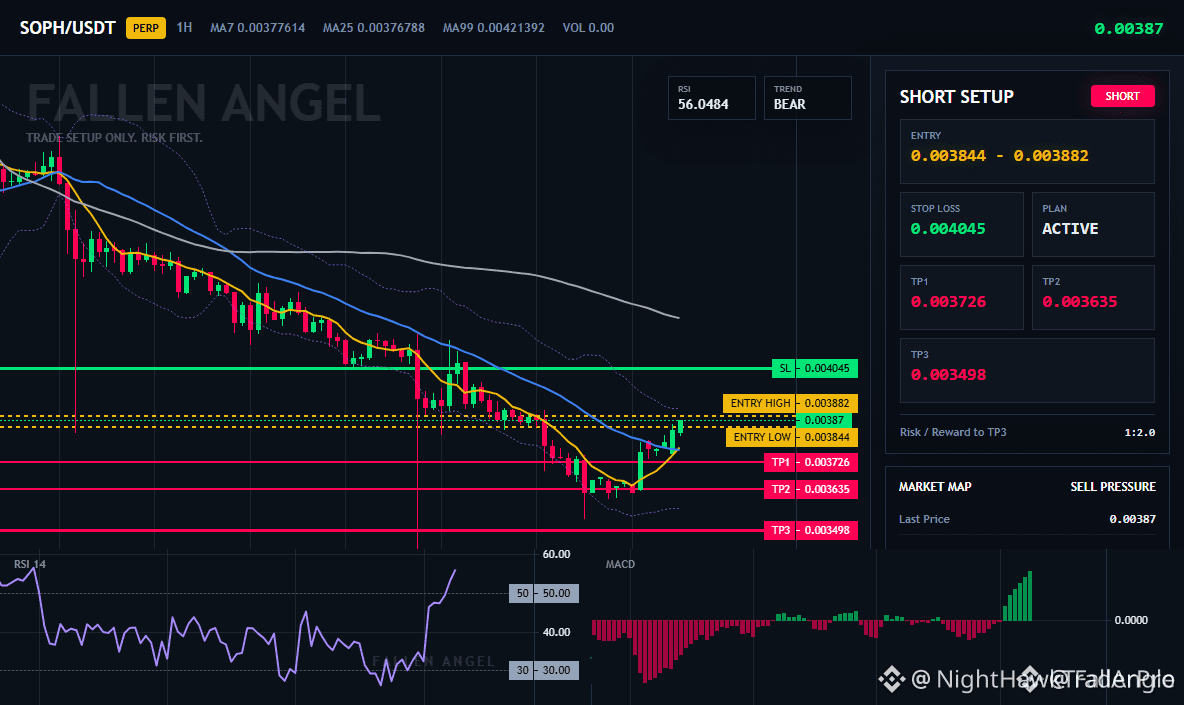
🔴 $SOPH SHORT ZONE: RISK IS DEFINED, NOT LUCK 📉
Entry: 0.00384 - 0.00388 ⚡
Target: 0.00373 / 0.00364 / 0.00350 🚀
Stop Loss: 0.00404 ⚠️
$SOPH is pressing into the short zone, and the 10x edge is not hope—it is a hard invalidation line. 📌 The 0.00404 stop keeps the thesis honest, while the 1:0.8 to 1:2.0 R:R ladder maps how sellers can squeeze lower without guessing. ⚡
If the zone holds, this becomes a controlled bearish continuation, not a hope trade. Are you respecting the invalidation or waiting for a higher rejection first? 👇
⚠️ Not financial advice. Always manage your risk. 🛡️
🏷️ #SOPH #ShortSetup #RiskManagement #Crypto
🎯 🛡️
🔴 $SOPH SHORT ZONE: RISK IS DEFINED, NOT LUCK 📉
Entry: 0.00384 - 0.00388 ⚡
Target: 0.00373 / 0.00364 / 0.00350 🚀
Stop Loss: 0.00404 ⚠️
$SOPH is pressing into the short zone, and the 10x edge is not hope—it is a hard invalidation line. 📌 The 0.00404 stop keeps the thesis honest, while the 1:0.8 to 1:2.0 R:R ladder maps how sellers can squeeze lower without guessing. ⚡
If the zone holds, this becomes a controlled bearish continuation, not a hope trade. Are you respecting the invalidation or waiting for a higher rejection first? 👇
⚠️ Not financial advice. Always manage your risk. 🛡️
🏷️ #SOPH #ShortSetup #RiskManagement #Crypto
🎯 🛡️
Entry: 0.00384 - 0.00388 ⚡
Target: 0.00373 / 0.00364 / 0.00350 🚀
Stop Loss: 0.00404 ⚠️
$SOPH is pressing into the short zone, and the 10x edge is not hope—it is a hard invalidation line. 📌 The 0.00404 stop keeps the thesis honest, while the 1:0.8 to 1:2.0 R:R ladder maps how sellers can squeeze lower without guessing. ⚡
If the zone holds, this becomes a controlled bearish continuation, not a hope trade. Are you respecting the invalidation or waiting for a higher rejection first? 👇
⚠️ Not financial advice. Always manage your risk. 🛡️
🏷️ #SOPH #ShortSetup #RiskManagement #Crypto
🎯 🛡️
102
翻訳参照
🚨 $AI BREAKS NEW GROUND, THEN LOSES EVERYTHING TO A CREEPER 💣
The test is a perfect risk-management lesson: $AI showed elite execution, then placed every critical asset in one chest. 📌 That is the same fragility that turns a strong trend into a wipeout when an unmodeled shock arrives. 🔍
A creeper is not noise—it is tail risk. The agent’s later potato grind and green-object vigilance reveal how quickly systems overfit to the last blow. 💡 Are you building resilient allocation, or storing conviction in one chest? 👇
⚠️ Not financial advice. Always manage your risk. 🛡️
🏷️ #AI #Crypto #Tech #RiskManagement #Web3
🦈 ⚖️
🚨 $AI BREAKS NEW GROUND, THEN LOSES EVERYTHING TO A CREEPER 💣
The test is a perfect risk-management lesson: $AI showed elite execution, then placed every critical asset in one chest. 📌 That is the same fragility that turns a strong trend into a wipeout when an unmodeled shock arrives. 🔍
A creeper is not noise—it is tail risk. The agent’s later potato grind and green-object vigilance reveal how quickly systems overfit to the last blow. 💡 Are you building resilient allocation, or storing conviction in one chest? 👇
⚠️ Not financial advice. Always manage your risk. 🛡️
🏷️ #AI #Crypto #Tech #RiskManagement #Web3
🦈 ⚖️
The test is a perfect risk-management lesson: $AI showed elite execution, then placed every critical asset in one chest. 📌 That is the same fragility that turns a strong trend into a wipeout when an unmodeled shock arrives. 🔍
A creeper is not noise—it is tail risk. The agent’s later potato grind and green-object vigilance reveal how quickly systems overfit to the last blow. 💡 Are you building resilient allocation, or storing conviction in one chest? 👇
⚠️ Not financial advice. Always manage your risk. 🛡️
🏷️ #AI #Crypto #Tech #RiskManagement #Web3
🦈 ⚖️
25
·
--
翻訳参照
$SYN is up 48% today and I am not touching it. One number is why.
1h RSI at 75 means momentum is stretched thin.
Price is at 96% of its 24h range buying here means chasing the last 48% move.
1h ATR is 7.1% any stop tighter than that gets shaken out by noise alone.
Tap $SYN and look at the last 24 hourly candles, the level is right there.
It could keep running without you. Missing it costs nothing. Getting killed trying to catch it costs everything.
Chasing $SYN here, or waiting for $0.07913?
📒 My log, last 7d: 14 calls closed, 3 hit a target, 11 stopped. Net -3.8R, losses included.
Binance data as of 16 Sep 06:30 UTC. Not financial advice.
#SYN #RiskManagement
$SYN is up 48% today and I am not touching it. One number is why.
1h RSI at 75 means momentum is stretched thin.
Price is at 96% of its 24h range buying here means chasing the last 48% move.
1h ATR is 7.1% any stop tighter than that gets shaken out by noise alone.
Tap $SYN and look at the last 24 hourly candles, the level is right there.
It could keep running without you. Missing it costs nothing. Getting killed trying to catch it costs everything.
Chasing $SYN here, or waiting for $0.07913?
📒 My log, last 7d: 14 calls closed, 3 hit a target, 11 stopped. Net -3.8R, losses included.
Binance data as of 16 Sep 06:30 UTC. Not financial advice.
#SYN #RiskManagement
1h RSI at 75 means momentum is stretched thin.
Price is at 96% of its 24h range buying here means chasing the last 48% move.
1h ATR is 7.1% any stop tighter than that gets shaken out by noise alone.
Tap $SYN and look at the last 24 hourly candles, the level is right there.
It could keep running without you. Missing it costs nothing. Getting killed trying to catch it costs everything.
Chasing $SYN here, or waiting for $0.07913?
📒 My log, last 7d: 14 calls closed, 3 hit a target, 11 stopped. Net -3.8R, losses included.
Binance data as of 16 Sep 06:30 UTC. Not financial advice.
#SYN #RiskManagement
42

比較:オプション vs フューチャーズ
タイトル:オプションかフューチャーズか:ポートフォリオにどちらを選ぶべき? ⚔️
内容:
どちらもデリバティブですが、フューチャーズとオプションではリスク管理が根本的に異なります。
📊 比較分析:
フューチャーズ:直線的な執行。証拠金が不足すると、直接的な清算リスクがあります。
オプション(買い):支払うプレミアムまでにリスクが上限。単純な買いでは、マージン・コールによる強制清算はありません。
柔軟性:オプションなら、複雑な戦略(ヘッジ、ボラティリティ、収益化)を実行できます。
資本の構成に合わせて、取扱いツールを調整してください。
#FuturesVsOptions #RiskManagement #CryptoDerivatives #Binance
比較:オプション vs フューチャーズ
タイトル:オプションかフューチャーズか:ポートフォリオにどちらを選ぶべき? ⚔️
内容:
どちらもデリバティブですが、フューチャーズとオプションではリスク管理が根本的に異なります。
📊 比較分析:
フューチャーズ:直線的な執行。証拠金が不足すると、直接的な清算リスクがあります。
オプション(買い):支払うプレミアムまでにリスクが上限。単純な買いでは、マージン・コールによる強制清算はありません。
柔軟性:オプションなら、複雑な戦略(ヘッジ、ボラティリティ、収益化)を実行できます。
資本の構成に合わせて、取扱いツールを調整してください。
#FuturesVsOptions #RiskManagement #CryptoDerivatives #Binance
タイトル:オプションかフューチャーズか:ポートフォリオにどちらを選ぶべき? ⚔️
内容:
どちらもデリバティブですが、フューチャーズとオプションではリスク管理が根本的に異なります。
📊 比較分析:
フューチャーズ:直線的な執行。証拠金が不足すると、直接的な清算リスクがあります。
オプション(買い):支払うプレミアムまでにリスクが上限。単純な買いでは、マージン・コールによる強制清算はありません。
柔軟性:オプションなら、複雑な戦略(ヘッジ、ボラティリティ、収益化)を実行できます。
資本の構成に合わせて、取扱いツールを調整してください。
#FuturesVsOptions #RiskManagement #CryptoDerivatives #Binance
16
翻訳参照
Stratégie de Base : L'Achat de Call (Long Call)
Titre : Pourquoi utiliser un Call au lieu de simplement acheter en Spot ? 📈💡
Contenu :
Lorsque vous anticipez un mouvement haussier puissant sur le marché, l'achat de Call offre une gestion du risque bien plus stricte que le marché Spot ou les Futures.
📌 Les avantages majeurs :
Risque strictement plafonné : Votre perte maximale est égale à la prime payée, peu importe la violence d'un crash imprévu.
Effet de levier asymétrique : Vous profitez pleinement du potentiel de hausse sans exposition aux liquidations forcées des Futures.
Un outil précieux à ajouter à votre arsenal pour dynamiser vos stratégies haussières.
#OptionsTrading #LongCall #Binance #CryptoEducation #RiskManagement
Stratégie de Base : L'Achat de Call (Long Call)
Titre : Pourquoi utiliser un Call au lieu de simplement acheter en Spot ? 📈💡
Contenu :
Lorsque vous anticipez un mouvement haussier puissant sur le marché, l'achat de Call offre une gestion du risque bien plus stricte que le marché Spot ou les Futures.
📌 Les avantages majeurs :
Risque strictement plafonné : Votre perte maximale est égale à la prime payée, peu importe la violence d'un crash imprévu.
Effet de levier asymétrique : Vous profitez pleinement du potentiel de hausse sans exposition aux liquidations forcées des Futures.
Un outil précieux à ajouter à votre arsenal pour dynamiser vos stratégies haussières.
#OptionsTrading #LongCall #Binance #CryptoEducation #RiskManagement
Titre : Pourquoi utiliser un Call au lieu de simplement acheter en Spot ? 📈💡
Contenu :
Lorsque vous anticipez un mouvement haussier puissant sur le marché, l'achat de Call offre une gestion du risque bien plus stricte que le marché Spot ou les Futures.
📌 Les avantages majeurs :
Risque strictement plafonné : Votre perte maximale est égale à la prime payée, peu importe la violence d'un crash imprévu.
Effet de levier asymétrique : Vous profitez pleinement du potentiel de hausse sans exposition aux liquidations forcées des Futures.
Un outil précieux à ajouter à votre arsenal pour dynamiser vos stratégies haussières.
#OptionsTrading #LongCall #Binance #CryptoEducation #RiskManagement
73
ログインして、さらにコンテンツを読む
厳選トピックで世界の暗号資産トレーダーの仲間入り
⚡️ 暗号資産に関する最新かつ有益な情報が見つかります。
💬 世界最大の暗号資産取引所から信頼されています。
👍 認証を受けたクリエイターから、有益なインサイトを得られます。
メール / 電話番号
トレンドトピック
1
#FedRateWatch
閲覧回数 1M
4,983人が討論中
2
#ZcashHoldersBackNU7Upgrade
閲覧回数 3,228
119人が討論中
3
#MSTRTradingVolumeSurpassesMorganStanley
閲覧回数 9,432
322人が討論中
4
#BitcoinFalls4%
閲覧回数 22,402
587人が討論中
5
#SKHynixInTalksToMakeMemoryChipsInUS
閲覧回数 10,392
246人が討論中
6
#OpenAIDiscussesNewFundingAt$1.2TValuation
閲覧回数 2,485
43人が討論中
7
#ArgentinaCommitsToOECDCryptoReportingBy2029
閲覧回数 19,305
411人が討論中
8
#EthereumFallsBelow$2400
閲覧回数 7,547
92人が討論中
9
#USDTLaunchesOnZamaPrivacyProtocol
閲覧回数 8,092
235人が討論中
10
#USSenateBlocksClarityAct
閲覧回数 65,414
543人が討論中