Binance Square
#mufg

mufg

閲覧回数 8,444
30人が討論中
iswemp2
·
--
メジャーな日本の銀行がブロックチェーン上で債券を扱い始めている MUFGは、日本の国債取引の決済をより迅速に行うためにブロックチェーン技術をテストしています。 面白いのは技術だけではありません。 従来の金融インフラが、ますますブロックチェーンのレール上で試されているという事実です。 これらのシステムが将来的にスケールすれば、ブロックチェーンは金融機関が資産を移し、従来の決済プロセスへの依存を減らしながら、取引をより速く決済するのに役立つ可能性があります。そしてこれは一つの銀行だけの話ではありません。 RWA(現実資産)の潮流は、より深く従来の金融へと進んでいます。 ビットコインは最も認知されている暗号資産かもしれませんが、このような実験は、ブロックチェーン技術そのものがなぜ機関投資家の関心を集めているのかを示しています。#Blockchain #RWA #MUFG
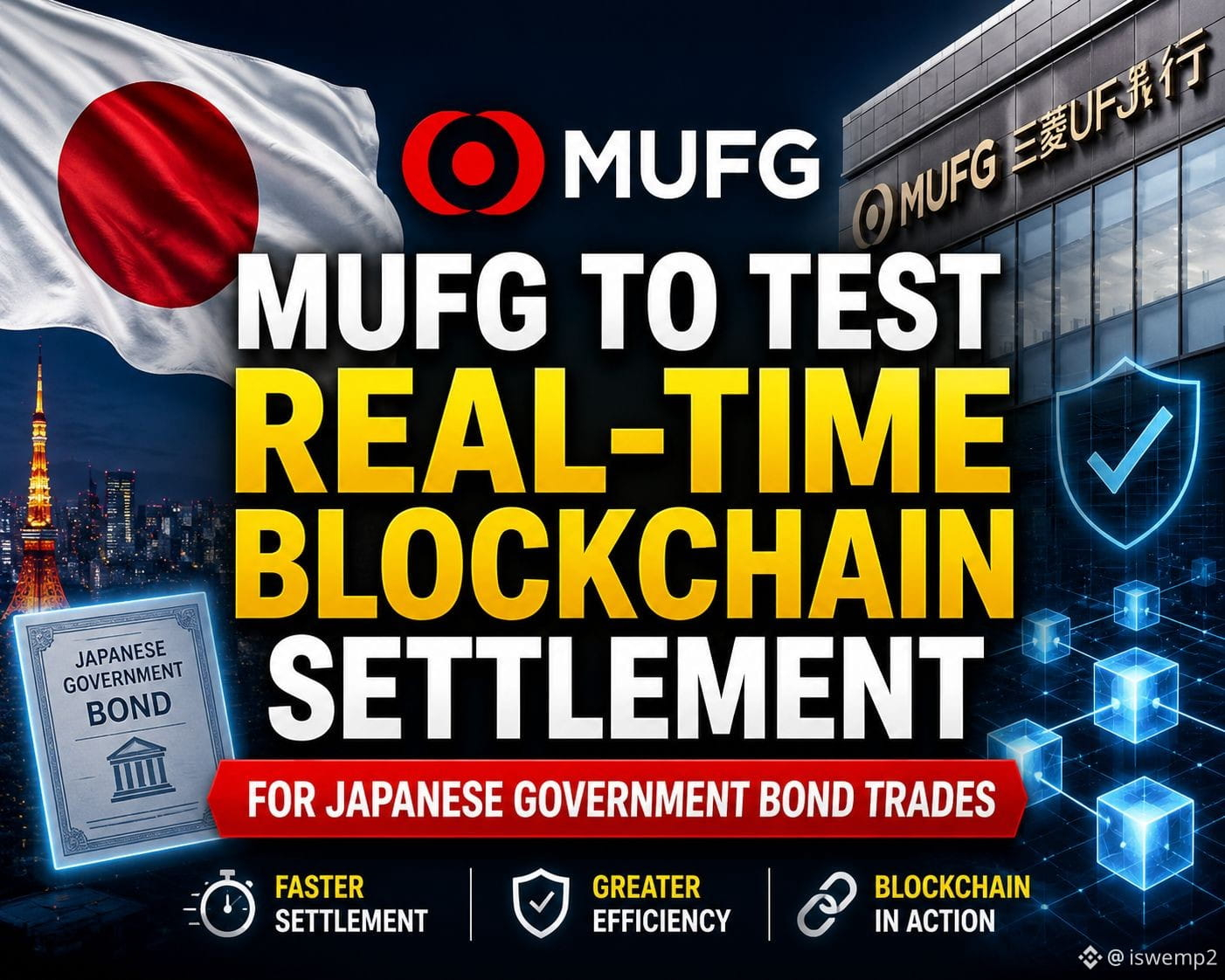
メジャーな日本の銀行がブロックチェーン上で債券を扱い始めている

MUFGは、日本の国債取引の決済をより迅速に行うためにブロックチェーン技術をテストしています。
面白いのは技術だけではありません。
従来の金融インフラが、ますますブロックチェーンのレール上で試されているという事実です。
これらのシステムが将来的にスケールすれば、ブロックチェーンは金融機関が資産を移し、従来の決済プロセスへの依存を減らしながら、取引をより速く決済するのに役立つ可能性があります。そしてこれは一つの銀行だけの話ではありません。

RWA(現実資産)の潮流は、より深く従来の金融へと進んでいます。
ビットコインは最も認知されている暗号資産かもしれませんが、このような実験は、ブロックチェーン技術そのものがなぜ機関投資家の関心を集めているのかを示しています。#Blockchain #RWA #MUFG
翻訳参照
🇯🇵 最新:2.7万亿美元资产规模的三菱日联金融集团(MUFG)正在启动概念验证项目,利用Canton Network将日本国债回购交易引入链上。 #MUFG #日本国债 #比特币
🇯🇵 最新:2.7万亿美元资产规模的三菱日联金融集团(MUFG)正在启动概念验证项目,利用Canton Network将日本国债回购交易引入链上。

#MUFG #日本国债 #比特币
MUFG、国債のブロックチェーン決済をリアルタイムで試験 - MUFGは日本の国債(JGB)向けに、ブロックチェーン上でのリアルタイム決済の試験を実施。 - Cantonネットワークを使用してオンチェーン取引を行う。 - 目的:迅速で透明性の高い取引が可能であることを実証。 #BinanceSquare #CryptoNews #MUFG #JGB #CantonNetwork $btc $eth vlikevn Titanbot 出典:CoinDesk
MUFG、国債のブロックチェーン決済をリアルタイムで試験

- MUFGは日本の国債(JGB)向けに、ブロックチェーン上でのリアルタイム決済の試験を実施。
- Cantonネットワークを使用してオンチェーン取引を行う。
- 目的:迅速で透明性の高い取引が可能であることを実証。
#BinanceSquare #CryptoNews #MUFG #JGB #CantonNetwork

$btc $eth

vlikevn Titanbot

出典:CoinDesk
翻訳参照
🚨MUFG’s Blockchain Move Could Change Traditional Finance Forever — Here’s Why It MattersThe line between traditional finance and blockchain technology is becoming increasingly difficult to ignore. A major development from Japan has put blockchain back in the spotlight after Mitsubishi UFJ Financial Group (MUFG) reportedly moved toward using blockchain technology for instant settlement of Japanese Government Bond (JGB) repo transactions. The reported plan targets commercial deployment as early as fiscal 2027 and could significantly change how institutions move collateral and settle transactions. � BigGo Finance +1 This is not simply another blockchain experiment. It represents a potentially important step toward bringing tokenization, instant settlement, digital assets and traditional financial markets closer together. 🇯🇵 What Is MUFG Planning? MUFG is reportedly exploring a blockchain-based system that could allow certain Japanese Government Bond repo transactions to settle almost instantly instead of relying on the traditional settlement process. The Japanese repo market is enormous, with outstanding balances reported at around ¥270 trillion, roughly $1.7 trillion. Moving even a portion of this market toward blockchain-based settlement could have major implications for institutional finance. � BigGo Finance Today, financial markets often depend on settlement processes that require time between the execution of a transaction and its final completion. Blockchain technology offers a different model. Instead of relying on multiple disconnected systems, institutions can potentially use a shared digital ledger where ownership, transaction records and settlement information are synchronized. That could help reduce settlement delays and improve capital efficiency. ⚡ Why Instant Settlement Matters The biggest potential advantage is speed. Traditional financial transactions can involve several parties, including banks, brokers, custodians, clearing systems and settlement institutions. Each participant may maintain its own records and processes. Blockchain can potentially simplify this structure. With near-instant settlement, institutions could potentially: Move collateral faster Reduce settlement delays Improve capital efficiency Lower certain operational risks Increase transparency Reduce reconciliation requirements Potentially make markets more efficient For a market worth trillions of dollars, even small improvements in capital efficiency can have a meaningful impact. This is why MUFG’s reported move is much bigger than a simple technology upgrade. It could represent a change in the financial infrastructure itself. 🔥 The Bigger Story: Tokenization Perhaps the most important part of this development is not just blockchain settlement. It is tokenization. Tokenization means representing traditional assets such as bonds, securities or deposits in a digital format that can interact with blockchain-based infrastructure. MUFG has already been working on digital-asset initiatives, including security tokens, tokenized deposits and blockchain-based financial infrastructure. Its own materials describe efforts around moving assets on-chain and improving payment infrastructure using blockchain technology. � MUFG +1 That makes the latest reported JGB initiative part of a much larger trend. The future financial system may not necessarily replace traditional assets with cryptocurrencies. Instead, traditional assets could increasingly become blockchain-enabled digital assets. 💰 What About Stablecoins? Another important piece of the story is the role of stablecoins and tokenized deposits. For blockchain-based financial markets to operate efficiently, institutions need both sides of a transaction to work digitally. Imagine a tokenized bond being transferred on-chain. If the bond moves instantly but the payment still requires a traditional banking process, the entire transaction cannot achieve true atomic settlement. That is why tokenized deposits and stablecoins are becoming increasingly important in institutional blockchain projects. MUFG and other Japanese banks have already been exploring stablecoin-related initiatives, with MUFG Bank stating that participating Japanese banks are targeting live transactions involving a jointly issued stablecoin during fiscal 2026. � MUFG Bank This creates an interesting possibility: Tokenized assets + blockchain settlement + digital money = a new financial infrastructure. 🌐 Why Crypto Investors Should Pay Attention Some crypto investors may look at this news and think: “MUFG is a traditional bank. What does this have to do with Bitcoin or crypto?” The answer is: infrastructure. The most important long-term crypto story may not be whether a particular coin goes up 10% tomorrow. The bigger story could be whether blockchain technology becomes part of the global financial system. If banks begin using blockchain for government bonds, securities, payments, collateral and settlement, then blockchain technology becomes increasingly integrated into the world's financial infrastructure. That could create additional demand for blockchain networks capable of supporting: high transaction volume + security + compliance + tokenized assets + institutional settlement. This does not automatically mean that every cryptocurrency will benefit. But it strengthens the broader argument that blockchain technology is moving beyond speculation. 📈 Is This Bullish for Blockchain? Potentially, yes. Institutional adoption is one of the strongest long-term narratives in the digital-asset sector. When major financial institutions experiment with blockchain, they are effectively testing whether the technology can handle real-world financial activity. The difference between a crypto project announcing a partnership and a major bank integrating blockchain into financial-market infrastructure is significant. The latter could potentially demonstrate real-world utility at scale. And Japan is becoming an especially interesting market to watch. Financial institutions there have already been working on security tokens, tokenized deposits, stablecoins and blockchain settlement. MUFG's own strategy documents show continued work around digital assets and the on-chain transition of traditional assets. � MUFG 🏦 Traditional Finance Is Slowly Moving On-Chain For years, blockchain was mostly associated with Bitcoin, Ethereum, DeFi and speculative crypto markets. That narrative is changing. Now, banks and financial institutions are increasingly asking a different question: “Can blockchain make our existing financial system faster and more efficient?” That question could ultimately be more important than the original crypto narrative. If blockchain can help institutions settle bonds faster, transfer collateral more efficiently, process payments continuously and tokenize traditionally illiquid assets, then the technology could become an important layer of the global financial system. The transition will probably not happen overnight. Regulation, cybersecurity, interoperability, liquidity and institutional risk management remain major challenges. But the direction is becoming increasingly clear. 🔮 What Could Happen Next? If MUFG successfully progresses toward its reported fiscal 2027 commercialization target, other financial institutions could watch closely. A successful implementation could encourage: More tokenized bonds More blockchain-based repo markets More institutional stablecoin usage More tokenized deposits More on-chain settlement infrastructure Greater institutional blockchain adoption The most important question will be whether blockchain-based settlement can move from pilot projects into large-scale production environments. That is where the real test begins. A proof of concept is one thing. Processing billions or trillions of dollars in real financial transactions safely and reliably is something completely different. 🚨 The Real Crypto Signal The biggest takeaway from MUFG's move is not that Bitcoin will immediately pump. It is not a direct buy signal for any particular cryptocurrency. Instead, it is a signal about the direction of financial infrastructure. The world’s largest financial institutions are increasingly investigating how blockchain can be used for real-world financial assets. That could eventually make tokenization and on-chain settlement one of the most important narratives in the next phase of digital finance. Bitcoin may remain the flagship digital asset, but the broader blockchain ecosystem could benefit if traditional financial markets increasingly move on-chain. The next major crypto cycle may therefore not be driven only by retail speculation. It could increasingly involve banks, asset managers, tokenized securities, stablecoins and institutional blockchain infrastructure. 🚀 Final Thoughts MUFG's reported blockchain initiative is a development worth watching closely. Japan's financial sector is exploring ways to combine traditional assets with blockchain technology, while stablecoins and tokenized deposits could provide the digital settlement layer needed to make these systems practical. If these experiments succeed, the impact could extend far beyond Japan. It could help demonstrate that blockchain is capable of becoming a core component of global financial infrastructure. For crypto investors, this is the bigger picture to watch: Blockchain is no longer only competing with traditional finance. Traditional finance is increasingly beginning to build on blockchain. And that shift could become one of the biggest stories in digital assets over the coming years. #MUFG #Blockchain #JGB #Tokenization #crypto #Stablecoin #RWA #DigitalAssets #Bitcoin #Ethereum #BinanceSquare

🚨MUFG’s Blockchain Move Could Change Traditional Finance Forever — Here’s Why It Matters

The line between traditional finance and blockchain technology is becoming increasingly difficult to ignore.
A major development from Japan has put blockchain back in the spotlight after Mitsubishi UFJ Financial Group (MUFG) reportedly moved toward using blockchain technology for instant settlement of Japanese Government Bond (JGB) repo transactions. The reported plan targets commercial deployment as early as fiscal 2027 and could significantly change how institutions move collateral and settle transactions. �
BigGo Finance +1
This is not simply another blockchain experiment. It represents a potentially important step toward bringing tokenization, instant settlement, digital assets and traditional financial markets closer together.
🇯🇵 What Is MUFG Planning?
MUFG is reportedly exploring a blockchain-based system that could allow certain Japanese Government Bond repo transactions to settle almost instantly instead of relying on the traditional settlement process.
The Japanese repo market is enormous, with outstanding balances reported at around ¥270 trillion, roughly $1.7 trillion. Moving even a portion of this market toward blockchain-based settlement could have major implications for institutional finance. �
BigGo Finance
Today, financial markets often depend on settlement processes that require time between the execution of a transaction and its final completion.
Blockchain technology offers a different model.
Instead of relying on multiple disconnected systems, institutions can potentially use a shared digital ledger where ownership, transaction records and settlement information are synchronized.
That could help reduce settlement delays and improve capital efficiency.
⚡ Why Instant Settlement Matters
The biggest potential advantage is speed.
Traditional financial transactions can involve several parties, including banks, brokers, custodians, clearing systems and settlement institutions. Each participant may maintain its own records and processes.
Blockchain can potentially simplify this structure.
With near-instant settlement, institutions could potentially:
Move collateral faster
Reduce settlement delays
Improve capital efficiency
Lower certain operational risks
Increase transparency
Reduce reconciliation requirements
Potentially make markets more efficient
For a market worth trillions of dollars, even small improvements in capital efficiency can have a meaningful impact.
This is why MUFG’s reported move is much bigger than a simple technology upgrade.
It could represent a change in the financial infrastructure itself.
🔥 The Bigger Story: Tokenization
Perhaps the most important part of this development is not just blockchain settlement.
It is tokenization.
Tokenization means representing traditional assets such as bonds, securities or deposits in a digital format that can interact with blockchain-based infrastructure.
MUFG has already been working on digital-asset initiatives, including security tokens, tokenized deposits and blockchain-based financial infrastructure. Its own materials describe efforts around moving assets on-chain and improving payment infrastructure using blockchain technology. �
MUFG +1
That makes the latest reported JGB initiative part of a much larger trend.
The future financial system may not necessarily replace traditional assets with cryptocurrencies.
Instead, traditional assets could increasingly become blockchain-enabled digital assets.
💰 What About Stablecoins?
Another important piece of the story is the role of stablecoins and tokenized deposits.
For blockchain-based financial markets to operate efficiently, institutions need both sides of a transaction to work digitally.
Imagine a tokenized bond being transferred on-chain.
If the bond moves instantly but the payment still requires a traditional banking process, the entire transaction cannot achieve true atomic settlement.
That is why tokenized deposits and stablecoins are becoming increasingly important in institutional blockchain projects.
MUFG and other Japanese banks have already been exploring stablecoin-related initiatives, with MUFG Bank stating that participating Japanese banks are targeting live transactions involving a jointly issued stablecoin during fiscal 2026. �
MUFG Bank
This creates an interesting possibility:
Tokenized assets + blockchain settlement + digital money = a new financial infrastructure.
🌐 Why Crypto Investors Should Pay Attention
Some crypto investors may look at this news and think:
“MUFG is a traditional bank. What does this have to do with Bitcoin or crypto?”
The answer is: infrastructure.
The most important long-term crypto story may not be whether a particular coin goes up 10% tomorrow.
The bigger story could be whether blockchain technology becomes part of the global financial system.
If banks begin using blockchain for government bonds, securities, payments, collateral and settlement, then blockchain technology becomes increasingly integrated into the world's financial infrastructure.
That could create additional demand for blockchain networks capable of supporting:
high transaction volume + security + compliance + tokenized assets + institutional settlement.
This does not automatically mean that every cryptocurrency will benefit.
But it strengthens the broader argument that blockchain technology is moving beyond speculation.
📈 Is This Bullish for Blockchain?
Potentially, yes.
Institutional adoption is one of the strongest long-term narratives in the digital-asset sector.
When major financial institutions experiment with blockchain, they are effectively testing whether the technology can handle real-world financial activity.
The difference between a crypto project announcing a partnership and a major bank integrating blockchain into financial-market infrastructure is significant.
The latter could potentially demonstrate real-world utility at scale.
And Japan is becoming an especially interesting market to watch.
Financial institutions there have already been working on security tokens, tokenized deposits, stablecoins and blockchain settlement. MUFG's own strategy documents show continued work around digital assets and the on-chain transition of traditional assets. �
MUFG
🏦 Traditional Finance Is Slowly Moving On-Chain
For years, blockchain was mostly associated with Bitcoin, Ethereum, DeFi and speculative crypto markets.
That narrative is changing.
Now, banks and financial institutions are increasingly asking a different question:
“Can blockchain make our existing financial system faster and more efficient?”
That question could ultimately be more important than the original crypto narrative.
If blockchain can help institutions settle bonds faster, transfer collateral more efficiently, process payments continuously and tokenize traditionally illiquid assets, then the technology could become an important layer of the global financial system.
The transition will probably not happen overnight.
Regulation, cybersecurity, interoperability, liquidity and institutional risk management remain major challenges.
But the direction is becoming increasingly clear.
🔮 What Could Happen Next?
If MUFG successfully progresses toward its reported fiscal 2027 commercialization target, other financial institutions could watch closely.
A successful implementation could encourage:
More tokenized bonds
More blockchain-based repo markets
More institutional stablecoin usage
More tokenized deposits
More on-chain settlement infrastructure
Greater institutional blockchain adoption
The most important question will be whether blockchain-based settlement can move from pilot projects into large-scale production environments.
That is where the real test begins.
A proof of concept is one thing.
Processing billions or trillions of dollars in real financial transactions safely and reliably is something completely different.
🚨 The Real Crypto Signal
The biggest takeaway from MUFG's move is not that Bitcoin will immediately pump.
It is not a direct buy signal for any particular cryptocurrency.
Instead, it is a signal about the direction of financial infrastructure.
The world’s largest financial institutions are increasingly investigating how blockchain can be used for real-world financial assets.
That could eventually make tokenization and on-chain settlement one of the most important narratives in the next phase of digital finance.
Bitcoin may remain the flagship digital asset, but the broader blockchain ecosystem could benefit if traditional financial markets increasingly move on-chain.
The next major crypto cycle may therefore not be driven only by retail speculation.
It could increasingly involve banks, asset managers, tokenized securities, stablecoins and institutional blockchain infrastructure.
🚀 Final Thoughts
MUFG's reported blockchain initiative is a development worth watching closely.
Japan's financial sector is exploring ways to combine traditional assets with blockchain technology, while stablecoins and tokenized deposits could provide the digital settlement layer needed to make these systems practical.
If these experiments succeed, the impact could extend far beyond Japan.
It could help demonstrate that blockchain is capable of becoming a core component of global financial infrastructure.
For crypto investors, this is the bigger picture to watch:
Blockchain is no longer only competing with traditional finance. Traditional finance is increasingly beginning to build on blockchain.
And that shift could become one of the biggest stories in digital assets over the coming years.
#MUFG #Blockchain #JGB #Tokenization #crypto #Stablecoin #RWA #DigitalAssets #Bitcoin #Ethereum #BinanceSquare
日本の三大銀行: #MUFG , #SMBC , そして #Mizuho - は、#FY2026 までに共同の法定通貨バックのステーブルコインを立ち上げる計画をしているとのこと。 このイニシアティブは、日本の金融庁とのパイロット実施に続くもので、世界最大の金融市場の一つでの銀行発行デジタル通貨に向けた重要なステップを示す可能性があります。
日本の三大銀行: #MUFG , #SMBC , そして #Mizuho - は、#FY2026 までに共同の法定通貨バックのステーブルコインを立ち上げる計画をしているとのこと。

このイニシアティブは、日本の金融庁とのパイロット実施に続くもので、世界最大の金融市場の一つでの銀行発行デジタル通貨に向けた重要なステップを示す可能性があります。
日本のメガバンク、2026年までに共同ステーブルコインを発表、USDT/USDCに挑戦 三つの日本の金融巨人、MUFG、SMFG、そしてみずほが共同運営のステーブルコインを立ち上げるためにタッグを組んでいる。これは小売向けのファンタジーではなく、まずは法人クライアントをターゲットにしており、その巨大な企業顧客基盤を活用する予定だ。2026年度末までに円ペッグのトークンを期待しており、ドル版もその後登場する見込みで、すべてMUFGのProgmat DLTプラットフォーム上で稼働する。 #stablecoin #yen #jpy #mufg #smfg
日本のメガバンク、2026年までに共同ステーブルコインを発表、USDT/USDCに挑戦

三つの日本の金融巨人、MUFG、SMFG、そしてみずほが共同運営のステーブルコインを立ち上げるためにタッグを組んでいる。これは小売向けのファンタジーではなく、まずは法人クライアントをターゲットにしており、その巨大な企業顧客基盤を活用する予定だ。2026年度末までに円ペッグのトークンを期待しており、ドル版もその後登場する見込みで、すべてMUFGのProgmat DLTプラットフォーム上で稼働する。

#stablecoin #yen #jpy #mufg #smfg
ログインして、さらにコンテンツを読む
厳選トピックで世界の暗号資産トレーダーの仲間入り
⚡️ 暗号資産に関する最新かつ有益な情報が見つかります。
💬 世界最大の暗号資産取引所から信頼されています。
👍 認証を受けたクリエイターから、有益なインサイトを得られます。
メール / 電話番号