
#binanceinflow
binanceinflow
閲覧回数 5,202
6人が討論中
注目
最新

記事
翻訳参照
$2.3B Back Into Binance: A Confidence Signal—But Not a Full Market “All Clear”When an exchange records $2.3 billion in net inflows, the headline is bigger than the number itself: it suggests that, during that period, more capital moved onto Binance than moved off it. In a market where exchange flows are watched closely for signs of fear, confidence, liquidity, and trading appetite, that reversal can matter.
But it should be read carefully. One strong daily inflow is a useful signal—not proof that every concern has disappeared.
What “net inflow” actually means
Net flow is simply:
Deposits − withdrawals = net inflow or outflow
So, a $2.3B net inflow means total deposits exceeded total withdrawals by about $2.3B during the measured window. It does not necessarily mean investors deployed $2.3B directly into Bitcoin or altcoins. Funds may arrive as stablecoins, collateral, assets transferred between wallets, or capital preparing to trade.
The immediate takeaway is that Binance attracted more value than it lost over that period.
Why the market pays attention
Large centralized exchanges are key liquidity hubs. When funds move onto them, market participants often interpret that in several possible ways:
Users may be regaining confidence in the platform after a period of withdrawals.Traders may be positioning for activity, such as spot buying, derivatives collateral, arbitrage, or market-making.Stablecoin liquidity may be returning, which can support higher trading volumes.The market may be shifting from defensive behavior to more active participation.
That said, inflows can also precede selling, especially when users deposit BTC, ETH, or other crypto assets to trade. The composition of the inflow matters: stablecoin deposits and crypto-asset deposits can imply different intentions.
Why this can be constructive for broader crypto liquidity
Binance remains an important venue for global crypto trading volume and order-book depth. More funds on the platform can improve available liquidity, tighten spreads, and support more efficient price discovery—particularly for large-cap assets and actively traded pairs.
If the inflows are sustained over several days rather than concentrated in a single session, the effects could include:
stronger spot and derivatives liquidity;more active market-making;greater capacity for large trades without moving price as sharply;renewed participation in altcoin markets;improved sentiment around centralized-exchange stability.
In a risk-on environment, returning exchange liquidity can also amplify momentum. That cuts both ways: it can help rallies extend, but it can also make liquidations and fast reversals more intense if leverage builds quickly.
The key caveat: inflows are not automatically bullish
A common mistake is treating exchange inflows as a simple “buy signal.” They are not.
For example:
Stablecoin inflows can indicate capital waiting to purchase assets, post collateral, or earn yield.BTC or ETH inflows can indicate potential selling, hedging, collateral use, or transfers by institutions and market makers.Large inflows after stress may reflect a recovery in operational confidence, but they can also be temporary repositioning.
The market reaction depends on what assets are flowing in, whether spot demand rises alongside the flows, and whether leverage is increasing faster than organic demand.
What to watch next
The most useful follow-through signals are:
Multi-day exchange-flow trend
A single 24-hour reading can be noisy. Persistent positive flows are more meaningful than one headline number.
Stablecoin balances and trading volume
Rising stablecoin liquidity paired with stronger spot volume can indicate more deployable buying power.
BTC and ETH exchange deposits
Large crypto deposits may increase potential sell-side supply, although they can also be used for derivatives collateral.
Funding rates and open interest
If derivatives leverage rises too quickly, a positive flow story can become fragile. Crowded positioning raises the risk of sharp liquidations.
Order-book depth and spreads
Better liquidity conditions support healthier price discovery; thin books make markets more vulnerable to abrupt moves.
Whether withdrawals remain orderly
Continued stable operations and transparent updates matter more than any one daily flow figure.
Bottom line
Binance’s $2.3B net inflow is best understood as a short-term confidence and liquidity signal: more capital entered the platform than exited during the reported period. That can support trading activity and improve market functioning, especially if it persists.
However, it is not a standalone verdict on market direction. The more important question is whether inflows continue, what assets are being deposited, how spot demand responds, and whether leverage stays controlled. Crypto markets can turn quickly, so exchange-flow data works best as one part of a broader picture—not as a guarantee of what prices will do next.
#crypto #BinanceInflow
$2.3B Back Into Binance: A Confidence Signal—But Not a Full Market “All Clear”
When an exchange records $2.3 billion in net inflows, the headline is bigger than the number itself: it suggests that, during that period, more capital moved onto Binance than moved off it. In a market where exchange flows are watched closely for signs of fear, confidence, liquidity, and trading appetite, that reversal can matter.
But it should be read carefully. One strong daily inflow is a useful signal—not proof that every concern has disappeared.
What “net inflow” actually means
Net flow is simply:
Deposits − withdrawals = net inflow or outflow
So, a $2.3B net inflow means total deposits exceeded total withdrawals by about $2.3B during the measured window. It does not necessarily mean investors deployed $2.3B directly into Bitcoin or altcoins. Funds may arrive as stablecoins, collateral, assets transferred between wallets, or capital preparing to trade.
The immediate takeaway is that Binance attracted more value than it lost over that period.
Why the market pays attention
Large centralized exchanges are key liquidity hubs. When funds move onto them, market participants often interpret that in several possible ways:
Users may be regaining confidence in the platform after a period of withdrawals.Traders may be positioning for activity, such as spot buying, derivatives collateral, arbitrage, or market-making.Stablecoin liquidity may be returning, which can support higher trading volumes.The market may be shifting from defensive behavior to more active participation.
That said, inflows can also precede selling, especially when users deposit BTC, ETH, or other crypto assets to trade. The composition of the inflow matters: stablecoin deposits and crypto-asset deposits can imply different intentions.
Why this can be constructive for broader crypto liquidity
Binance remains an important venue for global crypto trading volume and order-book depth. More funds on the platform can improve available liquidity, tighten spreads, and support more efficient price discovery—particularly for large-cap assets and actively traded pairs.
If the inflows are sustained over several days rather than concentrated in a single session, the effects could include:
stronger spot and derivatives liquidity;more active market-making;greater capacity for large trades without moving price as sharply;renewed participation in altcoin markets;improved sentiment around centralized-exchange stability.
In a risk-on environment, returning exchange liquidity can also amplify momentum. That cuts both ways: it can help rallies extend, but it can also make liquidations and fast reversals more intense if leverage builds quickly.
The key caveat: inflows are not automatically bullish
A common mistake is treating exchange inflows as a simple “buy signal.” They are not.
For example:
Stablecoin inflows can indicate capital waiting to purchase assets, post collateral, or earn yield.BTC or ETH inflows can indicate potential selling, hedging, collateral use, or transfers by institutions and market makers.Large inflows after stress may reflect a recovery in operational confidence, but they can also be temporary repositioning.
The market reaction depends on what assets are flowing in, whether spot demand rises alongside the flows, and whether leverage is increasing faster than organic demand.
What to watch next
The most useful follow-through signals are:
Multi-day exchange-flow trend
A single 24-hour reading can be noisy. Persistent positive flows are more meaningful than one headline number.
Stablecoin balances and trading volume
Rising stablecoin liquidity paired with stronger spot volume can indicate more deployable buying power.
BTC and ETH exchange deposits
Large crypto deposits may increase potential sell-side supply, although they can also be used for derivatives collateral.
Funding rates and open interest
If derivatives leverage rises too quickly, a positive flow story can become fragile. Crowded positioning raises the risk of sharp liquidations.
Order-book depth and spreads
Better liquidity conditions support healthier price discovery; thin books make markets more vulnerable to abrupt moves.
Whether withdrawals remain orderly
Continued stable operations and transparent updates matter more than any one daily flow figure.
Bottom line
Binance’s $2.3B net inflow is best understood as a short-term confidence and liquidity signal: more capital entered the platform than exited during the reported period. That can support trading activity and improve market functioning, especially if it persists.
However, it is not a standalone verdict on market direction. The more important question is whether inflows continue, what assets are being deposited, how spot demand responds, and whether leverage stays controlled. Crypto markets can turn quickly, so exchange-flow data works best as one part of a broader picture—not as a guarantee of what prices will do next.
#crypto #BinanceInflow
75

·
--
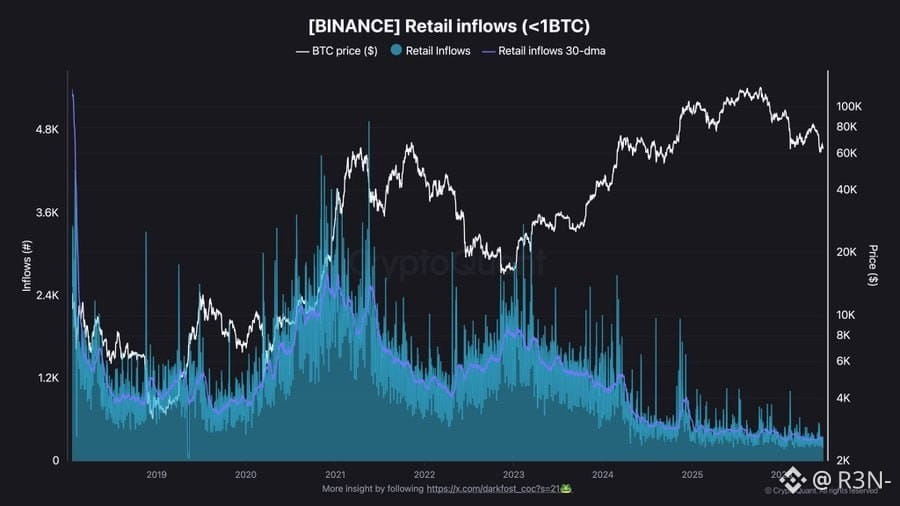
BinanceへのBitcoin流入が50%減少しているという報道は、詳しく見直す価値のある指標のひとつです。
一見すると、取引所に送られるコインが減ることは、売却を考えている投資家が減っていることを意味するかもしれません。
歴史的に、取引所への大量流入は売り圧力を高めることが多いです。通常、ユーザーは取引や換金を意図するときにBitcoinを取引所へ移すためです。こうした流入の減少は、保有者が売却に向かう準備をするよりも、$BTC の自己保管やコールドストレージで保有し続けることに、より安心感を持ち始めている可能性を示唆します。
とはいえ、個人投資家の活動が「正式に死んだ」と言うのは、さすがに言い過ぎでしょう。
取引所への流入は、全体像の一部にすぎません。個人投資家の参加は、ETFの購入、オンチェーンウォレット、分散型取引所、その他の中央集権型プラットフォームなどにも表れます。
より興味深いのは、行動の変化です。
もし、長期保有者の残高が増え続ける一方で、Binanceへコインを送るBitcoin保有者が減っているなら、それは恐怖の増大ではなく、確信の強まりを示しているのかもしれません。
1つの指標だけでは、物語の全体像はほとんど分かりません。
しかし、複数のオンチェーン指標が同じ方向に動き始めると、無視するのはかなり難しくなります。
#Binanceinflow #bitcoin
1
1
5k
ログインして、さらにコンテンツを読む
厳選トピックで世界の暗号資産トレーダーの仲間入り
⚡️ 暗号資産に関する最新かつ有益な情報が見つかります。
💬 世界最大の暗号資産取引所から信頼されています。
👍 認証を受けたクリエイターから、有益なインサイトを得られます。
メール / 電話番号
トレンドトピック
1
#USMidterms-WhatAreMarketsExpecting?
閲覧回数 168,625
1,245人が討論中
2
#USOctoberNFP-AreRateCutsStillPossible
閲覧回数 293,600
2,257人が討論中
3
#CircleQ3Revenue865M
閲覧回数 4,143
160人が討論中
4
#AMDBeatsExpectations-AINarrativeContinues
閲覧回数 41,916
456人が討論中
5
#FrenchAssemblyPassesSelfCustodiedCryptoReportingAmendment
閲覧回数 0
4人が討論中
6
#BinanceIncidentReport
閲覧回数 334,656
1,669人が討論中
7
#AnthropicIPOPricedDownasInvestorsEye$1.5T
閲覧回数 24,756
118人が討論中
8
#BoundlessToLaunchTokenizedAIInferencePlan
閲覧回数 662
22人が討論中
9
#HongKongPassesCryptoAssetReportingFrameworkAmendment
閲覧回数 149
8人が討論中
10
#37thQuarterlyBNBBurnRemoves1.64MillionBNB
閲覧回数 5,377
108人が討論中