
big Brother 96
2.4k Posts

big Brother 96
311 Following
4.5K+ Followers
3.0K+ Liked
Posts
All
Quotes
Live
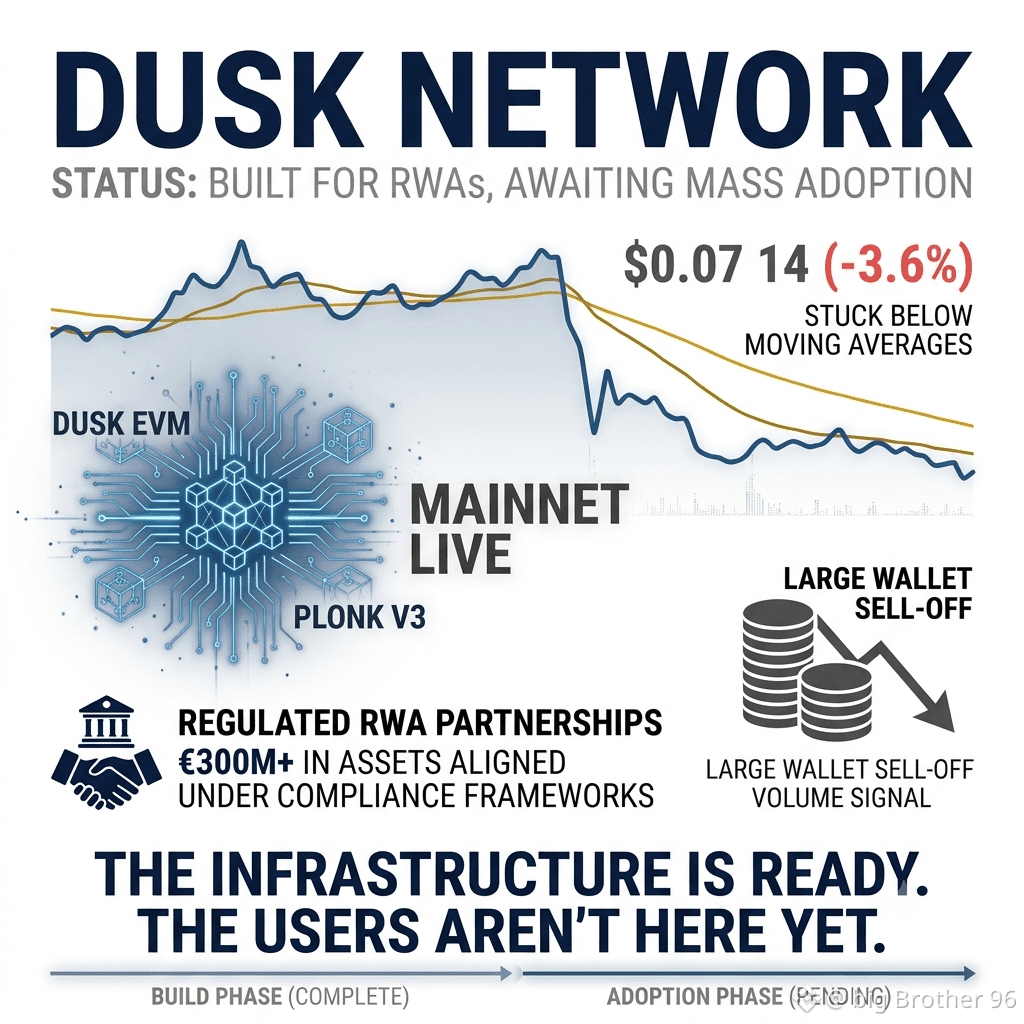
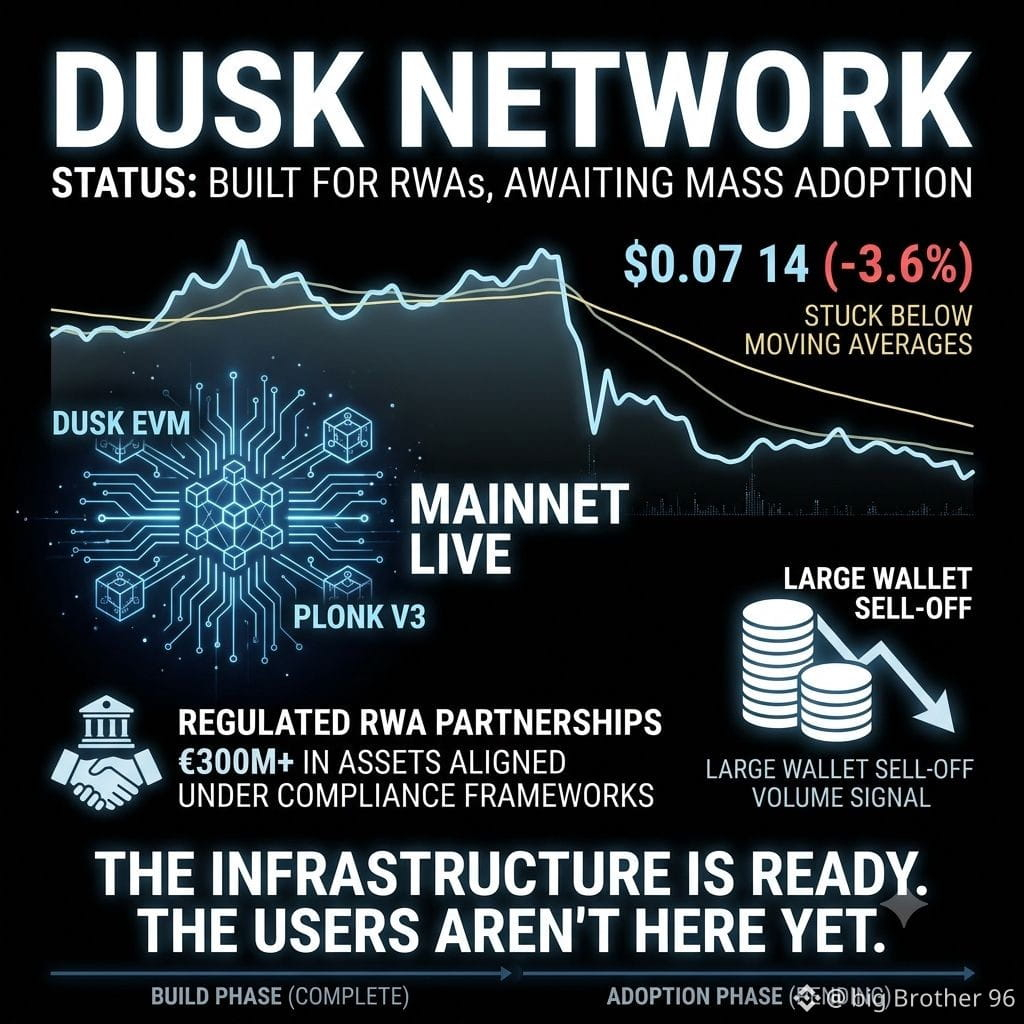
I keep an eye on DUSK the way you check on a project you used to be more excited about lhalf habit, half curiosity. Today it's down 3.6%, sitting around $0.0714, and my first instinct wasn't to look at the chart, it was to check what actually shipped. Turns out DuskEVM and PLONK V3 both went live on mainnet basically the same day the token got sold off. Nobody planned that timing. It just happened, and it's kind of telling.
There's real work going into regulated RWA partnerships too, something like €300M in assets being lined up under actual compliance frameworks, not the usual vague promises. But almost a fifth of today's volume was just large wallets heading for the exit, and the price is stuck under every moving average that matters.
What gets me is nobody's actually trading the assets this chain was built to hold yet. The infrastructure's basically done. The users aren't there.
Some things get built long before anyone shows up to use them.
@Dusk #dusk $DUSK
There's real work going into regulated RWA partnerships too, something like €300M in assets being lined up under actual compliance frameworks, not the usual vague promises. But almost a fifth of today's volume was just large wallets heading for the exit, and the price is stuck under every moving average that matters.
What gets me is nobody's actually trading the assets this chain was built to hold yet. The infrastructure's basically done. The users aren't there.
Some things get built long before anyone shows up to use them.
@Dusk #dusk $DUSK
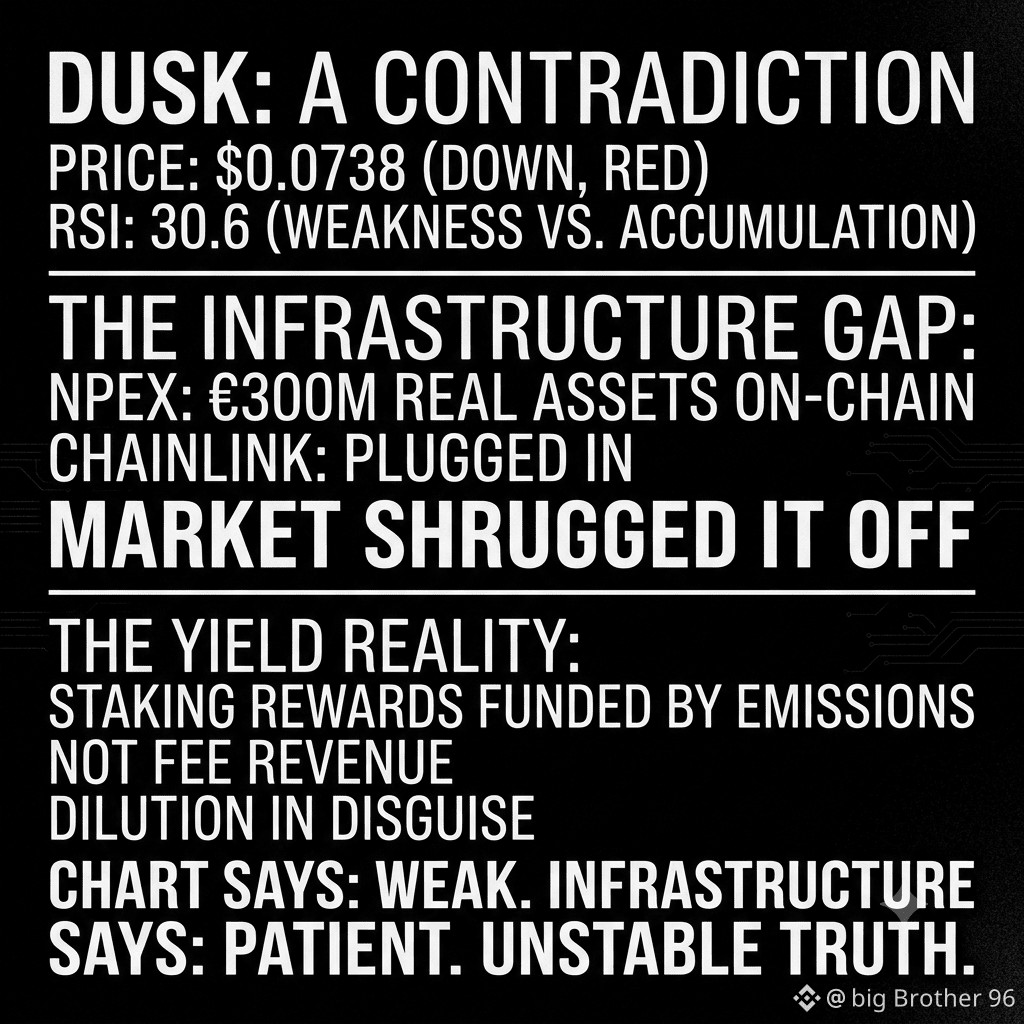
Kept checking DUSK's chart more than I should've today. Price down to $0.0738, red all day, RSI sitting at 30.6 — the kind of number that either pushes people into panic selling or into quiet accumulation, rarely anything in between.
But what actually caught my attention wasn't the price. NPEX is bringing 300 million euros worth of real assets onto this chain, Chainlink's plugged in too, and the market just shrugged it off. That gap tells you more than the candles do. Real-world asset infrastructure doesn't move on headlines — it gets built quietly, and people only realize it mattered a good while later.
What genuinely gives me pause is the yield. Staking rewards are mostly funded by new emissions, not actual fee revenue, so that "healthy-looking" APY is partly dilution wearing a disguise.
The chart says weak. The infrastructure says patient. Not sure both stay true for much longer.
@Dusk
#dusk
$DUSK
But what actually caught my attention wasn't the price. NPEX is bringing 300 million euros worth of real assets onto this chain, Chainlink's plugged in too, and the market just shrugged it off. That gap tells you more than the candles do. Real-world asset infrastructure doesn't move on headlines — it gets built quietly, and people only realize it mattered a good while later.
What genuinely gives me pause is the yield. Staking rewards are mostly funded by new emissions, not actual fee revenue, so that "healthy-looking" APY is partly dilution wearing a disguise.
The chart says weak. The infrastructure says patient. Not sure both stay true for much longer.
@Dusk
#dusk
$DUSK
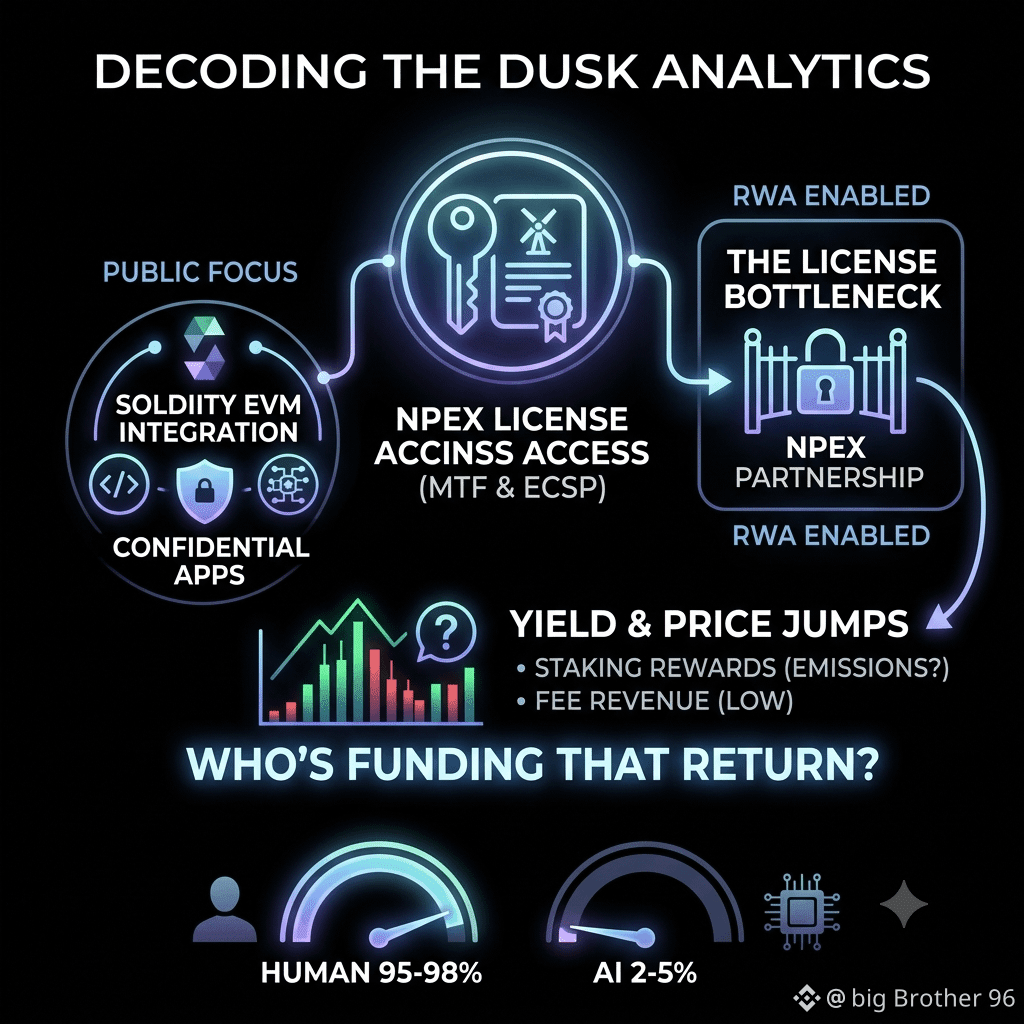
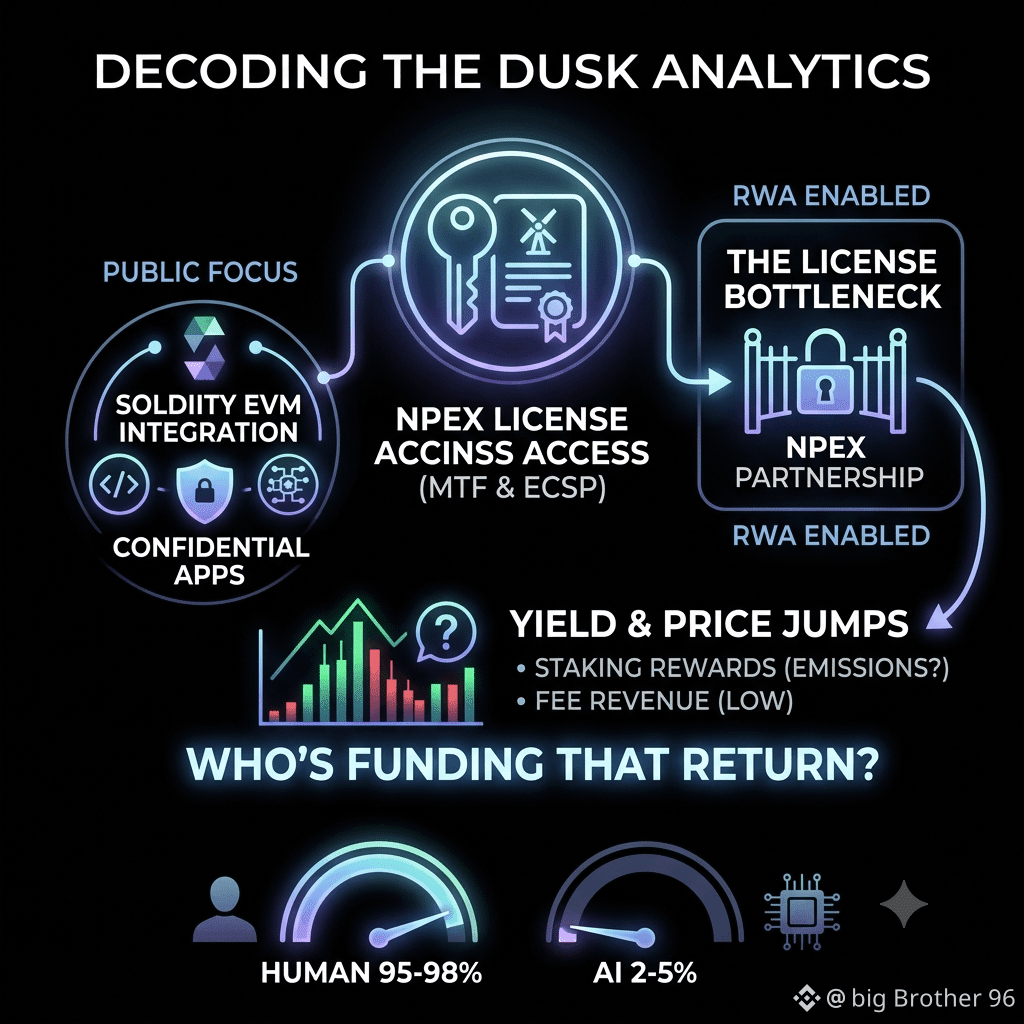
I keep watching this chain and honestly can't fully explain why. The price moves up and down, around $0.07 today, something else tomorrow — but my attention isn't on the price. It's on NPEX. That small Dutch exchange that's been running since 2008, holding both MTF and ECSP licenses. Dusk didn't get these licenses itself — it got access through the partnership. The difference sounds small but it matters.
Everyone else is talking about the EVM gawd àintegration, how Solidity developers can now easily build confidential apps. Fair enough. But licenses are the real bottleneck in this whole RWA game, and Dusk already has access to them.
What I can't shake is the yield question. Staking rewards are still running on emissions, fee revenue isn't much to speak of. So when the price suddenly jumps, I don't feel bullish — I feel curious. Who's actually funding that return?
@Dusk
#DUSKARMY.
$DUSK
Everyone else is talking about the EVM gawd àintegration, how Solidity developers can now easily build confidential apps. Fair enough. But licenses are the real bottleneck in this whole RWA game, and Dusk already has access to them.
What I can't shake is the yield question. Staking rewards are still running on emissions, fee revenue isn't much to speak of. So when the price suddenly jumps, I don't feel bullish — I feel curious. Who's actually funding that return?
@Dusk
#DUSKARMY.
$DUSK
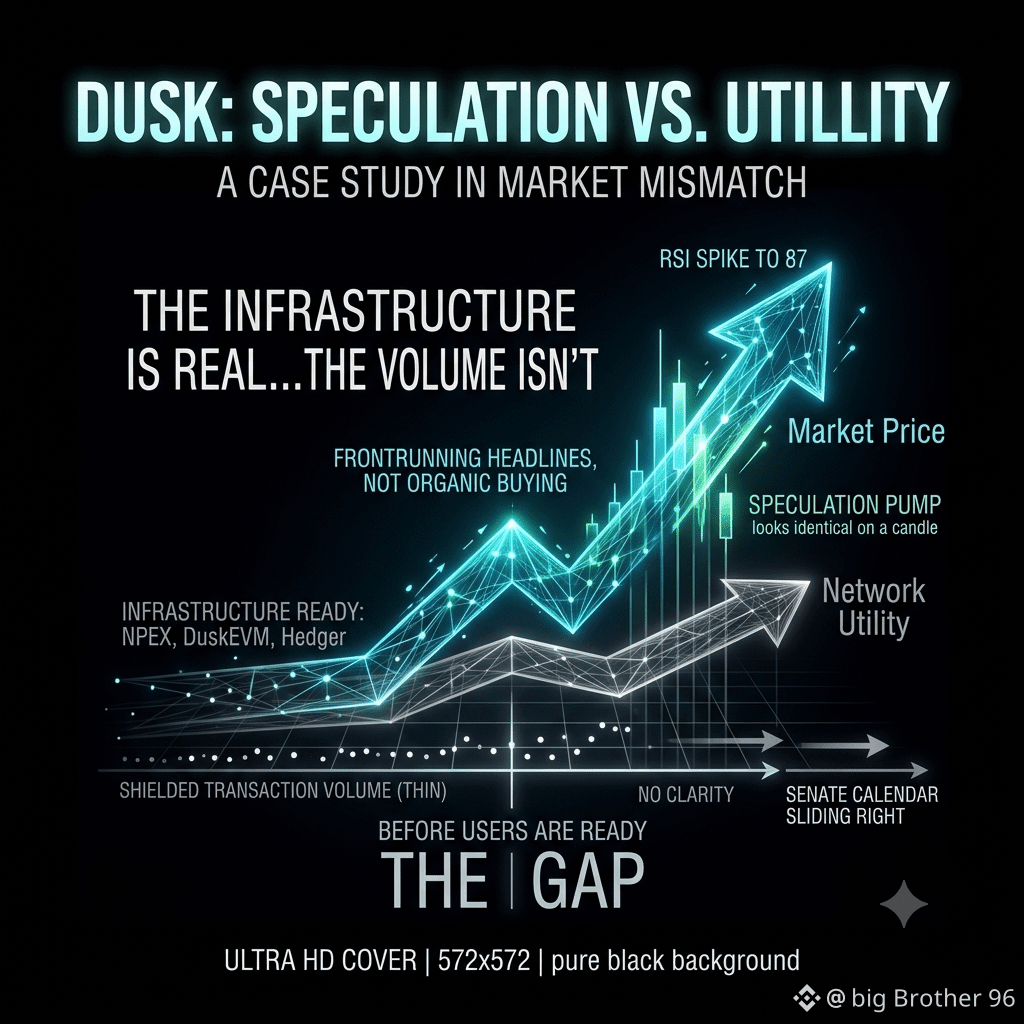
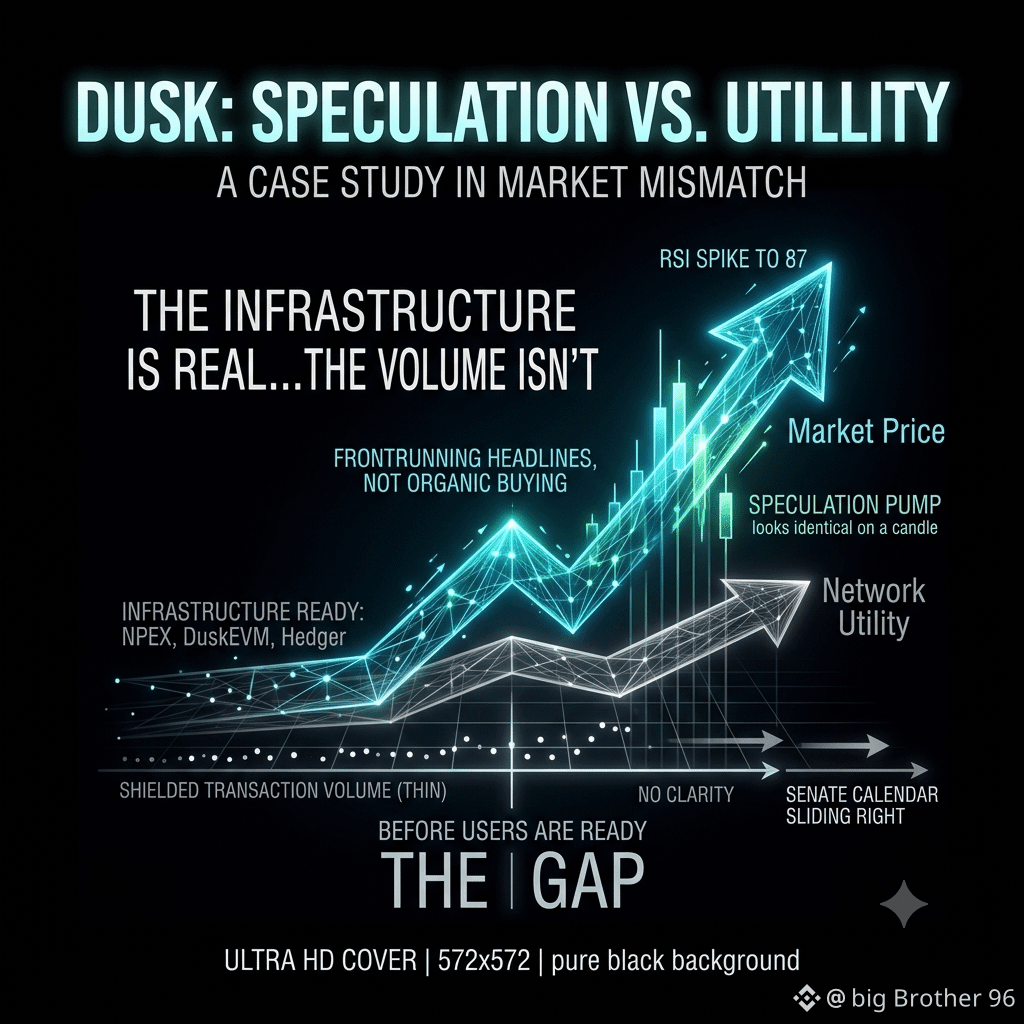
I keep a small $DUSK bag mostly out of stubbornness at this point. Watched it stall out at $0.079 this morning and thought, yeah, that's the shape of every RWA pump lately not organic buying, just people front-running a Senate calendar that keeps sliding right. CLARITY's been "close" since June.
Here's the part that actually bugs me. The infrastructure is real. NPEX is tokenizing equity, $DUSK EVM lets Solidity devs walk straight in, Hedger does confidential execution most chains can't touch. I've poked around the explorer more than once looking for shielded transaction volume, and it's thin, almost quiet. So an RSI spike to 87 wasn't the network getting used, it was a headline getting priced in ahead of time. Two very different things that look identical on a candle.
The chain is ready before the users are. That gap never shows up on any indicator, you only notice it if you're actually watching.
@Dusk #dusk $DUSK
Here's the part that actually bugs me. The infrastructure is real. NPEX is tokenizing equity, $DUSK EVM lets Solidity devs walk straight in, Hedger does confidential execution most chains can't touch. I've poked around the explorer more than once looking for shielded transaction volume, and it's thin, almost quiet. So an RSI spike to 87 wasn't the network getting used, it was a headline getting priced in ahead of time. Two very different things that look identical on a candle.
The chain is ready before the users are. That gap never shows up on any indicator, you only notice it if you're actually watching.
@Dusk #dusk $DUSK
I keep coming back to one thing, while everyone else stares at that RSI-above-83 number the one that, no matter how good the story is, usually ends on a red candle. But the chart isn't what interests me.
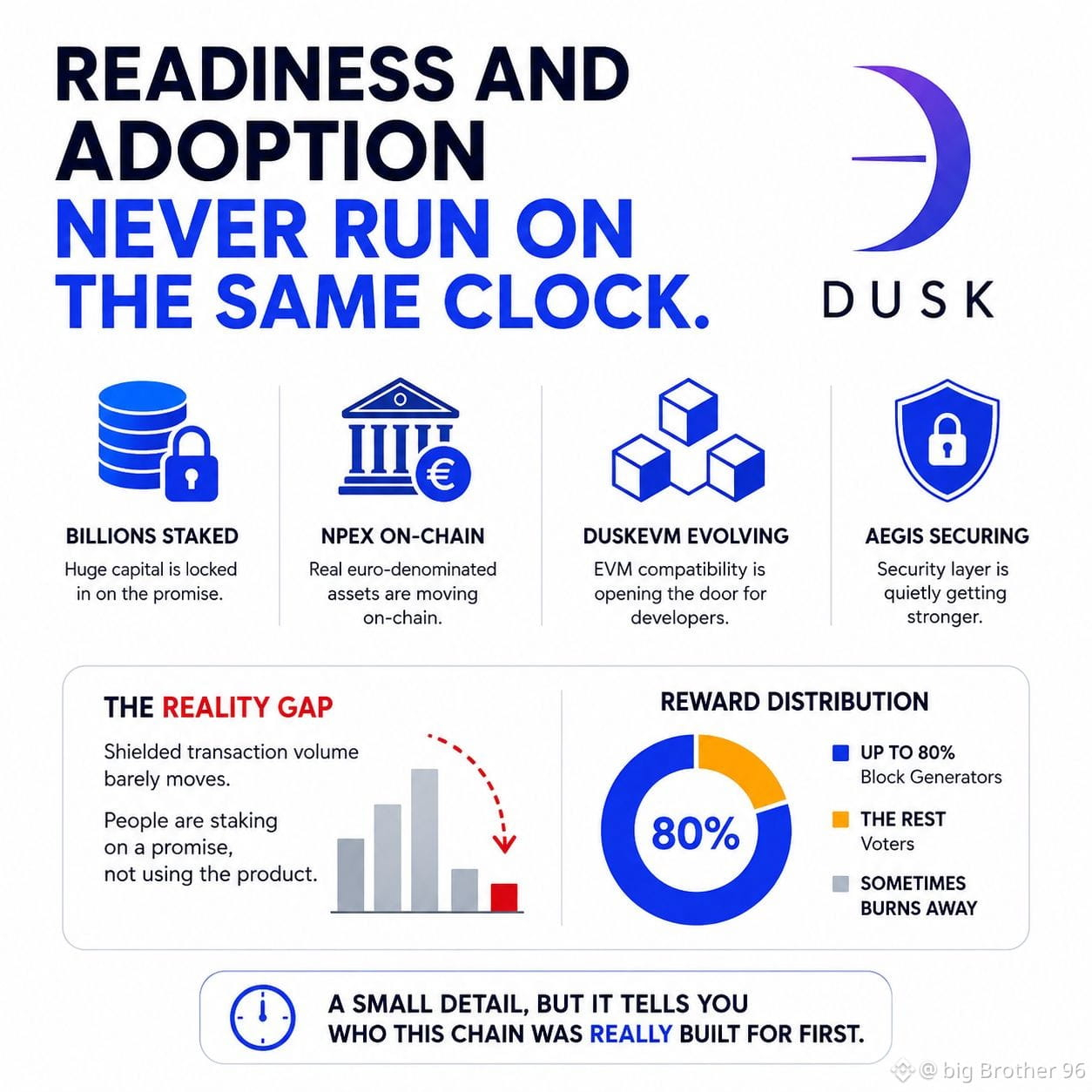
What really catches my eye is the gap between staking and actual usage. Billions worth is locked, NPEX is bringing real euro-denominated assets on-chain, DuskEVM is taking shape, AEGIS is quietly hardening the security layer and despite all that, the volume of shielded transactions barely moves. People are staking on a promise, not touching the product. That's not necessarily a bad thing, it's just the truth of where this stands right now.
Then there's the reward distribution nobody talks about block generators get up to 80%, voters get what's left over, which sometimes just burns away. A small detail, but it tells you who this chain was really built for first.
Readiness and adoption never run on the same clock.
@Dusk #dusk $DUSK
What really catches my eye is the gap between staking and actual usage. Billions worth is locked, NPEX is bringing real euro-denominated assets on-chain, DuskEVM is taking shape, AEGIS is quietly hardening the security layer and despite all that, the volume of shielded transactions barely moves. People are staking on a promise, not touching the product. That's not necessarily a bad thing, it's just the truth of where this stands right now.
Then there's the reward distribution nobody talks about block generators get up to 80%, voters get what's left over, which sometimes just burns away. A small detail, but it tells you who this chain was really built for first.
Readiness and adoption never run on the same clock.
@Dusk #dusk $DUSK
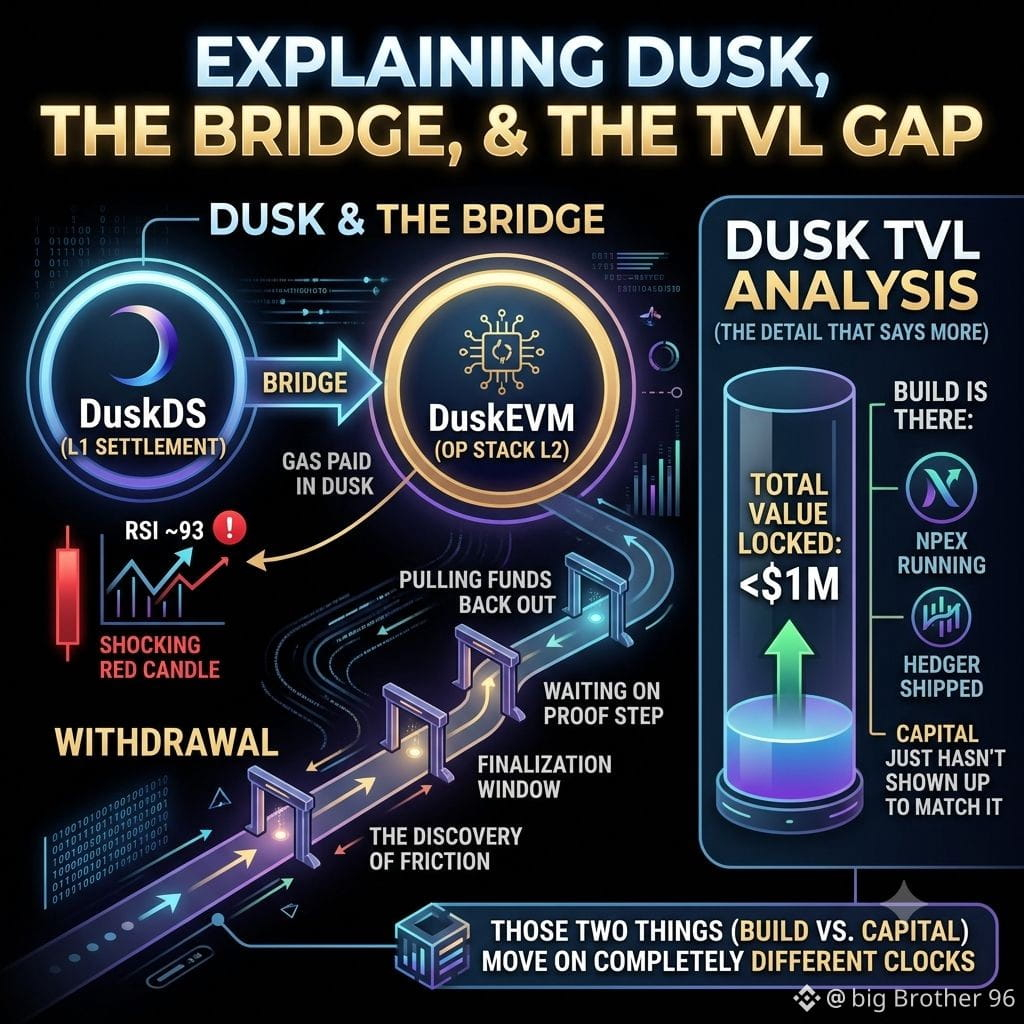
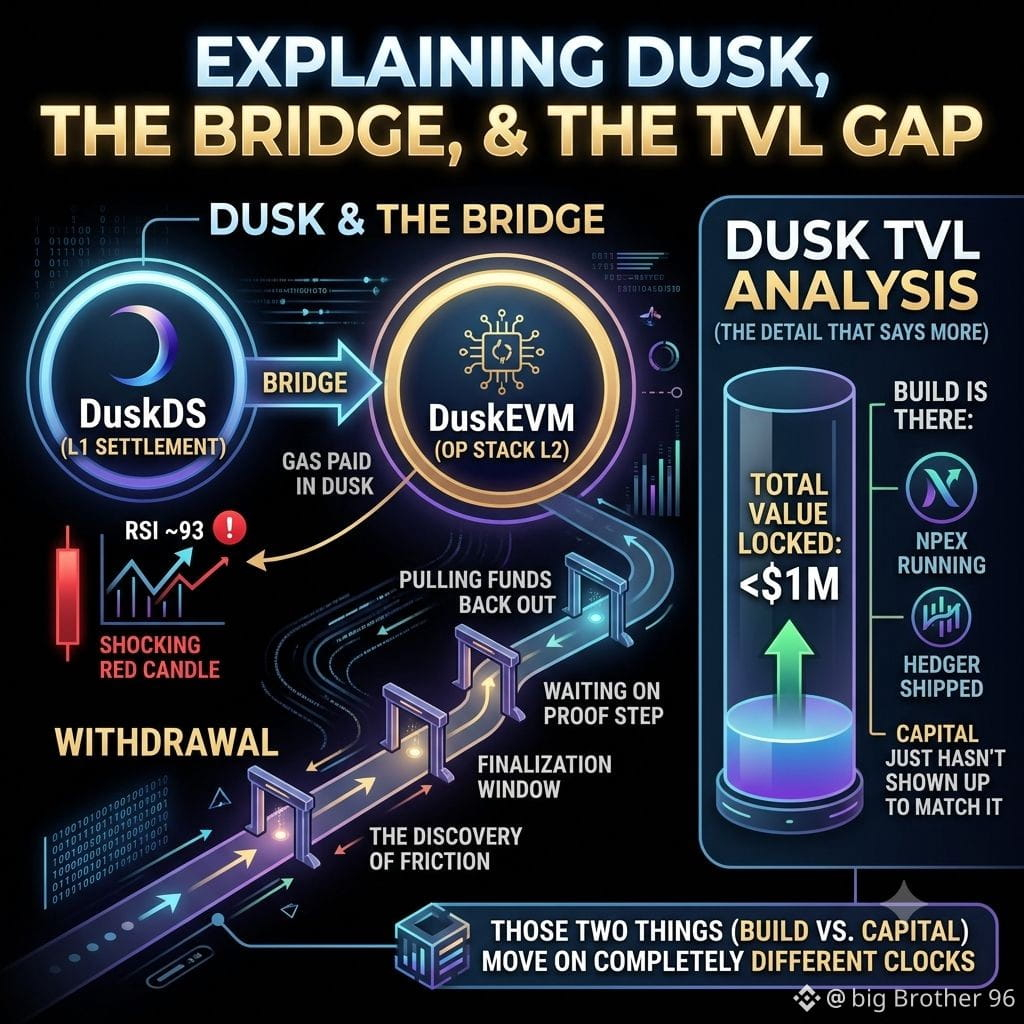
I keep an eye on DUSK mostly out of habit at this point, and this week was the usual script RSI up near 93, everyone in the replies acting shocked when the red candle showed up right on cue. That part's not worth much thought.
What actually made me pause was the bridge. DuskEVM runs on OP Stack and settles back through DuskDS, gas paid in $DUSK , all fine in theory but pulling funds back out means waiting on a proof step and a finalization window that basically nobody reads about until they're already trying to leave. Bad time to be discovering new friction.
The detail that says more than the chart, though, is TVL still sitting under a million even with NPEX running and Hedger already shipped. The build is there. The capital just hasn't shown up to match it, and those two things move on completely different clocks.
@Dusk #dusk $DUSK
What actually made me pause was the bridge. DuskEVM runs on OP Stack and settles back through DuskDS, gas paid in $DUSK , all fine in theory but pulling funds back out means waiting on a proof step and a finalization window that basically nobody reads about until they're already trying to leave. Bad time to be discovering new friction.
The detail that says more than the chart, though, is TVL still sitting under a million even with NPEX running and Hedger already shipped. The build is there. The capital just hasn't shown up to match it, and those two things move on completely different clocks.
@Dusk #dusk $DUSK
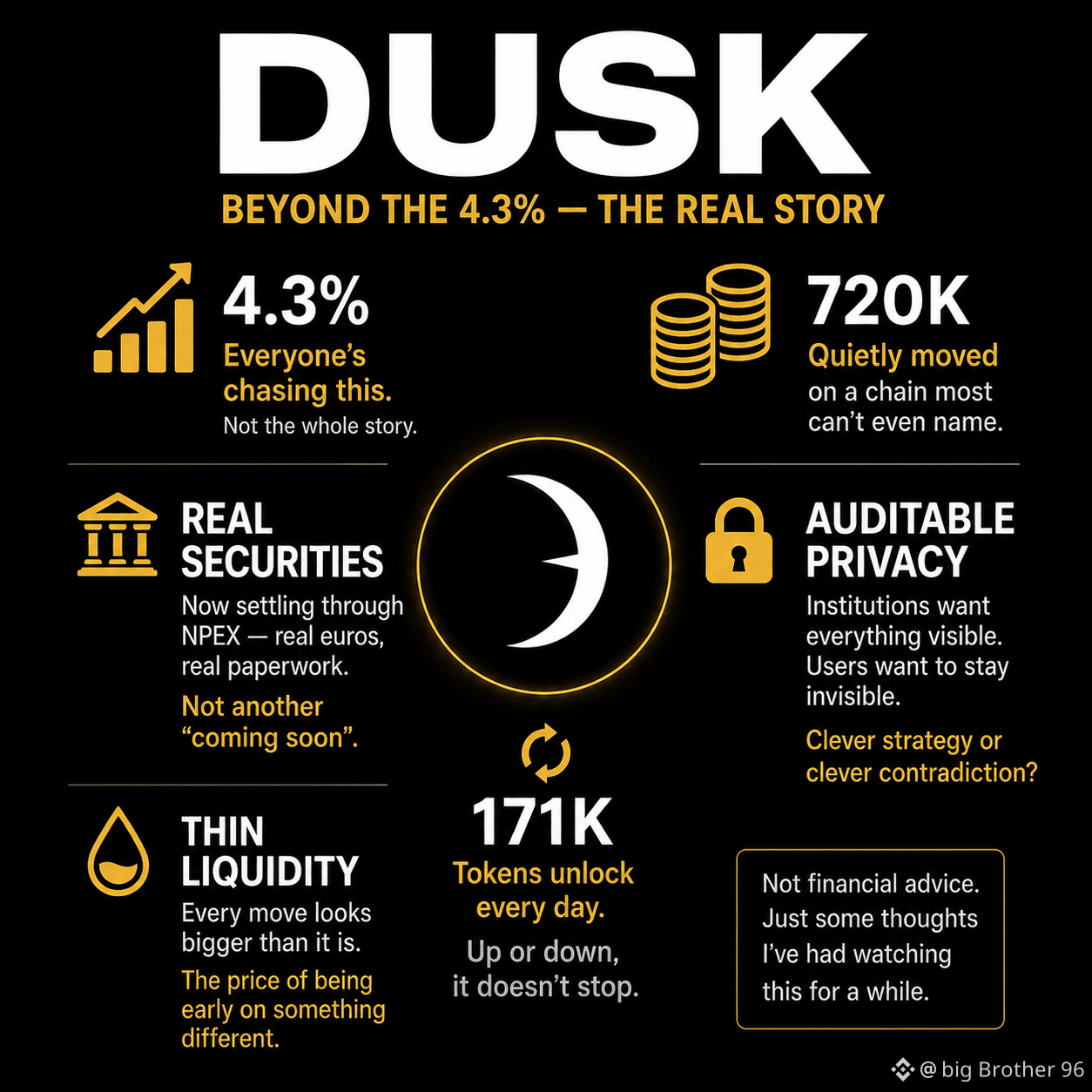
Not financial advice just some thoughts I'have had watching this for a while.
Everyone's chasing that 4.3%, as if that's the real story. The truth is, the real thing is the 720k that quietly moved on a chain most people can't even properly name. I remember when $DUSK was just a whitepaper, and nobody took it seriously except a handful of people in some Telegram group. Now real securities are actually settling through NPEX real euros, real paperwork not another "coming soon" promise. It's just that this part isn't as flashy as a green candle, so nobody talks about it.
On the other hand, 171k tokens quietly unlock every day, whether the price goes up or down no one shows that in a chart screenshot. Liquidity is thin, so every move looks more dramatic than it actually is that's the price you pay for getting into something small and different early.
And then there's this "auditable privacy" idea, which is strange too. Institutions want everything visible; users want to stay invisible. Dusk is trying to sell both at once and honestly, I still can't tell if that's a genuinely clever strategy or just a contradiction dressed up in good marketing.
@Dusk
#dusk
$DUSK
Everyone's chasing that 4.3%, as if that's the real story. The truth is, the real thing is the 720k that quietly moved on a chain most people can't even properly name. I remember when $DUSK was just a whitepaper, and nobody took it seriously except a handful of people in some Telegram group. Now real securities are actually settling through NPEX real euros, real paperwork not another "coming soon" promise. It's just that this part isn't as flashy as a green candle, so nobody talks about it.
On the other hand, 171k tokens quietly unlock every day, whether the price goes up or down no one shows that in a chart screenshot. Liquidity is thin, so every move looks more dramatic than it actually is that's the price you pay for getting into something small and different early.
And then there's this "auditable privacy" idea, which is strange too. Institutions want everything visible; users want to stay invisible. Dusk is trying to sell both at once and honestly, I still can't tell if that's a genuinely clever strategy or just a contradiction dressed up in good marketing.
@Dusk
#dusk
$DUSK
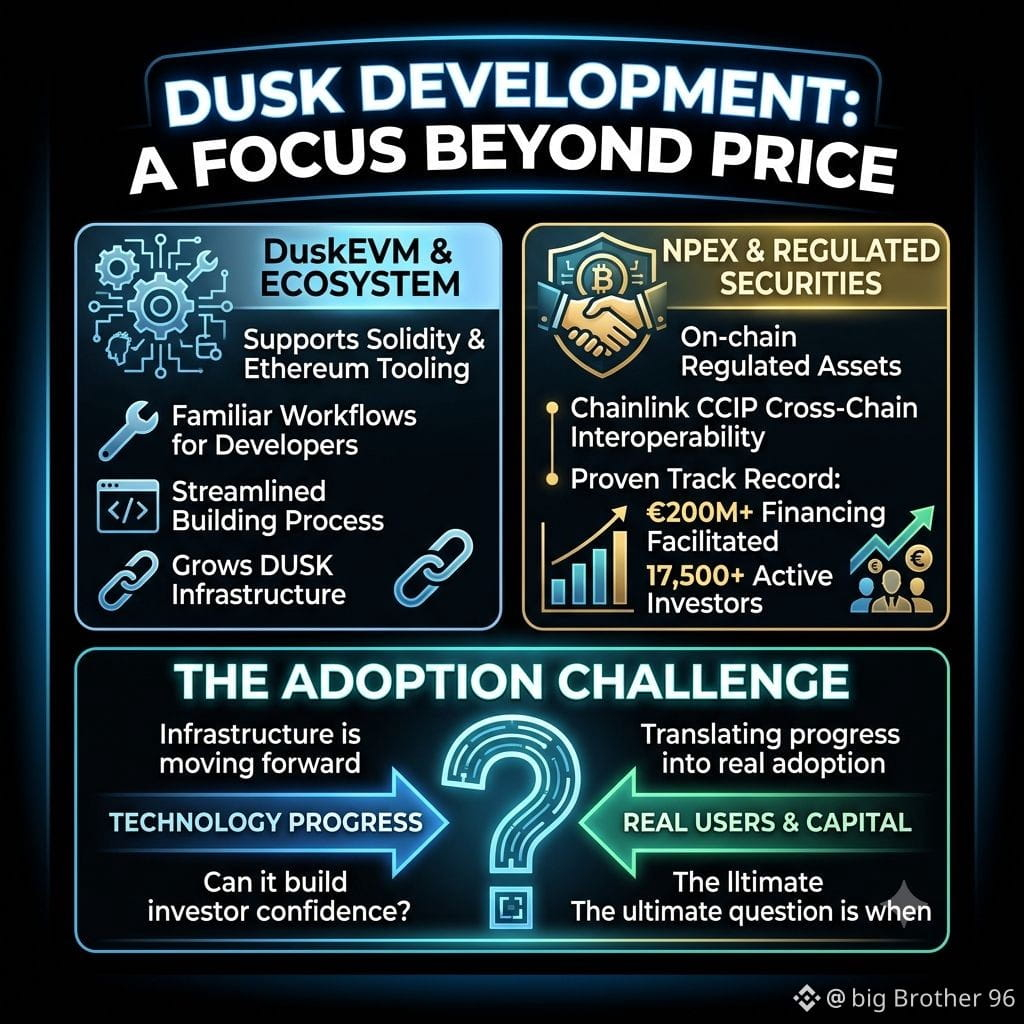
Why do I keep coming back to DUSK? Maybe because its development is more interesting to me than the price action.
DuskEVM supports Solidity and familiar Ethereum tooling, which means developers can build on $DUSK using workflows they already know.
Then there’s NPEX. Dusk and NPEX are working on infrastructure for bringing regulated securities on-chain, with Chainlink CCIP being used for cross-chain interoperability in the setup.
NPEX isn’t just another platform either. According to Dusk, NPEX has facilitated more than €200M in financing and has 17,500+ active investors across its network.
That’s the part I find most interesting. The infrastructure is moving forward, but how much of that progress eventually translates into real adoption remains to be seen.
For me, the bigger question isn’t the technology anymore.
It’s when real users and real capital start using that infrastructure with the same level of confidence.
@Dusk
#dusk
$DUSK
DuskEVM supports Solidity and familiar Ethereum tooling, which means developers can build on $DUSK using workflows they already know.
Then there’s NPEX. Dusk and NPEX are working on infrastructure for bringing regulated securities on-chain, with Chainlink CCIP being used for cross-chain interoperability in the setup.
NPEX isn’t just another platform either. According to Dusk, NPEX has facilitated more than €200M in financing and has 17,500+ active investors across its network.
That’s the part I find most interesting. The infrastructure is moving forward, but how much of that progress eventually translates into real adoption remains to be seen.
For me, the bigger question isn’t the technology anymore.
It’s when real users and real capital start using that infrastructure with the same level of confidence.
@Dusk
#dusk
$DUSK
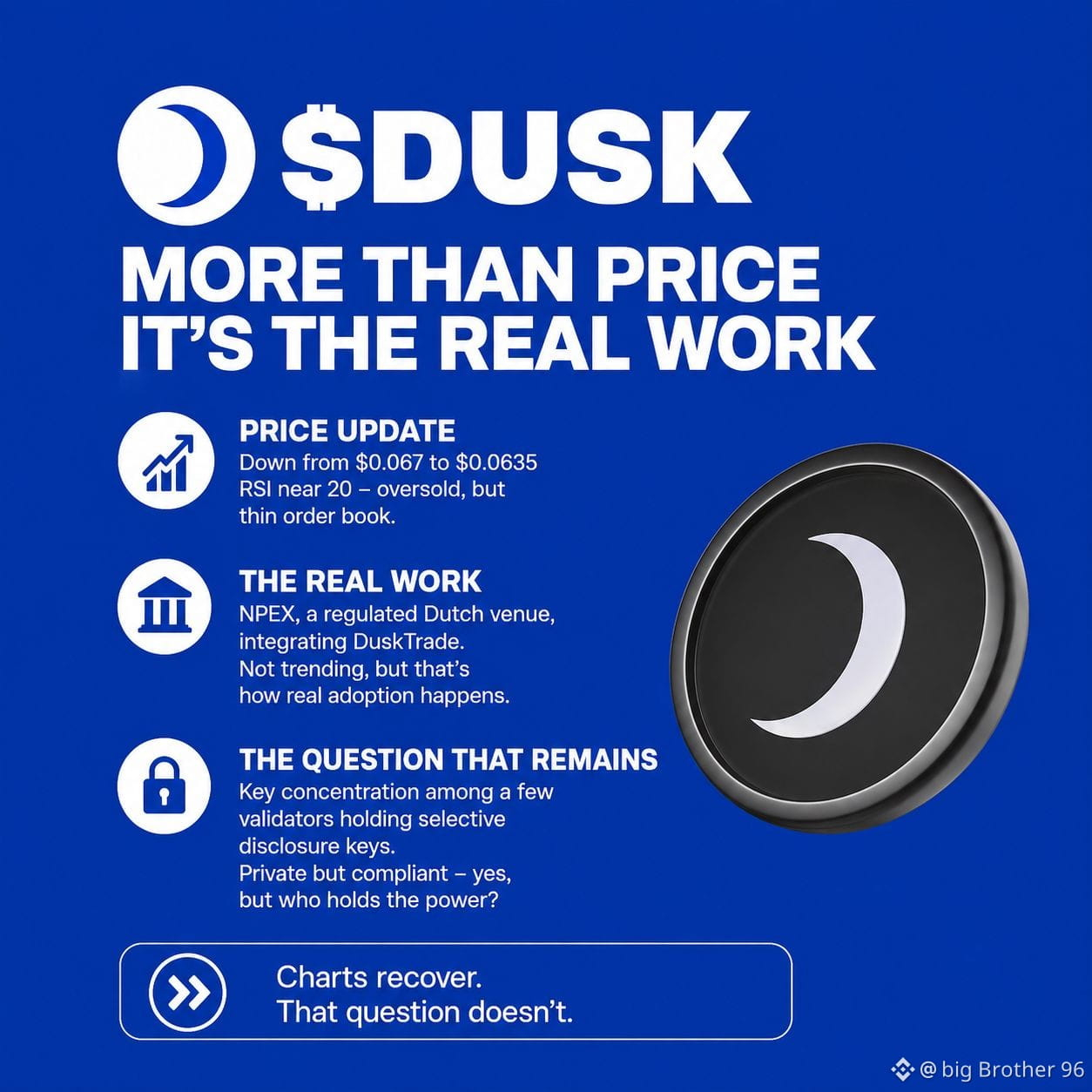
Pulled up DUSK again this morning, more out of habit than anything. Down from .067 to .0635 in a day, RSI sitting near 20 the kind of number that looks alarming until you remember how thin this order book actually is.
The part I keep chewing on isn't the price, it's NPEX A regulated Dutch trading venue quietly integrating DuskTrade doesn't trend on anyone's feed, but that's the actual work slow, unglamorous, the stuff that takes years before it means anything. Everyone's busy repeating the MiCA angle like it's news.
What actually bugs me is the key concentration. A small group of validators holding the selective disclosure keys is the tension nobody wants to sit with, because it cuts against the whole "private but compliant" pitch. Charts recover. That question doesn't.
@Dusk #dusk $DUSK
The part I keep chewing on isn't the price, it's NPEX A regulated Dutch trading venue quietly integrating DuskTrade doesn't trend on anyone's feed, but that's the actual work slow, unglamorous, the stuff that takes years before it means anything. Everyone's busy repeating the MiCA angle like it's news.
What actually bugs me is the key concentration. A small group of validators holding the selective disclosure keys is the tension nobody wants to sit with, because it cuts against the whole "private but compliant" pitch. Charts recover. That question doesn't.
@Dusk #dusk $DUSK
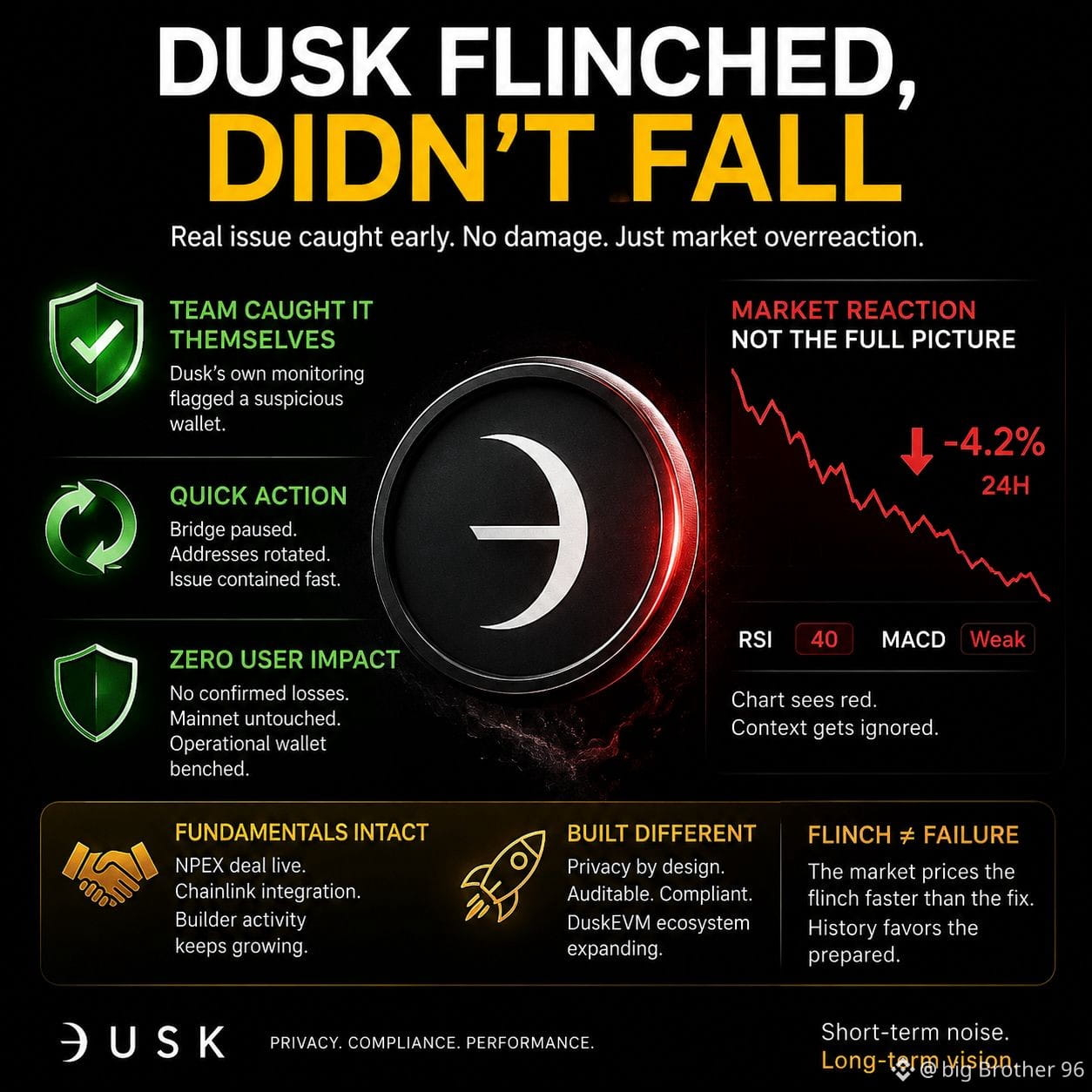
Been in Dusk's Discord since testnet so this didn't read like a headline to me it read like watching someone I half know trip over something they usually step around clean.
What's getting skipped is that the team caught this themselves Not a whitehat tip not a Twitter thread doing their job for them their own monitoring flagged a wallet acting strange and they paused the bridge and rotated addresses before most people even noticed something was off. Go read the actual notice and it's almost boring. No confirmed user losses. Mainnet never touched. Just an operational wallet quietly benched while they cleaned up.
But the chart doesn't know any of that, it just sees red. RSI dipping to 40, a rough 24 hours, and suddenly the NPEX deal and the Chainlink work are background noise nobody wants to bring up mid-selloff.
I've sat through enough of these to know the difference between a chain actually bleeding and one just wincing.
The market usually prices the flinch faster than it prices the fix.
@Dusk
#dusk
$DUSK
What's getting skipped is that the team caught this themselves Not a whitehat tip not a Twitter thread doing their job for them their own monitoring flagged a wallet acting strange and they paused the bridge and rotated addresses before most people even noticed something was off. Go read the actual notice and it's almost boring. No confirmed user losses. Mainnet never touched. Just an operational wallet quietly benched while they cleaned up.
But the chart doesn't know any of that, it just sees red. RSI dipping to 40, a rough 24 hours, and suddenly the NPEX deal and the Chainlink work are background noise nobody wants to bring up mid-selloff.
I've sat through enough of these to know the difference between a chain actually bleeding and one just wincing.
The market usually prices the flinch faster than it prices the fix.
@Dusk
#dusk
$DUSK
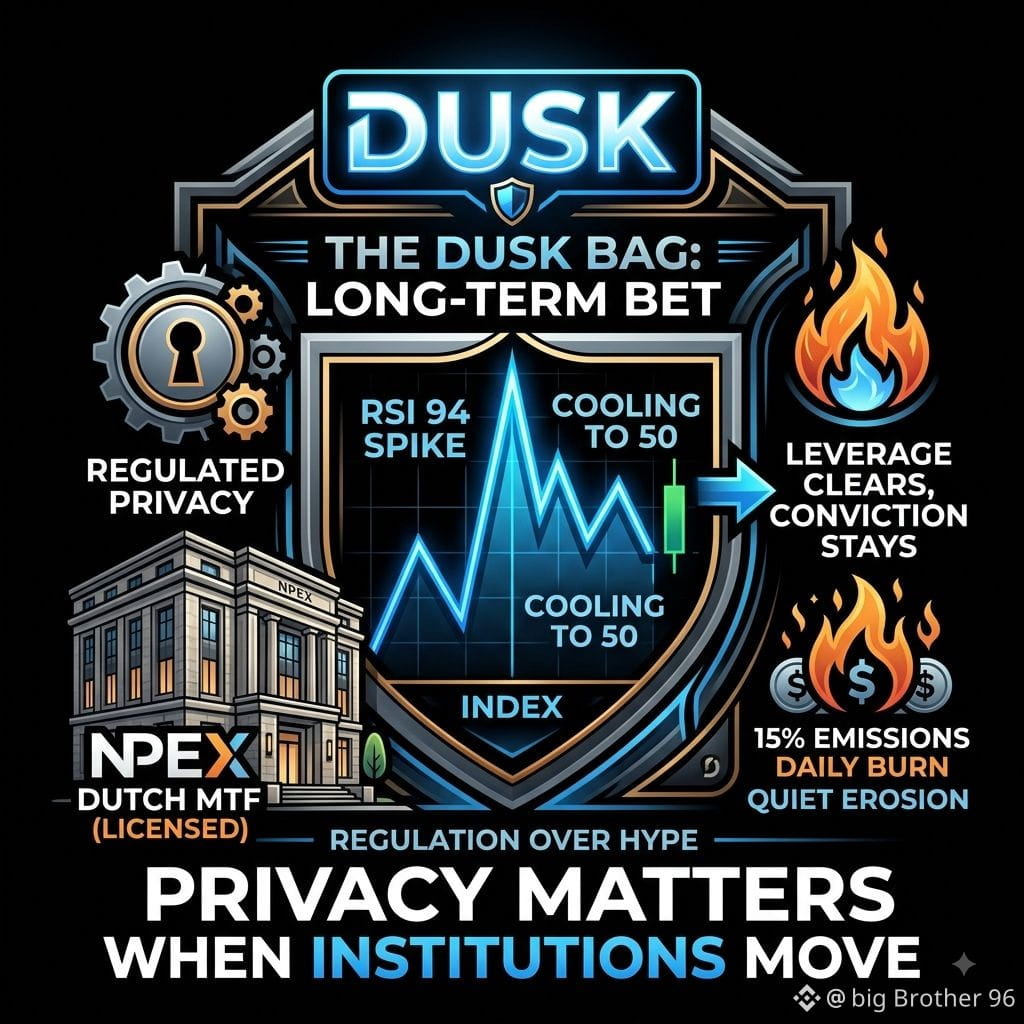
I've had a small DUSK bag sitting quiet since before anyone bothered saying "regulated privacy" like it meant something, so when the NPEX news hit my feed it didn't feel like a headline more like watching a slow bet finally start paying attention to itself NPEX isn't some scrappy DeFi shop chasing a narrative either it's a Dutch MTF that's been licensed and grinding away since before crypto had anything real to prove. Institutions like that don't move fast, and they definitely don't move for hype, they wait until the rails actually hold weight, which is the part everyone scrolling past the 8.8% candle keeps missing. RSI spiking to 94 then cooling to 50 doesn't spook me, that's just leverage clearing out, not conviction leaving the building. What I actually watch is the burn, 15% of emissions gone every single day, no announcement, no chart pattern, just quiet erosion working in your favor while everyone else stares at price. Privacy only starts mattering once the people with something real to lose start asking for it.
@Dusk
#dusk
$DUSK
@Dusk
#dusk
$DUSK
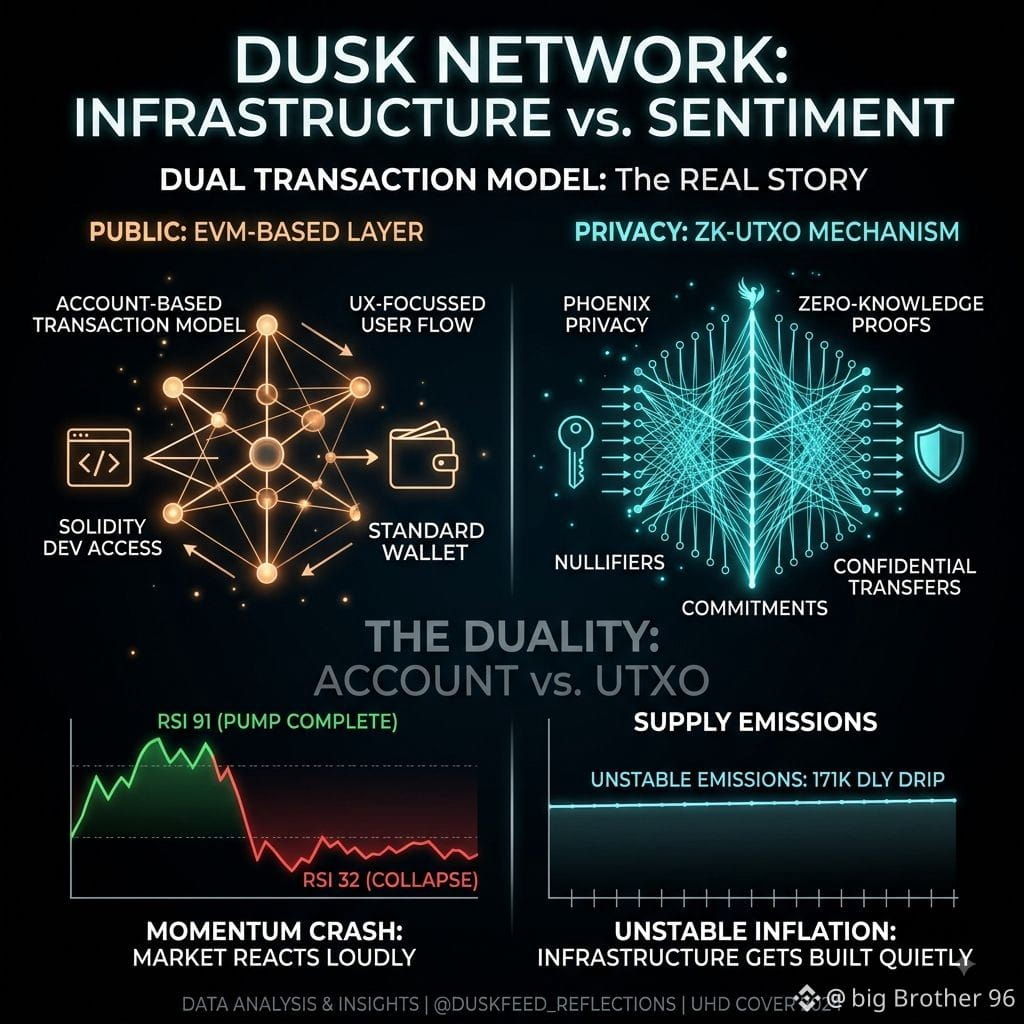
Been sitting with the DUSK feed longer than I probably should have tonight. Everyone's talking about the EVM testnet like it's the whole story and sure, letting Solidity devs walk into regulated RWA infrastructure without relearning everything is a real unlock, not nothing. But the thing I keep coming back to is the dual transaction model nobody brings up unprompted. Account based for the people who just want it to work, UTXO sitting quietly underneath for anyone who still remembers why this space cared about privacy in the first place. That's the actual bet here, not the testnet headline.
Checked the RSI almost by accident 91 collapsing to 32 in a few hours. The pump everyone's celebrating had already finished before most people looked up.
And the unlocks just keep dripping, 171K a day, easy to ignore until it isn't.
Infrastructure gets built quietly. Price reacts loudly. Rarely on the same clock.
@Dusk
#dusk
$DUSK
Checked the RSI almost by accident 91 collapsing to 32 in a few hours. The pump everyone's celebrating had already finished before most people looked up.
And the unlocks just keep dripping, 171K a day, easy to ignore until it isn't.
Infrastructure gets built quietly. Price reacts loudly. Rarely on the same clock.
@Dusk
#dusk
$DUSK
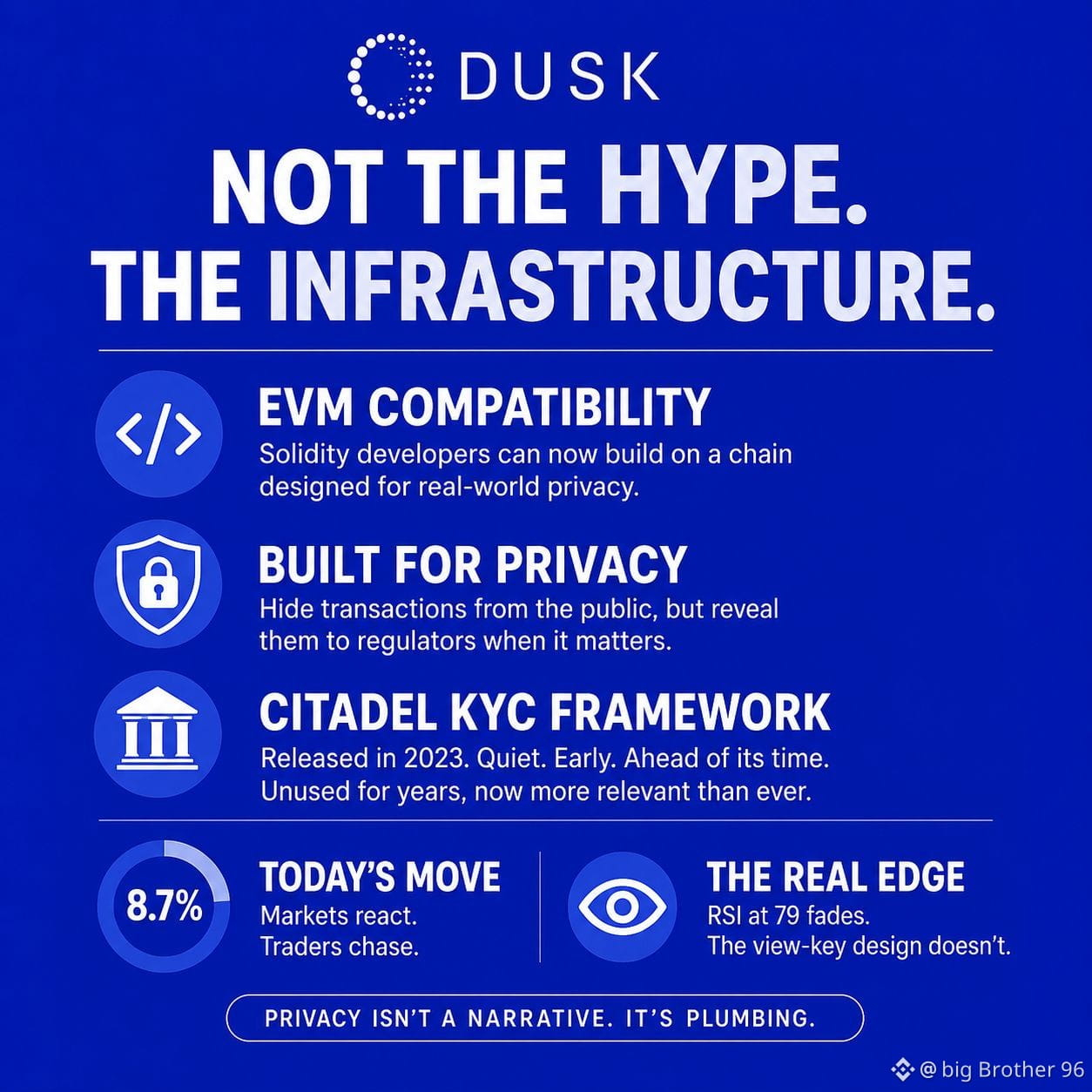
I have been half watching Dusk for years now, the way you keep an eye on a project that keeps missing its own deadlines but never actually stops moving. Six years of "mainnet soon," and then it just... shows up. The EVM piece is the part that actually got my attention, not the price. Solidity devs can now deploy on a chain that was built around a genuinely unglamorous problem how do you hide a transaction from the public while still showing it to a regulator when they ask. That's not a narrative, that's plumbing.
Everyone's talking about the 8.7% move today. I keep coming back to Citadel instead, that KYC framework they quietly shipped back in 2023 and basically nobody covered. It sat there unused for years, waiting for the market to catch up to why it mattered. That's usually how you tell what's real the thing nobody clapped for at the time.
RSI at 79 fades by next week. The view-key design doesn't.
@Dusk
#dusk
$DUSK
Everyone's talking about the 8.7% move today. I keep coming back to Citadel instead, that KYC framework they quietly shipped back in 2023 and basically nobody covered. It sat there unused for years, waiting for the market to catch up to why it mattered. That's usually how you tell what's real the thing nobody clapped for at the time.
RSI at 79 fades by next week. The view-key design doesn't.
@Dusk
#dusk
$DUSK
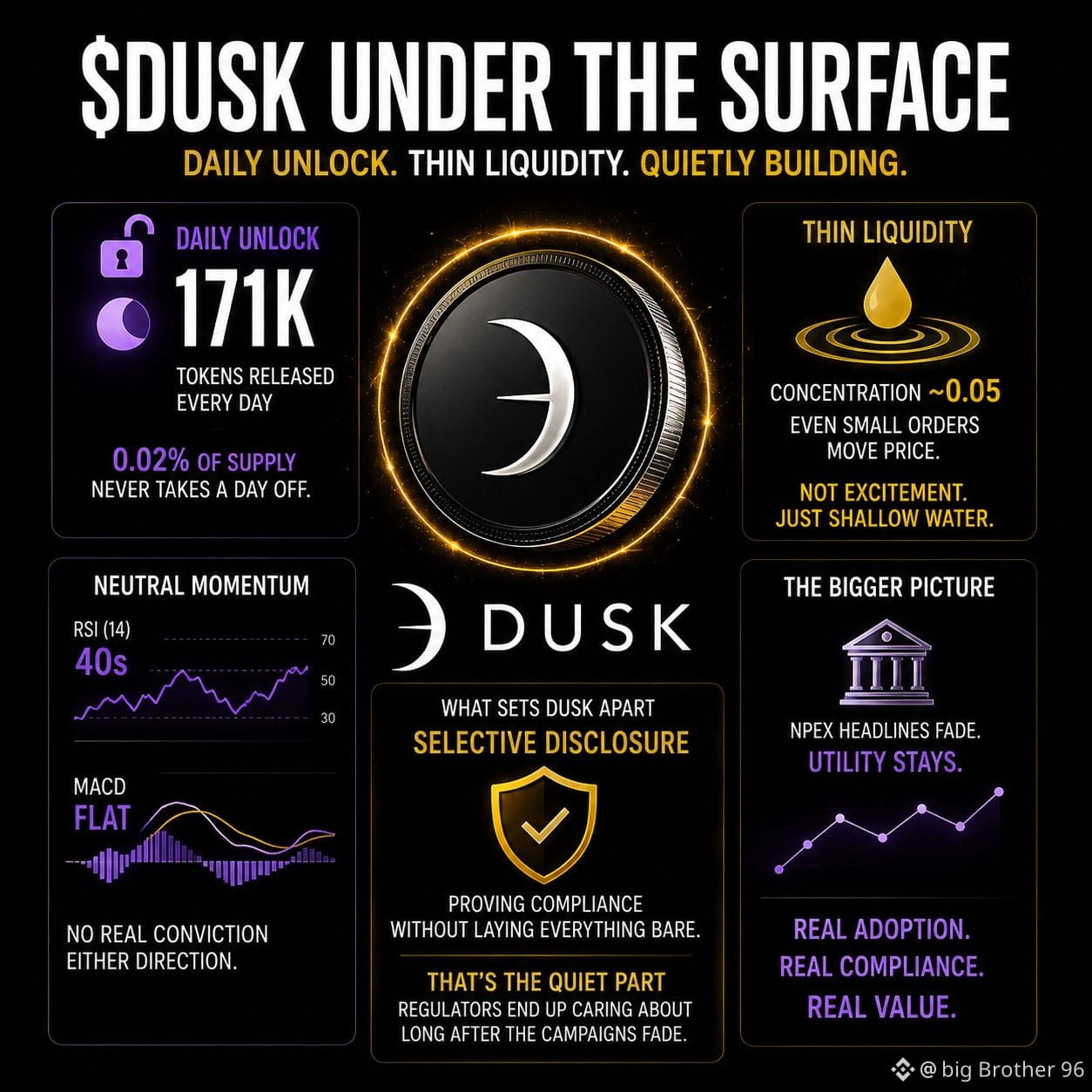
Been watching DUSK for a bit now and the thing that actually catches my eye isn't the NPEX headline everyone keeps repeating it's that daily unlock ticking away quietly underneath it all. Around 171K tokens released every day, just 0.02%, easy to shrug off until you notice it never takes a day off.
I pull up the order book sometimes just to see, and it's thin. Concentration's been sitting near 0.05 for a while, so even a modest order nudges price around more than it should. That's not volatility from excitement, that's just shallow water.
RSI's been drifting in the 40s, MACD barely twitching no real conviction either direction right now.
What actually holds my attention long term is the selective disclosure piece, proving compliance without laying everything bare. That's the quiet part regulators end up caring about long after the campaigns fade.
@Dusk
#dusk
$DUSK
I pull up the order book sometimes just to see, and it's thin. Concentration's been sitting near 0.05 for a while, so even a modest order nudges price around more than it should. That's not volatility from excitement, that's just shallow water.
RSI's been drifting in the 40s, MACD barely twitching no real conviction either direction right now.
What actually holds my attention long term is the selective disclosure piece, proving compliance without laying everything bare. That's the quiet part regulators end up caring about long after the campaigns fade.
@Dusk
#dusk
$DUSK
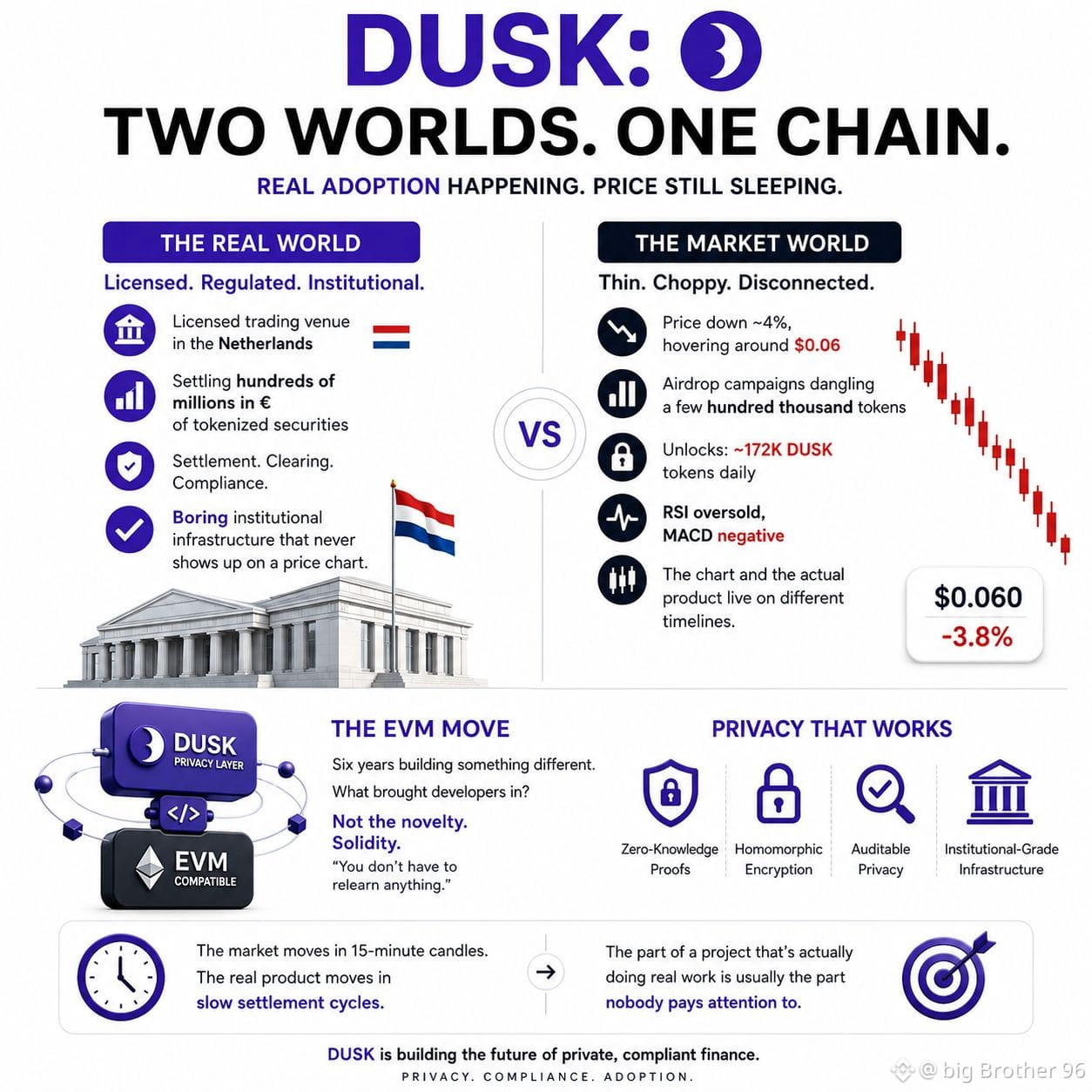
I have been holding a small bag of DUSK since earlier this year, mostly because the whole auditable privacy idea actually made sense to me. Today it’s sitting in the red again down under 4%, hovering right around six cents. Nothing crazy enough to make you panic check your portfolio, just that slow grind.
What always trips me up looking at this chart is the massive gap between price action and actual adoption. Somewhere in the Netherlands, a fully licensed venue is settling hundreds of millions of euros in tokenized securities on this chain. Real institutional volume, clearing in the background stuff that never turns into a hype tweet or a green candle. Meanwhile, the retail market is just thin and choppy, getting moved around by random campaigns throwing out a few hundred thousand tokens as bait. It’s wild how two completely different worlds are running on the exact same ticker.
Then there’s the EVM pivot They spent six years building something totally customzero knowledge proofs, homomorphic encryption, a whole ground up privacy stack. But what actually brought devs in? Solidity. Just telling people "you don't have to learn a new language." It’s almost funny if you’ve followed DUSK long enough to remember when the entire pitch was about not being like Ethereum.
On top of all that, emissions don't pause for anything. Roughly 172k tokens hitting the market every single day, regardless of institutional progress or market sentiment. RSI is oversold, MACD looks weak, and the chart couldn't care less about the Hedger module or backend tokenization progress.
The market moves in 15-minute candles, but the real product moves in slow settlement cycles. Funny how the only part of a project actually doing real work is usually the part nobody pays attention to
@Dusk
#dusk
$DUSK
What always trips me up looking at this chart is the massive gap between price action and actual adoption. Somewhere in the Netherlands, a fully licensed venue is settling hundreds of millions of euros in tokenized securities on this chain. Real institutional volume, clearing in the background stuff that never turns into a hype tweet or a green candle. Meanwhile, the retail market is just thin and choppy, getting moved around by random campaigns throwing out a few hundred thousand tokens as bait. It’s wild how two completely different worlds are running on the exact same ticker.
Then there’s the EVM pivot They spent six years building something totally customzero knowledge proofs, homomorphic encryption, a whole ground up privacy stack. But what actually brought devs in? Solidity. Just telling people "you don't have to learn a new language." It’s almost funny if you’ve followed DUSK long enough to remember when the entire pitch was about not being like Ethereum.
On top of all that, emissions don't pause for anything. Roughly 172k tokens hitting the market every single day, regardless of institutional progress or market sentiment. RSI is oversold, MACD looks weak, and the chart couldn't care less about the Hedger module or backend tokenization progress.
The market moves in 15-minute candles, but the real product moves in slow settlement cycles. Funny how the only part of a project actually doing real work is usually the part nobody pays attention to
@Dusk
#dusk
$DUSK
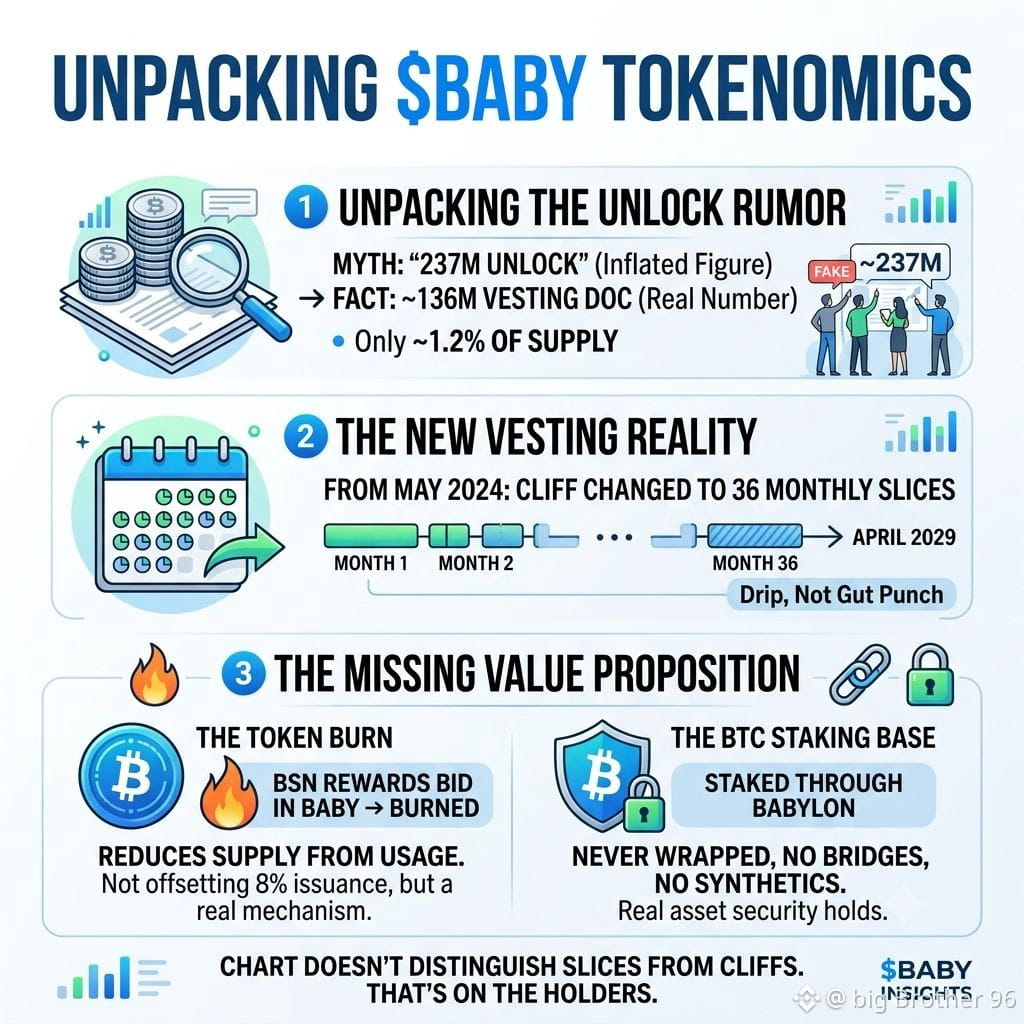
$BABY dipped to $0.0103 this morning, lowest I'have seen it, and honestly didn't even flinch, RSI's been sliding toward 19 all week so the number wasn't the surprise. What got me was watching everyone post the same "237M unlock" figure like it's the only stat that matters today. Went and pulled the actual vesting doc because it felt inflated, and yeah, it is, real number's closer to 136M, about 1.2% of supply. Someone rounded up for effect once and it just kept getting copy pasted after that.
But that's not even the part worth sitting with. Back in May Babylon quietly switched the investor unlock from one big cliff into thirty six monthly slices, so Tuesday isn't "the unlock," it's the first of thirty five more, running all the way to April 2029. Everyone's bracing for one gut punch when it's actually just going to keep dripping for three years no matter where price sits. Feels like the wrong thing to be scared of, or at least scared of on the wrong timeline.
What I actually think about more, low key, is the burn auction. BSN rewards get bid on in BABY and whatever wins gets burned, gone. Caught one settling a few weeks back while half paying attention to something else and it stuck with me, because it's the one piece of this token where using the network actually costs supply instead of adding to it. Not close to offsetting 8% annual issuance, not even in the neighborhood, but it's real, it happens because something got used.
And the base thing still holds, the reason I paid attention to this in the first place. BTC staked through it never gets wrapped, never touches a bridge, no synthetic stand in pretending to be the real asset. That hasn't moved an inch since before the price did whatever it's doing now.
Chart doesn't know the difference between a slice and a cliff though. That part's on whoever's holding it.
@BabylonLabs_io
#baby
$BABY
But that's not even the part worth sitting with. Back in May Babylon quietly switched the investor unlock from one big cliff into thirty six monthly slices, so Tuesday isn't "the unlock," it's the first of thirty five more, running all the way to April 2029. Everyone's bracing for one gut punch when it's actually just going to keep dripping for three years no matter where price sits. Feels like the wrong thing to be scared of, or at least scared of on the wrong timeline.
What I actually think about more, low key, is the burn auction. BSN rewards get bid on in BABY and whatever wins gets burned, gone. Caught one settling a few weeks back while half paying attention to something else and it stuck with me, because it's the one piece of this token where using the network actually costs supply instead of adding to it. Not close to offsetting 8% annual issuance, not even in the neighborhood, but it's real, it happens because something got used.
And the base thing still holds, the reason I paid attention to this in the first place. BTC staked through it never gets wrapped, never touches a bridge, no synthetic stand in pretending to be the real asset. That hasn't moved an inch since before the price did whatever it's doing now.
Chart doesn't know the difference between a slice and a cliff though. That part's on whoever's holding it.
@BabylonLabs_io
#baby
$BABY
Checked BABY again this morning, mostly out of habit. $0.0108, red everywhere I looked. But honestly my first reaction wasn't about the price, it was about this August 10 unlock everyone's suddenly whispering about like it's some kind of countdown clock.
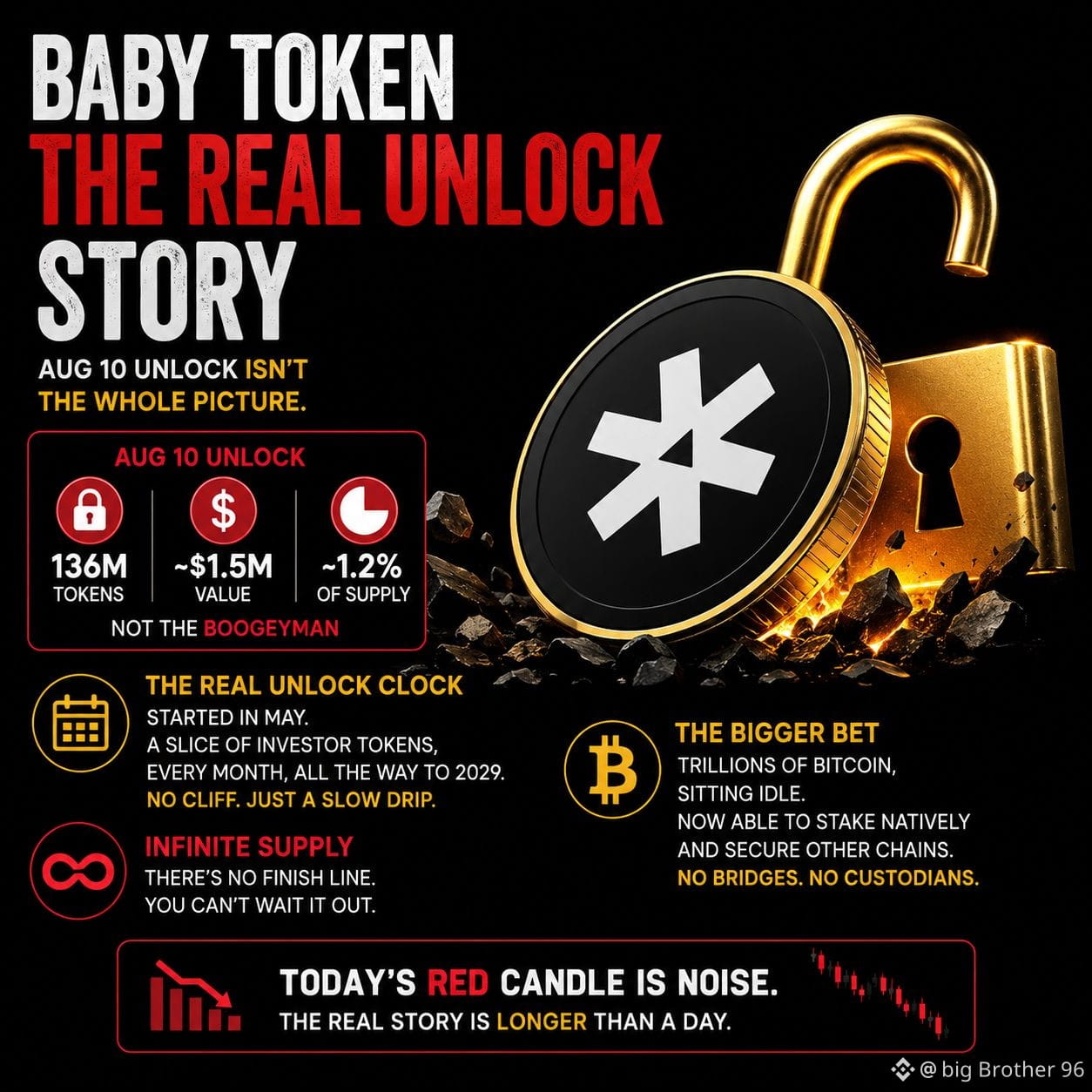
So instead of just nodding along with the panic, I went and actually pulled the number myself. Turns out it's 136 million tokens, around $1.5M, something like 1.2% of total supply. (CoinGecko) That's the boogeyman. Somewhere between the report and the group chats it got dressed up into a bigger deal than it is. Happens a lot in this space a small, scheduled, kind of boring release turns into a "sell pressure event" by the time it's made the rounds.
What actually stuck with me was something further back that nobody's really talking about. The real unlock clock started back in May, releasing a slice of the locked investor stack, then the same slice every single month after, running all the way through to 2029. (Babylonlabs) There's no drama to that, so it just doesn't get attention. It's not one cliff, it's a slow monthly drip that most people have already stopped watching. And honestly there's no point where it stops either, because the supply itself has no ceiling. It's infinite. (Tokenomist) You can't wait it out. There's no "once we're past this unlock, it's clean" moment coming.
And under all of it is the actual strange premise of the whole thing taking trillions of dollars of Bitcoin that's just sitting there doing nothing, and giving it a way to stake natively and secure other chains, no bridge, no custodian involved. (CoinMarketCap) That's a genuinely odd bet to try to price with a token. Bitcoin holders don't panic. They don't chase. So you've got this governance token trying to move fast on top of an asset class that historically doesn't move for anybody.
Makes today's red candle feel kind of beside the point, honestly.
@BabylonLabs_io
#baby
$BABY
So instead of just nodding along with the panic, I went and actually pulled the number myself. Turns out it's 136 million tokens, around $1.5M, something like 1.2% of total supply. (CoinGecko) That's the boogeyman. Somewhere between the report and the group chats it got dressed up into a bigger deal than it is. Happens a lot in this space a small, scheduled, kind of boring release turns into a "sell pressure event" by the time it's made the rounds.
What actually stuck with me was something further back that nobody's really talking about. The real unlock clock started back in May, releasing a slice of the locked investor stack, then the same slice every single month after, running all the way through to 2029. (Babylonlabs) There's no drama to that, so it just doesn't get attention. It's not one cliff, it's a slow monthly drip that most people have already stopped watching. And honestly there's no point where it stops either, because the supply itself has no ceiling. It's infinite. (Tokenomist) You can't wait it out. There's no "once we're past this unlock, it's clean" moment coming.
And under all of it is the actual strange premise of the whole thing taking trillions of dollars of Bitcoin that's just sitting there doing nothing, and giving it a way to stake natively and secure other chains, no bridge, no custodian involved. (CoinMarketCap) That's a genuinely odd bet to try to price with a token. Bitcoin holders don't panic. They don't chase. So you've got this governance token trying to move fast on top of an asset class that historically doesn't move for anybody.
Makes today's red candle feel kind of beside the point, honestly.
@BabylonLabs_io
#baby
$BABY
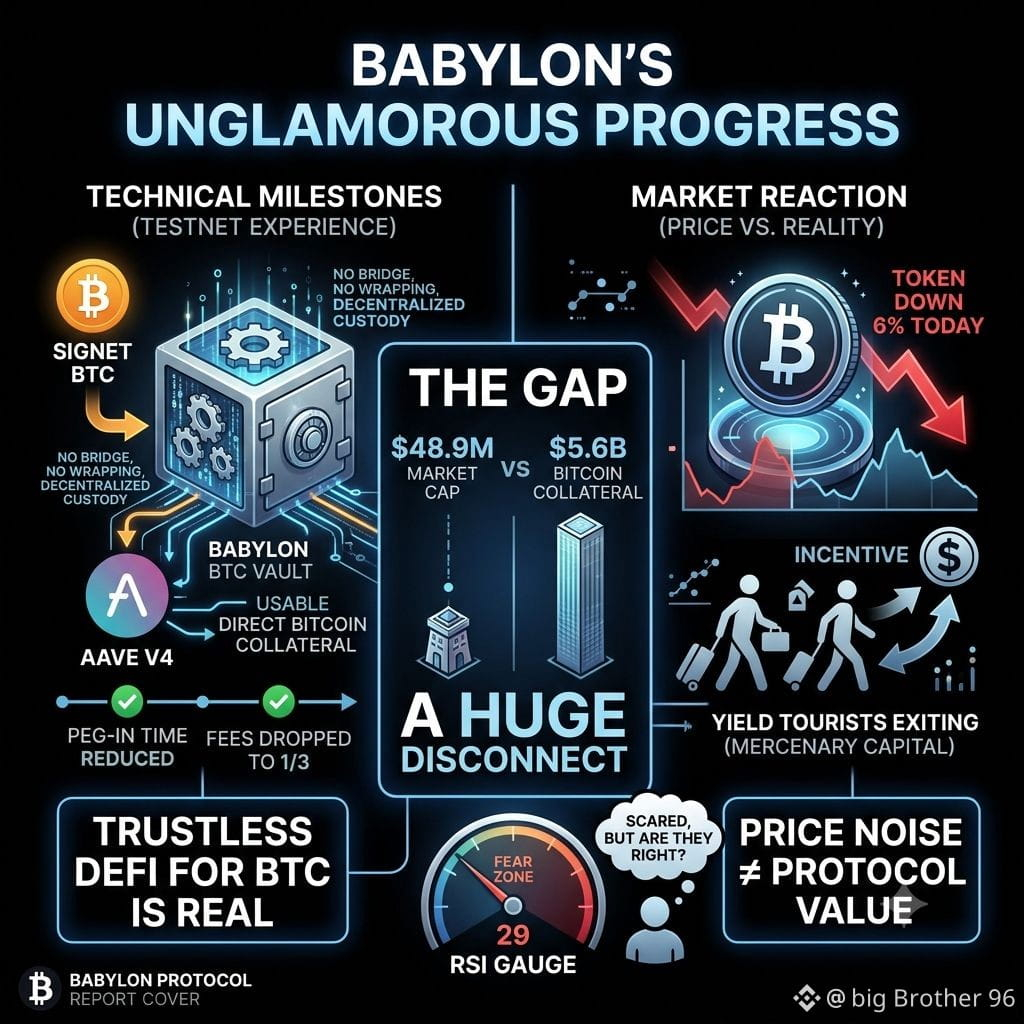
I have actually run through the Babylon testnet flow myself, which is more than I can say for most people posting charts about it today. Locked some signet BTC into a vault, watched it show up as usable collateral on Aave v4, and never once had to hand it off to a bridge or wrap it into some synthetic version of itself. You keep waiting for the catch, the moment where you have to trust some multisig with your coins, and it just never shows up. That's the part that stuck with me more than any price candle.
Because yeah, the token's down 6% today. People are treating that like it's the whole story. But peg in times on the vault side used to take forever and now they're down to a few hours, fees dropped to a third of what they were, and none of that made anyone's timeline. It's the unglamorous kind of progress, the stuff that only matters once real money starts moving through it instead of testnet BTC.
The outflow everyone's pointing at, almost 15,000 BTC leaving in what looks like one clean move, reads less like fear and more like yield tourists checking out once the incentive that brought them in dried up. That's just what mercenary capital does. It was never loyal to the mission, it was loyal to the number.
What actually sits with me is the gap between a $48.9M market cap and $5.6B in Bitcoin sitting inside this thing as collateral. Somewhere in that math is either a market badly underpricing what it means to govern Bitcoin-backed lending rails, or a market that just hasn't caught up yet.
An RSI of 29 tells you people are scared right now. It doesn't tell you they're right.
@BabylonLabs_io
#baby
$BABY
Because yeah, the token's down 6% today. People are treating that like it's the whole story. But peg in times on the vault side used to take forever and now they're down to a few hours, fees dropped to a third of what they were, and none of that made anyone's timeline. It's the unglamorous kind of progress, the stuff that only matters once real money starts moving through it instead of testnet BTC.
The outflow everyone's pointing at, almost 15,000 BTC leaving in what looks like one clean move, reads less like fear and more like yield tourists checking out once the incentive that brought them in dried up. That's just what mercenary capital does. It was never loyal to the mission, it was loyal to the number.
What actually sits with me is the gap between a $48.9M market cap and $5.6B in Bitcoin sitting inside this thing as collateral. Somewhere in that math is either a market badly underpricing what it means to govern Bitcoin-backed lending rails, or a market that just hasn't caught up yet.
An RSI of 29 tells you people are scared right now. It doesn't tell you they're right.
@BabylonLabs_io
#baby
$BABY
Been sitting with this BABY chart for a bit and one thing keeps nagging at me more than the actual pump.
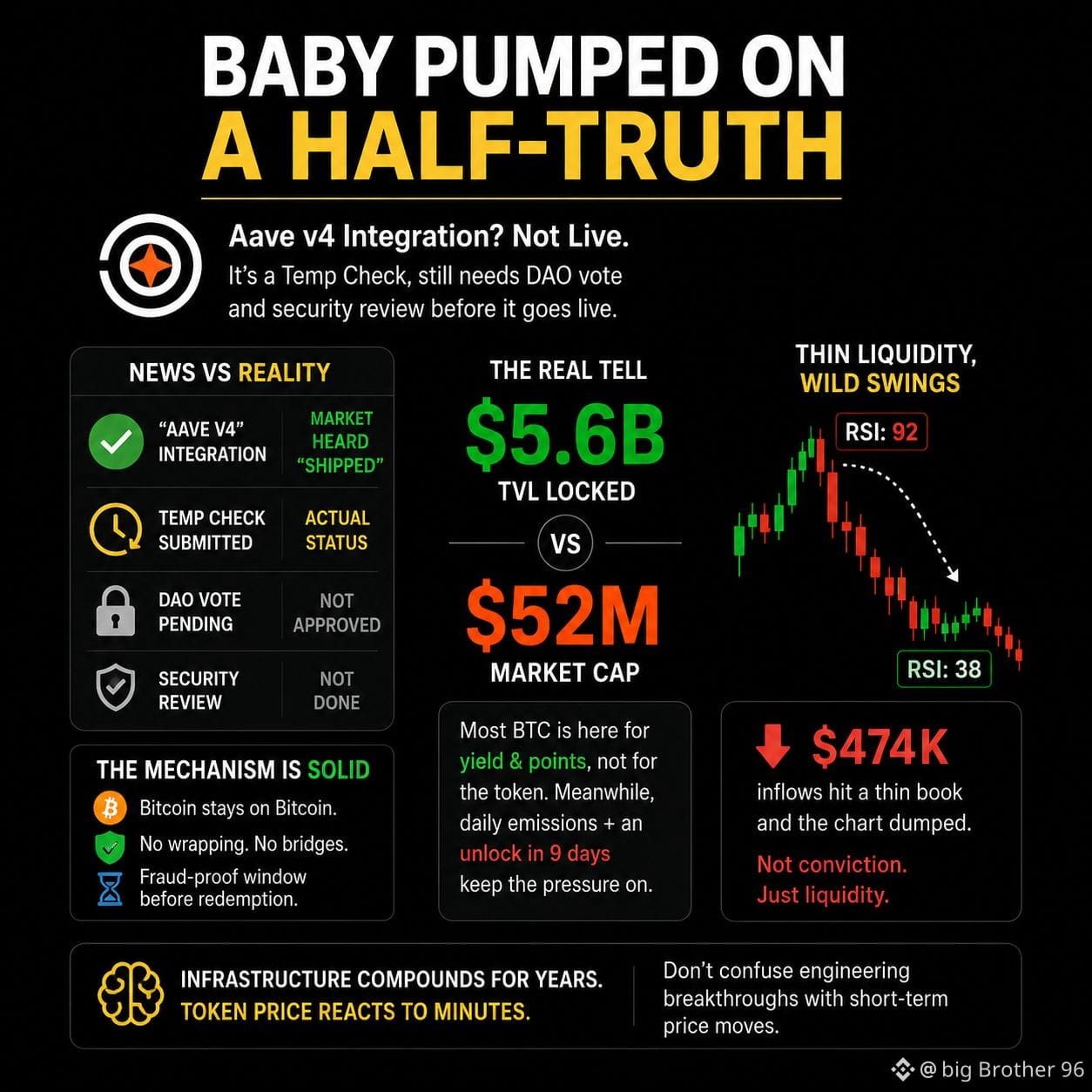
Everyone's talking about "the Aave v4 integration" like it's a done deal. It isn't. I pulled up the governance thread myself it's a Temp Check, still needs a DAO vote, still needs a security review before either of those Spokes actually goes live. Somewhere between the announcement and the price chart, "submitted for community feedback" turned into "shipped," and the market just ran with it.
What actually stuck with me wasn't the news, it was the numbers sitting next to each other. $5.6B locked in this protocol. $52M market cap on the token. That gap isn't really about valuation, it's a tell most of that BTC isn't parked there out of conviction in BABY, it's sitting there for yield and points, while the token underneath has to absorb daily emissions plus another unlock in nine days no matter how the chart looks this afternoon.
Credit where it's due on the mechanism itself Bitcoin never leaves its own chain, no wrapping, redemption gated by an actual fraud-proof window instead of "trust us." That part's solid engineering and it'll matter regardless of what the token does this week. But the infrastructure and the token trading on top of it are moving on completely different clocks. One compounds quietly over years. The other just swung from an RSI of 92 down to 38 because $474K walked through the door and a market this thin had nowhere to absorb it.
Thin books make for dramatic candles. They don't make for conviction. Worth remembering the next time a headline says "integration" like the vote already happened.
@BabylonLabs_io
#baby
$BABY
Everyone's talking about "the Aave v4 integration" like it's a done deal. It isn't. I pulled up the governance thread myself it's a Temp Check, still needs a DAO vote, still needs a security review before either of those Spokes actually goes live. Somewhere between the announcement and the price chart, "submitted for community feedback" turned into "shipped," and the market just ran with it.
What actually stuck with me wasn't the news, it was the numbers sitting next to each other. $5.6B locked in this protocol. $52M market cap on the token. That gap isn't really about valuation, it's a tell most of that BTC isn't parked there out of conviction in BABY, it's sitting there for yield and points, while the token underneath has to absorb daily emissions plus another unlock in nine days no matter how the chart looks this afternoon.
Credit where it's due on the mechanism itself Bitcoin never leaves its own chain, no wrapping, redemption gated by an actual fraud-proof window instead of "trust us." That part's solid engineering and it'll matter regardless of what the token does this week. But the infrastructure and the token trading on top of it are moving on completely different clocks. One compounds quietly over years. The other just swung from an RSI of 92 down to 38 because $474K walked through the door and a market this thin had nowhere to absorb it.
Thin books make for dramatic candles. They don't make for conviction. Worth remembering the next time a headline says "integration" like the vote already happened.
@BabylonLabs_io
#baby
$BABY
I have been following $BABY closely, and one thing stands out to me. Most people are watching every small price move, but I think the more interesting story is happening underneath.
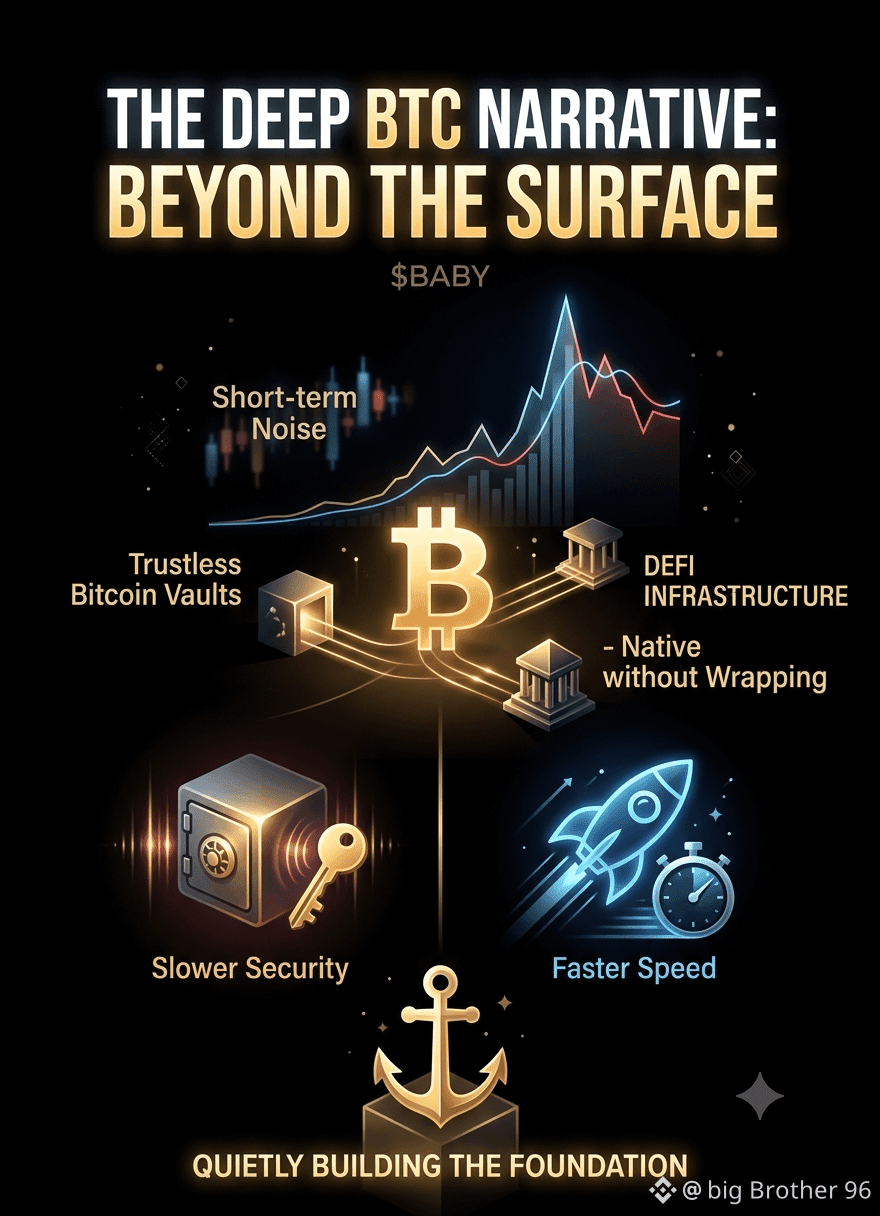
What caught my attention is how Trustless Bitcoin Vaults are trying to make native BTC useful in DeFi without relying on wrapped versions. That changes the experience in a subtle way. It feels less like forcing Bitcoin into another ecosystem and more like building around what Bitcoin already is.
The recent jump in volume and inflows was encouraging, but the quick pullback after the rally reminded me how fast sentiment can shift when traders chase momentum. Short-term charts can be noisy, while infrastructure usually takes much longer to prove its value.
I also keep thinking about the trade-off between speed and security. It's easy to overlook, but slowing things down a little can sometimes be the price of doing things with fewer trust assumptions.
That’s the part I’m watching now—not the candles, but the direction the foundation is quietly taking.
@BabylonLabs_io #baby $BABY
What caught my attention is how Trustless Bitcoin Vaults are trying to make native BTC useful in DeFi without relying on wrapped versions. That changes the experience in a subtle way. It feels less like forcing Bitcoin into another ecosystem and more like building around what Bitcoin already is.
The recent jump in volume and inflows was encouraging, but the quick pullback after the rally reminded me how fast sentiment can shift when traders chase momentum. Short-term charts can be noisy, while infrastructure usually takes much longer to prove its value.
I also keep thinking about the trade-off between speed and security. It's easy to overlook, but slowing things down a little can sometimes be the price of doing things with fewer trust assumptions.
That’s the part I’m watching now—not the candles, but the direction the foundation is quietly taking.
@BabylonLabs_io #baby $BABY
Log in to explore more content