
老许在带单--先赚后付
126 Posts

老许在带单--先赚后付
聊天室:p313933 职业交易8年合约操作,1000u 三天实现9000u,极限行情用10w u 实现2000w u现货完善周期布局,熊市埋伏低于币种,牛市及时止盈,过往埋伏标的平均持仓6到8个月
Occasional Trader
0 Following
1.5K+ Followers
1.7K+ Liked
Posts
All
Quotes
Videos
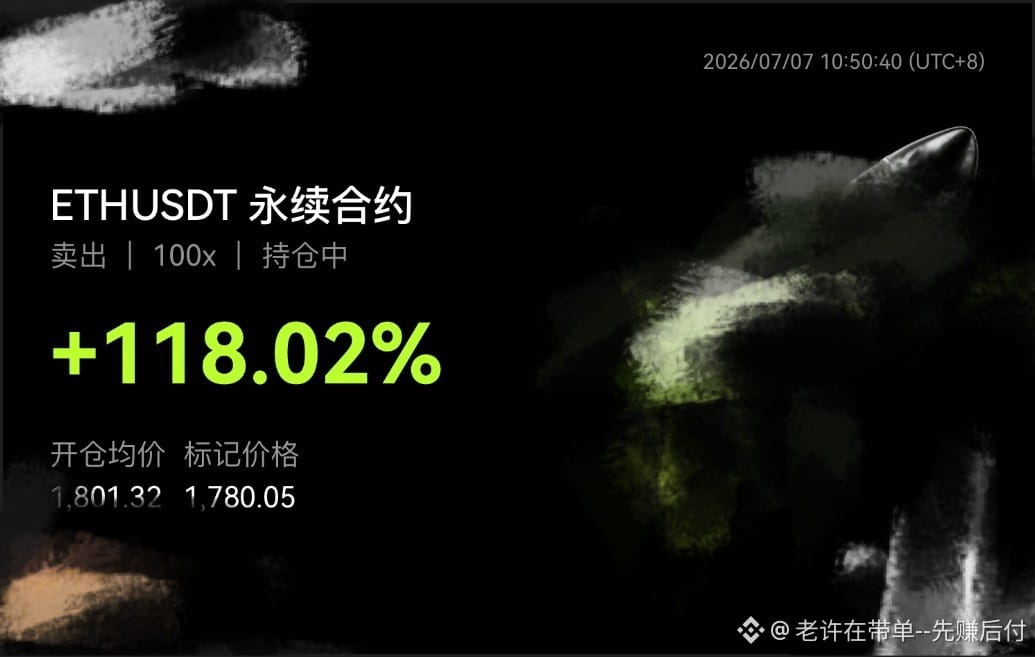
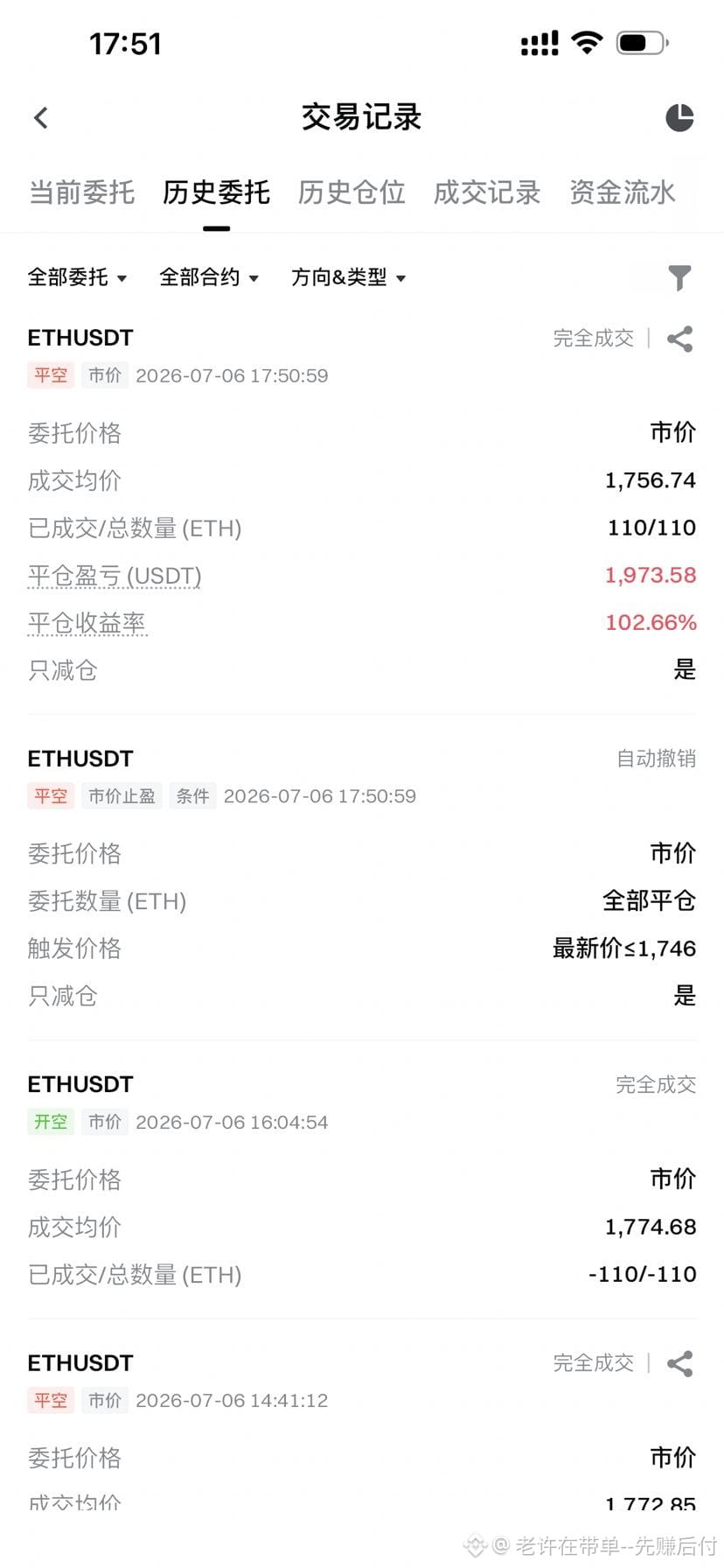
I reminded the brothers yesterday to focus on the 1750-1780 range. During the day, we also successfully entered a short position, and the profit is in hand first. $ETH
Before the US stock market opened in the evening, ETH broke below 1750 and dipped to around 1720.
But the 1720 level held up strongly—there wasn’t a high-volume breakdown—so the rebound was already set in motion.
I originally planned to keep watching and continue trading when the US market opened, but last night I was really delayed by the World Cup.
I got too carried away watching it. By the time I snapped back to reality, ETH had already pushed all the way up to 1800.
We didn’t catch this rebound, and the brothers say I’m a hindsight trader—I admit it. Last night I really was just focused on the games. Neymar got knocked out first, and then in the early hours, C罗 also went home to sleep!!!
That said, it’s a good thing that the short positions we pre-placed around 1800 were filled smoothly. Since the plan was already set, I didn’t go chasing to change the strategy.
When I got up today and checked this morning, ETH had surged to as high as 1833. Even though it broke above the previous high, our stop loss remained at 1850. The target is still 1650—the entire trading plan hasn’t changed in any way.
The biggest fear in trading is panicking just because price moves up a little, or changing your approach just because it drops a little.
Since we chose to take a mid-term short, we give the market enough room to move.
As long as 1850 hasn’t been broken, I’ll stick with the original judgment: for the short term, I still expect consolidation, and at higher levels there’s still an expectation of a pullback.
Trading isn’t about getting every single trade right—it’s about strictly executing your own trading plan.
#三星Q2营业利润预增19倍股价跌逾6% #以太坊周涨12.4% #币安九周年
Before the US stock market opened in the evening, ETH broke below 1750 and dipped to around 1720.
But the 1720 level held up strongly—there wasn’t a high-volume breakdown—so the rebound was already set in motion.
I originally planned to keep watching and continue trading when the US market opened, but last night I was really delayed by the World Cup.
I got too carried away watching it. By the time I snapped back to reality, ETH had already pushed all the way up to 1800.
We didn’t catch this rebound, and the brothers say I’m a hindsight trader—I admit it. Last night I really was just focused on the games. Neymar got knocked out first, and then in the early hours, C罗 also went home to sleep!!!
That said, it’s a good thing that the short positions we pre-placed around 1800 were filled smoothly. Since the plan was already set, I didn’t go chasing to change the strategy.
When I got up today and checked this morning, ETH had surged to as high as 1833. Even though it broke above the previous high, our stop loss remained at 1850. The target is still 1650—the entire trading plan hasn’t changed in any way.
The biggest fear in trading is panicking just because price moves up a little, or changing your approach just because it drops a little.
Since we chose to take a mid-term short, we give the market enough room to move.
As long as 1850 hasn’t been broken, I’ll stick with the original judgment: for the short term, I still expect consolidation, and at higher levels there’s still an expectation of a pullback.
Trading isn’t about getting every single trade right—it’s about strictly executing your own trading plan.
#三星Q2营业利润预增19倍股价跌逾6% #以太坊周涨12.4% #币安九周年
$ETH take some time to visit Heilongjiang in Northeast China, and experience the border-trade culture at the China-Russia junction
We’ll do our best to be good little learners!!!
We’ll do our best to be good little learners!!!

$ETH says that no matter how much you talk, it’s not as good as proving it with a live account!!!
After three days of settling, the US stock market opens today. A new round of trading opportunities is here
Old Xu has already arranged the strategy internally and wants the brothers to call @老许在带单--先赚后付
#SK海力士称基金拟购最多70亿美元ADR
After three days of settling, the US stock market opens today. A new round of trading opportunities is here
Old Xu has already arranged the strategy internally and wants the brothers to call @老许在带单--先赚后付
#SK海力士称基金拟购最多70亿美元ADR

$ETH pulled from 1550 to 1810 in one go, rebounding 16% in a week. Now the market is full of "bloody chips" everywhere. What do you think this wave is really about?
#南非发布加密税收指南草案 #SpaceX将于7月7日纳入纳斯达克100 #韩股KOSPI涨2.7%芯片股领涨
#南非发布加密税收指南草案 #SpaceX将于7月7日纳入纳斯达克100 #韩股KOSPI涨2.7%芯片股领涨
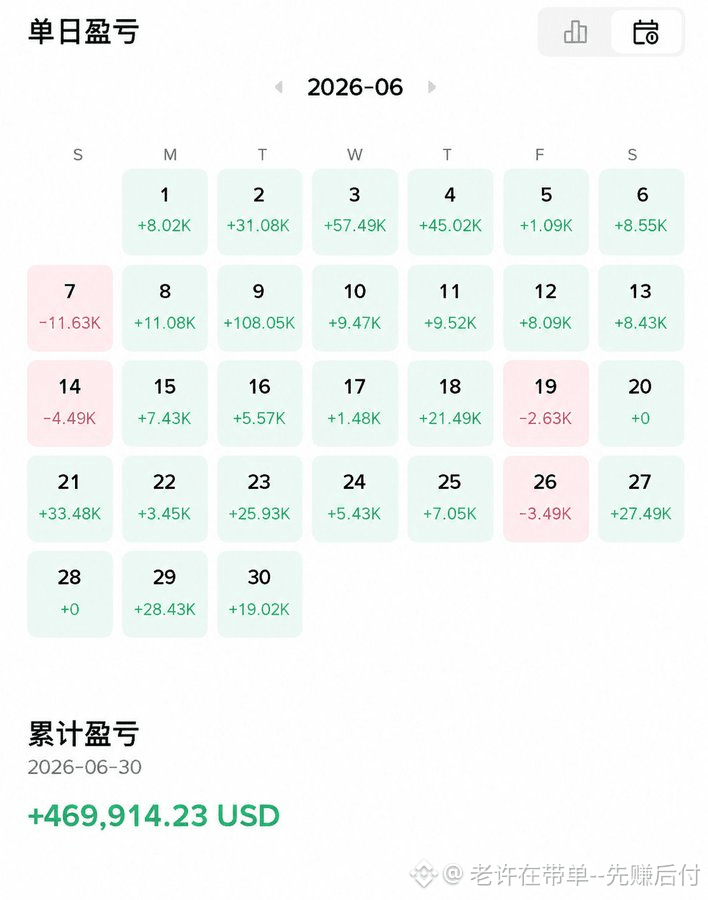

牛回,回调就是机会
30%
逼空行情,后面还有新高
16%
熊市反弹,拉高就是出货
44%
先看戏,等回踩确认再说
10%
91 votes • Voting closed
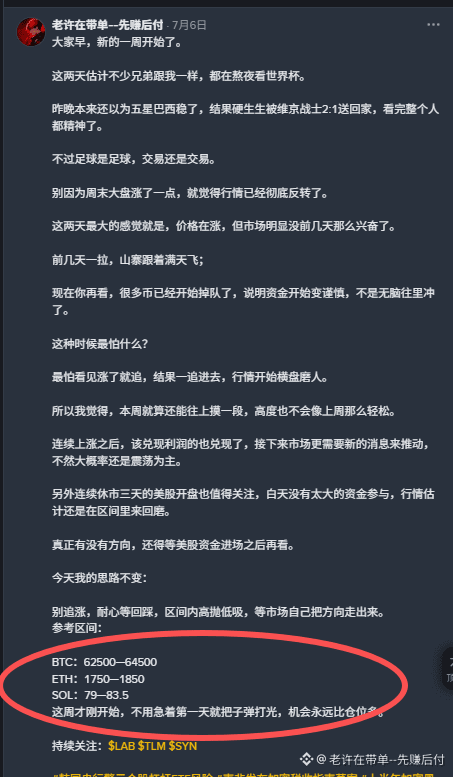
Good morning, everyone. A new week has begun.
Over the past couple of days, I bet many brothers, just like me, have been staying up late watching the World Cup.
Last night, I thought five-star Brazil was surely on the way to victory, but the Viking warriors literally sent them home 2:1. After watching it, I felt fully energized.
But football is football—trading is trading.
Don’t think the market has completely reversed just because the overall market index rose a little over the weekend.
The biggest feeling these past two days is: prices are going up, but the market isn’t nearly as excited as it was in the first few days.
Back then, once it started climbing, copycats flooded the market everywhere;
Now, when you look again, many coins have started to fall behind, which suggests that capital is becoming more cautious—not mindlessly rushing in.
So what’s the most dangerous thing at a time like this?
The biggest fear is seeing it rise and then chasing—only to chase in, and then the market starts to grind sideways, wearing you out.
So I think this week, even if prices can still climb a bit, the height won’t be as easy as last week.
After a series of consecutive gains, whatever can be cashed out has already been cashed out. Next, the market needs fresh news to drive it forward; otherwise, it’s likely to remain range-bound.
Also, the U.S. stocks reopening after three straight market holidays is worth keeping an eye on. During the daytime, there likely won’t be much capital participation, so the行情 (market action) is expected to keep grinding back and forth within a range.
Whether there’s truly a direction will only become clear once U.S. market funds step in.
My game plan today stays the same:
Don’t chase the breakout. Wait patiently for a pullback. High-sell and low-buy within the range, and let the market show its direction on its own.
Reference ranges:
BTC: 62500—64500
ETH: 1750—1850
SOL: 79—83.5
This week has only just started. You don’t need to fire all your bullets on day one—opportunities are always more plentiful than positions.
Keep watching: $LAB $TLM $SYN
#韩国央行警示个股杠杆ETF风险 #南非发布加密税收指南草案 #上半年加密黑客达207起损失9.72亿美元
Over the past couple of days, I bet many brothers, just like me, have been staying up late watching the World Cup.
Last night, I thought five-star Brazil was surely on the way to victory, but the Viking warriors literally sent them home 2:1. After watching it, I felt fully energized.
But football is football—trading is trading.
Don’t think the market has completely reversed just because the overall market index rose a little over the weekend.
The biggest feeling these past two days is: prices are going up, but the market isn’t nearly as excited as it was in the first few days.
Back then, once it started climbing, copycats flooded the market everywhere;
Now, when you look again, many coins have started to fall behind, which suggests that capital is becoming more cautious—not mindlessly rushing in.
So what’s the most dangerous thing at a time like this?
The biggest fear is seeing it rise and then chasing—only to chase in, and then the market starts to grind sideways, wearing you out.
So I think this week, even if prices can still climb a bit, the height won’t be as easy as last week.
After a series of consecutive gains, whatever can be cashed out has already been cashed out. Next, the market needs fresh news to drive it forward; otherwise, it’s likely to remain range-bound.
Also, the U.S. stocks reopening after three straight market holidays is worth keeping an eye on. During the daytime, there likely won’t be much capital participation, so the行情 (market action) is expected to keep grinding back and forth within a range.
Whether there’s truly a direction will only become clear once U.S. market funds step in.
My game plan today stays the same:
Don’t chase the breakout. Wait patiently for a pullback. High-sell and low-buy within the range, and let the market show its direction on its own.
Reference ranges:
BTC: 62500—64500
ETH: 1750—1850
SOL: 79—83.5
This week has only just started. You don’t need to fire all your bullets on day one—opportunities are always more plentiful than positions.
Keep watching: $LAB $TLM $SYN
#韩国央行警示个股杠杆ETF风险 #南非发布加密税收指南草案 #上半年加密黑客达207起损失9.72亿美元
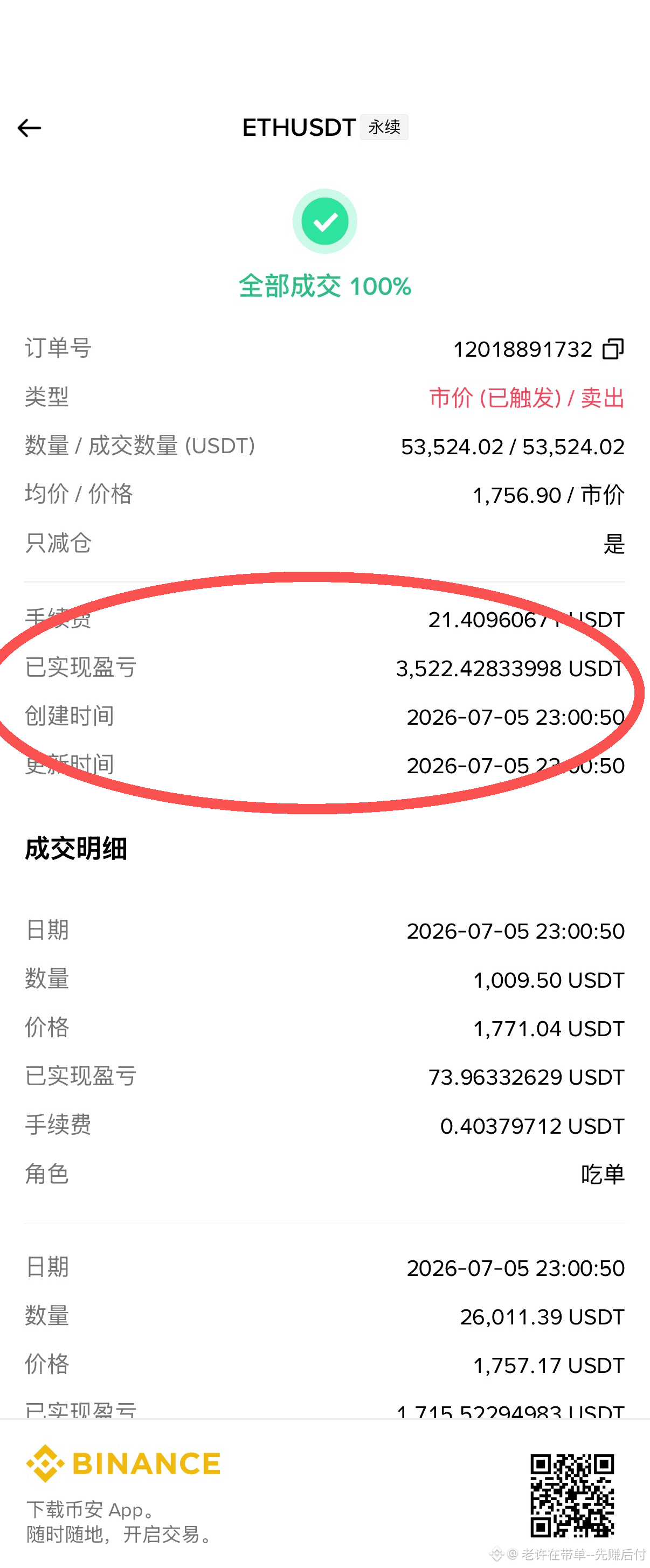

$LAB has started messing around again with funding rates charged per hour.
From the order book, after testing a low around 5.5, it didn’t keep selling off with increasing volume—instead, it repeatedly printed a series of bullish candles, pushing the price back toward the moving average area.
This kind of move doesn’t look like a natural rebound; it looks more like the market maker using the funding rate to continuously squeeze shorts.
Recently, LAB’s playbook has been very clear: every time it gets close to funding fee settlement, the order book becomes active. The more shorts there are, the more incentive the market maker has to push upward—using liquidation and stop-loss hunts to drive the price higher;
then once there are more and more buyers chasing, they flip and dump to liquidate the crowd, so both sides of the trade end up paying them.
There are only about a dozen minutes left until funding fees are settled, and this is the most critical time point of the day.
Don’t rush into chasing at this moment. Whether it keeps pumping or suddenly dips, it could just be the market maker sweeping liquidity.
Wait until the funding fee settlement is completed. Watch whether the order book continues to push with rising volume or whether it fades from the highs—then deciding your entry direction will be safer.
Personally, I’m more inclined to wait for signals before acting. If the move has structure, you trade; if it doesn’t, you watch. After all, with coins like this, it’s not about technical indicators—it’s about which side the market maker is planning to liquidate next.
#Revolut将下架USDT #吉利布兰德吁禁官员发行数字资产 #COMEX黄金收涨1.49%报4187.3美元
From the order book, after testing a low around 5.5, it didn’t keep selling off with increasing volume—instead, it repeatedly printed a series of bullish candles, pushing the price back toward the moving average area.
This kind of move doesn’t look like a natural rebound; it looks more like the market maker using the funding rate to continuously squeeze shorts.
Recently, LAB’s playbook has been very clear: every time it gets close to funding fee settlement, the order book becomes active. The more shorts there are, the more incentive the market maker has to push upward—using liquidation and stop-loss hunts to drive the price higher;
then once there are more and more buyers chasing, they flip and dump to liquidate the crowd, so both sides of the trade end up paying them.
There are only about a dozen minutes left until funding fees are settled, and this is the most critical time point of the day.
Don’t rush into chasing at this moment. Whether it keeps pumping or suddenly dips, it could just be the market maker sweeping liquidity.
Wait until the funding fee settlement is completed. Watch whether the order book continues to push with rising volume or whether it fades from the highs—then deciding your entry direction will be safer.
Personally, I’m more inclined to wait for signals before acting. If the move has structure, you trade; if it doesn’t, you watch. After all, with coins like this, it’s not about technical indicators—it’s about which side the market maker is planning to liquidate next.
#Revolut将下架USDT #吉利布兰德吁禁官员发行数字资产 #COMEX黄金收涨1.49%报4187.3美元
继续逼空,直接拉破9
65%
收完资金费立马砸盘
15%
8.8横盘磨人,来回收割
14%
先观望,等方向出来再跟
6%
166 votes • Voting closed
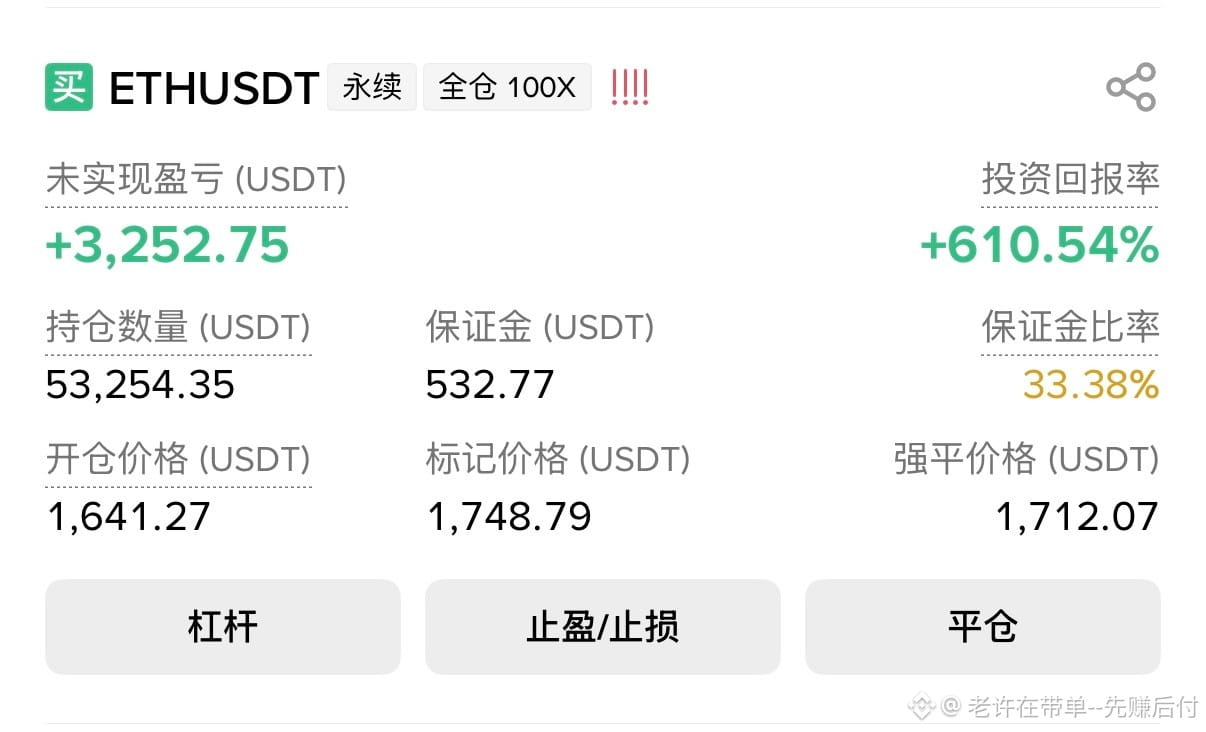
The bullish idea I shared last night has already been gradually realized in the early session today.$ETH
As I told the brothers last night, ETF capital has started flowing back in, institutions have continued to increase their holdings, and with expectations of further rate hikes being delayed, market sentiment has begun to warm up—this rebound is very likely not just a fleeting blip.
So when we saw the pullback, we didn’t hesitate. We continued to lead the brothers to buy on dips at lower levels.
As it turned out, we were right about the direction, and the market didn’t let everyone down. This morning’s rally basically played out as expected.
Many people always like to wait until prices rise before they believe the trend. But the people who really make money are often already on board early, when the market is still full of doubt.
The market won’t stop just because you hesitate. Once a trend forms, the rest is simply to ride the momentum.
Congratulations to the brothers who followed along—the profit continues to expand. Next, we’ll keep watching whether the market can further open up the upside space.
#Uniswap成为Robinhood二层链主要AMM #新罕布什尔HB639保护数字资产自托管 #吉利布兰德吁禁官员发行数字资产
As I told the brothers last night, ETF capital has started flowing back in, institutions have continued to increase their holdings, and with expectations of further rate hikes being delayed, market sentiment has begun to warm up—this rebound is very likely not just a fleeting blip.
So when we saw the pullback, we didn’t hesitate. We continued to lead the brothers to buy on dips at lower levels.
As it turned out, we were right about the direction, and the market didn’t let everyone down. This morning’s rally basically played out as expected.
Many people always like to wait until prices rise before they believe the trend. But the people who really make money are often already on board early, when the market is still full of doubt.
The market won’t stop just because you hesitate. Once a trend forms, the rest is simply to ride the momentum.
Congratulations to the brothers who followed along—the profit continues to expand. Next, we’ll keep watching whether the market can further open up the upside space.
#Uniswap成为Robinhood二层链主要AMM #新罕布什尔HB639保护数字资产自托管 #吉利布兰德吁禁官员发行数字资产
老许在带单--先赚后付
·
--
Bullish$ETH Those who understand understand, brothers. ETF funds have once again turned to net inflows, and institutions have also begun continuously accumulating BTC and ETH. The amount of large Ethereum staking keeps increasing, and market expectations for rate hikes have been pushed back further. A chain of good news is slowly starting to take effect.
Taken individually, these messages might have limited impact, but put together, it means money is rebuilding confidence.老许公开策略交流群
The price action also gives the answer.
ETH has stabilized repeatedly around the 1500 level. After each pullback, there is incoming capital to support it. Here, it no longer behaves like before where it drops the moment it’s touched. Instead, each dip is met with someone buying, each push lifts the low points, and the large-scale structure is being repaired step by step.
I’ve always said: the truly big move won’t start only after everyone has figured it out.
Earlier, when others were still shouting for 1400 or 1300 near 1500, I had already started positioning in batches at lower levels with my brothers. Now that the trend is beginning to strengthen, our thinking naturally needs to change with the market.
Going with the trend is the fastest way to make money.
As long as the big structure hasn’t been broken, personally I will still maintain a bullish outlook. During the day, I’ll continue to focus mainly on buying more from low levels. Pullbacks are opportunities, not risks.
The market won’t keep waiting for people. Opportunities always belong to those who prepare in advance.
#道指创历史新高 #韩国股市上涨5% #比特币较1月峰值下跌44%
Taken individually, these messages might have limited impact, but put together, it means money is rebuilding confidence.老许公开策略交流群
The price action also gives the answer.
ETH has stabilized repeatedly around the 1500 level. After each pullback, there is incoming capital to support it. Here, it no longer behaves like before where it drops the moment it’s touched. Instead, each dip is met with someone buying, each push lifts the low points, and the large-scale structure is being repaired step by step.
I’ve always said: the truly big move won’t start only after everyone has figured it out.
Earlier, when others were still shouting for 1400 or 1300 near 1500, I had already started positioning in batches at lower levels with my brothers. Now that the trend is beginning to strengthen, our thinking naturally needs to change with the market.
Going with the trend is the fastest way to make money.
As long as the big structure hasn’t been broken, personally I will still maintain a bullish outlook. During the day, I’ll continue to focus mainly on buying more from low levels. Pullbacks are opportunities, not risks.
The market won’t keep waiting for people. Opportunities always belong to those who prepare in advance.
#道指创历史新高 #韩国股市上涨5% #比特币较1月峰值下跌44%
$ETH Those who understand understand, brothers. ETF funds have once again turned to net inflows, and institutions have also begun continuously accumulating BTC and ETH. The amount of large Ethereum staking keeps increasing, and market expectations for rate hikes have been pushed back further. A chain of good news is slowly starting to take effect.
Taken individually, these messages might have limited impact, but put together, it means money is rebuilding confidence.老许公开策略交流群
The price action also gives the answer.
ETH has stabilized repeatedly around the 1500 level. After each pullback, there is incoming capital to support it. Here, it no longer behaves like before where it drops the moment it’s touched. Instead, each dip is met with someone buying, each push lifts the low points, and the large-scale structure is being repaired step by step.
I’ve always said: the truly big move won’t start only after everyone has figured it out.
Earlier, when others were still shouting for 1400 or 1300 near 1500, I had already started positioning in batches at lower levels with my brothers. Now that the trend is beginning to strengthen, our thinking naturally needs to change with the market.
Going with the trend is the fastest way to make money.
As long as the big structure hasn’t been broken, personally I will still maintain a bullish outlook. During the day, I’ll continue to focus mainly on buying more from low levels. Pullbacks are opportunities, not risks.
The market won’t keep waiting for people. Opportunities always belong to those who prepare in advance.
#道指创历史新高 #韩国股市上涨5% #比特币较1月峰值下跌44%
Taken individually, these messages might have limited impact, but put together, it means money is rebuilding confidence.老许公开策略交流群
The price action also gives the answer.
ETH has stabilized repeatedly around the 1500 level. After each pullback, there is incoming capital to support it. Here, it no longer behaves like before where it drops the moment it’s touched. Instead, each dip is met with someone buying, each push lifts the low points, and the large-scale structure is being repaired step by step.
I’ve always said: the truly big move won’t start only after everyone has figured it out.
Earlier, when others were still shouting for 1400 or 1300 near 1500, I had already started positioning in batches at lower levels with my brothers. Now that the trend is beginning to strengthen, our thinking naturally needs to change with the market.
Going with the trend is the fastest way to make money.
As long as the big structure hasn’t been broken, personally I will still maintain a bullish outlook. During the day, I’ll continue to focus mainly on buying more from low levels. Pullbacks are opportunities, not risks.
The market won’t keep waiting for people. Opportunities always belong to those who prepare in advance.
#道指创历史新高 #韩国股市上涨5% #比特币较1月峰值下跌44%
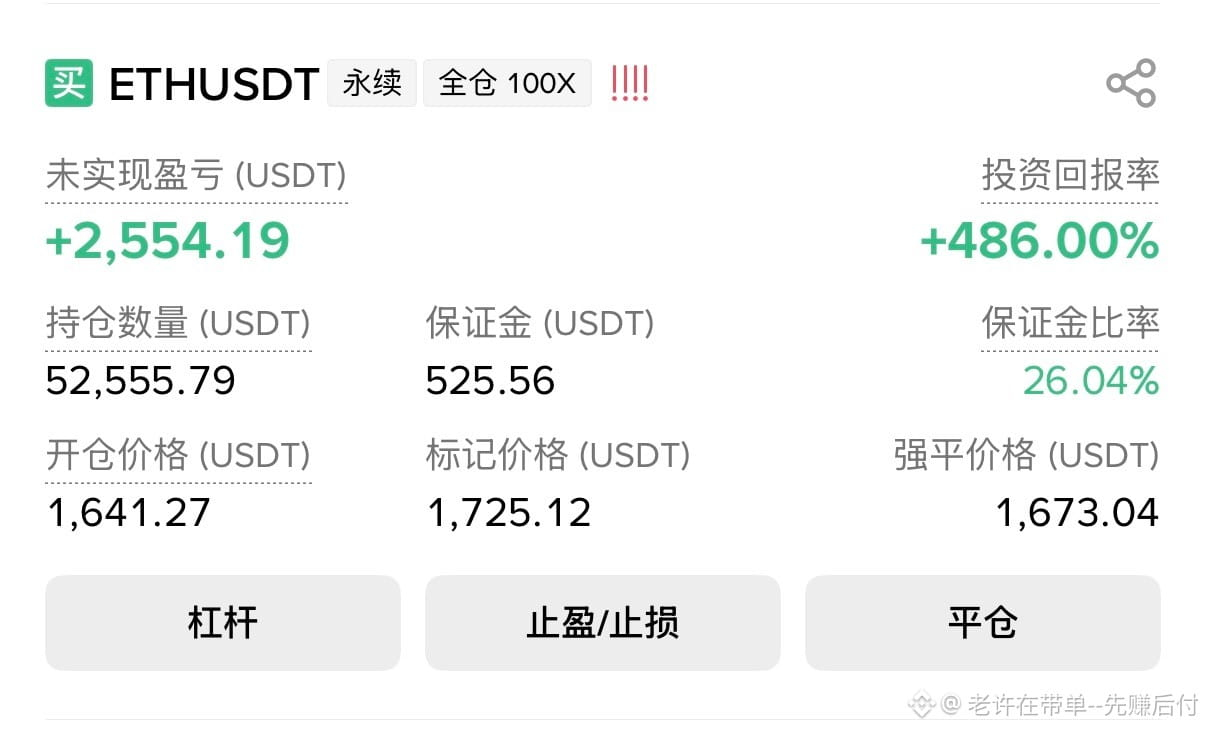
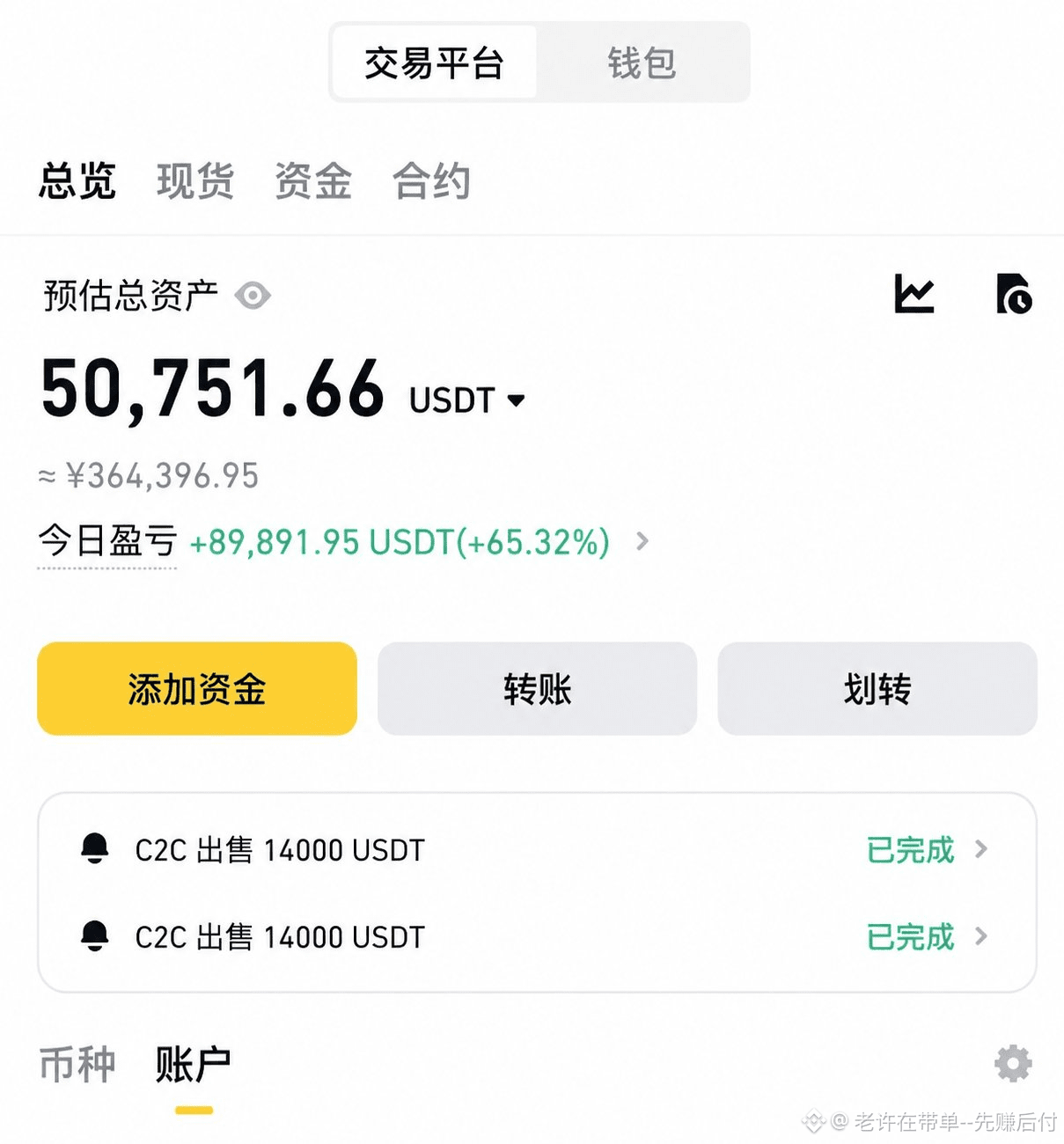
Selling 680,000 yuan worth of U and getting labeled “involved in fraud”—this is something to be truly wary of (avoid the traps)
Recently I came across a real case, and it’s quite typical.
A brother of mine was looking for a seller on an exchange to sell U. The amount was relatively large. Midway through, the other party said they needed to switch to a different bank card for payment, and they kept stressing, “The funds are all from relatives and friends—everything is safe,” and insisting that he should transfer the money first and only then release the coins.
It sounds like a very proper process, right?
But the moment the money arrived, the card was frozen immediately. All 680,000 yuan was marked as involved in fraud—on top of that, it was classified as the same type of flagged card.
What’s even more troublesome is that now, when contacting them, you can only go through the procedures and wait for handling. After waiting for several days, there still wasn’t any clear outcome—only that you should keep waiting.
In fact, this isn’t a rare case in the circle anymore.
The key point isn’t the “trading method,” but that the fund path itself is uncontrollable.
The traps many people fall into are usually:
Seeing “transfer first” makes them let their guard down
Seeing a “friend’s card/relative’s card” makes them lower their risk assessment
The bigger the amount, the easier it is to get led by the nose
But the reality is: once there’s a problem in the fund trail, a card isn’t something you can just say “it’s fine” and have it be fine.
To put it simply, here are a few key points (very real):
For large withdrawals, try not to use any opaque private-card routes
Any temporary card switching is, in essence, a risk point
Once the card is flagged as involved in fraud, the process usually can’t be resolved in a short time
There’s also something many people don’t know:
If the incoming funds are identified as fraud-involved, in some cases they may be subject to direct return/chargeback processing. It’s not something you can necessarily get back just by cooperating.$ALLO
So when it comes to doing OTC in the crypto market now, the core issue isn’t “how big the price spread is.”
It’s: have you controlled the risk chain.
$MU
In one sentence: Whether you can make money is one thing—but whether your funds can safely be withdrawn is another.
#以太坊突破1700美元涨7.98% #道指创历史新高 #韩国股市上涨5%
Recently I came across a real case, and it’s quite typical.
A brother of mine was looking for a seller on an exchange to sell U. The amount was relatively large. Midway through, the other party said they needed to switch to a different bank card for payment, and they kept stressing, “The funds are all from relatives and friends—everything is safe,” and insisting that he should transfer the money first and only then release the coins.
It sounds like a very proper process, right?
But the moment the money arrived, the card was frozen immediately. All 680,000 yuan was marked as involved in fraud—on top of that, it was classified as the same type of flagged card.
What’s even more troublesome is that now, when contacting them, you can only go through the procedures and wait for handling. After waiting for several days, there still wasn’t any clear outcome—only that you should keep waiting.
In fact, this isn’t a rare case in the circle anymore.
The key point isn’t the “trading method,” but that the fund path itself is uncontrollable.
The traps many people fall into are usually:
Seeing “transfer first” makes them let their guard down
Seeing a “friend’s card/relative’s card” makes them lower their risk assessment
The bigger the amount, the easier it is to get led by the nose
But the reality is: once there’s a problem in the fund trail, a card isn’t something you can just say “it’s fine” and have it be fine.
To put it simply, here are a few key points (very real):
For large withdrawals, try not to use any opaque private-card routes
Any temporary card switching is, in essence, a risk point
Once the card is flagged as involved in fraud, the process usually can’t be resolved in a short time
There’s also something many people don’t know:
If the incoming funds are identified as fraud-involved, in some cases they may be subject to direct return/chargeback processing. It’s not something you can necessarily get back just by cooperating.$ALLO
So when it comes to doing OTC in the crypto market now, the core issue isn’t “how big the price spread is.”
It’s: have you controlled the risk chain.
$MU
In one sentence: Whether you can make money is one thing—but whether your funds can safely be withdrawn is another.
#以太坊突破1700美元涨7.98% #道指创历史新高 #韩国股市上涨5%
ALLO+1.94%
MUUS+0.60%
Do you know what “a precise liquidation” means? $ETH
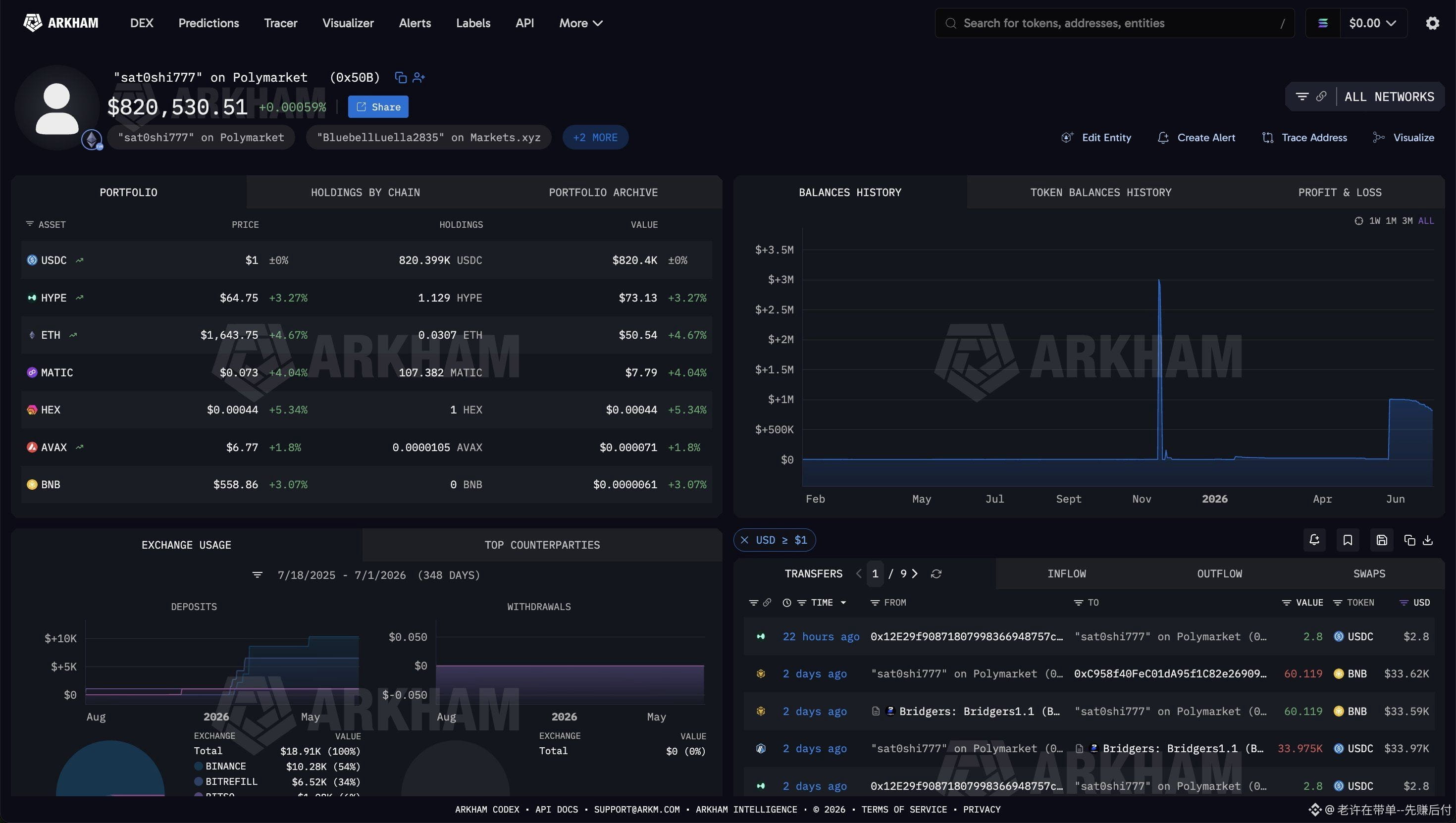
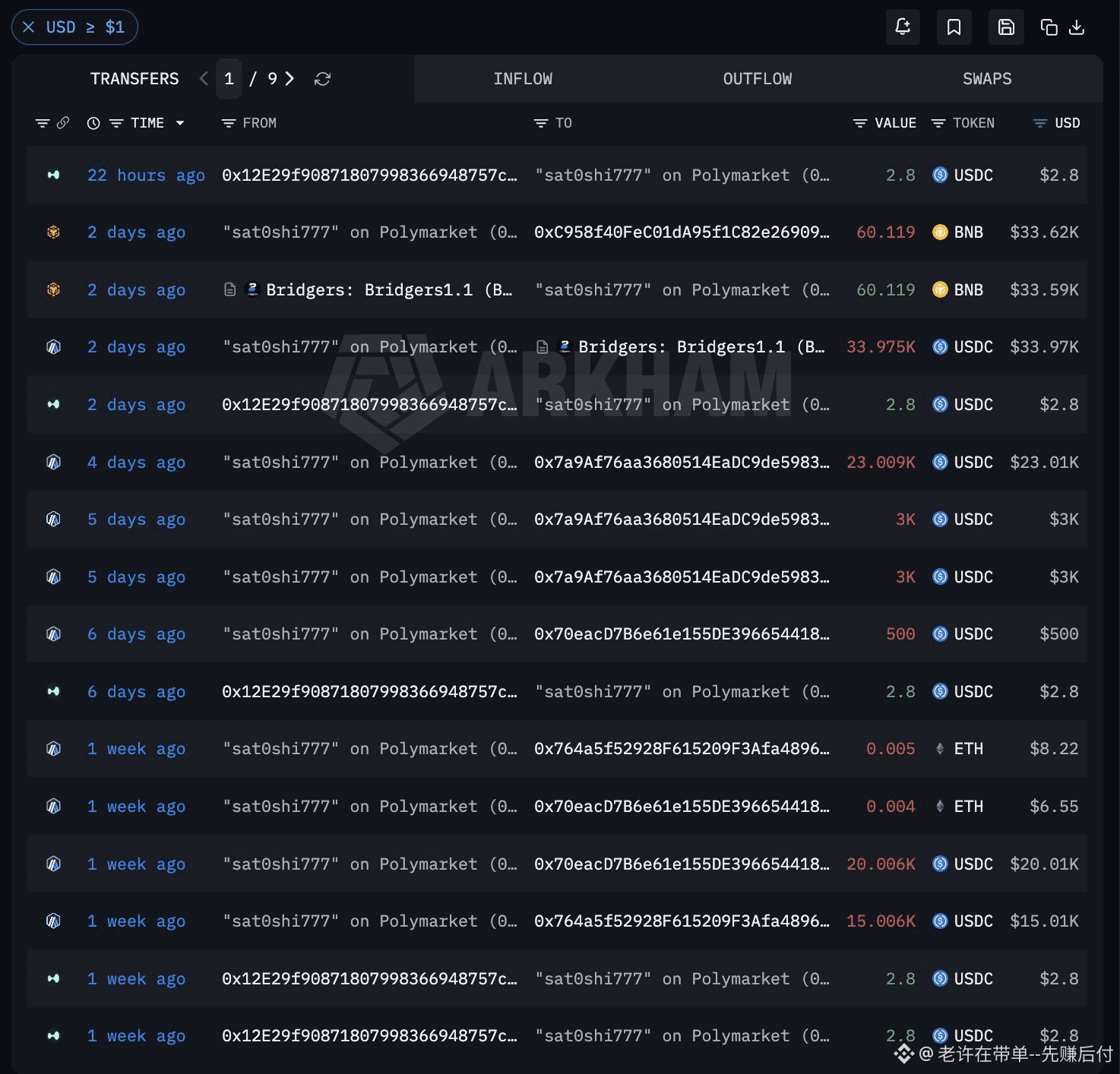
Last night’s ETH move had a “great whale” called sat0shi777, basically being singled out by the market.
He held short positions of roughly $90 million worth of ETH—typical of a heavily loaded bearish bet. $ALLO $STAR
Then the price rallied, directly triggering liquidations within a short time:
One liquidation forced the system to close about 316,000 ETH, worth over $50 million, with losses immediately hitting over $4 million.
And at the time, ETH had just pushed up to around 1,700.
But the story wasn’t over.
He still had about $38 million in short positions that hadn’t been liquidated, with the liquidation line at roughly $1,764.
Where is the price now? 1,710.
So there’s only a very narrow buffer left in between.
As for this ETH rebound, the structure is actually very clear:
It’s not simply “good news,” and it’s not a trend reversal—it’s a reverse squeeze after the shorts were piled up too heavily.
After several consecutive quarters of decline, short expectations were too一致, and most of them were basically betting that it would keep breaking down.
Then when the jobs report came out, macro sentiment loosened slightly, and the price leveraged that momentum to move up.
Once it moved up, the dense leveraged zone overhead started to break down.
What you’re seeing as the surge is, in part, being “squeezed” out by the shorts.
Now the market situation is simple:
It’s not one-sided long, and it’s not one-sided short—it’s both sides waiting for the other to die first.
There are two key levels:
1,764 — the final line of defense for the shorts
1,650 — the crucial support to hold for this rebound
The middle part, in plain terms, is the battleground.
One-sentence summary:
This isn’t a bull market rebound, and it isn’t a bear market rebound—it’s leverage liquidating each other.
Whoever can’t hold out, gets eliminated first.
#闪迪希捷美光股价下跌 #以太坊突破1700美元涨7.98% #道指创历史新高 #韩国股市上涨5%
Last night’s ETH move had a “great whale” called sat0shi777, basically being singled out by the market.
He held short positions of roughly $90 million worth of ETH—typical of a heavily loaded bearish bet. $ALLO $STAR
Then the price rallied, directly triggering liquidations within a short time:
One liquidation forced the system to close about 316,000 ETH, worth over $50 million, with losses immediately hitting over $4 million.
And at the time, ETH had just pushed up to around 1,700.
But the story wasn’t over.
He still had about $38 million in short positions that hadn’t been liquidated, with the liquidation line at roughly $1,764.
Where is the price now? 1,710.
So there’s only a very narrow buffer left in between.
As for this ETH rebound, the structure is actually very clear:
It’s not simply “good news,” and it’s not a trend reversal—it’s a reverse squeeze after the shorts were piled up too heavily.
After several consecutive quarters of decline, short expectations were too一致, and most of them were basically betting that it would keep breaking down.
Then when the jobs report came out, macro sentiment loosened slightly, and the price leveraged that momentum to move up.
Once it moved up, the dense leveraged zone overhead started to break down.
What you’re seeing as the surge is, in part, being “squeezed” out by the shorts.
Now the market situation is simple:
It’s not one-sided long, and it’s not one-sided short—it’s both sides waiting for the other to die first.
There are two key levels:
1,764 — the final line of defense for the shorts
1,650 — the crucial support to hold for this rebound
The middle part, in plain terms, is the battleground.
One-sentence summary:
This isn’t a bull market rebound, and it isn’t a bear market rebound—it’s leverage liquidating each other.
Whoever can’t hold out, gets eliminated first.
#闪迪希捷美光股价下跌 #以太坊突破1700美元涨7.98% #道指创历史新高 #韩国股市上涨5%
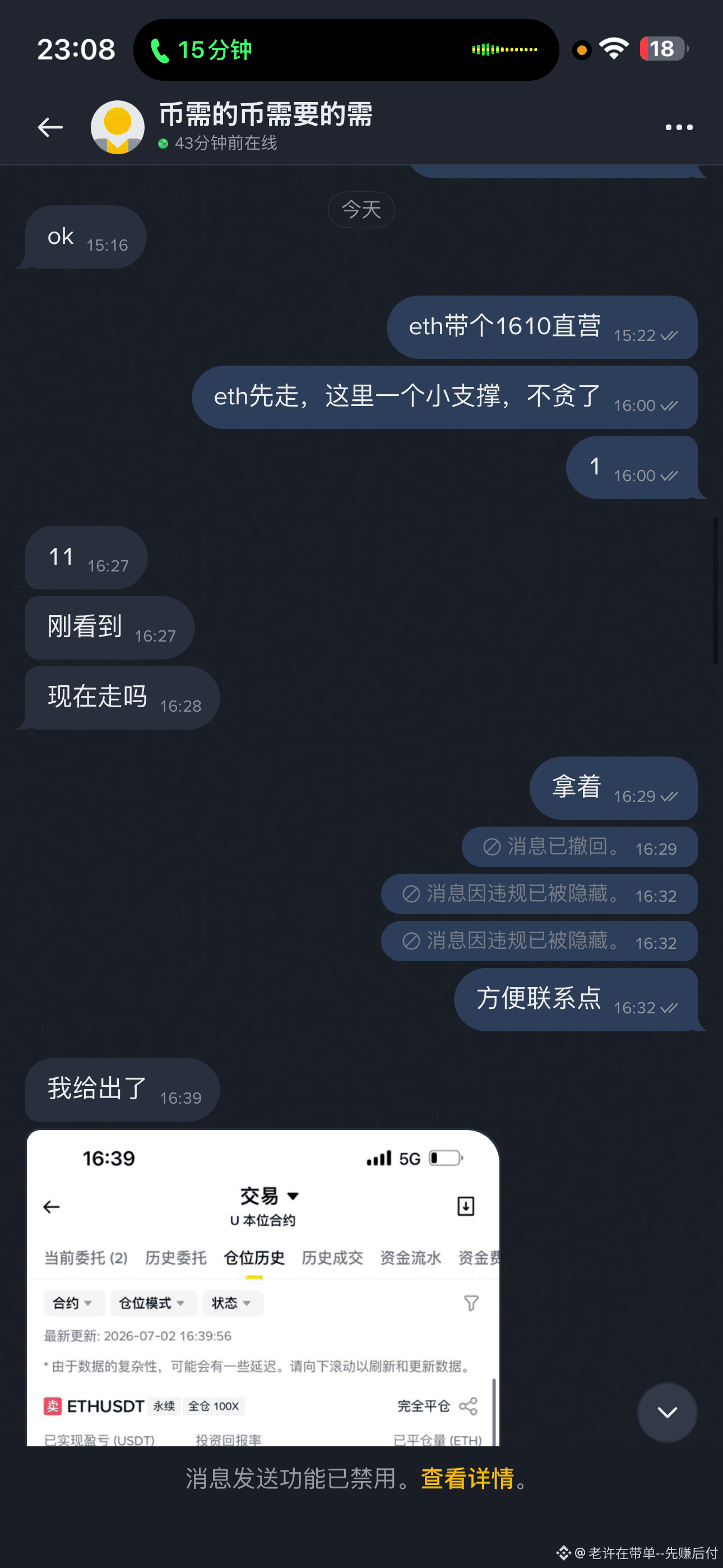

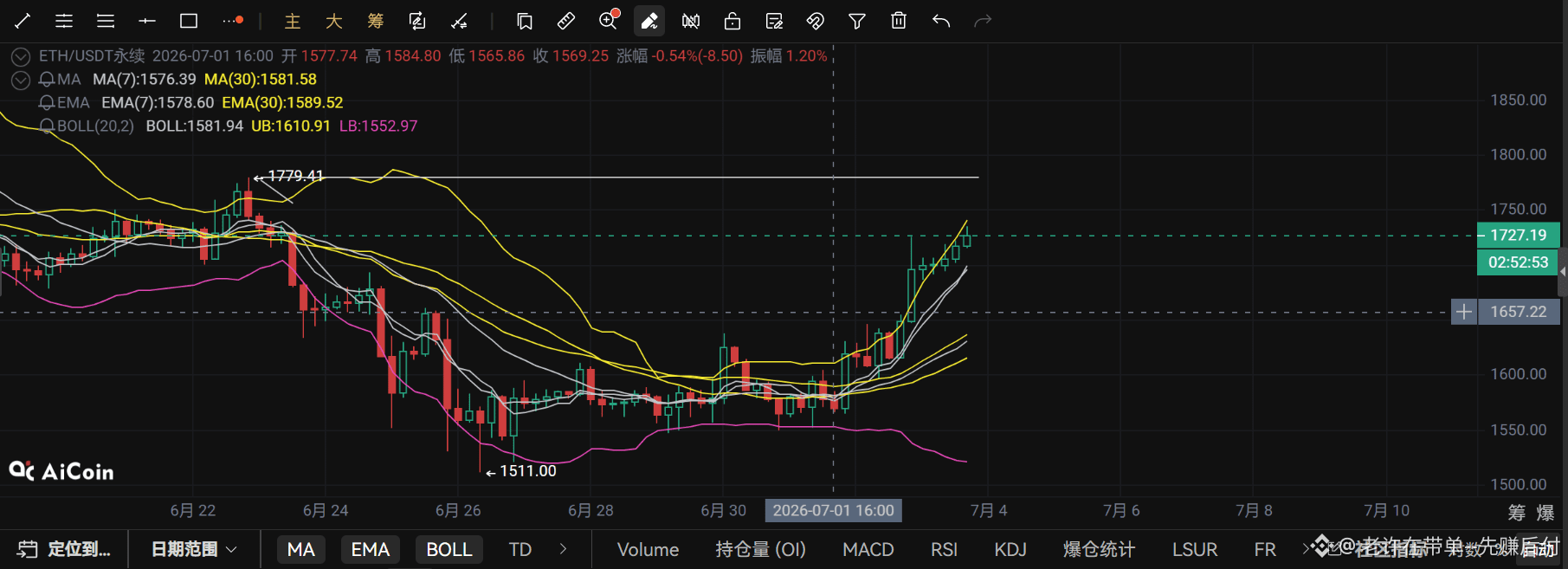
After non-farm, there was a rebound, but overall it still moved in a rather awkward way. It’s not the kind of trend where capital pushes everything upward at once. It’s more like pulling up while someone is slowly taking profits along the way.
So you’ll see that 1710 rises not decisively, and its pullback is also not decisive—it's more of a back-and-forth grind.
The core issue with this kind of market is essentially this: there’s no sustained capital driving it.
And then there’s one very key point—US stock markets are closed tonight.
This will directly affect liquidity.
With no participation from the US stock market, the market loses a “force that sets the direction.” On the crypto side, it becomes even easier for it to turn into:
Either a mild range-bound grind, or a short move driven suddenly by local capital, but both are hard to sustain.
So in this kind of environment today, it’s actually less suitable to bet on direction.
Because once liquidity drops, the easiest thing for the market to do is—repeat sweeps.
My personal view is quite simple:
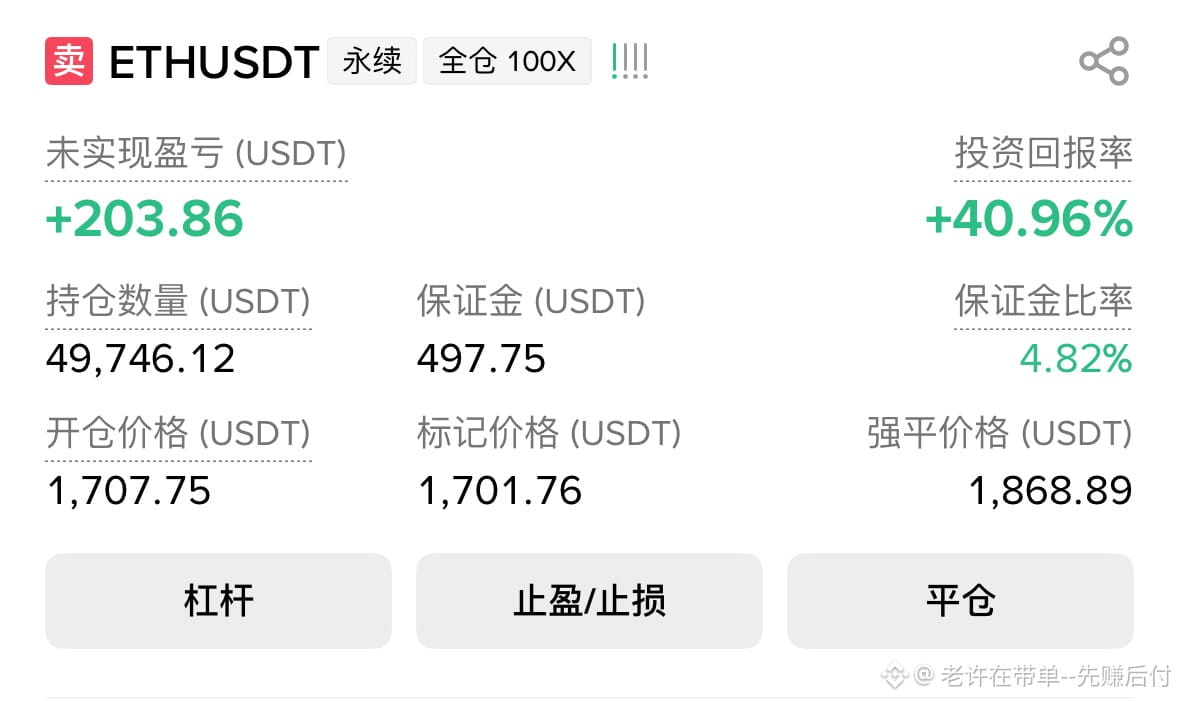
It’s not that there’s no opportunity anymore—rather, the pace has slowed down. We temporarily withdrew the short positions we entered last night.
When the pace slows, the difficulty of trading goes up.
#CumberlandFarms申请美国IPO #韩国KOSPI开盘涨1.41% #MemeCore的M代币回涨近150%
So you’ll see that 1710 rises not decisively, and its pullback is also not decisive—it's more of a back-and-forth grind.
The core issue with this kind of market is essentially this: there’s no sustained capital driving it.
And then there’s one very key point—US stock markets are closed tonight.
This will directly affect liquidity.
With no participation from the US stock market, the market loses a “force that sets the direction.” On the crypto side, it becomes even easier for it to turn into:
Either a mild range-bound grind, or a short move driven suddenly by local capital, but both are hard to sustain.
So in this kind of environment today, it’s actually less suitable to bet on direction.
Because once liquidity drops, the easiest thing for the market to do is—repeat sweeps.
My personal view is quite simple:
It’s not that there’s no opportunity anymore—rather, the pace has slowed down. We temporarily withdrew the short positions we entered last night.
When the pace slows, the difficulty of trading goes up.
#CumberlandFarms申请美国IPO #韩国KOSPI开盘涨1.41% #MemeCore的M代币回涨近150%
老许在带单--先赚后付
·
--
BearishThe concubine has already decisively broken through the 1710 key resistance line just now, and the short-term liquidity above has basically been quickly swept through. $ETH
This kind of price action is actually quite typical: it’s not a trend starting, but rather first clearing out the positions above.
Many people see a breakout and rush to buy on momentum, but from a structural perspective, this segment looks more like a “liquidity-driven sharp spike,” not a continuation of the uptrend with expanding volume.
The key point is: after the breakout, is there sustained volume and support, or is it just a rally driven by emotion? If it’s the latter, then this kind of upward push usually won’t have strong follow-through.
Also, since tomorrow the U.S. stock market will be closed, liquidity itself will be lower, and the market is likely to fall into a rhythm of “spike up—pull back—then retest.”
So at this level, my thinking is very simple:
If it can’t hold above 1710 again and shows signs of a stall, then this rally is more likely to be viewed as a pre-pullback structure after a liquidity sweep.
At that time, it will make more sense to consider the risk-reward of short positions, rather than chasing direction during the acceleration phase.
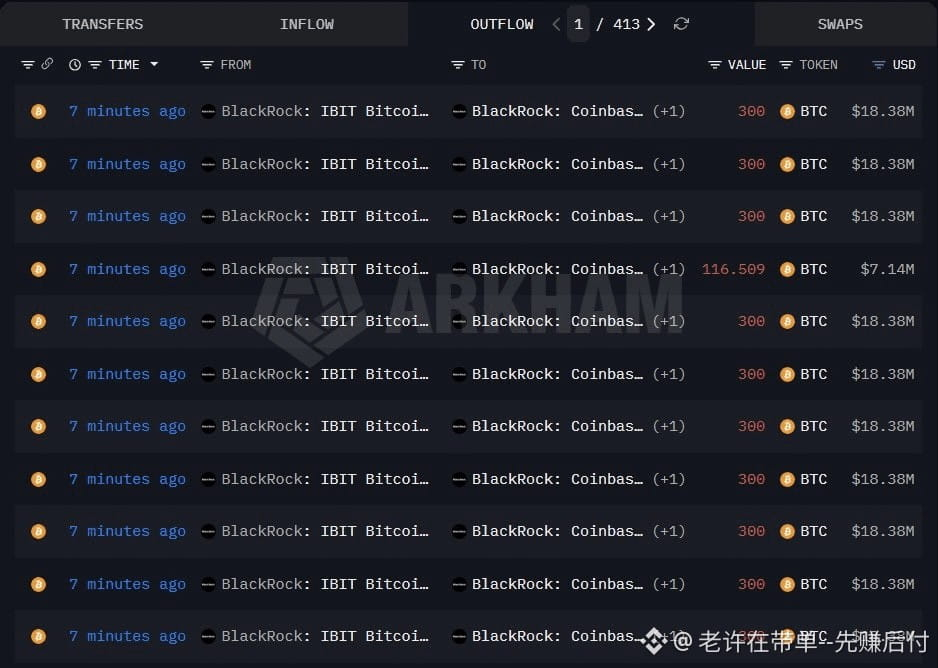
#贝莱德IBIT比特币持仓减少近10万枚 #韩国KOSPI指数暴跌7.89% #比特币经历2022年来最差上半年 #比特币6月下跌20.5%至58526美元
This kind of price action is actually quite typical: it’s not a trend starting, but rather first clearing out the positions above.
Many people see a breakout and rush to buy on momentum, but from a structural perspective, this segment looks more like a “liquidity-driven sharp spike,” not a continuation of the uptrend with expanding volume.
The key point is: after the breakout, is there sustained volume and support, or is it just a rally driven by emotion? If it’s the latter, then this kind of upward push usually won’t have strong follow-through.
Also, since tomorrow the U.S. stock market will be closed, liquidity itself will be lower, and the market is likely to fall into a rhythm of “spike up—pull back—then retest.”
So at this level, my thinking is very simple:
If it can’t hold above 1710 again and shows signs of a stall, then this rally is more likely to be viewed as a pre-pullback structure after a liquidity sweep.
At that time, it will make more sense to consider the risk-reward of short positions, rather than chasing direction during the acceleration phase.
#贝莱德IBIT比特币持仓减少近10万枚 #韩国KOSPI指数暴跌7.89% #比特币经历2022年来最差上半年 #比特币6月下跌20.5%至58526美元
The concubine has already decisively broken through the 1710 key resistance line just now, and the short-term liquidity above has basically been quickly swept through. $ETH
This kind of price action is actually quite typical: it’s not a trend starting, but rather first clearing out the positions above.
Many people see a breakout and rush to buy on momentum, but from a structural perspective, this segment looks more like a “liquidity-driven sharp spike,” not a continuation of the uptrend with expanding volume.
The key point is: after the breakout, is there sustained volume and support, or is it just a rally driven by emotion? If it’s the latter, then this kind of upward push usually won’t have strong follow-through.
Also, since tomorrow the U.S. stock market will be closed, liquidity itself will be lower, and the market is likely to fall into a rhythm of “spike up—pull back—then retest.”
So at this level, my thinking is very simple:
If it can’t hold above 1710 again and shows signs of a stall, then this rally is more likely to be viewed as a pre-pullback structure after a liquidity sweep.
At that time, it will make more sense to consider the risk-reward of short positions, rather than chasing direction during the acceleration phase.
#贝莱德IBIT比特币持仓减少近10万枚 #韩国KOSPI指数暴跌7.89% #比特币经历2022年来最差上半年 #比特币6月下跌20.5%至58526美元
This kind of price action is actually quite typical: it’s not a trend starting, but rather first clearing out the positions above.
Many people see a breakout and rush to buy on momentum, but from a structural perspective, this segment looks more like a “liquidity-driven sharp spike,” not a continuation of the uptrend with expanding volume.
The key point is: after the breakout, is there sustained volume and support, or is it just a rally driven by emotion? If it’s the latter, then this kind of upward push usually won’t have strong follow-through.
Also, since tomorrow the U.S. stock market will be closed, liquidity itself will be lower, and the market is likely to fall into a rhythm of “spike up—pull back—then retest.”
So at this level, my thinking is very simple:
If it can’t hold above 1710 again and shows signs of a stall, then this rally is more likely to be viewed as a pre-pullback structure after a liquidity sweep.
At that time, it will make more sense to consider the risk-reward of short positions, rather than chasing direction during the acceleration phase.
#贝莱德IBIT比特币持仓减少近10万枚 #韩国KOSPI指数暴跌7.89% #比特币经历2022年来最差上半年 #比特币6月下跌20.5%至58526美元
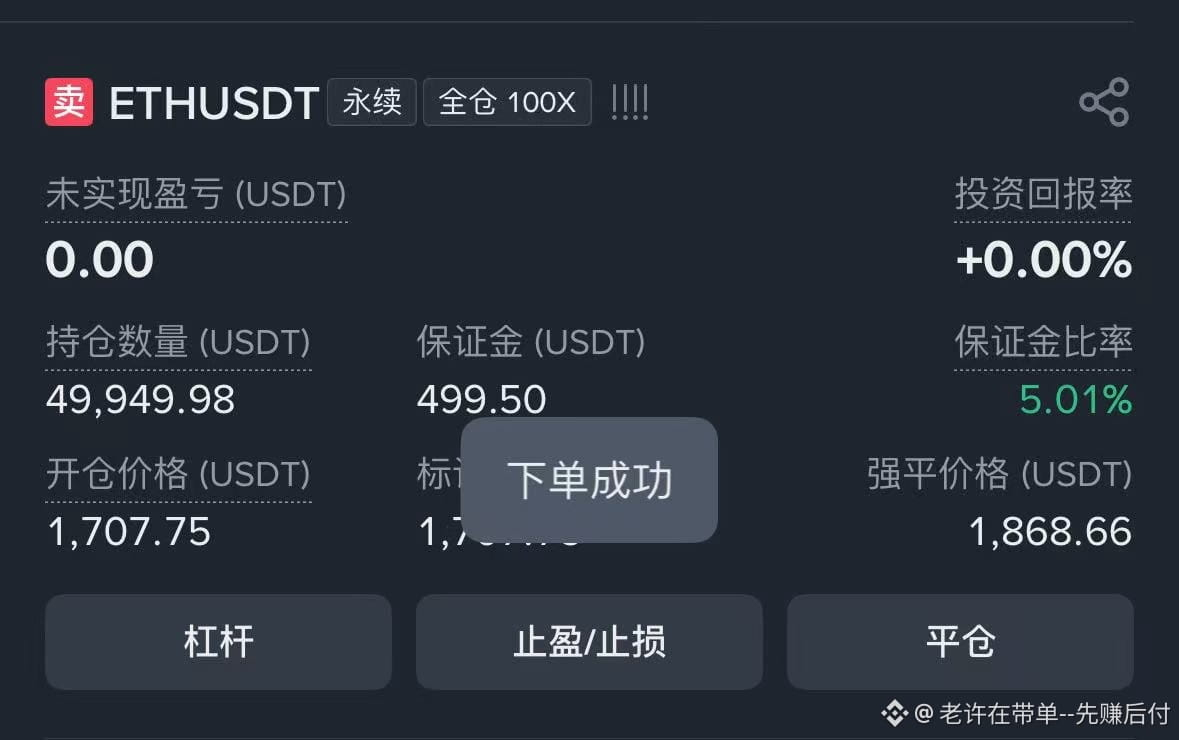
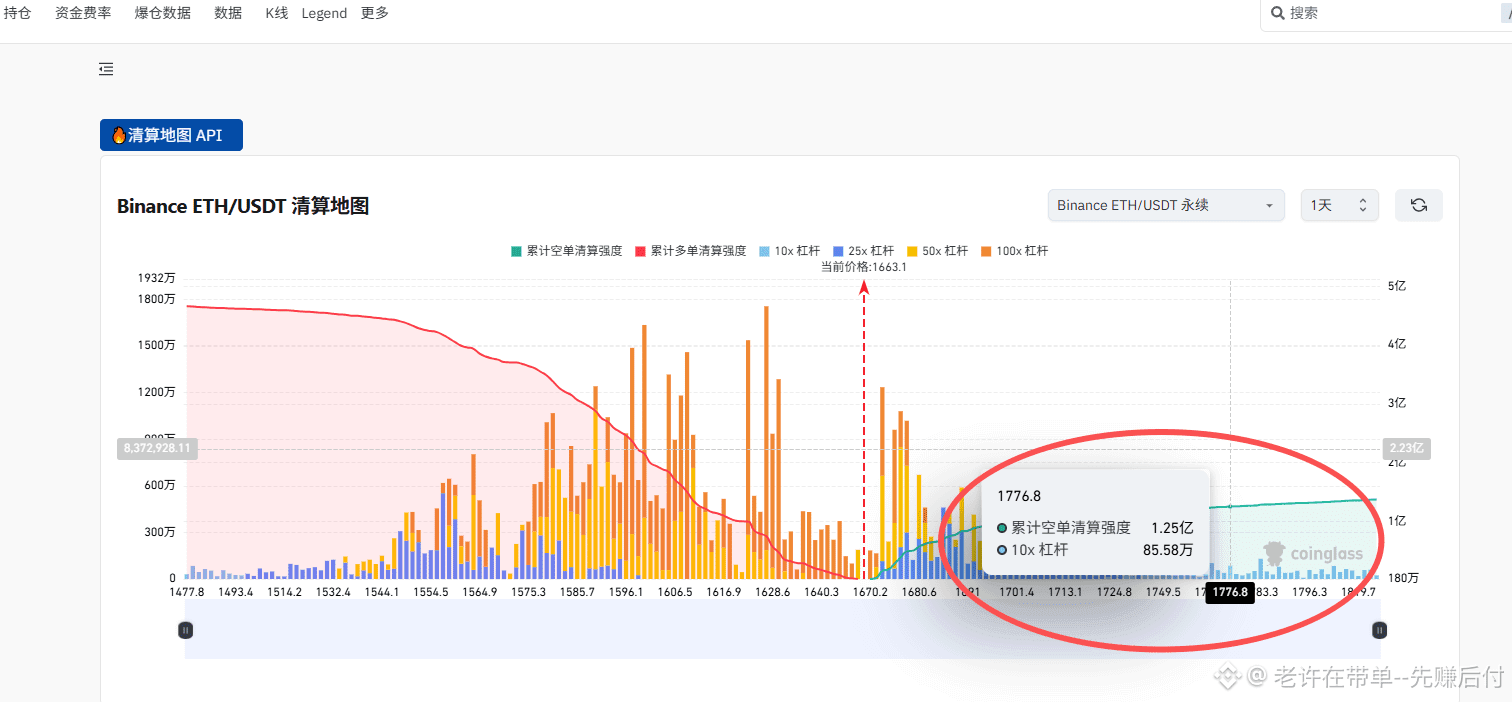
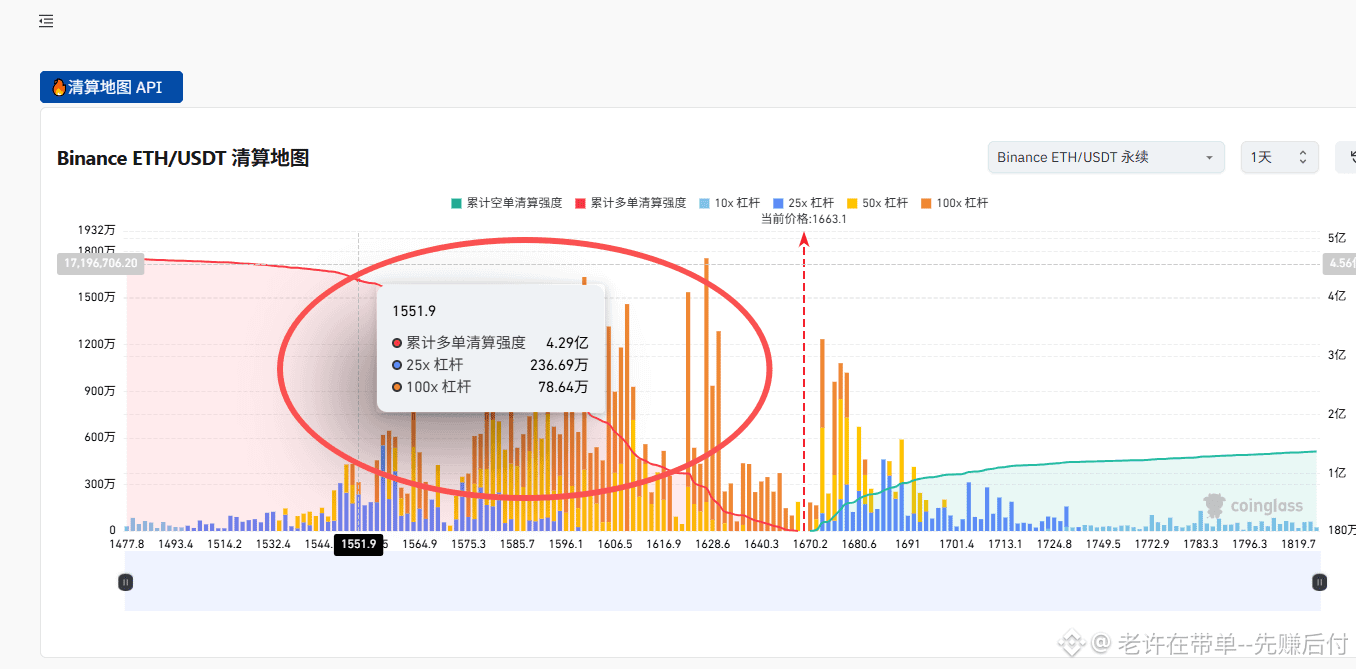
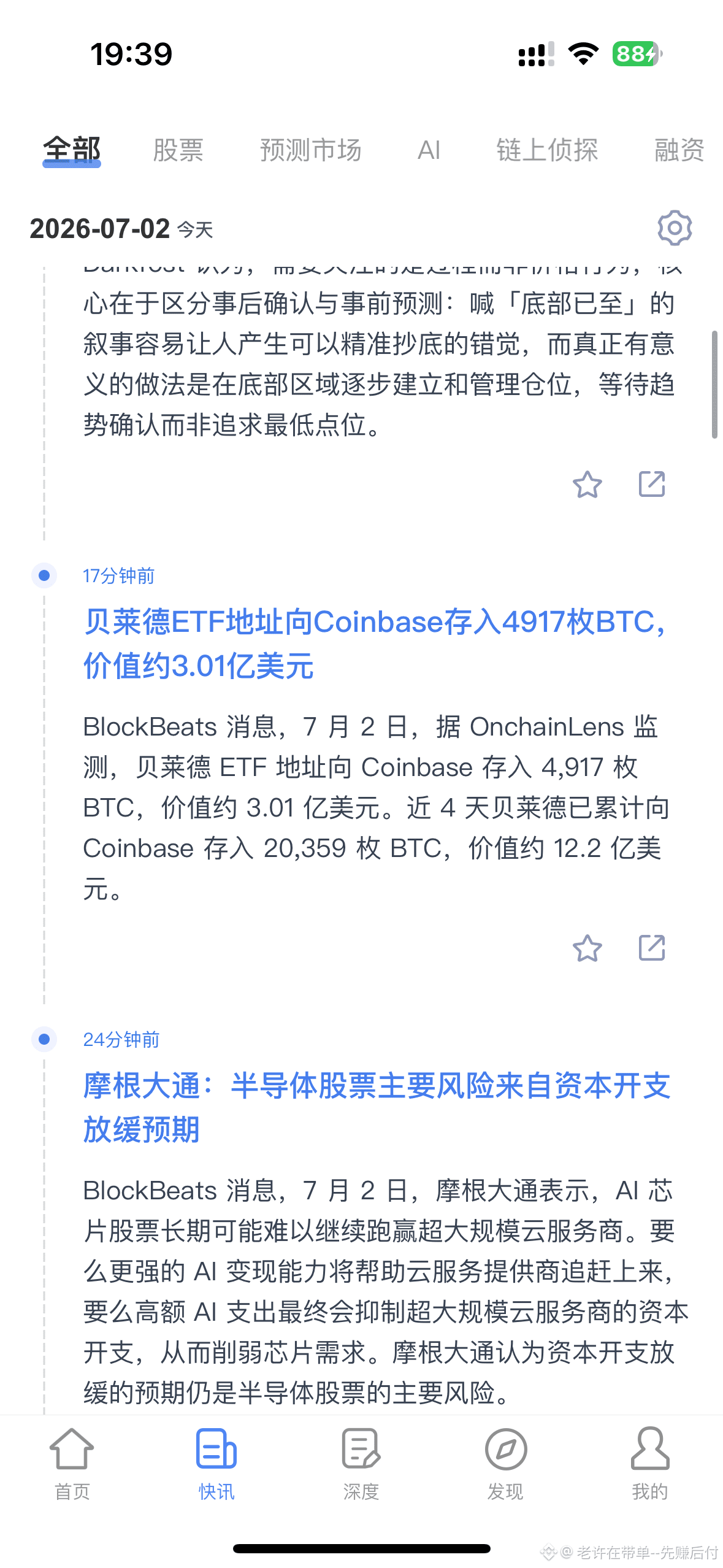
What signal does BlackRock release? Are institutions continuing to dump high-quality safe-haven assets?
The impact from the non-farm data is also prompting the market to move in advance. During the day, it has already risen by 2%.
So after the data is released tonight, will the market surge sharply upward, or will it return below 1600???
Old Xu has already made preparations for this round of market action. Brothers who don’t know how to trade yet, call...
$ETH $M
#比特币经历2022年来最差上半年 #比特币6月下跌20.5%至58526美元
The impact from the non-farm data is also prompting the market to move in advance. During the day, it has already risen by 2%.
So after the data is released tonight, will the market surge sharply upward, or will it return below 1600???
Old Xu has already made preparations for this round of market action. Brothers who don’t know how to trade yet, call...
$ETH $M
#比特币经历2022年来最差上半年 #比特币6月下跌20.5%至58526美元
继续逼空,上方还有新高
40%
先冲后砸,典型诱多行情
40%
数据落地后直接大波动,双向收割
10%
看不懂,先观望不动手
10%
30 votes • Voting closed
Tomorrow the US stock market is closed, and ahead-of-time digestion of the Non-Farm Payrolls will happen together with today—this kind of timing is actually quite crucial.
By normal logic, yesterday’s ETF was still a net outflow of nearly 200 million, so the market itself had a bearish expectation. But the price action took a completely opposite rhythm—it moved upward directly.
This makes it easy to wonder: is this a case of anticipating the opposite and squeezing short sellers?
Because there’s a very clear phenomenon in the market right now: there are actually quite a lot of shorts. Especially after continuous choppy trading, many people tend to position in advance for a pullback.
Once such a consensus expectation becomes too concentrated, it’s actually easier to get counter-squeezed.
But having said that, I’m more inclined to take a neutral view here.
It’s not that we must squeeze shorts, and it’s not that we must flip long. Rather, in this kind of environment, fundamentally it’s a liquidity-driven back-and-forth扫盘 (sweeping the market), and the direction isn’t stable.
So the key isn’t in guessing, but in structure:
If there is structure, follow it; if there isn’t structure, take a break.
What the market fears most isn’t having no action—it’s trading a行情 (market move) with emotions when there’s no structure.
#比特币6月下跌20.5%至58526美元 #Bitcoin has had its worst first half since 2022
By normal logic, yesterday’s ETF was still a net outflow of nearly 200 million, so the market itself had a bearish expectation. But the price action took a completely opposite rhythm—it moved upward directly.
This makes it easy to wonder: is this a case of anticipating the opposite and squeezing short sellers?
Because there’s a very clear phenomenon in the market right now: there are actually quite a lot of shorts. Especially after continuous choppy trading, many people tend to position in advance for a pullback.
Once such a consensus expectation becomes too concentrated, it’s actually easier to get counter-squeezed.
But having said that, I’m more inclined to take a neutral view here.
It’s not that we must squeeze shorts, and it’s not that we must flip long. Rather, in this kind of environment, fundamentally it’s a liquidity-driven back-and-forth扫盘 (sweeping the market), and the direction isn’t stable.
So the key isn’t in guessing, but in structure:
If there is structure, follow it; if there isn’t structure, take a break.
What the market fears most isn’t having no action—it’s trading a行情 (market move) with emotions when there’s no structure.
#比特币6月下跌20.5%至58526美元 #Bitcoin has had its worst first half since 2022


老许在带单--先赚后付
·
--
According to past patterns, U.S. tech stocks have sold off sharply, and the market is likely under pressure as well.
But this time, Bitcoin not only didn’t fall—it's actually reclaimed the level above 61,000, which suggests that the market is starting to see a new shift.老许公开策略交流群
I believe this isn’t that capital has suddenly turned optimistic; rather, selling pressure is weakening.
In the recent stretch of consecutive declines, most of those who needed to panic have basically already been shaken out. Now, even if the broader market turns bearish, Bitcoin’s downside has clearly narrowed, indicating that investors are gradually taking positions at lower levels instead of simply dumping.
Last night’s decline in U.S. stocks was mainly due to the drag from the AI sector.
The market has started re-evaluating tech companies’ capital expenditures. Some funds have chosen to lock in profits, so chip stocks have seen a relatively larger pullback.
However, this kind of adjustment at the moment is more about capital rotating within the U.S. stock market, and it hasn’t been rapidly transmitted to the crypto market like in the past.
Also, the Federal Reserve still hasn’t released any clear easing signals. The market is now waiting for tonight’s Non-Farm Payrolls data.
If employment data comes in significantly stronger than expected, the U.S. dollar may continue to strengthen, and risk assets could face pressure in the short term. If the data is weaker, it could improve expectations for subsequent policy easing, which would be more favorable for the market.
One more point that can’t be overlooked: even though the U.S.-Iran negotiations are still progressing, differences remain on both sides, so it’s unlikely that a decisive outcome will be reached in the short term. Therefore, the impact of news on price action is likely to be mainly short-term sentiment-driven fluctuations.
My view hasn’t changed.
The market is a bit stronger than a few days ago, but it still hasn’t truly broken out into a new trend.
Until there’s a breakout of key resistance with increased volume, I’d rather treat it as a consolidation and repair phase—not the start of a new uptrend.
Today’s key focus:
BTC: Resistance around 62,000. Only after it holds above that level is there a chance for further upside room to open.
ETH: Resistance around 1,680. After a breakout, watch whether it can continue with volume.
SOL: Resistance around 81.
In terms of trading, continue to focus mainly on intraday shorts. If you don’t understand, don’t trade impulsively—wait for the market to show its direction, then follow the trend. That will give you a higher chance of success.
$B $MU $LAB
#韩国股市跌6% #比特币ETF6月净流出45亿美元 #MORPHO涨超12%
But this time, Bitcoin not only didn’t fall—it's actually reclaimed the level above 61,000, which suggests that the market is starting to see a new shift.老许公开策略交流群
I believe this isn’t that capital has suddenly turned optimistic; rather, selling pressure is weakening.
In the recent stretch of consecutive declines, most of those who needed to panic have basically already been shaken out. Now, even if the broader market turns bearish, Bitcoin’s downside has clearly narrowed, indicating that investors are gradually taking positions at lower levels instead of simply dumping.
Last night’s decline in U.S. stocks was mainly due to the drag from the AI sector.
The market has started re-evaluating tech companies’ capital expenditures. Some funds have chosen to lock in profits, so chip stocks have seen a relatively larger pullback.
However, this kind of adjustment at the moment is more about capital rotating within the U.S. stock market, and it hasn’t been rapidly transmitted to the crypto market like in the past.
Also, the Federal Reserve still hasn’t released any clear easing signals. The market is now waiting for tonight’s Non-Farm Payrolls data.
If employment data comes in significantly stronger than expected, the U.S. dollar may continue to strengthen, and risk assets could face pressure in the short term. If the data is weaker, it could improve expectations for subsequent policy easing, which would be more favorable for the market.
One more point that can’t be overlooked: even though the U.S.-Iran negotiations are still progressing, differences remain on both sides, so it’s unlikely that a decisive outcome will be reached in the short term. Therefore, the impact of news on price action is likely to be mainly short-term sentiment-driven fluctuations.
My view hasn’t changed.
The market is a bit stronger than a few days ago, but it still hasn’t truly broken out into a new trend.
Until there’s a breakout of key resistance with increased volume, I’d rather treat it as a consolidation and repair phase—not the start of a new uptrend.
Today’s key focus:
BTC: Resistance around 62,000. Only after it holds above that level is there a chance for further upside room to open.
ETH: Resistance around 1,680. After a breakout, watch whether it can continue with volume.
SOL: Resistance around 81.
In terms of trading, continue to focus mainly on intraday shorts. If you don’t understand, don’t trade impulsively—wait for the market to show its direction, then follow the trend. That will give you a higher chance of success.
$B $MU $LAB
#韩国股市跌6% #比特币ETF6月净流出45亿美元 #MORPHO涨超12%
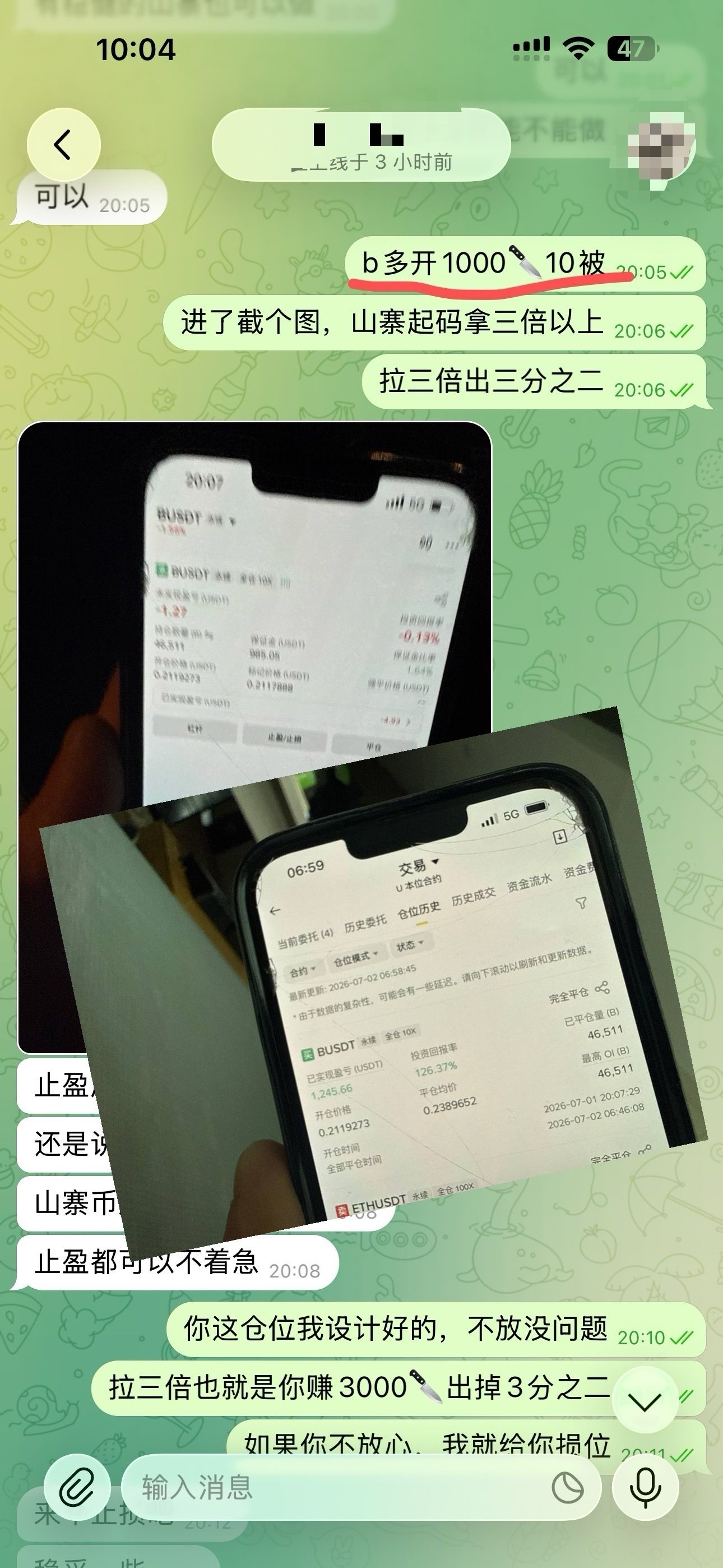
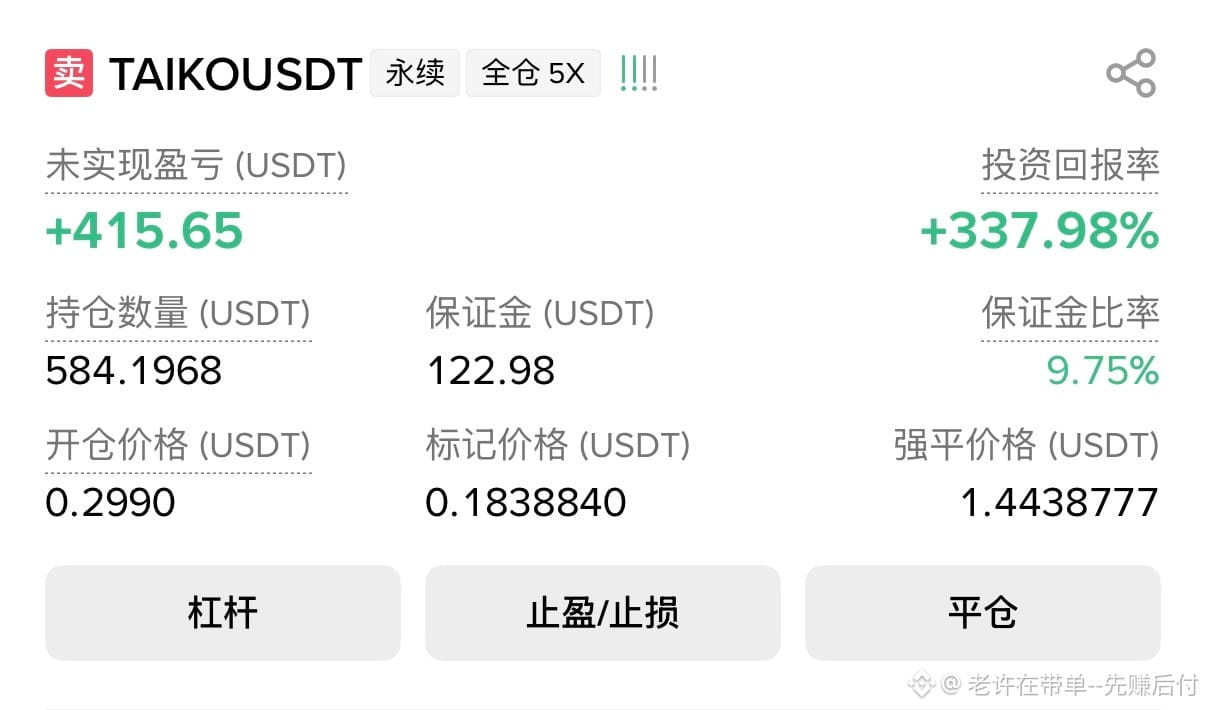
$TAIKO Like a fleeting bloom. The 5 a.m. pump—honestly, it’s a bit outrageous.
The dog cartel took the price from 0.12 straight up to 0.53; in a short time it moved nearly 300+ points. If you went long, basically you just doubled instantly. At the extreme, there was even a 10x or 20x range.
But the issue is right here.
You’ll notice that in the past while, these shill coins have a very obvious characteristic: they pump fast, and they dump fast too—there’s no lingering or “fighting it out.” $RAVE is also the same kind of operator. Even now, plenty of brothers are still trapped at the top.
It’s not like the old days of slow rise and slow decline. Now it feels more like a task-based operation: first, using an extreme spike to suck out all the liquidity, then immediately flipping and slamming it back down—the whole process is very straightforward.
In essence, this kind of chart isn’t price moving along a trend; it’s sweeping liquidity + clearing positions + resetting the chip structure.
So what you’re seeing isn’t just simple strength, but a contest of funds under extreme emotions.
When they pump, they don’t talk logic. When they dump, they don’t show mercy.
In this environment, it’s definitely a pity that long positions didn’t get to benefit. But short positions can’t be thrown around recklessly either. Because once the market sentiment fades, the pullback speed is often even faster than the pump.
$MU
#比特币6月下跌20.5%至58526美元 #比特币经历2022年来最差上半年 #韩国KOSPI指数暴跌7.89%
The dog cartel took the price from 0.12 straight up to 0.53; in a short time it moved nearly 300+ points. If you went long, basically you just doubled instantly. At the extreme, there was even a 10x or 20x range.
But the issue is right here.
You’ll notice that in the past while, these shill coins have a very obvious characteristic: they pump fast, and they dump fast too—there’s no lingering or “fighting it out.” $RAVE is also the same kind of operator. Even now, plenty of brothers are still trapped at the top.
It’s not like the old days of slow rise and slow decline. Now it feels more like a task-based operation: first, using an extreme spike to suck out all the liquidity, then immediately flipping and slamming it back down—the whole process is very straightforward.
In essence, this kind of chart isn’t price moving along a trend; it’s sweeping liquidity + clearing positions + resetting the chip structure.
So what you’re seeing isn’t just simple strength, but a contest of funds under extreme emotions.
When they pump, they don’t talk logic. When they dump, they don’t show mercy.
In this environment, it’s definitely a pity that long positions didn’t get to benefit. But short positions can’t be thrown around recklessly either. Because once the market sentiment fades, the pullback speed is often even faster than the pump.
$MU
#比特币6月下跌20.5%至58526美元 #比特币经历2022年来最差上半年 #韩国KOSPI指数暴跌7.89%
According to past patterns, U.S. tech stocks have sold off sharply, and the market is likely under pressure as well.
But this time, Bitcoin not only didn’t fall—it's actually reclaimed the level above 61,000, which suggests that the market is starting to see a new shift.老许公开策略交流群
I believe this isn’t that capital has suddenly turned optimistic; rather, selling pressure is weakening.
In the recent stretch of consecutive declines, most of those who needed to panic have basically already been shaken out. Now, even if the broader market turns bearish, Bitcoin’s downside has clearly narrowed, indicating that investors are gradually taking positions at lower levels instead of simply dumping.
Last night’s decline in U.S. stocks was mainly due to the drag from the AI sector.
The market has started re-evaluating tech companies’ capital expenditures. Some funds have chosen to lock in profits, so chip stocks have seen a relatively larger pullback.
However, this kind of adjustment at the moment is more about capital rotating within the U.S. stock market, and it hasn’t been rapidly transmitted to the crypto market like in the past.
Also, the Federal Reserve still hasn’t released any clear easing signals. The market is now waiting for tonight’s Non-Farm Payrolls data.
If employment data comes in significantly stronger than expected, the U.S. dollar may continue to strengthen, and risk assets could face pressure in the short term. If the data is weaker, it could improve expectations for subsequent policy easing, which would be more favorable for the market.
One more point that can’t be overlooked: even though the U.S.-Iran negotiations are still progressing, differences remain on both sides, so it’s unlikely that a decisive outcome will be reached in the short term. Therefore, the impact of news on price action is likely to be mainly short-term sentiment-driven fluctuations.
My view hasn’t changed.
The market is a bit stronger than a few days ago, but it still hasn’t truly broken out into a new trend.
Until there’s a breakout of key resistance with increased volume, I’d rather treat it as a consolidation and repair phase—not the start of a new uptrend.
Today’s key focus:
BTC: Resistance around 62,000. Only after it holds above that level is there a chance for further upside room to open.
ETH: Resistance around 1,680. After a breakout, watch whether it can continue with volume.
SOL: Resistance around 81.
In terms of trading, continue to focus mainly on intraday shorts. If you don’t understand, don’t trade impulsively—wait for the market to show its direction, then follow the trend. That will give you a higher chance of success.
$B $MU $LAB
#韩国股市跌6% #比特币ETF6月净流出45亿美元 #MORPHO涨超12%
But this time, Bitcoin not only didn’t fall—it's actually reclaimed the level above 61,000, which suggests that the market is starting to see a new shift.老许公开策略交流群
I believe this isn’t that capital has suddenly turned optimistic; rather, selling pressure is weakening.
In the recent stretch of consecutive declines, most of those who needed to panic have basically already been shaken out. Now, even if the broader market turns bearish, Bitcoin’s downside has clearly narrowed, indicating that investors are gradually taking positions at lower levels instead of simply dumping.
Last night’s decline in U.S. stocks was mainly due to the drag from the AI sector.
The market has started re-evaluating tech companies’ capital expenditures. Some funds have chosen to lock in profits, so chip stocks have seen a relatively larger pullback.
However, this kind of adjustment at the moment is more about capital rotating within the U.S. stock market, and it hasn’t been rapidly transmitted to the crypto market like in the past.
Also, the Federal Reserve still hasn’t released any clear easing signals. The market is now waiting for tonight’s Non-Farm Payrolls data.
If employment data comes in significantly stronger than expected, the U.S. dollar may continue to strengthen, and risk assets could face pressure in the short term. If the data is weaker, it could improve expectations for subsequent policy easing, which would be more favorable for the market.
One more point that can’t be overlooked: even though the U.S.-Iran negotiations are still progressing, differences remain on both sides, so it’s unlikely that a decisive outcome will be reached in the short term. Therefore, the impact of news on price action is likely to be mainly short-term sentiment-driven fluctuations.
My view hasn’t changed.
The market is a bit stronger than a few days ago, but it still hasn’t truly broken out into a new trend.
Until there’s a breakout of key resistance with increased volume, I’d rather treat it as a consolidation and repair phase—not the start of a new uptrend.
Today’s key focus:
BTC: Resistance around 62,000. Only after it holds above that level is there a chance for further upside room to open.
ETH: Resistance around 1,680. After a breakout, watch whether it can continue with volume.
SOL: Resistance around 81.
In terms of trading, continue to focus mainly on intraday shorts. If you don’t understand, don’t trade impulsively—wait for the market to show its direction, then follow the trend. That will give you a higher chance of success.
$B $MU $LAB
#韩国股市跌6% #比特币ETF6月净流出45亿美元 #MORPHO涨超12%
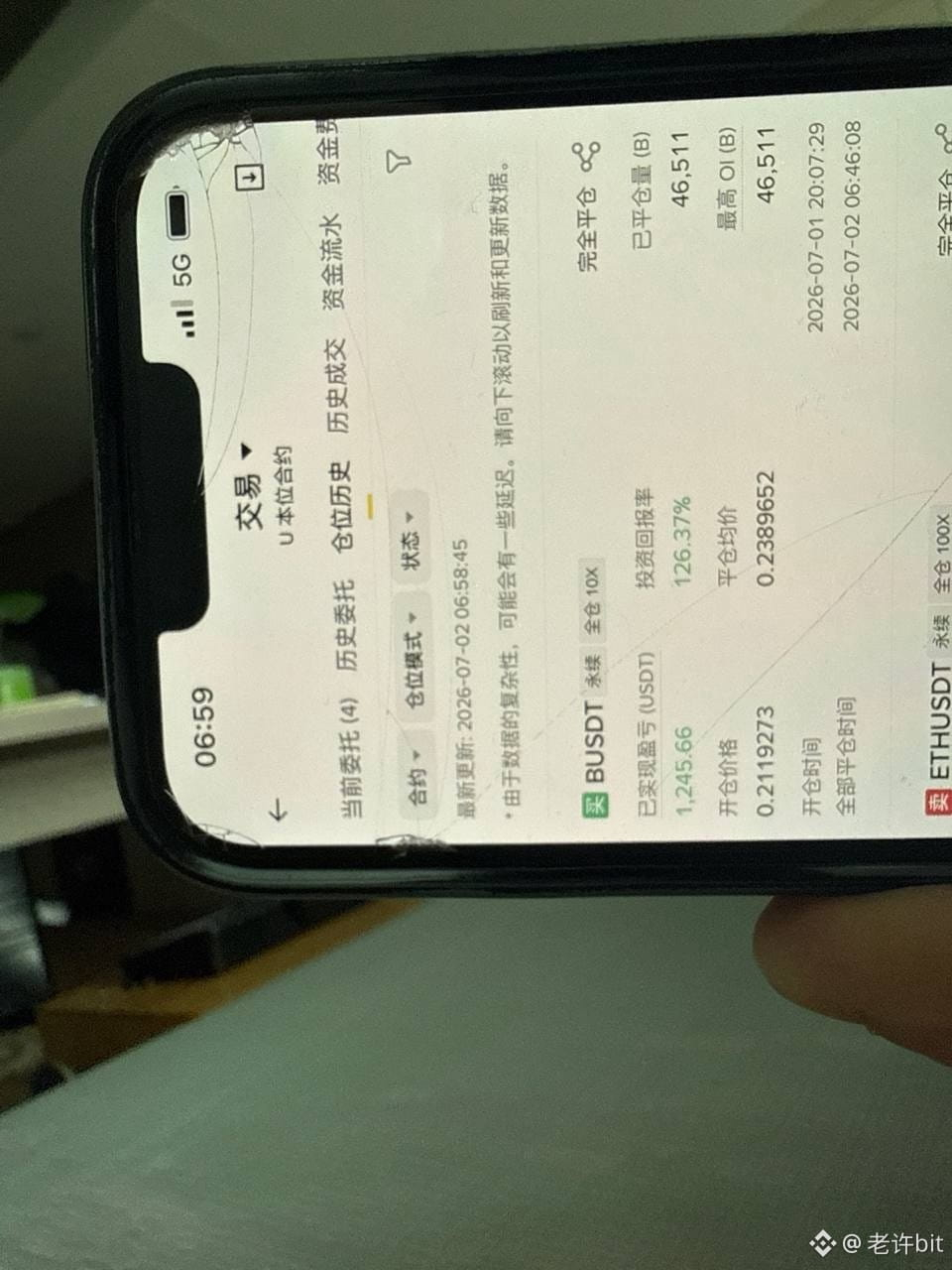
Quoted content has been removed
$ETH July’s open-door strong start was given by the mistress!!!
We’re continuing to strategize and build the groundwork. Our strength is undeniable—every follower will be treated with care and attention.
No after-the-fact talk—an absolutely early factual pick.
Keep an eye on: $DYDX $LAB
#Circle被剔除罗素成长指数 #现货白银涨3%至每盎司$60.10 #原油价格下跌
We’re continuing to strategize and build the groundwork. Our strength is undeniable—every follower will be treated with care and attention.
No after-the-fact talk—an absolutely early factual pick.
Keep an eye on: $DYDX $LAB
#Circle被剔除罗素成长指数 #现货白银涨3%至每盎司$60.10 #原油价格下跌
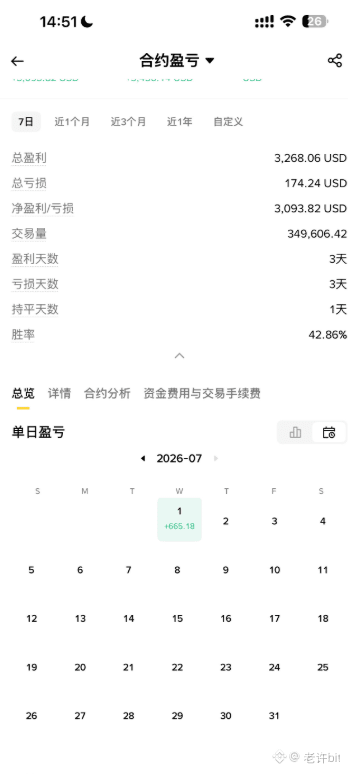

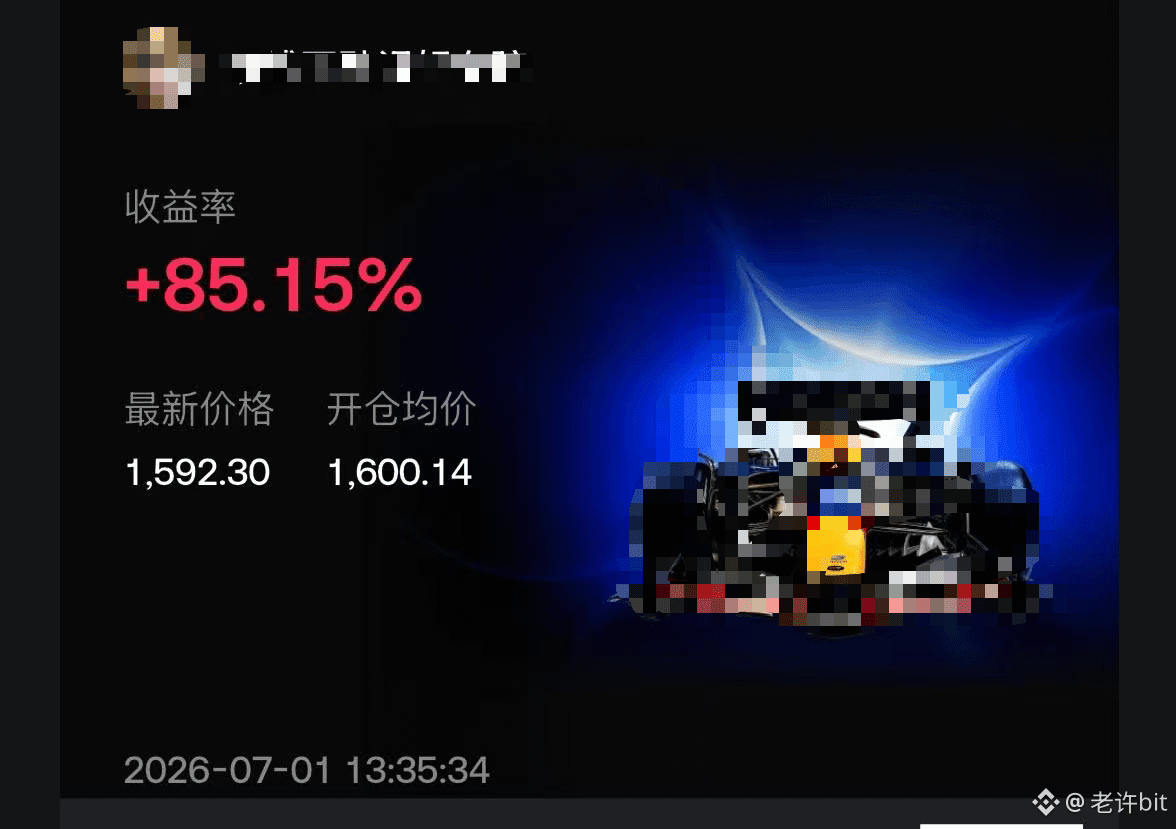
$ETH The secondary high midday session volume spike sent it higher—its peak just barely touched the 1600 resistance level that we repeatedly emphasized in the early session.
The 1600 short orders that were placed in advance have already filled successfully. For this leg, we’ve secured nearly double the expected profit potential.
That said, in my view, this pullback hasn’t finished yet.
1600 is not only a whole-number level, but also a short-term high-density trading zone. After pushing higher, the trading volume didn’t continue to expand—instead it started to shrink. This indicates there isn’t enough momentum from chasing-buyers, and sell pressure from above still remains.
As long as price doesn’t break out and hold above 1600 on increasing volume, rebounds are more likely to be about repairing the move rather than a trend reversal.
For brothers who are currently in cash, around 1575–1585 you can still consider building short positions in batches, and strictly place your stop-loss.
Targets: first look at 1550. After a break below, then watch the area around 1520.
Trading isn’t about who enters first—it’s about who can act decisively from a high-probability position.
Keep monitoring: $DYDX $LAB
#现货白银涨3%至每盎司$60.10 #原油价格下跌 #台湾通过虚拟资产服务法
The 1600 short orders that were placed in advance have already filled successfully. For this leg, we’ve secured nearly double the expected profit potential.
That said, in my view, this pullback hasn’t finished yet.
1600 is not only a whole-number level, but also a short-term high-density trading zone. After pushing higher, the trading volume didn’t continue to expand—instead it started to shrink. This indicates there isn’t enough momentum from chasing-buyers, and sell pressure from above still remains.
As long as price doesn’t break out and hold above 1600 on increasing volume, rebounds are more likely to be about repairing the move rather than a trend reversal.
For brothers who are currently in cash, around 1575–1585 you can still consider building short positions in batches, and strictly place your stop-loss.
Targets: first look at 1550. After a break below, then watch the area around 1520.
Trading isn’t about who enters first—it’s about who can act decisively from a high-probability position.
Keep monitoring: $DYDX $LAB
#现货白银涨3%至每盎司$60.10 #原油价格下跌 #台湾通过虚拟资产服务法

老许在带单--先赚后付
·
--
Good morning, everyone. The first trading day of July, and the market still hasn’t given a clear direction.
Many people feel recent market action is boring—up a little every day, down a little every day. In fact, this kind of setup is the easiest to lose money in.
Why? Because the market has entered a period of information vacuum.
The negative news that needed to be digested has mostly already been digested, but new positive catalysts have still not appeared. Naturally, capital won’t rush to launch a trending market.
So every upswing you see recently is more like short-term funds scrambling to catch a rebound, rather than big money beginning to enter.
There’s another phenomenon worth noting.
Although BTC has been holding key support, altcoins have clearly been weaker. This suggests that market capital is becoming increasingly concentrated, and risk appetite hasn’t truly recovered yet.
Also, July itself is a month that tends to amplify volatility.
Nonfarm payrolls, CPI, and Fed speeches will be released throughout the month. Before these data land, many institutions will proactively reduce positions and wait for a clearer direction. As a result, in the short term the market is more likely to show a "back-and-forth sweep" pattern rather than continuous one-way rallies.
My view is still very clear.
The most important thing now isn’t guessing the bottom, but waiting for the market to show its direction.
If BTC can regain and hold above 60,000, and trading volume expands in sync, then the repair rally may still have room to continue;
On the other hand, as long as it can’t hold above that level after repeated attempts, every rebound is more suitable to be treated as profit-taking from higher levels rather than chasing the move.
Key levels to watch today
📍BTC: Support around 57,000; resistance around 60,000.
📍ETH: Support around 1,500; above 1,600 is still the short-term line in the sand.
📍SOL: Support around 70.
Trading approach:
At present, we should still treat the market as range-bound but weak. Be patient and wait for high-probability opportunities—don’t rush into trades.
The truly profitable traders aren’t the ones with the most trading次数; they’re the best at waiting.
July has just started. You don’t need to make the most money on day one—you just need to get the rhythm right.
Keep monitoring: $LAB $XNY $ZBT
Many people feel recent market action is boring—up a little every day, down a little every day. In fact, this kind of setup is the easiest to lose money in.
Why? Because the market has entered a period of information vacuum.
The negative news that needed to be digested has mostly already been digested, but new positive catalysts have still not appeared. Naturally, capital won’t rush to launch a trending market.
So every upswing you see recently is more like short-term funds scrambling to catch a rebound, rather than big money beginning to enter.
There’s another phenomenon worth noting.
Although BTC has been holding key support, altcoins have clearly been weaker. This suggests that market capital is becoming increasingly concentrated, and risk appetite hasn’t truly recovered yet.
Also, July itself is a month that tends to amplify volatility.
Nonfarm payrolls, CPI, and Fed speeches will be released throughout the month. Before these data land, many institutions will proactively reduce positions and wait for a clearer direction. As a result, in the short term the market is more likely to show a "back-and-forth sweep" pattern rather than continuous one-way rallies.
My view is still very clear.
The most important thing now isn’t guessing the bottom, but waiting for the market to show its direction.
If BTC can regain and hold above 60,000, and trading volume expands in sync, then the repair rally may still have room to continue;
On the other hand, as long as it can’t hold above that level after repeated attempts, every rebound is more suitable to be treated as profit-taking from higher levels rather than chasing the move.
Key levels to watch today
📍BTC: Support around 57,000; resistance around 60,000.
📍ETH: Support around 1,500; above 1,600 is still the short-term line in the sand.
📍SOL: Support around 70.
Trading approach:
At present, we should still treat the market as range-bound but weak. Be patient and wait for high-probability opportunities—don’t rush into trades.
The truly profitable traders aren’t the ones with the most trading次数; they’re the best at waiting.
July has just started. You don’t need to make the most money on day one—you just need to get the rhythm right.
Keep monitoring: $LAB $XNY $ZBT
$DYDX news sold out. The waterfall begins
It’s been less than an hour since I posted my last post and—waterfall!!!
This time, how many brothers are trapped on the mountaintop again?
If you don’t know how to get out, call @老许在带单--先赚后付 for a perfect get-out-of-trap strategy
Keep watching: $LAB $BASED
#Circle被剔除罗素成长指数 #韩元跌至2009年以来最弱 #现货白银涨3%至每盎司$60.10 #原油价格下跌
It’s been less than an hour since I posted my last post and—waterfall!!!
This time, how many brothers are trapped on the mountaintop again?
If you don’t know how to get out, call @老许在带单--先赚后付 for a perfect get-out-of-trap strategy
Keep watching: $LAB $BASED
#Circle被剔除罗素成长指数 #韩元跌至2009年以来最弱 #现货白银涨3%至每盎司$60.10 #原油价格下跌
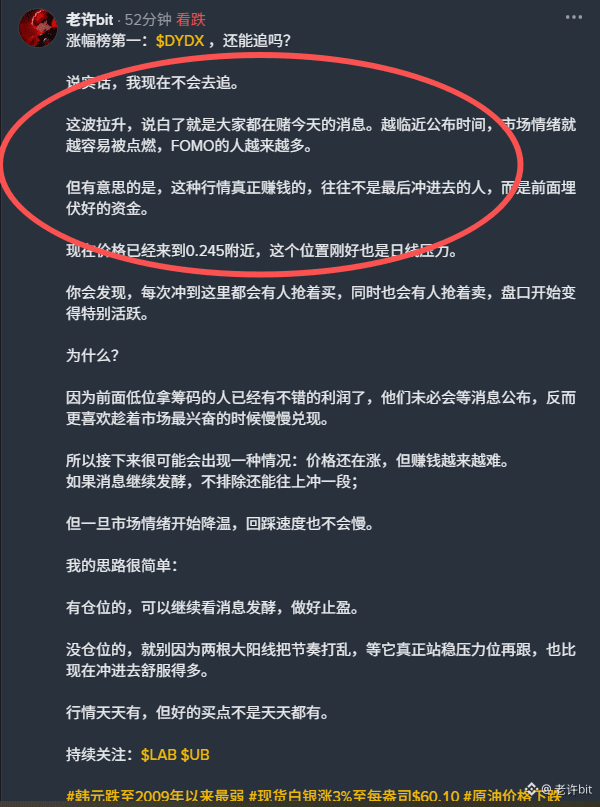
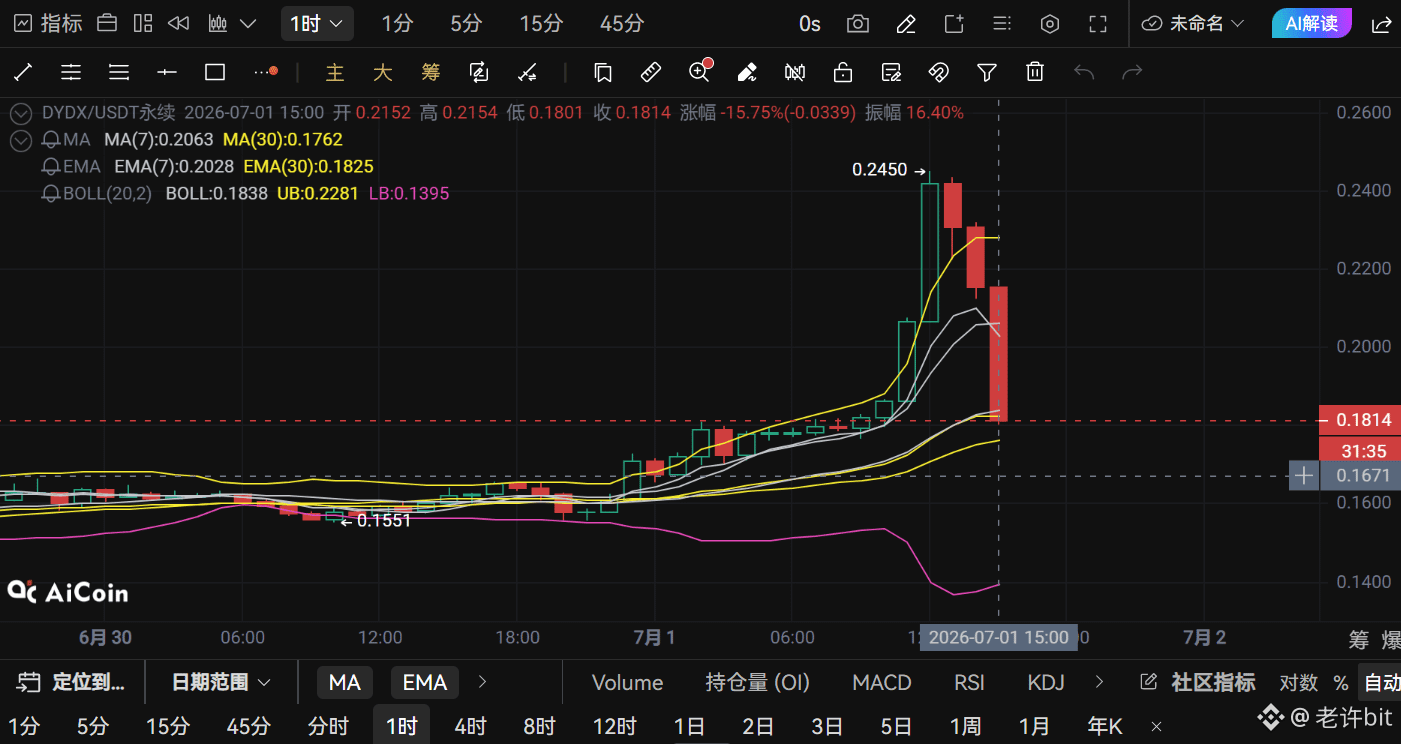
Top Gainer: $DYDX — Can you still chase it?
Honestly, I wouldn’t chase it right now.
This surge, put simply, is everyone betting on today’s news. The closer it gets to the time of release, the easier it is for market sentiment to get ignited, and the number of FOMO buyers keeps growing.
But here’s the interesting part: in this kind of market, the ones who truly make money are often not the last people who rush in, but the funds that were already positioned early.
Now the price is already around 0.245, and this spot happens to align with daily resistance.
You’ll notice that every time it pushes up to this level, some people rush to buy while others rush to sell—the order book starts getting especially active.
Why?
Because the people who bought earlier at lower levels already have solid profits. They may not even wait for the news release; instead, they prefer to gradually realize gains while the market is at its most excited.
So the next likely scenario is: price keeps rising, but it gets harder and harder to make money.
If the news continues to build up, there’s a chance it can still push higher for a bit;
but once market sentiment starts cooling down, the pullback won’t be slow.
My thinking is very simple:
If you already have a position, you can keep watching the news build-up and be sure to take profit with stop targets.
If you don’t have a position, don’t let two big bullish candles throw off your timing. Wait until it truly holds above the resistance level, and chasing later will feel a lot more comfortable than rushing in now.
Markets have opportunities every day, but good entry points aren’t always there.
Keep monitoring: $LAB $UB
#韩元跌至2009年以来最弱 #现货白银涨3%至每盎司$60.10 #原油价格下跌
Honestly, I wouldn’t chase it right now.
This surge, put simply, is everyone betting on today’s news. The closer it gets to the time of release, the easier it is for market sentiment to get ignited, and the number of FOMO buyers keeps growing.
But here’s the interesting part: in this kind of market, the ones who truly make money are often not the last people who rush in, but the funds that were already positioned early.
Now the price is already around 0.245, and this spot happens to align with daily resistance.
You’ll notice that every time it pushes up to this level, some people rush to buy while others rush to sell—the order book starts getting especially active.
Why?
Because the people who bought earlier at lower levels already have solid profits. They may not even wait for the news release; instead, they prefer to gradually realize gains while the market is at its most excited.
So the next likely scenario is: price keeps rising, but it gets harder and harder to make money.
If the news continues to build up, there’s a chance it can still push higher for a bit;
but once market sentiment starts cooling down, the pullback won’t be slow.
My thinking is very simple:
If you already have a position, you can keep watching the news build-up and be sure to take profit with stop targets.
If you don’t have a position, don’t let two big bullish candles throw off your timing. Wait until it truly holds above the resistance level, and chasing later will feel a lot more comfortable than rushing in now.
Markets have opportunities every day, but good entry points aren’t always there.
Keep monitoring: $LAB $UB
#韩元跌至2009年以来最弱 #现货白银涨3%至每盎司$60.10 #原油价格下跌
Log in to explore more content