
MR WHICK
7.4k Posts
MR WHICK
THE WORLD BOWS DOWN, IF THERE IS SOMEONE TO MAKE IT BOW 😉
674 Following
29.5K+ Followers
22.9K+ Liked
Posts
All
Videos
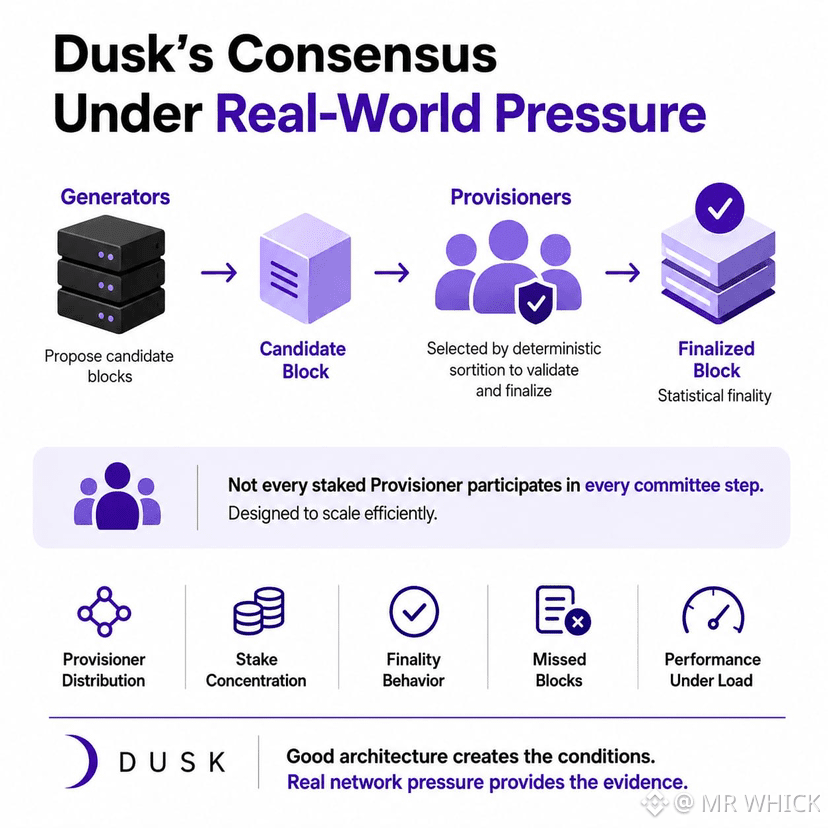
#dusk I keep coming back to one question about Dusk’s consensus: efficiency can look convincing on paper, but what happens when real network activity starts putting pressure on the system?
Dusk’s Segregated Byzantine Agreement (SBA) separates consensus responsibilities. Generators propose candidate blocks, while Provisioners are selected into committees through deterministic sortition to validate and finalize them. The goal is statistical finality, where a finalized block should become irreversible with only a negligible probability of a fork.
What I find interesting is that Dusk doesn’t require every staked Provisioner to participate in every committee step. That could become important as activity scales, although the architecture itself can’t prove how efficiently the network will perform under sustained real-world demand.
That’s the part I’d rather watch than assume.
Provisioner distribution, stake concentration, finality behavior, missed blocks, and performance under heavy activity should tell us much more about how durable DUSK’s consensus really is.
Good architecture creates the conditions. Real network pressure provides the evidence. @Dusk $DUSK
Dusk’s Segregated Byzantine Agreement (SBA) separates consensus responsibilities. Generators propose candidate blocks, while Provisioners are selected into committees through deterministic sortition to validate and finalize them. The goal is statistical finality, where a finalized block should become irreversible with only a negligible probability of a fork.
What I find interesting is that Dusk doesn’t require every staked Provisioner to participate in every committee step. That could become important as activity scales, although the architecture itself can’t prove how efficiently the network will perform under sustained real-world demand.
That’s the part I’d rather watch than assume.
Provisioner distribution, stake concentration, finality behavior, missed blocks, and performance under heavy activity should tell us much more about how durable DUSK’s consensus really is.
Good architecture creates the conditions. Real network pressure provides the evidence. @Dusk $DUSK
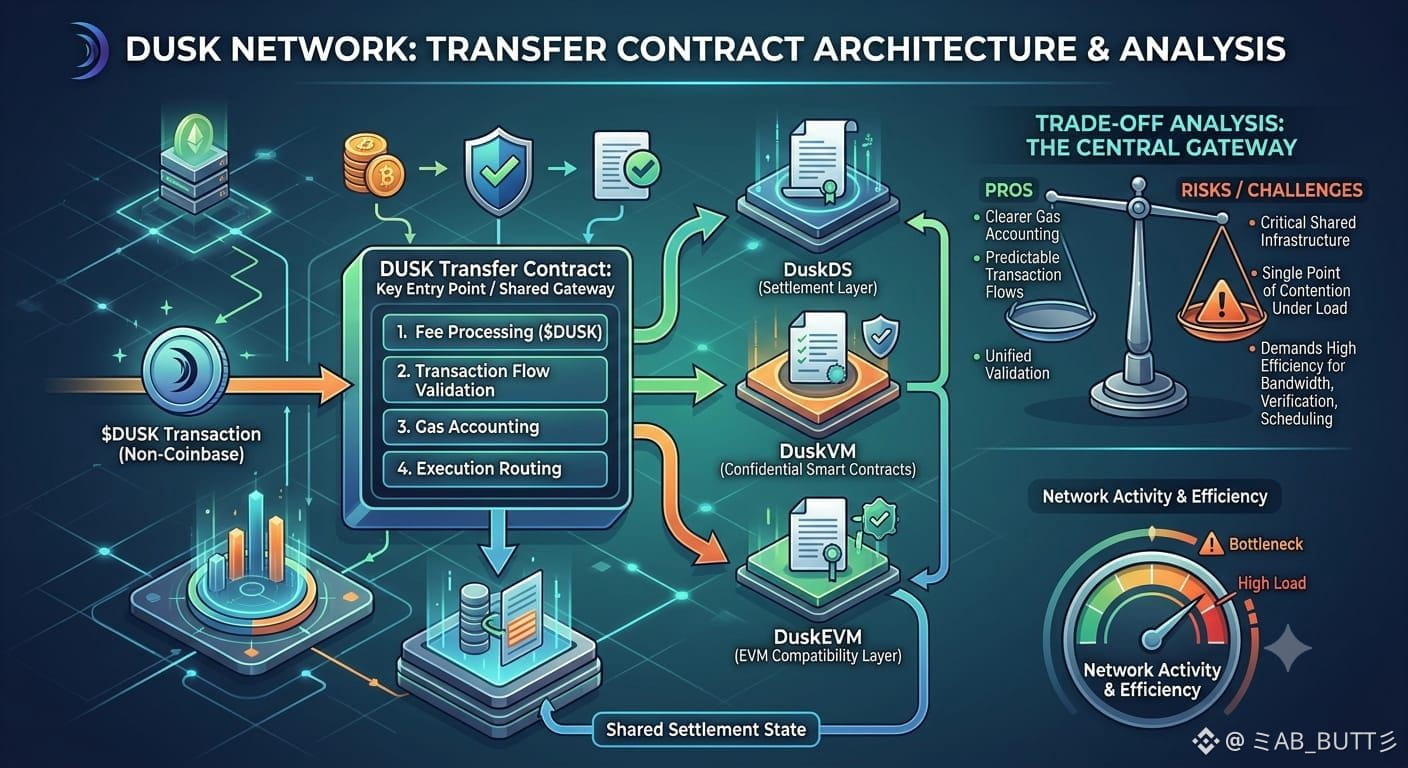
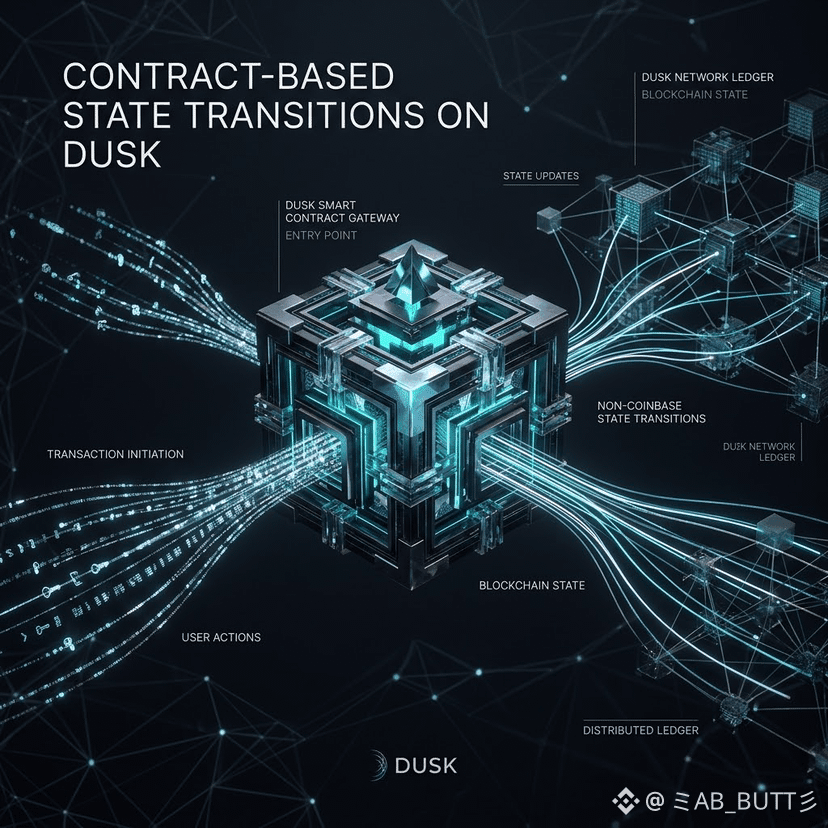
One thing I noticed is that using any dApp on @Dusk means going through the same initial protocol path.
I see the DUSK Transfer Contract as a key entry point for non-coinbase state changes on DuskDS. The protocol separates the asset and compute layers in theory but they still coordinate through a shared settlement state.
$DUSK is the native token used to pay for computation on the network. That’s why standard transactions begin by processing fees through the Transfer Contract. It handles the fee, validates the relevant transaction flow, then routes execution toward the target smart contract.
Why does this matter? Using one shared gateway can make gas accounting clearer and more predictable. But there's also a trade-off. The Transfer Contract becomes critical shared infrastructure because every transaction must pass through its fee and validation path.
If network activity grows significantly, demand for bandwidth, verification and transaction scheduling could increase. That does not automatically mean the compute layer becomes a bottleneck but it makes efficiency under load an important metric to watch.
Dusk’s architecture, including DuskDS, DuskVM and DuskEVM is designed to support different execution needs while keeping settlement connected to the same network. #dusk $DUSK @Dusk $DUSK
I see the DUSK Transfer Contract as a key entry point for non-coinbase state changes on DuskDS. The protocol separates the asset and compute layers in theory but they still coordinate through a shared settlement state.
$DUSK is the native token used to pay for computation on the network. That’s why standard transactions begin by processing fees through the Transfer Contract. It handles the fee, validates the relevant transaction flow, then routes execution toward the target smart contract.
Why does this matter? Using one shared gateway can make gas accounting clearer and more predictable. But there's also a trade-off. The Transfer Contract becomes critical shared infrastructure because every transaction must pass through its fee and validation path.
If network activity grows significantly, demand for bandwidth, verification and transaction scheduling could increase. That does not automatically mean the compute layer becomes a bottleneck but it makes efficiency under load an important metric to watch.
Dusk’s architecture, including DuskDS, DuskVM and DuskEVM is designed to support different execution needs while keeping settlement connected to the same network. #dusk $DUSK @Dusk $DUSK
@Dusk You know how every time you interact with any decentralised app on @Dusk , you have to go through the exact same initial choke point?
DUSK Contract is the only entry point for all non-coinbase state transitions on the network. The protocol separates the native asset layer from the generalised compute layer but they have the same exact state space.
This is why: The only asset that can compensate the network for computational gas is $DUSK . This rule means that each standard transaction must first call the DUSK Contract to perform fee logic before routing execution to a destination smart contract.
Do you think this unified state model will be able to handle heavy smart contract congestion? #dusk $DUSK @Dusk
DUSK Contract is the only entry point for all non-coinbase state transitions on the network. The protocol separates the native asset layer from the generalised compute layer but they have the same exact state space.
This is why: The only asset that can compensate the network for computational gas is $DUSK . This rule means that each standard transaction must first call the DUSK Contract to perform fee logic before routing execution to a destination smart contract.
Do you think this unified state model will be able to handle heavy smart contract congestion? #dusk $DUSK @Dusk
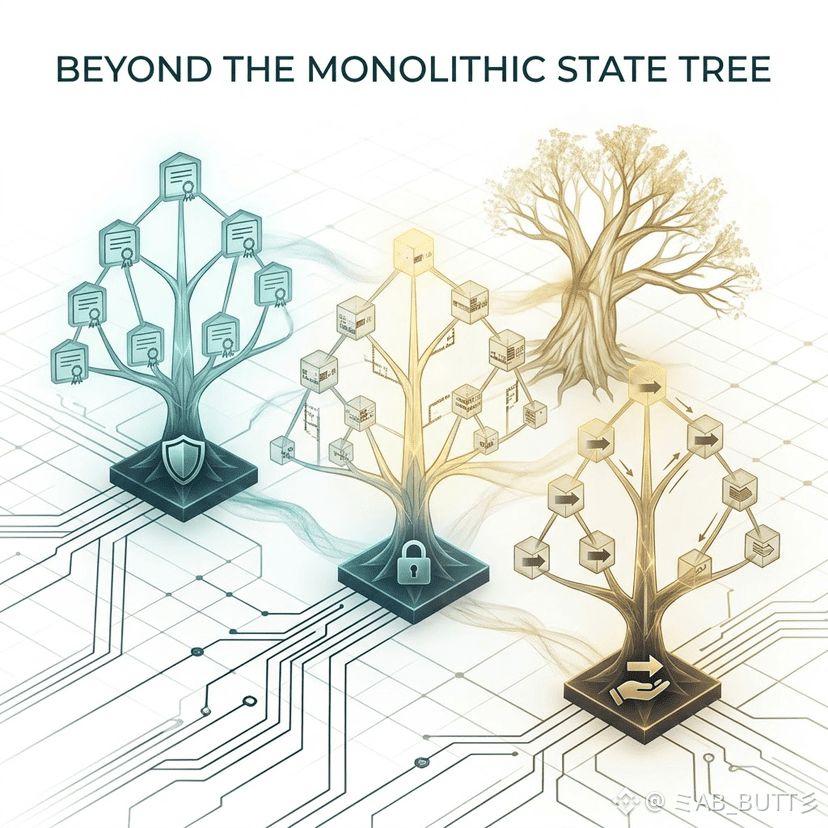
Everyone is talking about RWA compliance, but almost no one understands the on-chain architecture making it actually work.
I was diving into how Dusk handles this, and their Zedger model is way more intricate than people realize. Regulated DeFi creates a tricky engineering problem: participant identities, historical account balances, and in-flight transfers operate on entirely different lifecycles.
Most blockchains just cram all this data into one massive monolithic state tree. Instead, Dusk isolates state across three dedicated Poseidon Merkle trees:
- whitelistTree: Verifies your authorized identity without exposing actual personal credentials on the public ledger.
- memorySlotTree: Keeps your balance history private by tracking the root commitments of user accounts (Sparse Merkle-Segment Tries).
- coinTree: Acts as the transient layer, managing UTXO-style transfers while assets await receiver acceptance or timeout claims.
Does verifying membership proofs across three different trees increase zero-knowledge computation costs? Yes. But this three-tier separation completely eliminates transaction graph leakage while keeping institutional issuers strictly aligned with regulatory standards. It is a brilliant trade-off.
Do you think this three-tier architecture will become the standard for institutional DeFi? Let me know your thoughts below! 👇 #dusk $DUSK @Dusk
I was diving into how Dusk handles this, and their Zedger model is way more intricate than people realize. Regulated DeFi creates a tricky engineering problem: participant identities, historical account balances, and in-flight transfers operate on entirely different lifecycles.
Most blockchains just cram all this data into one massive monolithic state tree. Instead, Dusk isolates state across three dedicated Poseidon Merkle trees:
- whitelistTree: Verifies your authorized identity without exposing actual personal credentials on the public ledger.
- memorySlotTree: Keeps your balance history private by tracking the root commitments of user accounts (Sparse Merkle-Segment Tries).
- coinTree: Acts as the transient layer, managing UTXO-style transfers while assets await receiver acceptance or timeout claims.
Does verifying membership proofs across three different trees increase zero-knowledge computation costs? Yes. But this three-tier separation completely eliminates transaction graph leakage while keeping institutional issuers strictly aligned with regulatory standards. It is a brilliant trade-off.
Do you think this three-tier architecture will become the standard for institutional DeFi? Let me know your thoughts below! 👇 #dusk $DUSK @Dusk
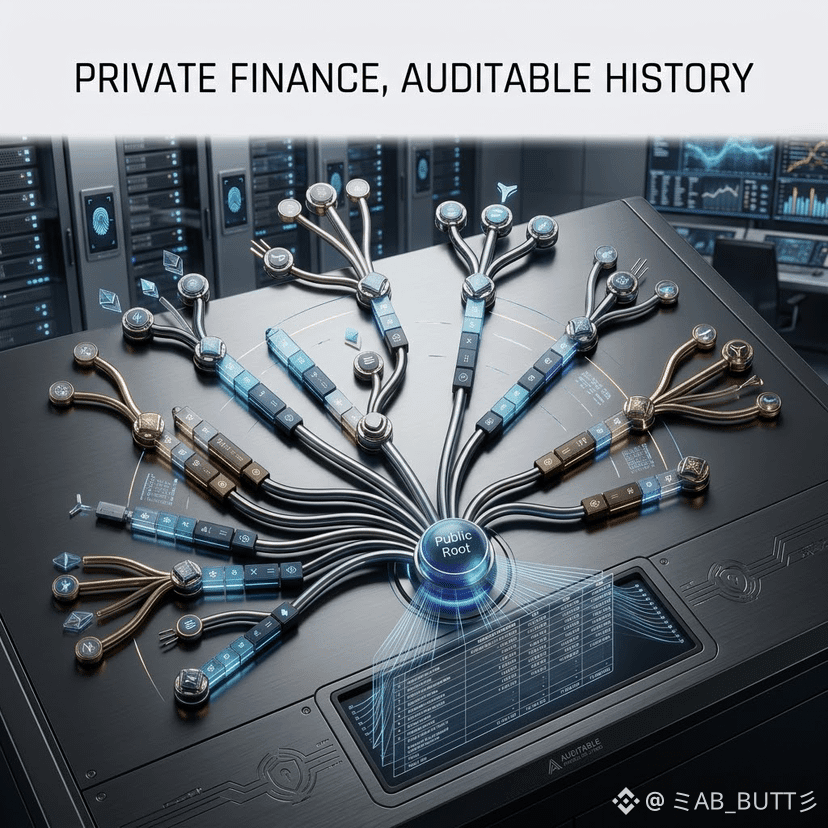
Most blockchains struggle with a core conflict: securities regulations require a detailed history of account balances, but public ledgers expose everything. To solve this, Dusk created something entirely new for its Zedger model: the Sparse Merkle-Segment Trie (SMST).
Standard UTXO models cannot track interval balances or separate dividend-eligible funds from transactional ones. SMST fixes this by merging the cryptographic accumulator properties of a Sparse Merkle Tree with a Segment Tree's ability to store interval data.
Inside an SMST, every node tracks specific balance states: maximum, transactional, voting, and dividend balances. This design allows an account to securely log every balance change across different segments of time while only revealing the changes to a public root.
The implication? Asset operators can definitively reconstruct a capitalization table for compliance at any historical snapshot, without stripping the user of their on-chain privacy. #dusk $DUSK @Dusk
Standard UTXO models cannot track interval balances or separate dividend-eligible funds from transactional ones. SMST fixes this by merging the cryptographic accumulator properties of a Sparse Merkle Tree with a Segment Tree's ability to store interval data.
Inside an SMST, every node tracks specific balance states: maximum, transactional, voting, and dividend balances. This design allows an account to securely log every balance change across different segments of time while only revealing the changes to a public root.
The implication? Asset operators can definitively reconstruct a capitalization table for compliance at any historical snapshot, without stripping the user of their on-chain privacy. #dusk $DUSK @Dusk
Verified
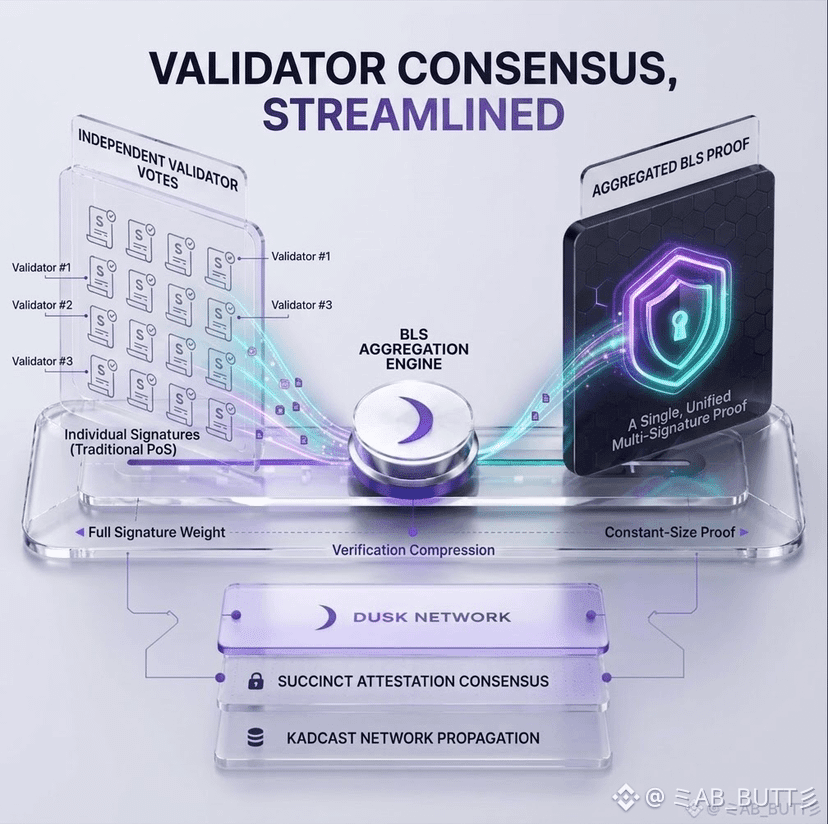
#dusk One detail in Dusk’s consensus architecture makes this more interesting. Instead of storing each validator’s vote separately, the network aggregates BLS signatures into a single proof. In a traditional setup, every validator signature takes up individual block space. In Dusk, hundreds of committee votes are compressed into one constant-sized signature while still verifying every participant.
I think the useful idea here is scalability. Dusk didn’t force nodes to store every independent signature because permanent validator bloat makes running a node too expensive over time.
There’s even a practical trade-off: aggregating BLS signatures requires slightly more cryptographic computation, but it saves massive bandwidth and on-chain storage. That helps keep hardware requirements low for node runners.
So the better question isn’t “how many validators can sign?” It’s how efficiently can the chain record their consensus? $DUSK @Dusk
I think the useful idea here is scalability. Dusk didn’t force nodes to store every independent signature because permanent validator bloat makes running a node too expensive over time.
There’s even a practical trade-off: aggregating BLS signatures requires slightly more cryptographic computation, but it saves massive bandwidth and on-chain storage. That helps keep hardware requirements low for node runners.
So the better question isn’t “how many validators can sign?” It’s how efficiently can the chain record their consensus? $DUSK @Dusk
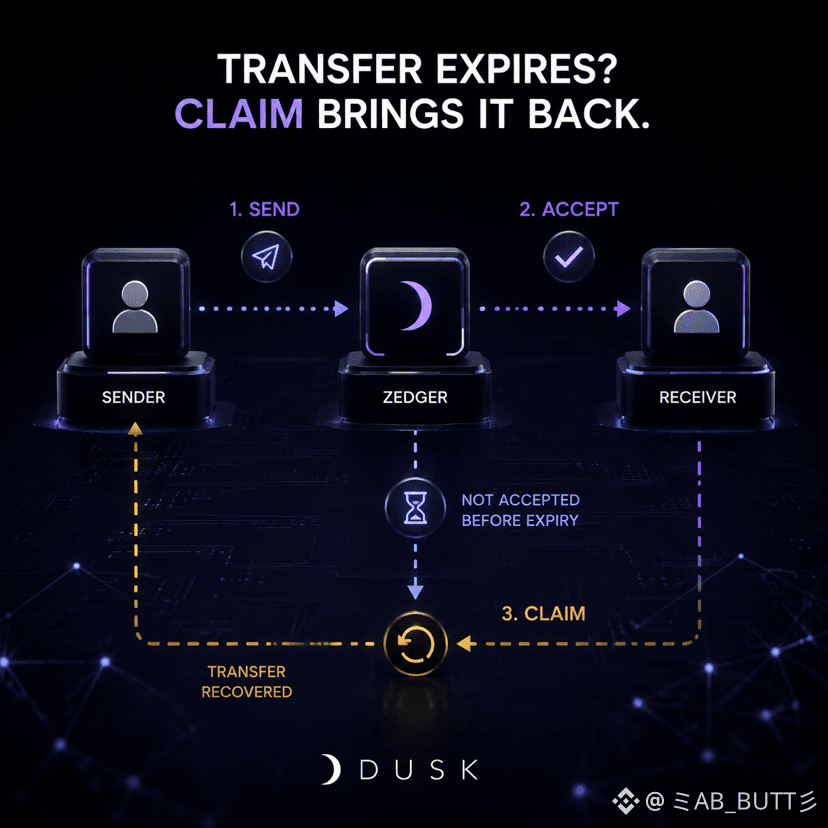
Using tokenized stocks as collateral raises one critical question for me: what changes when traditional market risk enters DeFi?
In @TermMax Alpha’s fixed-term lending engine, the answer comes down to structural friction: market hours versus 24/7 liquidation.
Traditional equities don’t trade on weekends, but smart contracts run non-stop. If an off-chain stock gaps down at Monday's market open, on-chain vaults must absorb days of accumulated price movement in a single block.
TermMax solves the duration problem by locking in fixed borrowing rates and fixed maturities that match equity holding horizons.
The trade-off matters, though. Borrowers avoid sudden variable rate spikes, but they accept off-chain custody wrappers and oracle settlement risks instead.
That’s what I find interesting: fixed rates create predictability, but RWA collateral means accepting real-world market friction on-chain. #termmax @TermMax
In @TermMax Alpha’s fixed-term lending engine, the answer comes down to structural friction: market hours versus 24/7 liquidation.
Traditional equities don’t trade on weekends, but smart contracts run non-stop. If an off-chain stock gaps down at Monday's market open, on-chain vaults must absorb days of accumulated price movement in a single block.
TermMax solves the duration problem by locking in fixed borrowing rates and fixed maturities that match equity holding horizons.
The trade-off matters, though. Borrowers avoid sudden variable rate spikes, but they accept off-chain custody wrappers and oracle settlement risks instead.
That’s what I find interesting: fixed rates create predictability, but RWA collateral means accepting real-world market friction on-chain. #termmax @TermMax
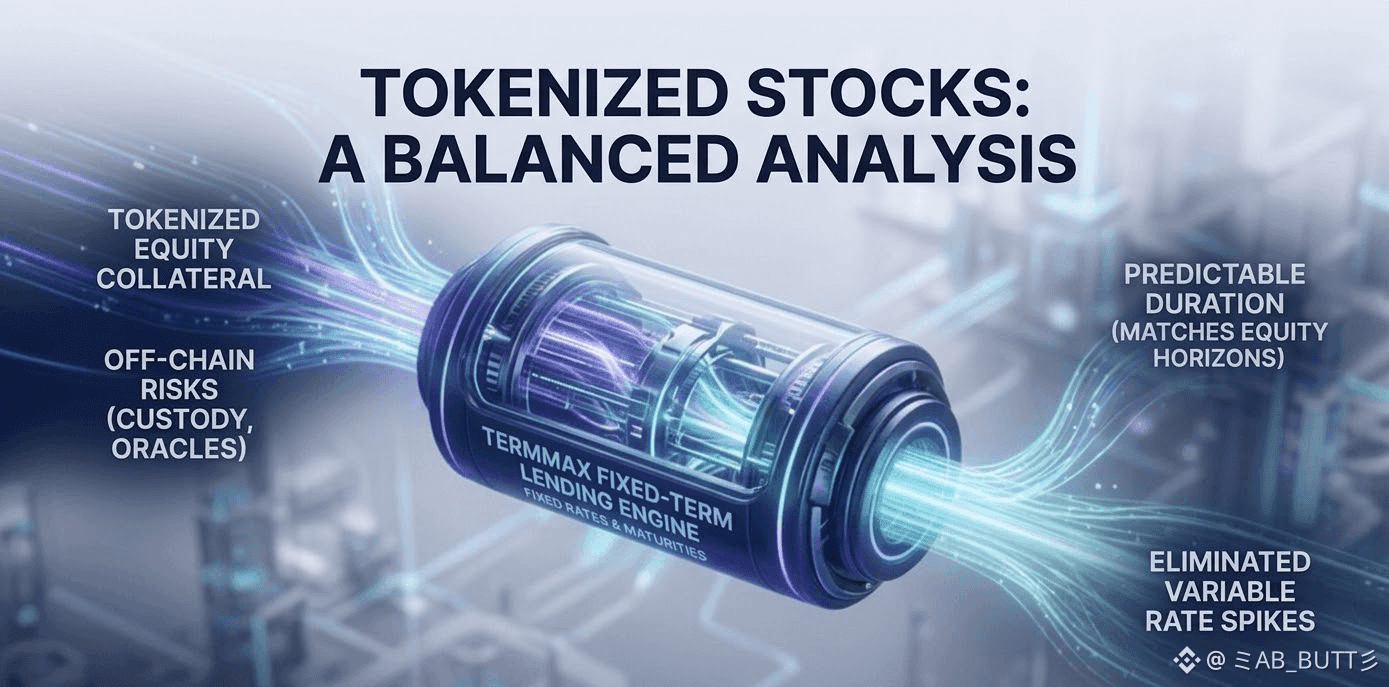
#dusk one detail in Dusk’s Phoenix model makes this more interesting. The network can keep track of balance changes without exposing every transaction and value behind them. Instead of publishing a complete financial history, Phoenix uses encrypted notes and zero-knowledge proofs to maintain valid state while keeping sensitive details private.
I think the useful idea here is continuity. Dusk doesn’t need everyone to see every past transaction to know that the current state is valid.
That creates an interesting trade-off: the network can preserve a long-term record of balance changes while avoiding the need to publish the full financial history behind those balances.
So the better question isn’t “does Dusk keep transaction history?” It’s how much of that history actually needs to be public? $DUSK @Dusk
I think the useful idea here is continuity. Dusk doesn’t need everyone to see every past transaction to know that the current state is valid.
That creates an interesting trade-off: the network can preserve a long-term record of balance changes while avoiding the need to publish the full financial history behind those balances.
So the better question isn’t “does Dusk keep transaction history?” It’s how much of that history actually needs to be public? $DUSK @Dusk
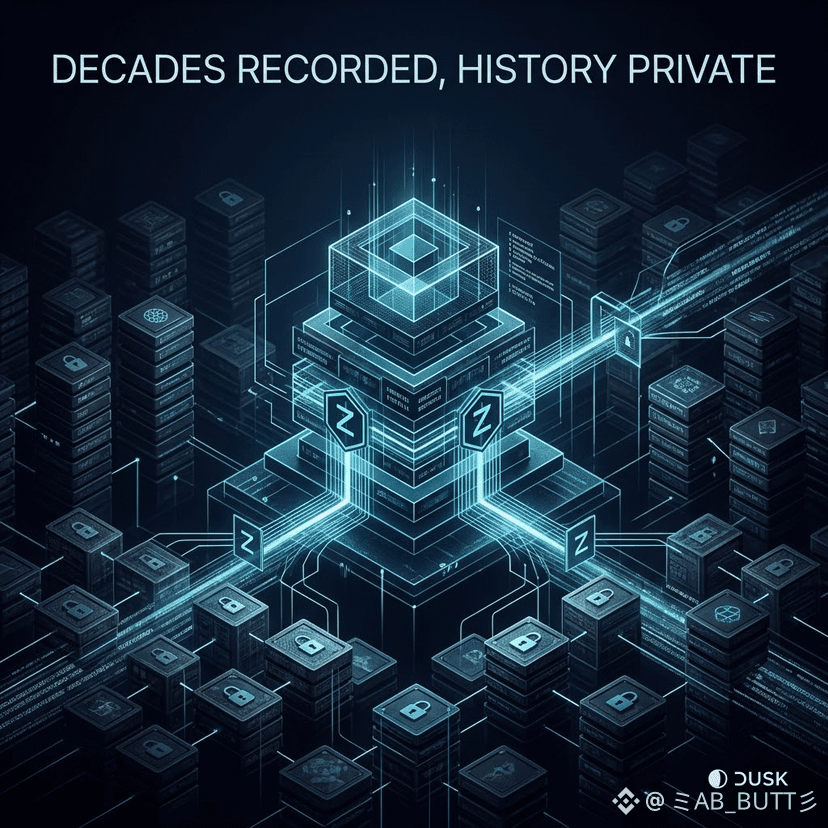
A fixed rate sounds like certainty—until you ask who absorbs the uncertainty behind it.
In @TermMax fixed-rate lending and borrowing lock the rate for a defined maturity, so the borrower knows the interest cost upfront and the lender gets a predictable return. TermMax’s interface separates these fixed-rate markets by maturity, with users choosing specific terms rather than floating indefinitely. (TermMax)
That predictability doesn’t remove interest-rate risk. It changes where it sits.
My read is that the party locking the fixed rate gives up some flexibility if market rates move later. If rates fall, a borrower may be stuck paying the agreed rate; if rates rise, a lender may miss better opportunities elsewhere.
That’s the hidden trade-off: fixed returns reduce rate uncertainty, but they can also create opportunity cost.
So the interesting question isn’t whether the rate is fixed. It’s who benefits when the market moves away from that fixed rate? #termmax @TermMax
In @TermMax fixed-rate lending and borrowing lock the rate for a defined maturity, so the borrower knows the interest cost upfront and the lender gets a predictable return. TermMax’s interface separates these fixed-rate markets by maturity, with users choosing specific terms rather than floating indefinitely. (TermMax)
That predictability doesn’t remove interest-rate risk. It changes where it sits.
My read is that the party locking the fixed rate gives up some flexibility if market rates move later. If rates fall, a borrower may be stuck paying the agreed rate; if rates rise, a lender may miss better opportunities elsewhere.
That’s the hidden trade-off: fixed returns reduce rate uncertainty, but they can also create opportunity cost.
So the interesting question isn’t whether the rate is fixed. It’s who benefits when the market moves away from that fixed rate? #termmax @TermMax
Partly True
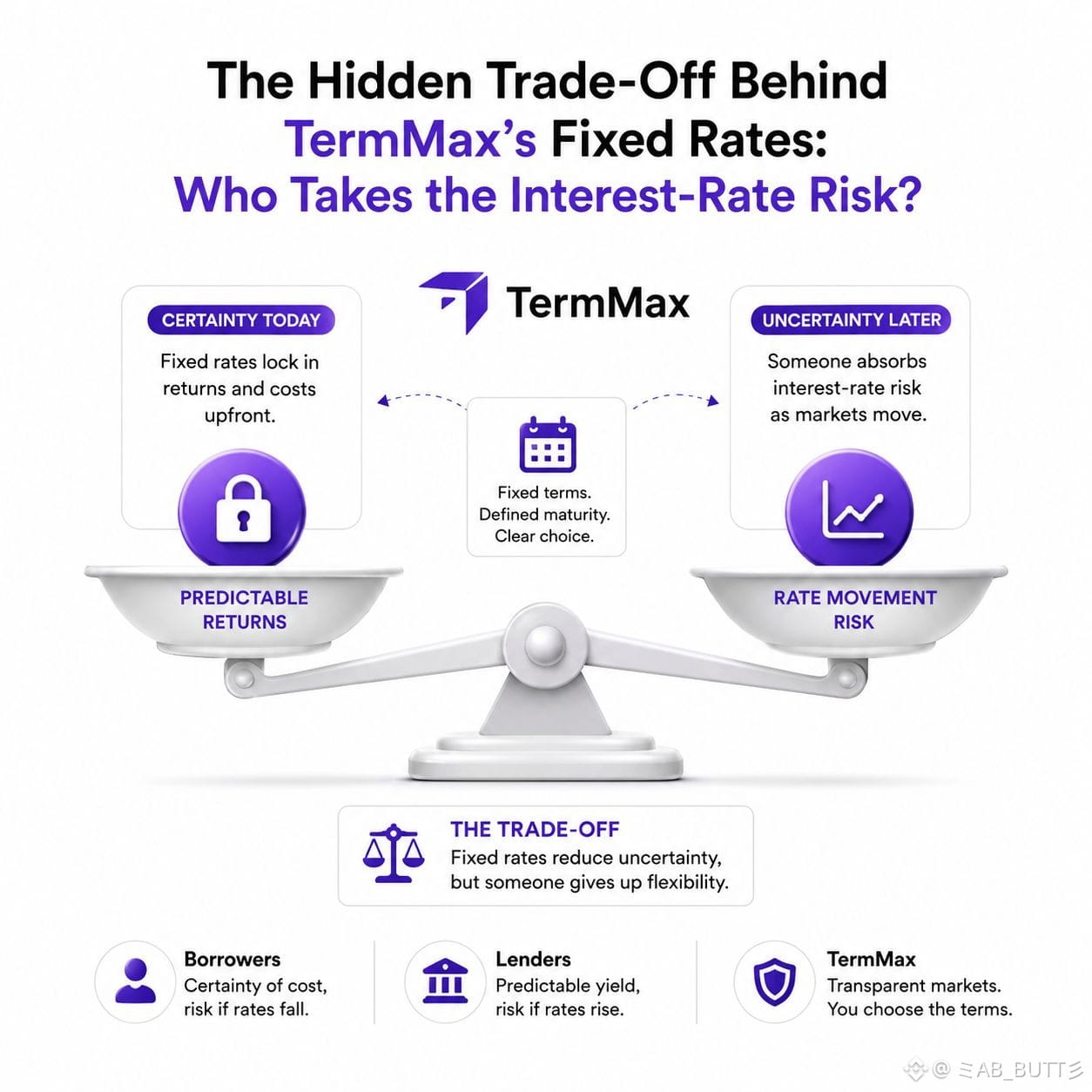
#dusk $DUSK @Dusk a Zedger transfer can be sent without becoming final for the receiver — and that’s exactly why CLAIM exists.
In Dusk’s Zedger design, SEND doesn’t immediately make a transfer part of the receiver’s accepted balance. The receiver still has to ACCEPT it before the transfer expires.
If that never happens, CLAIM provides the sender a defined way to recover the expired transfer rather than leaving it unresolved indefinitely.
That creates an interesting three-step lifecycle:
SEND initiates → ACCEPT completes → CLAIM handles expiry.
What stands out is that Zedger explicitly accounts for the case where the receiving side simply does nothing. The protocol doesn’t have to assume every initiated transfer will successfully complete.
The unanswered question is more practical: how often does CLAIM actually become necessary under real network activity?
The mechanism is documented. Its real-world usage is the evidence worth watching next.
In Dusk’s Zedger design, SEND doesn’t immediately make a transfer part of the receiver’s accepted balance. The receiver still has to ACCEPT it before the transfer expires.
If that never happens, CLAIM provides the sender a defined way to recover the expired transfer rather than leaving it unresolved indefinitely.
That creates an interesting three-step lifecycle:
SEND initiates → ACCEPT completes → CLAIM handles expiry.
What stands out is that Zedger explicitly accounts for the case where the receiving side simply does nothing. The protocol doesn’t have to assume every initiated transfer will successfully complete.
The unanswered question is more practical: how often does CLAIM actually become necessary under real network activity?
The mechanism is documented. Its real-world usage is the evidence worth watching next.
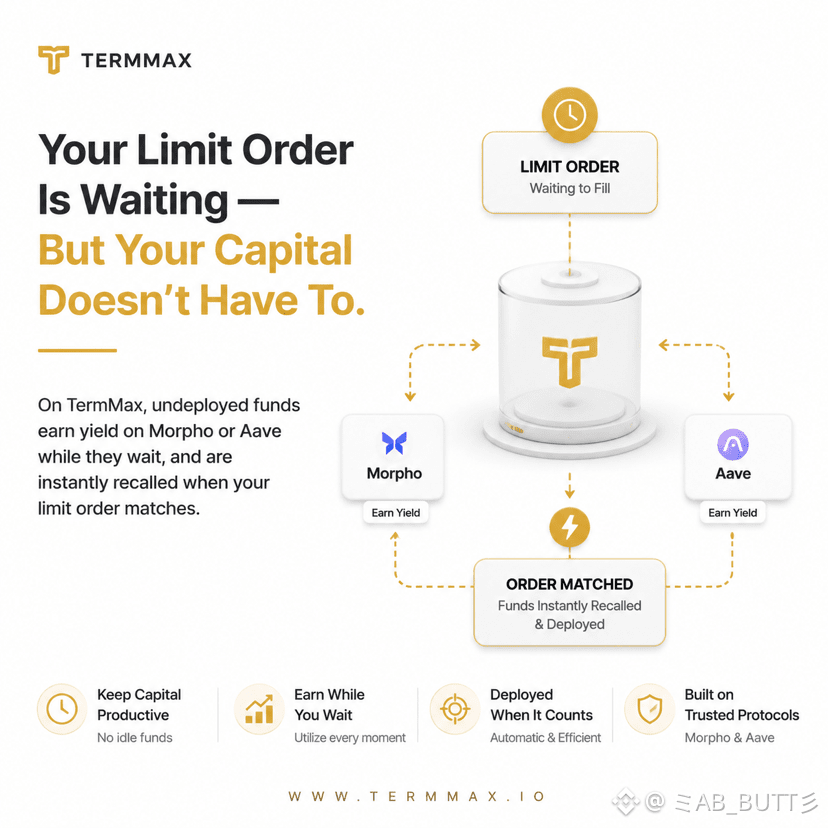
#termmax A limit order waiting to fill usually means capital waiting too. TermMax is trying to change that.
In TermMax’s curator vault design, undeployed funds can be routed to Morpho or Aave to earn floating yield while they wait. When a borrower matches the vault’s rate curve, the required funds are atomically recalled and deployed into the fixed-rate market.
That changes the economics of waiting. A curator doesn’t necessarily have to choose between keeping liquidity ready for a future fixed-rate trade and putting that capital to work elsewhere.
The interesting part isn’t simply “extra yield.” It’s capital utilization: TermMax attempts to make the waiting period productive without removing the liquidity from its intended fixed-rate strategy.
The trade-off? That idle yield remains dependent on the external lending venue and its prevailing rates and risks.
For TermMax, execution efficiency may start before an order even fills. @TermMax
In TermMax’s curator vault design, undeployed funds can be routed to Morpho or Aave to earn floating yield while they wait. When a borrower matches the vault’s rate curve, the required funds are atomically recalled and deployed into the fixed-rate market.
That changes the economics of waiting. A curator doesn’t necessarily have to choose between keeping liquidity ready for a future fixed-rate trade and putting that capital to work elsewhere.
The interesting part isn’t simply “extra yield.” It’s capital utilization: TermMax attempts to make the waiting period productive without removing the liquidity from its intended fixed-rate strategy.
The trade-off? That idle yield remains dependent on the external lending venue and its prevailing rates and risks.
For TermMax, execution efficiency may start before an order even fills. @TermMax
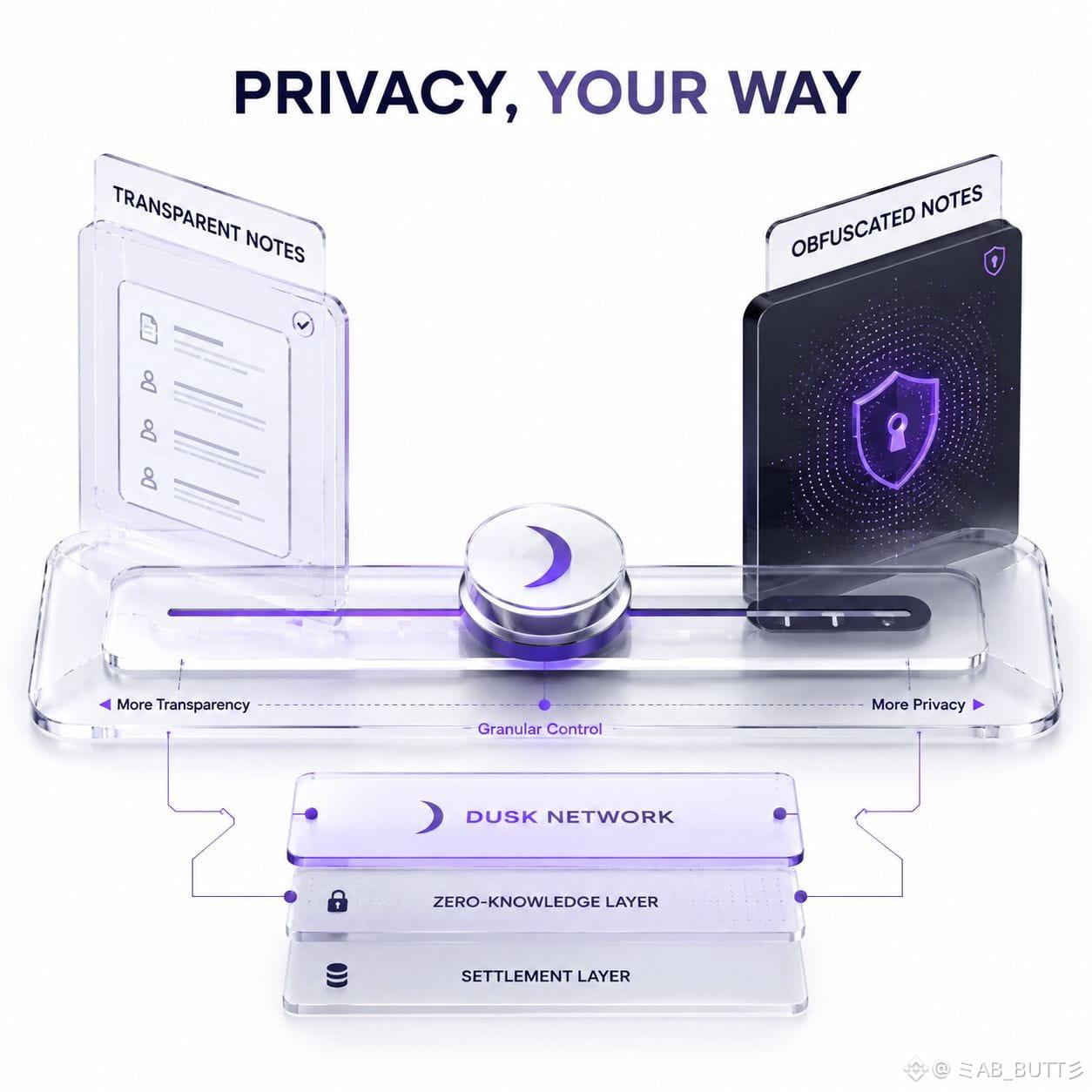
#dusk One detail in Dusk’s Phoenix model makes this more interesting. Notes can be transparent or obfuscated, meaning the system can handle different levels of information visibility inside the same transaction model. In a transparent note, the value is visible. In an obfuscated note, the value is encrypted, while the note still uses Dusk’s privacy mechanism.
I think the useful idea here is flexibility. Dusk didn’t make every note equally visible because some data may need to be checked, while some should stay hidden.
There’s even a practical trade-off: Dusk made zero-value transactions transparent because keeping them obfuscated would add unnecessary entries to the note tree. That helps reduce avoidable data over time.
So the better question isn’t “private or public?” It’s what actually needs to be visible? $DUSK @Dusk
I think the useful idea here is flexibility. Dusk didn’t make every note equally visible because some data may need to be checked, while some should stay hidden.
There’s even a practical trade-off: Dusk made zero-value transactions transparent because keeping them obfuscated would add unnecessary entries to the note tree. That helps reduce avoidable data over time.
So the better question isn’t “private or public?” It’s what actually needs to be visible? $DUSK @Dusk
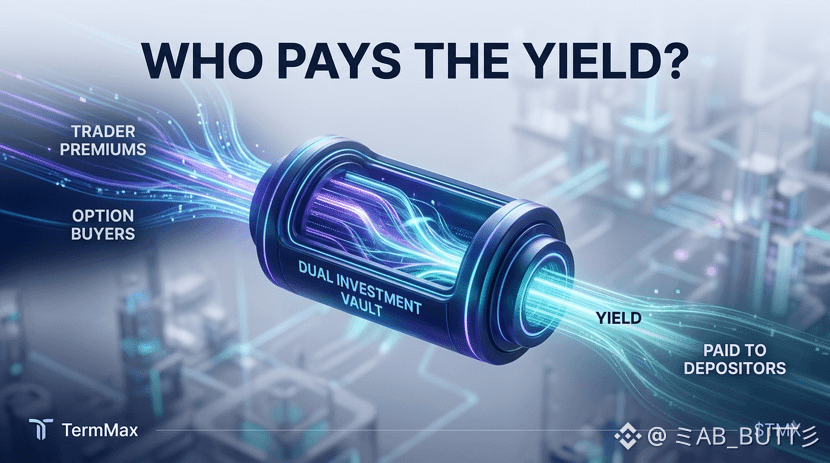
High yield always raises one question for me: who is actually paying it?
In @TermMax Alpha’s Dual Investment Vaults, the answer is surprisingly direct: Long and Short option buyers.
Traders pay premiums upfront to gain leveraged Call or Put exposure. Those premiums become yield for the Dual Investment liquidity providers taking the opposite side. TermMax’s own Alpha interface explicitly states that vault yields are paid by Long/Short buyers. (TermMax)
So the yield isn’t appearing from nowhere. It reflects real demand for optionality and leverage.
The trade-off matters, though. Vault depositors are underwriting those options, meaning returns come with exposure to the underlying asset and settlement conditions—not free yield.
That’s what I find interesting: higher option demand can create more premium income, but the yield exists because someone is accepting the other side of the risk. #termmax @TermMax
In @TermMax Alpha’s Dual Investment Vaults, the answer is surprisingly direct: Long and Short option buyers.
Traders pay premiums upfront to gain leveraged Call or Put exposure. Those premiums become yield for the Dual Investment liquidity providers taking the opposite side. TermMax’s own Alpha interface explicitly states that vault yields are paid by Long/Short buyers. (TermMax)
So the yield isn’t appearing from nowhere. It reflects real demand for optionality and leverage.
The trade-off matters, though. Vault depositors are underwriting those options, meaning returns come with exposure to the underlying asset and settlement conditions—not free yield.
That’s what I find interesting: higher option demand can create more premium income, but the yield exists because someone is accepting the other side of the risk. #termmax @TermMax
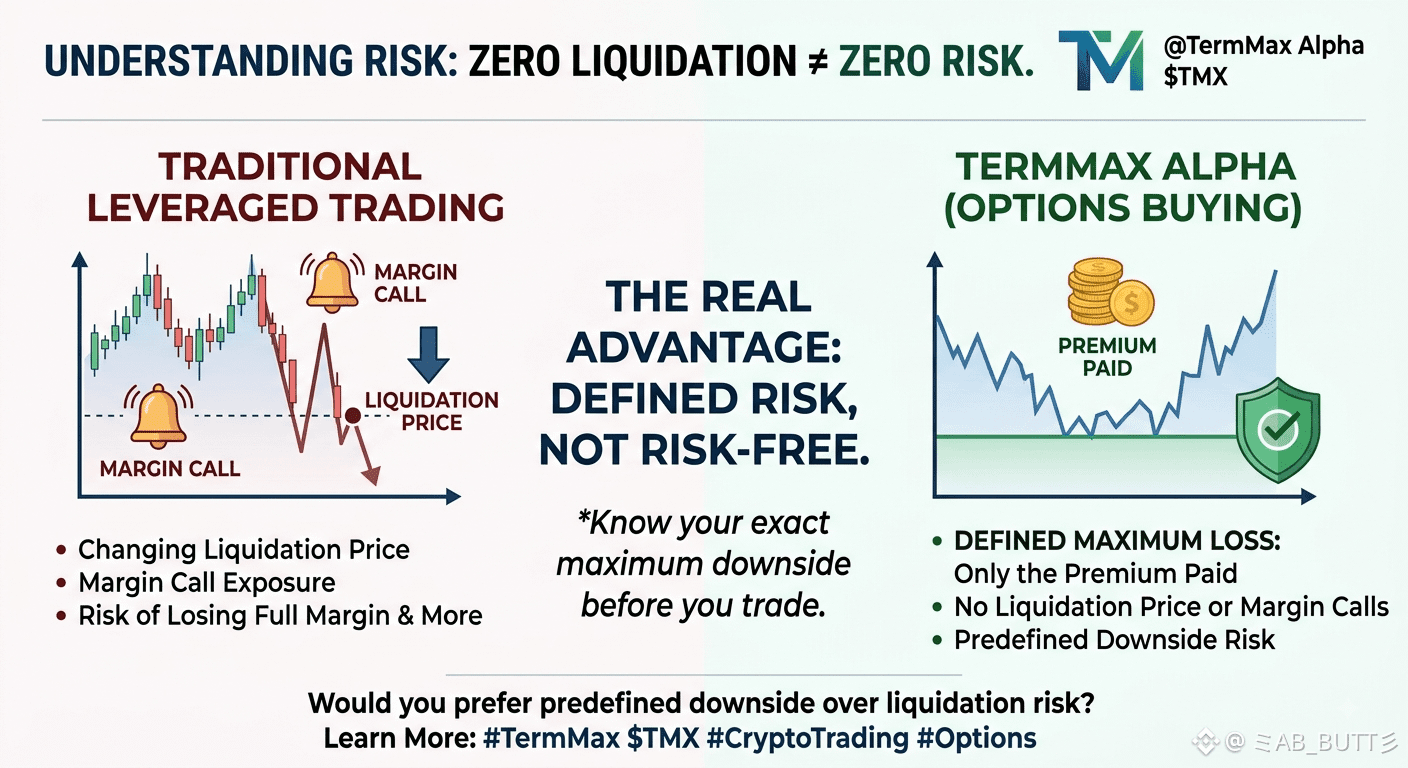
“Zero liquidation” does not mean zero risk.
That’s the most important thing to understand about @TermMax Alpha.
When you buy a Call or Put, you pay the option premium upfront. Unlike traditional leveraged trading, there’s no changing liquidation price or margin call. For the option buyer, the maximum loss is the premium paid.
So if your trade costs $50 and your prediction fails completely, you can lose that full $50 — but not more from that position.
That’s the real advantage: defined risk, not risk-free trading.
There’s still another problem: liquidity. Closing early requires a counterparty, so thin markets can mean slippage or difficulty exiting.
Also, this limited-loss structure applies to the option buyer, not automatically to Dual Investment liquidity providers.
TermMax Alpha doesn’t eliminate risk. It changes how risk is structured.
Would you prefer predefined downside over liquidation risk?
#termmax @TermMax
That’s the most important thing to understand about @TermMax Alpha.
When you buy a Call or Put, you pay the option premium upfront. Unlike traditional leveraged trading, there’s no changing liquidation price or margin call. For the option buyer, the maximum loss is the premium paid.
So if your trade costs $50 and your prediction fails completely, you can lose that full $50 — but not more from that position.
That’s the real advantage: defined risk, not risk-free trading.
There’s still another problem: liquidity. Closing early requires a counterparty, so thin markets can mean slippage or difficulty exiting.
Also, this limited-loss structure applies to the option buyer, not automatically to Dual Investment liquidity providers.
TermMax Alpha doesn’t eliminate risk. It changes how risk is structured.
Would you prefer predefined downside over liquidation risk?
#termmax @TermMax
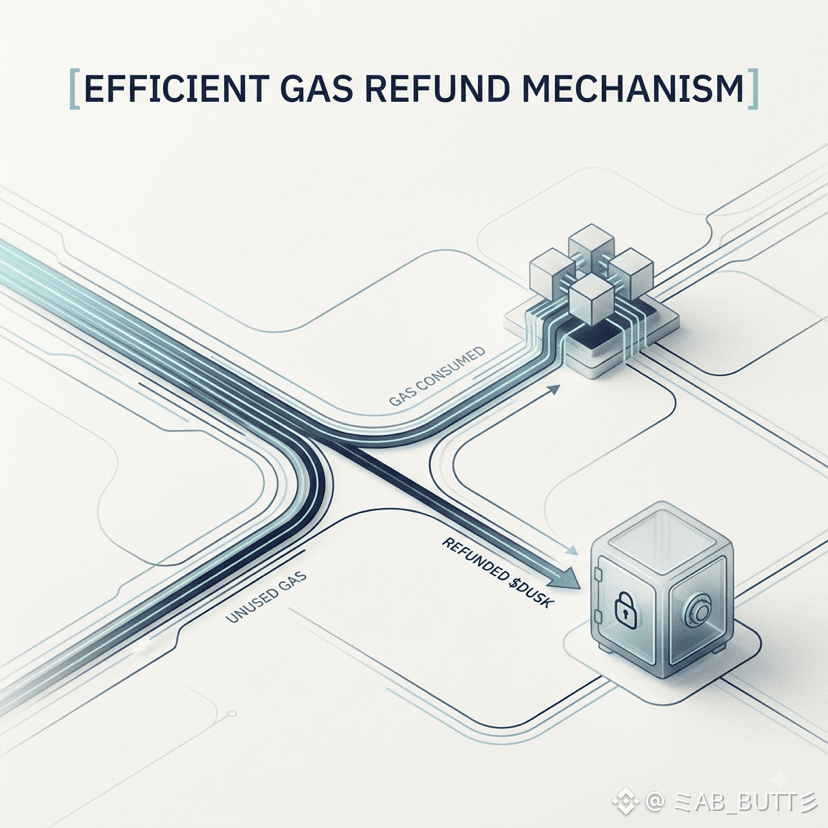
#dusk What happens if you reserve more gas than a DUSK transaction actually uses? The unused part is not simply lost.
When a transaction sets its gas price and gas limit, Dusk also includes a stealth address in the fee data. If execution finishes without consuming all the allocated gas, the remaining value can be returned to that address as a refund.
That detail is easy to miss, but it matters. Users need enough gas allowance to let a contract finish, yet they should not have to treat every unused unit as wasted $DUSK .
The design also fits Dusk’s broader approach of keeping transaction handling precise without making the refund process unnecessarily public.
One question I would still watch in practice is how predictable those refunds feel during more complex contract execution.
For me, this is a small mechanism with a practical message: good transaction design is not only about charging for computation, but also about handling what was never actually used. $DUSK @Dusk
When a transaction sets its gas price and gas limit, Dusk also includes a stealth address in the fee data. If execution finishes without consuming all the allocated gas, the remaining value can be returned to that address as a refund.
That detail is easy to miss, but it matters. Users need enough gas allowance to let a contract finish, yet they should not have to treat every unused unit as wasted $DUSK .
The design also fits Dusk’s broader approach of keeping transaction handling precise without making the refund process unnecessarily public.
One question I would still watch in practice is how predictable those refunds feel during more complex contract execution.
For me, this is a small mechanism with a practical message: good transaction design is not only about charging for computation, but also about handling what was never actually used. $DUSK @Dusk
Partly True
#dusk What if two DUSK participants finalize the same block but do not hold an identical certificate object?
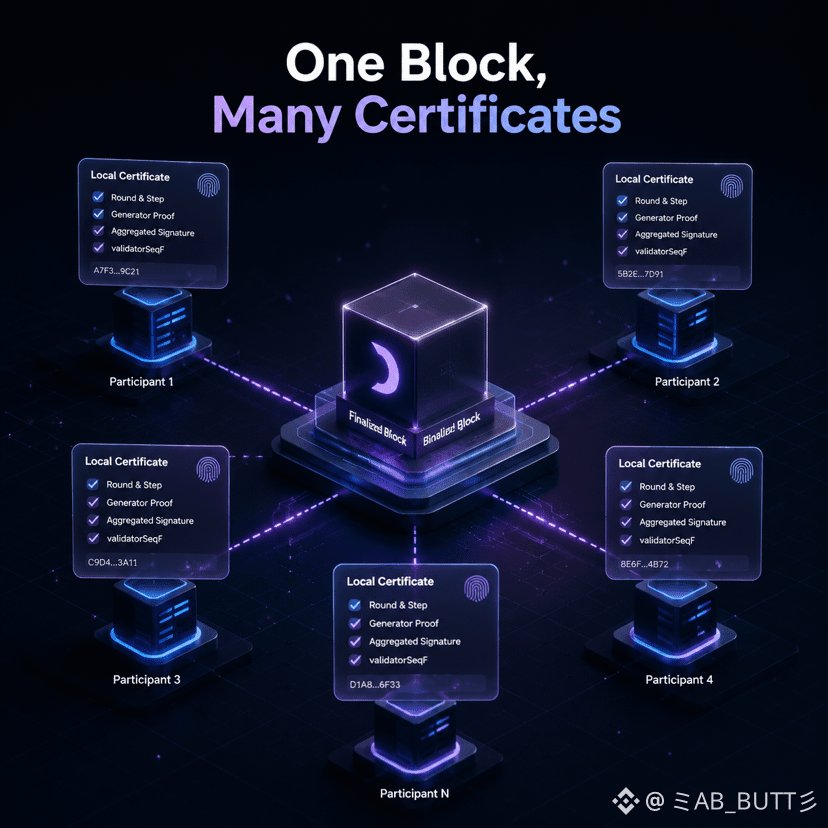
That is actually possible by design. Dusk’s whitepaper states that block certificates are constructed locally by each consensus participant, meaning there is no uniform certificate for a consensus round.
What matters is the evidence inside it. A certificate contains the round and consensus step, the Generator’s Proof-of-Blind-Bid proof and score, an aggregated BLS signature from committee validators, and validatorSeqF, a binary mapping showing which validators contributed signatures across the three relevant committees.
The whitepaper does not explicitly explain the motivation for making certificates local, so claiming a specific reason would be speculation.
What I find interesting is the distinction this creates: participants need to agree on the finalized block, but they do not need one universally distributed representation of its certificate.
For $DUSK , consensus is therefore about shared finality—not necessarily identical locally constructed evidence of that finality.
@Dusk $DUSK @Dusk
That is actually possible by design. Dusk’s whitepaper states that block certificates are constructed locally by each consensus participant, meaning there is no uniform certificate for a consensus round.
What matters is the evidence inside it. A certificate contains the round and consensus step, the Generator’s Proof-of-Blind-Bid proof and score, an aggregated BLS signature from committee validators, and validatorSeqF, a binary mapping showing which validators contributed signatures across the three relevant committees.
The whitepaper does not explicitly explain the motivation for making certificates local, so claiming a specific reason would be speculation.
What I find interesting is the distinction this creates: participants need to agree on the finalized block, but they do not need one universally distributed representation of its certificate.
For $DUSK , consensus is therefore about shared finality—not necessarily identical locally constructed evidence of that finality.
@Dusk $DUSK @Dusk
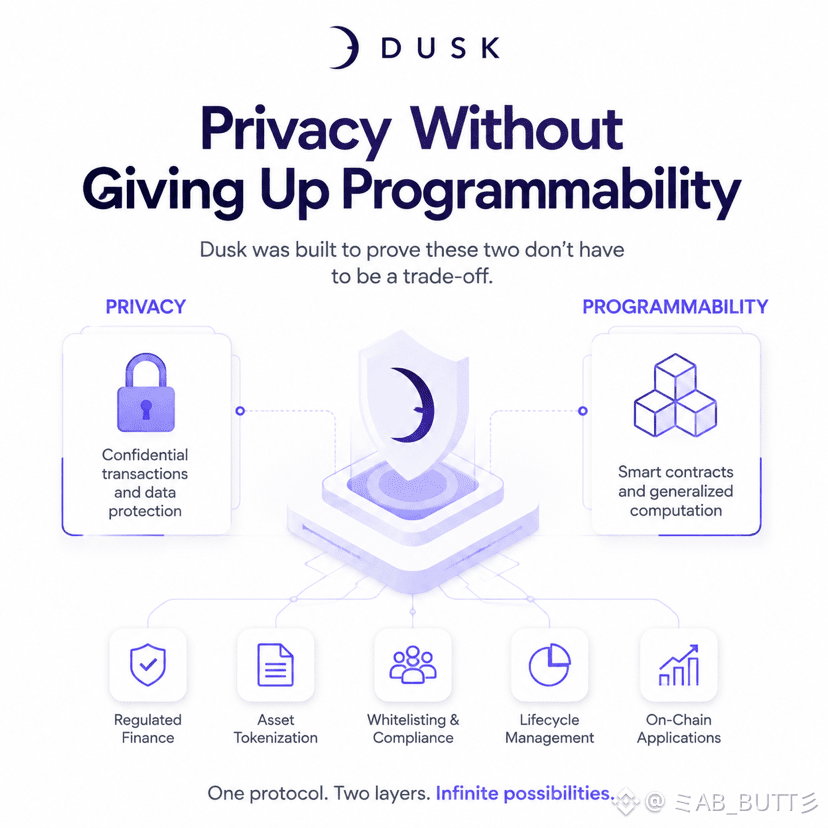
Privacy on a blockchain is useful only if the network can still support meaningful computation. That tension is exactly where DUSK becomes interesting. Dusk was designed as a privacy preserving distributed ledger with two connected layers. The native DUSK asset layer and a generalized compute layer. The goal was not simply to protect transaction information. It was to support confidential transactions while still allowing programmable state changes and smart contract execution. This matters because regulated finance needs more than private payments. It needs rules verification lifecycle management and applications that can operate on chain without exposing every sensitive detail publicly. Dusk approaches this challenge by combining privacy focused transaction models with native zero knowledge proof support in its compute environment. The core idea is straightforward. Privacy should not force a blockchain to sacrifice programmability. Dusk was designed to make both capabilities coexist within the same protocol. #dusk $DUSK @Dusk
Privacy and regulation are often treated as opposing goals. @Dusk takes a different approach by designing its architecture around both. $DUSK #dusk
Its Zedger model was created specifically for privacy-preserving security tokenization and lifecycle management. Instead of treating every transaction as completely open or completely hidden Zedger introduces controlled mechanisms such as whitelisted users and explicit approval for incoming transfers.
It also keeps separate records for transactional voting and dividend-eligible balances. This matters because regulated financial assets can require more than simple ownership tracking. They may need controlled participation and an auditable history of balance changes.
The interesting part is the design philosophy. Dusk is not simply adding privacy to an existing financial system. Its whitepaper explores how privacy features can coexist with the structured requirements of regulated assets.
For on-chain finance this could be a meaningful architectural direction. #dusk $DUSK @Dusk
Its Zedger model was created specifically for privacy-preserving security tokenization and lifecycle management. Instead of treating every transaction as completely open or completely hidden Zedger introduces controlled mechanisms such as whitelisted users and explicit approval for incoming transfers.
It also keeps separate records for transactional voting and dividend-eligible balances. This matters because regulated financial assets can require more than simple ownership tracking. They may need controlled participation and an auditable history of balance changes.
The interesting part is the design philosophy. Dusk is not simply adding privacy to an existing financial system. Its whitepaper explores how privacy features can coexist with the structured requirements of regulated assets.
For on-chain finance this could be a meaningful architectural direction. #dusk $DUSK @Dusk
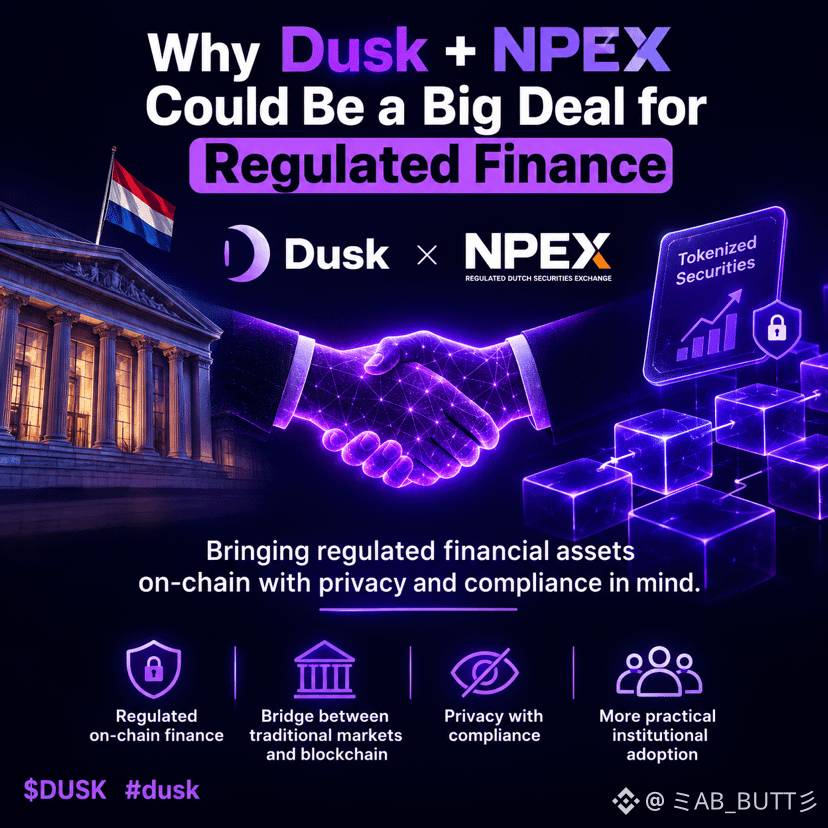
What makes the Dusk + NPEX partnership interesting isn’t simply putting securities on a blockchain. It’s the connection between blockchain infrastructure and a regulated financial market.
NPEX is a regulated Dutch securities exchange while Dusk is designed with privacy and regulated asset tokenization in mind. That combination could make on chain financial instruments more practical for institutions that cannot simply ignore compliance requirements.
The bigger point is that adoption in regulated finance needs more than fast transactions. It needs infrastructure capable of handling privacy transparency where required and the operational realities of financial markets.
That’s why I’m watching this collaboration closely. If Dusk can help bridge traditional securities markets with blockchain rails in a compliant way it could demonstrate a real world use case beyond speculation.
For me this is where DUSK becomes especially interesting. #dusk $DUSK @Dusk
NPEX is a regulated Dutch securities exchange while Dusk is designed with privacy and regulated asset tokenization in mind. That combination could make on chain financial instruments more practical for institutions that cannot simply ignore compliance requirements.
The bigger point is that adoption in regulated finance needs more than fast transactions. It needs infrastructure capable of handling privacy transparency where required and the operational realities of financial markets.
That’s why I’m watching this collaboration closely. If Dusk can help bridge traditional securities markets with blockchain rails in a compliant way it could demonstrate a real world use case beyond speculation.
For me this is where DUSK becomes especially interesting. #dusk $DUSK @Dusk
Log in to explore more content