


Dusk Network doesn’t feel like a project that was born from a hype cycle, because the way they talk about themselves keeps coming back to one simple pressure that most blockchains avoid, which is that real financial markets cannot operate with everything exposed in public all the time, and if tokenized assets are ever going to become normal, the underlying chain has to respect privacy while still allowing the kind of controlled transparency that regulators and institutions demand. Dusk is positioning itself as a Layer-1 built specifically for that world, where confidentiality is not a feature you add later, but something that sits inside the transaction model and the asset standard from the start.
What makes this interesting is that Dusk isn’t selling “privacy” as pure invisibility, because that’s not what regulated finance wants, and it’s not what regulated finance can legally accept, so the project leans into a more mature version of privacy where sensitive details can be protected during transfers and contract execution, while still leaving room for auditability when it’s legitimately required. Their own updates around Phoenix make it clear they’ve been shaping the design toward privacy-preserving compliance rather than anonymity for its own sake, which is a subtle but very important difference if the end goal is financial infrastructure instead of a niche privacy community.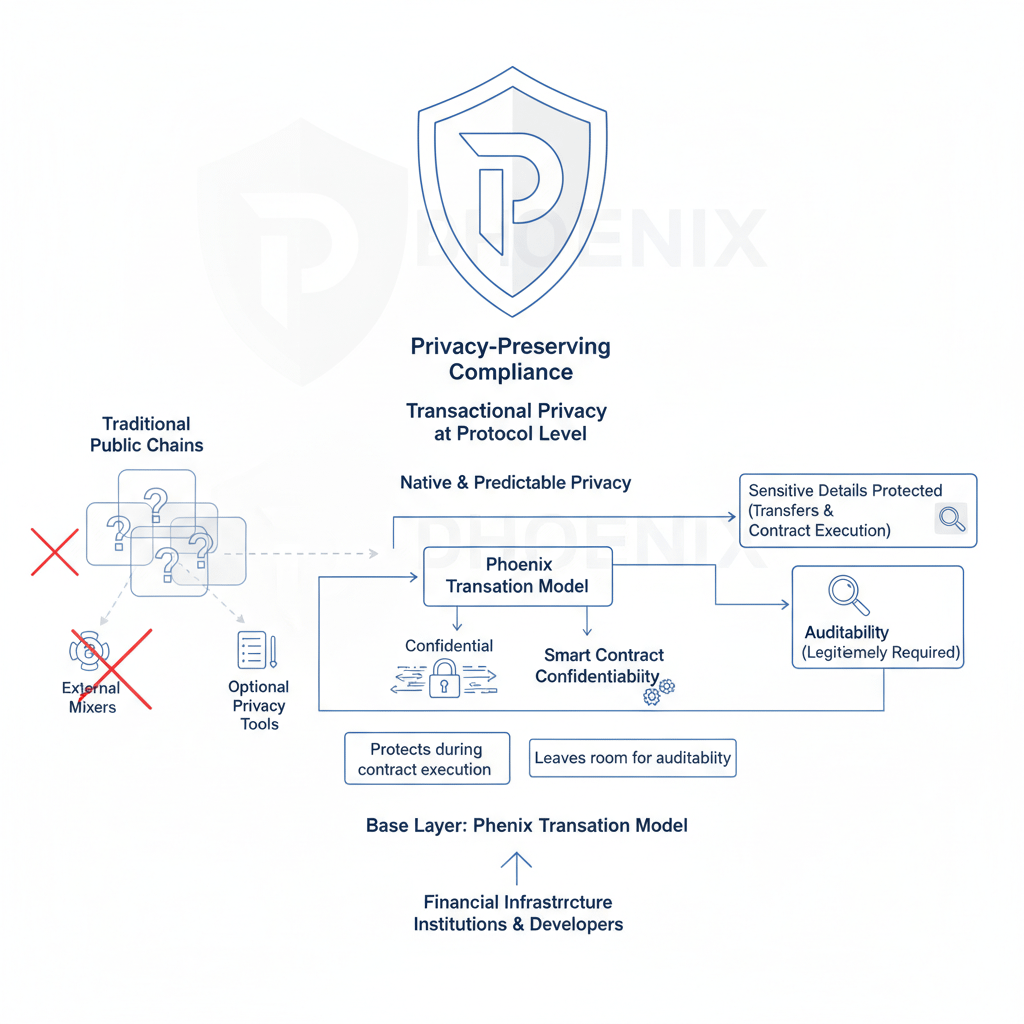
At the base layer, Dusk describes Phoenix as the transaction model that brings confidentiality into transfers and smart contract behavior, and this is where the project begins to separate itself from typical account-based public chains, because Phoenix is meant to protect transactional privacy at protocol level rather than relying on external mixers or optional privacy tools. The bigger idea is that privacy should be native and predictable, so developers and institutions aren’t building on assumptions that break the moment the chain gets busy or the regulatory climate shifts.
On top of that, Dusk talks about Zedger as a hybrid approach designed for tokenized securities, and this is where the project’s “financial markets” focus starts to look more concrete, because securities don’t behave like simple transferable coins, they come with rules, constraints, and lifecycle events that need to exist without turning the whole system into a surveillance machine. The reason this matters is simple: if the asset is regulated, the chain has to support compliant behavior natively, otherwise compliance gets pushed into off-chain gatekeepers and the promise of on-chain settlement becomes weaker.
That’s also why Dusk keeps emphasizing XSC, the Confidential Security Contract standard, because they’re not just saying “you can tokenize things here,” they’re trying to offer a standard that is purpose-built for confidential, compliant securities issuance and transfer. In practice, standards are what create repeatability, because issuers and platforms don’t want to reinvent compliance logic and privacy mechanics every time they launch a new instrument, and Dusk is aiming to make that process feel like a template rather than a custom engineering project.
When you look at what they’re doing behind the scenes, it reads like a long-term build toward settlement-grade infrastructure, where fast and predictable finality matters as much as privacy, because in finance you don’t want “probably final,” you want final, and you want it on a schedule that can support real settlement workflows. Their documentation around core components and consensus describes a structure designed to deliver deterministic settlement behavior suitable for financial applications, which is exactly the kind of boring detail that becomes extremely valuable if the chain is expected to carry real asset value.
The project’s modular direction is another part of the story that people miss at first glance, because it’s not as flashy as privacy tech, but it solves a real adoption problem, which is integration friction and developer onboarding. Dusk has discussed evolving into a multi-layer architecture with a settlement foundation and an EVM execution layer, which is basically them saying they want builders to use familiar tooling where possible, while still keeping privacy execution and financial-specific logic as a core advantage rather than something sacrificed for compatibility.
Now if we bring it back to the token story, the DUSK token you linked is the ERC-20 contract on Ethereum, and it gives a clear public footprint for supply and activity, which matters for anyone trying to understand what they actually hold today. On the token page, the max supply is shown as 500,000,000 DUSK, and you can also see holder count and transfer activity directly, which is the kind of transparent baseline that helps separate narrative from measurable movement, even before you think about how the token connects to staking, fees, and security on the Dusk network itself.
If Dusk succeeds in the direction they’re aiming for, the benefits become very clean and practical, because you get a chain where institutions can move value and settle assets without exposing every detail to the public, while issuers can create tokenized instruments with built-in confidentiality and compliance behavior instead of bolting those requirements on afterward. You also get a clearer path for tokenized real-world assets to behave like real securities on-chain, with privacy and auditability existing in the same design rather than being treated like enemies that can’t coexist.
For “what’s next,” the most realistic forward path is not a single magical announcement, it’s a sequence where Dusk continues hardening the settlement layer, continues pushing standards like XSC into practical issuance flows, and keeps reducing integration friction so developers and partners can actually deploy real applications without fighting the stack. The strongest sign of progress will always be usage that looks like the target market, meaning more issuance and more compliant asset flows, not just trading volatility, and their own public roadmap direction around modular evolution suggests they understand that adoption is built through usability, not just innovation.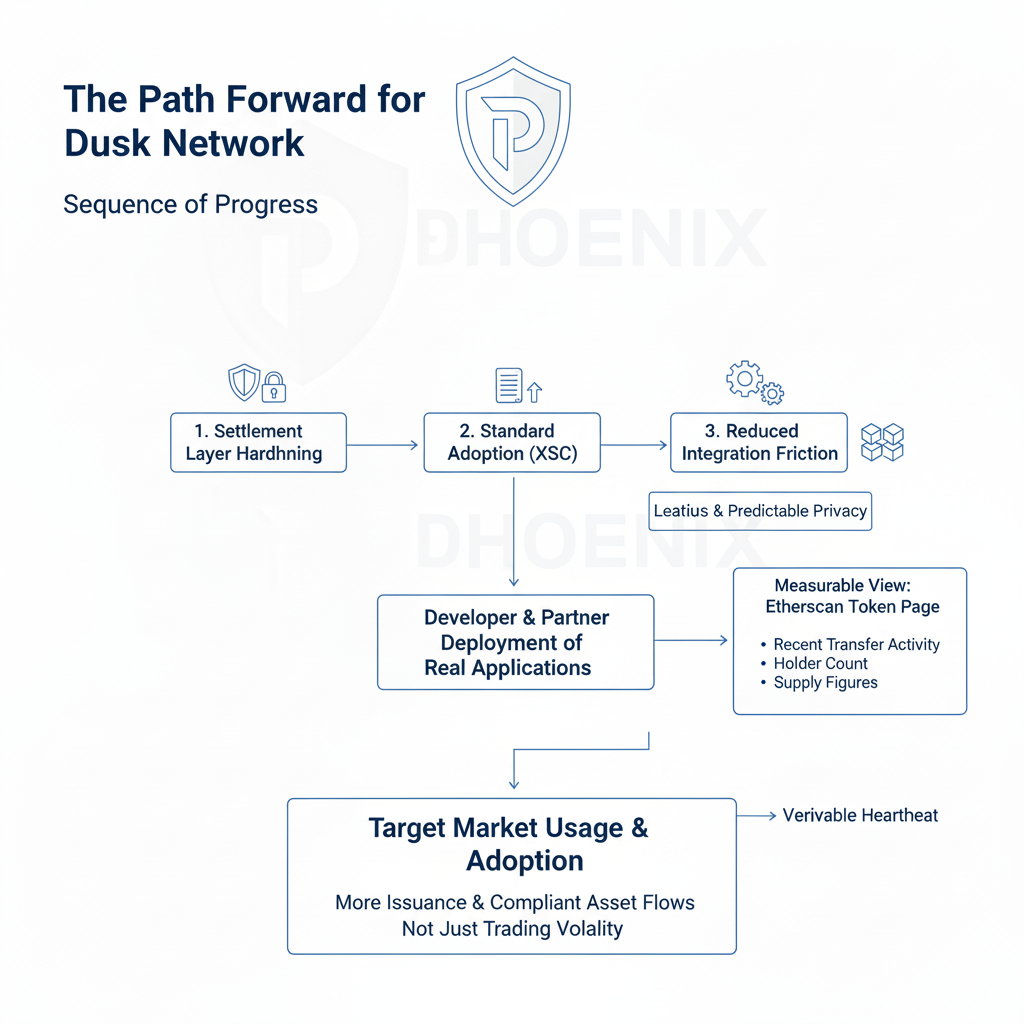
If you want a clean “last 24 hours” snapshot that doesn’t depend on opinions, the Etherscan token page provides a measurable view of recent transfer activity, along with the holder count and supply figures, and that’s a useful heartbeat even when there isn’t a fresh headline posted on the project site that day. It won’t tell you everything about ecosystem progress, but it does tell you the token is actively moving, and it grounds the conversation in something you can verify at any moment without trusting anyone’s narrative.
My takeaway is that Dusk is building for a future where privacy is treated as necessary infrastructure for markets, not a rebellious gimmick, and where compliance is handled through protocol-aware design rather than centralized control. The project’s value is not just in saying “we do privacy,” but in how it tries to make confidentiality compatible with real-world asset behavior, settlement finality, and institutional integration, which is a much harder job than launching another general-purpose chain, and that difficulty is exactly why the upside is meaningful if they keep executing.
