
The discrepancy between the token's little price and its large product claim is what tells Vanar, not a noisy chart. With a market capitalization in the mid-teens of millions and a couple million in 24-hour volume, depending on the venue you look at, $VANRY is now trading at about six-tenths of a penny, or $0.0063. According to CoinMarketCap, the market capitalization is approximately $14.2 million on a circulating supply of about 2.256 billion, with a maximum of 2.4 billion. Because it trades like a tiny cap and requires little flow to move, Bybit displays a comparable price band and even prints the intraday high and low.
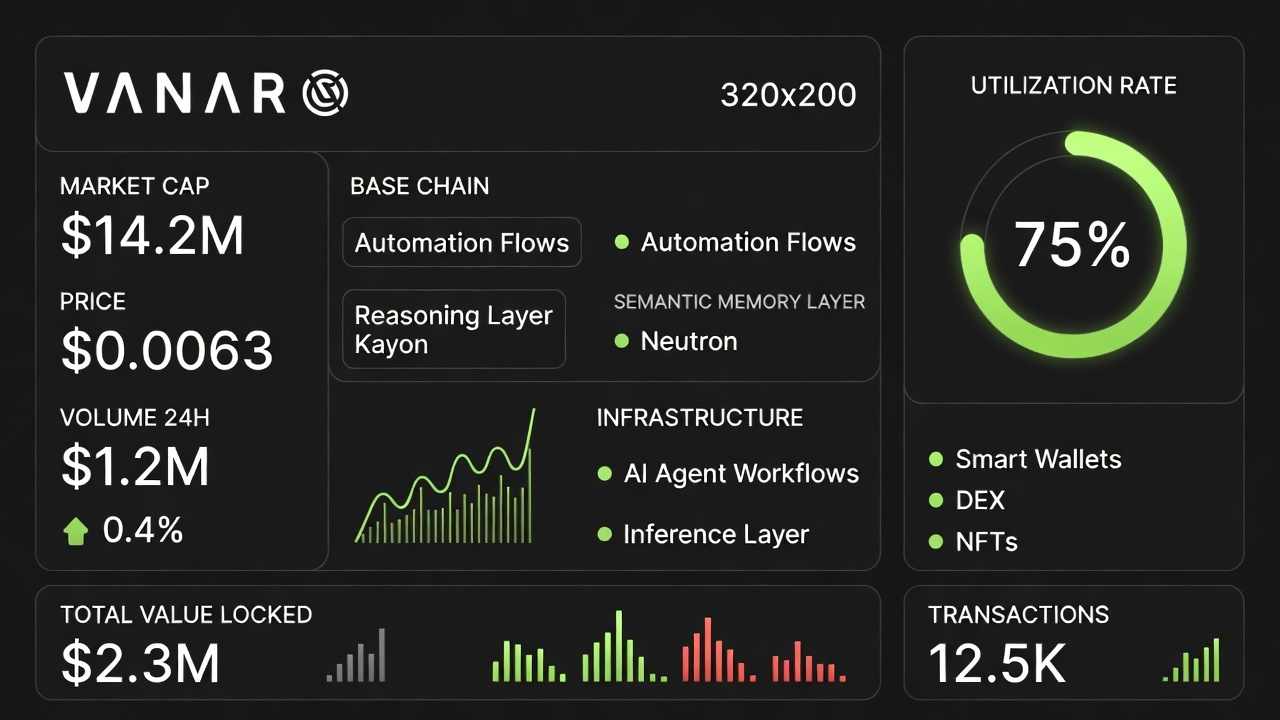
The thing most traders overlook when they look at that chart and continue is this. The only significant concern if @Vanar were "just another chain" would be its ability to acquire users. However, the pitch is not the same. The argument is that AI is a task that modifies the base layer's requirements rather than a feature that can be added to apps later. If you accept that premise, you evaluate Vanar as infrastructure for agent workflows—data in, reasoning, verification, actions out—rather than as you would a general L1.
Consider it this way. Most chains may function as a ledger fairly well. Software agents that must read jumbled inputs, maintain context, demonstrate their activities, and then carry out transactions within restrictions are not intended to work there. In markets, auditability, authorization, and consistent performance under pressure are the three things that separate a nice demo from something that institutions can rely on. Vanar is making a conscious effort to productize those "boring" requirements as primitives at the protocol level.
The architecture they are selling is where things get interesting. The fundamental concept is a stack consisting of a base chain, automation (Flows), reasoning layer (Kayon), and semantic memory layer (Neutron). The key aspect is that unstructured data becomes structured objects, those objects become queryable, and the logic acting on them is meant to be traceable. You can scoff at any chain website that displays layers. That is the distinction between "AI as infrastructure" and "AI integration." You need more than just a chat interface if an agent is going to confirm an invoice, verify a document, or check a compliance rule before a payment is made. The state, provenance, and replayable trail of the agent's actions are necessary.
What is the market lacking, then? In one limited sense, it's possible that #vanar has already passed the "whitepaper phase" because the chain is operational and has been used. ~193.8M transactions, ~28.6M wallet addresses, and ~8.94M blocks are displayed in their own explorer. For something the market values as a rounding error, those are significant cumulative figures. However, sticky demand is not comparable to cumulative numbers. They do inform you of the existence of the rails, the flow of blocks, and the fact that utilization has occasionally occurred at scale. For this reason, even though the price seems sleepy, I don't think this will vanish right away.
When considering this as a trade, positioning and liquidity are the immediate realities. Although VANRY's volume-to-market-cap ratio of 0.18, as displayed by TradingView, is a respectable "attention density" for a token this tiny, it also indicates fragility. Sharp squeezes and sharp air pockets can be obtained from very little news when volume is a significant portion of market capitalization. That is reciprocal.
"Number goes up because AI" is not the bull case. It is more precise. The bull thesis is that agent workflows that can securely execute high-frequency, low-trust tasks will become an actual category. It is not necessary for the token to rank among the top 50 assets if Vanar's framework of "semantic memory + reasoning + bounded automation" corresponds to actual enterprise or PayFi pipelines. If they can demonstrate recurrent use fees or a plausible route to them, even a minor repricing from a market valuation of about $14 million to, say, $150 million to $300 million is 10x to 20x territory, and that's still not crazy in relative terms. However, that is only possible if the narrative results in receipts, such as active deployments, actual throughput linked to business operations,
You should take the bear situation seriously because it is simpler. The story of AI-native infrastructure is simple to promote because it is difficult to disprove early on. It is possible to publish product pages and architecture diagrams without having a product-market fit. Additionally, you can achieve impressive overall transaction counts without significant economic demand, particularly if the chain is inflated by incentives, airdrop dynamics, or internal activity. On the token side, tiny stocks with daily volumes of a few million can appear liquid until they aren't. Just the decision to stop holding "maybe" narratives can cause a $0.006 token to cut in half if broader risk is turned off.
What, then, would make me reconsider either way? If Vanar begins to demonstrate that the AI stack is generating quantifiable on-chain behavior beyond transfers, such as contract interactions linked to Neutron-style data objects, recurring users linked to particular dapps, and a distinct pattern of fees that increase with usage while remaining predictable, I would become more constructive. If price action remains poor and the chain's public statistics remain unchanged, or if it is still unable to validate the "AI layers" in the wild beyond first-party assertions, I would become more cautious.
Keep it dull if you're following this like a trader. Watch the price and volume in real time, but also keep an eye on whether the chain's activity resembles a living economy or a heartbeat monitor. Since the entire thesis is "AI becomes infrastructure," the win condition is not hype but rather repeatable procedures that are essential to someone's business and run every day. VANRY is a high-beta choice on a large idea priced like a little trial until you realize that.
