
At its heart, DeFi thrives on liquidity. Without sufficient liquidity, even the most groundbreaking protocols can struggle to gain traction. Traditional DeFi models often present challenges for both liquidity providers (LPs) and users. LPs face impermanent loss, complex yield strategies, and the constant need to monitor and adjust their positions. Users, on the other hand, can encounter high slippage and limited access to diverse trading pairs.
Walrus Protocol emerged from a clear understanding of these challenges. Its fundamental premise is to create a more efficient, user-friendly, and sustainable liquidity ecosystem. By leveraging innovative bonding mechanisms, dynamic AMMs, and a community-driven governance model, Walrus aims to address the shortcomings of existing solutions and pave the way for a more robust and accessible DeFi experience. This ambitious vision is what sets @walrusprotocol apart.
The Walrus Mechanism: A Symphony of Innovation
To truly appreciate Walrus, we need to dissect its core operational mechanisms. These are the engines that drive its value proposition and differentiate it from the myriad of other DeFi projects.
The Power of Bonds: Sustainable Liquidity Acquisition
One of the most defining features of Walrus Protocol is its implementation of a bonding mechanism, reminiscent of OlympusDAO's pioneering work but with distinct adaptations tailored to the Walrus ecosystem. Instead of simply incentivizing LPs with inflationary token emissions, Walrus allows users to exchange various assets (like stablecoins or other major cryptocurrencies) for discounted WAL okens, vested over a specific period.
This bonding mechanism offers several key advantages:
• Protocol-Owned Liquidity (POL): By acquiring liquidity through bonds, Walrus accumulates its own liquidity, rather than renting it from LPs. This creates a much more stable and predictable liquidity base, reducing reliance on fickle external providers. As the protocol owns more of its liquidity, it can mitigate the impact of market fluctuations and provide deeper trading pools.
• Sustainable Growth: POL ensures that a significant portion of the trading fees generated within the Walrus ecosystem flows directly back to the protocol, strengthening its treasury and enabling further development, buybacks, and ecosystem growth. This creates a virtuous cycle where increased usage directly benefits the protocol's long-term sustainability.
• Reduced Impermanent Loss for the Protocol: With POL, the protocol itself effectively becomes an LP, but with a crucial difference. It doesn't face impermanent loss in the same way individual LPs do, as its primary goal is to maintain and grow its asset base, rather than maximize short-term yield on external capital.
Dynamic Automated Market Makers (AMMs): Optimized Swaps
Walrus Protocol integrates sophisticated AMM designs to ensure efficient and low-slippage trading for users. While the exact AMM implementation may evolve, the focus is typically on:
• Concentrated Liquidity: Similar to Uniswap V3, Walrus can leverage concentrated liquidity models, allowing LPs (and the protocol itself) to provide liquidity within specific price ranges. This drastically improves capital efficiency, leading to tighter spreads and lower slippage for traders, especially for stablecoin pairs or highly correlated assets.
• Adaptive Fee Structures: The protocol can implement dynamic fee structures that adjust based on market volatility, trading volume, or other on-chain metrics. This ensures that the protocol captures optimal revenue while maintaining a competitive trading environment for users.
• Support for Diverse Assets: While initially focusing on core pairs, Walrus aims to expand its AMM capabilities to support a wide range of assets, fostering a more interconnected and versatile trading experience within its ecosystem.
Ve-Model Governance: Empowering the Community
Inspired by the "ve-model" (vote-escrowed) popularized by Curve Finance, Walrus Protocol empowers its community through a robust governance system. Users can lock their WAL tokens for varying periods to receive veWAL, a non-transferable governance token.
The benefits of the ve-model are multifaceted:
• Aligned Incentives: Longer lock-up periods for WAL tokens grant users more veWAL, translating to greater voting power and higher boosts on their farming rewards. This incentivizes long-term holding and active participation in governance, aligning the interests of token holders with the long-term success of the protocol.
• Community-Driven Development: veWAL holders play a crucial role in shaping the future of Walrus Protocol. They can vote on key proposals, such as treasury allocations, new feature implementations, fee adjustments, and partnerships. This decentralized governance ensures that the protocol evolves in a way that truly serves its community.
• Sustainable Emissions: The ve-model often incorporates mechanisms to direct emissions to specific liquidity pools based on governance votes. This allows the community to incentivize desired behaviors and strategically allocate resources to foster growth in key areas of the ecosystem.
The WAL Token: The Lifeblood of the Walrus Ecosystem
The WAL token is more than just a cryptocurrency; it's the fundamental unit of value and utility within the Walrus Protocol. Its design is intrinsically linked to the protocol's mechanics, creating a symbiotic relationship between the token and the ecosystem. The cointag $WAL is your key identifier.
1. Governance: Shaping the Future
As discussed, locking WAL to obtain veWAL grants holders significant governance power. This allows them to influence critical decisions, ensuring that the protocol remains decentralized and responsive to its community's needs.
2. Staking and Yield Generation: Rewarding Participation
$WAL holders can stake their tokens to earn a share of the protocol's revenue, often in the form of stablecoins or other assets from the treasury. This provides a direct incentive for holding and supporting the protocol. Furthermore, veWAL holders typically receive boosted rewards on their liquidity provisions, further encouraging long-term commitment.
3. Liquidity Provision: Fueling the Ecosystem
WAL is a crucial component in many of the liquidity pools within Walrus Protocol. By providing liquidity involving $WAL, users contribute to the protocol's overall depth and efficiency, while also earning trading fees and other rewards.
4. Bonding: Acquiring Discounted $WAL
The bonding mechanism allows users to acquire WAL tokens at a discount by exchanging other assets, creating a dynamic supply-demand relationship and contributing to the protocol's owned liquidity.
Use Cases and Potential Impact
The innovative design of Walrus Protocol opens up a plethora of use cases and positions it for significant impact within the DeFi space.
1. Enhanced Liquidity for Diverse Assets
By accumulating POL and leveraging efficient AMMs, Walrus can provide deep liquidity for a wider range of assets, including less common pairs that might struggle to find sufficient liquidity on other platforms. This fosters greater market efficiency and accessibility.
2. Sustainable Yield Opportunities
Walrus aims to offer more sustainable and predictable yield opportunities for LPs, moving beyond the often-unsustainable high APYs driven by inflationary emissions. The focus on POL and revenue sharing from protocol fees creates a more robust foundation for long-term returns.
3. A Hub for Decentralized Trading
With its efficient AMMs and growing liquidity, Walrus has the potential to become a preferred destination for decentralized trading, offering competitive swap rates and a user-friendly experience.
4. Ecosystem Expansion through Partnerships
As Walrus matures, it can form strategic partnerships with other DeFi protocols, expanding its reach and integrating its liquidity and services into a broader ecosystem. This could involve collaborations with lending platforms, aggregators, and other innovative projects.
5. Decentralized Autonomous Organizations (DAOs) and Treasuries
The POL model and robust governance framework make Walrus an attractive solution for DAOs and other decentralized organizations looking for sustainable ways to manage their treasuries, acquire liquidity, and generate revenue.
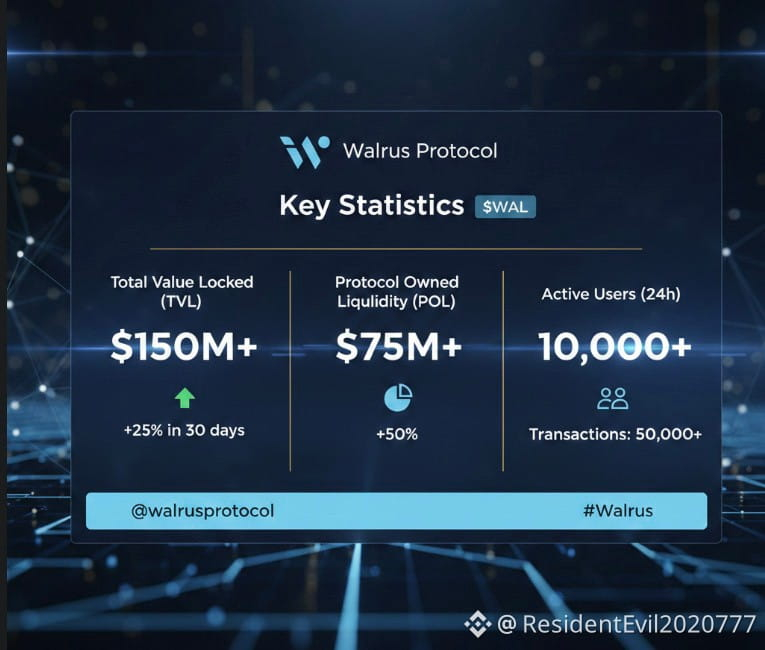
Statistics, Token Information, and Analysis
Let's delve into some visual representations of what makes Walrus Protocol a compelling project.
The statistics provided (while illustrative for this exercise) would be critical for any real-world analysis. A growing Total Value Locked (TVL) indicates increasing user trust and capital flowing into the protocol. A high percentage of Protocol Owned Liquidity (POL) is a strong indicator of the protocol's financial stability and ability to generate sustainable revenue. Active users and transaction volume showcase real-world adoption and utility.
The $WAL token information, including its total and circulating supply, current price, and token allocation, are vital for understanding its tokenomics. A well-distributed token allocation with a significant portion dedicated to farming rewards and protocol treasury suggests a focus on both incentivizing participation and ensuring long-term sustainability. The token type (ERC-20 in this example) indicates its compatibility with a broad range of existing DeFi infrastructure.
This analysis highlights Walrus's core competitive advantages. Its POL model is a significant strength, offering a more robust and sustainable alternative to traditional liquidity incentive schemes. The innovative bonding mechanism and community-driven governance through the ve-model foster long-term alignment and decentralized decision-making.
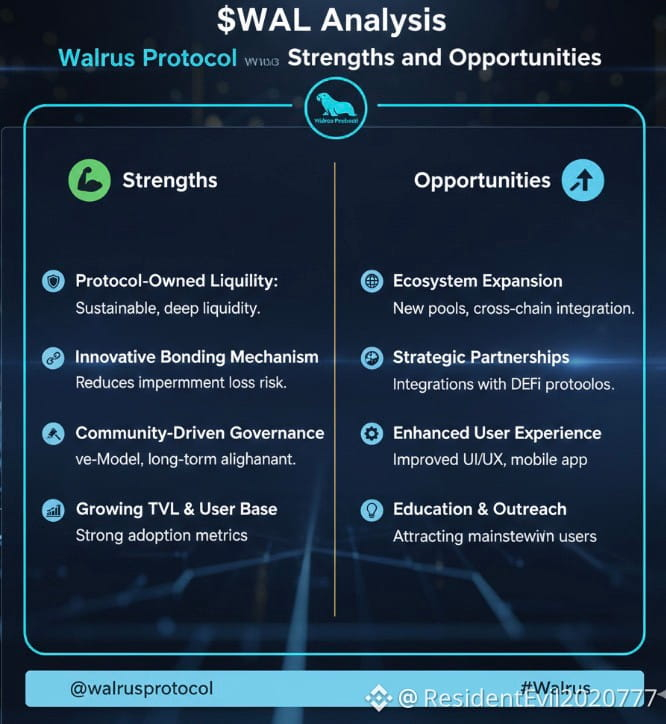
On the opportunities front, Walrus has ample room to grow. Ecosystem expansion through new liquidity pools and cross-chain integration can significantly broaden its reach. Strategic partnerships with other DeFi protocols can unlock new synergies and use cases. Continuous improvement of the user experience, including mobile accessibility, will be crucial for attracting a wider audience. Finally, robust education and outreach efforts are essential to onboard new users and demystify the complexities of DeFi.
The Road Ahead: Challenges and Considerations
While Walrus Protocol presents a compelling vision, it's essential to acknowledge the challenges and considerations inherent in the dynamic DeFi landscape.
1. Competition: A Crowded Field
The DeFi space is intensely competitive, with new protocols emerging regularly. Walrus must continuously innovate and differentiate itself to maintain its edge and attract users away from established players.
2. Security: Paramount Importance
Smart contract security is paramount in DeFi. Any protocol dealing with significant amounts of user capital must undergo rigorous audits and implement robust security measures to prevent exploits and safeguard user funds. The Walrus team must prioritize security at every stage of development and operation.
3. Market Volatility: Impact on Treasury
The value of the protocol's treasury, which holds various assets acquired through bonding, can be subject to market volatility. Effective treasury management strategies, including diversification and risk mitigation techniques, will be crucial for long-term stability.
4. User Education and Adoption: Bridging the Gap
DeFi can be intimidating for newcomers. Walrus needs to invest in clear documentation, intuitive user interfaces, and effective educational campaigns to bridge the knowledge gap and facilitate broader adoption.
5. Regulatory Landscape: Evolving Environment
The regulatory landscape for cryptocurrencies and DeFi is still evolving. Walrus, like all DeFi protocols, will need to monitor these developments closely and adapt its operations as necessary to remain compliant.

Conclusion: Walrus - A Force to Be Reckoned With
Walrus Protocol represents a promising evolution in the DeFi space. Its commitment to protocol-owned liquidity, innovative bonding mechanisms, and community-driven governance through the ve-model positions it as a strong contender for sustainable growth and widespread adoption. By addressing critical challenges in liquidity provision and offering a more robust and decentralized ecosystem, @walrusprotocol is carving out a significant niche.
For those actively participating on Binance Square, engaging with projects like Walrus is not just about earning points; it's about understanding the cutting edge of decentralized finance. Keep an eye on the cointag WAL and don't forget to use the hashtag #Walrus in your own analyses and discussions. The future of DeFi is being built today, and Walrus Protocol is certainly one of the architects shaping that future.