

Plasma Imagine sending a stablecoin the way you send a message: you type an address, hit send, and it’s done—no “get gas first,” no second-guessing confirmations, no waiting while the network feels moody. That’s the emotional center of Plasma’s design. It’s being shaped as a stablecoin-first Layer-1 where the “default user” isn’t a trader juggling volatile tokens, but a normal person or business moving dollars across borders, paying suppliers, settling invoices, or sending family support. The project’s own docs frame this as purpose-built rails for stablecoin payments rather than a general chain that happens to support stablecoins.
Plasma feel different in one breath: it aims to keep full EVM compatibility using Reth (so the Ethereum world still feels familiar), reach sub-second style settlement confidence through PlasmaBFT (so the money feels final), then add stablecoin-native UX like gasless USDT transfers and stablecoin-first gas (so users don’t need a separate volatile token just to move “digital dollars”). And on top of that, Plasma talks about Bitcoin anchoring as a neutrality and censorship-resistance booster—an external “integrity anchor” meant to strengthen long-horizon confidence.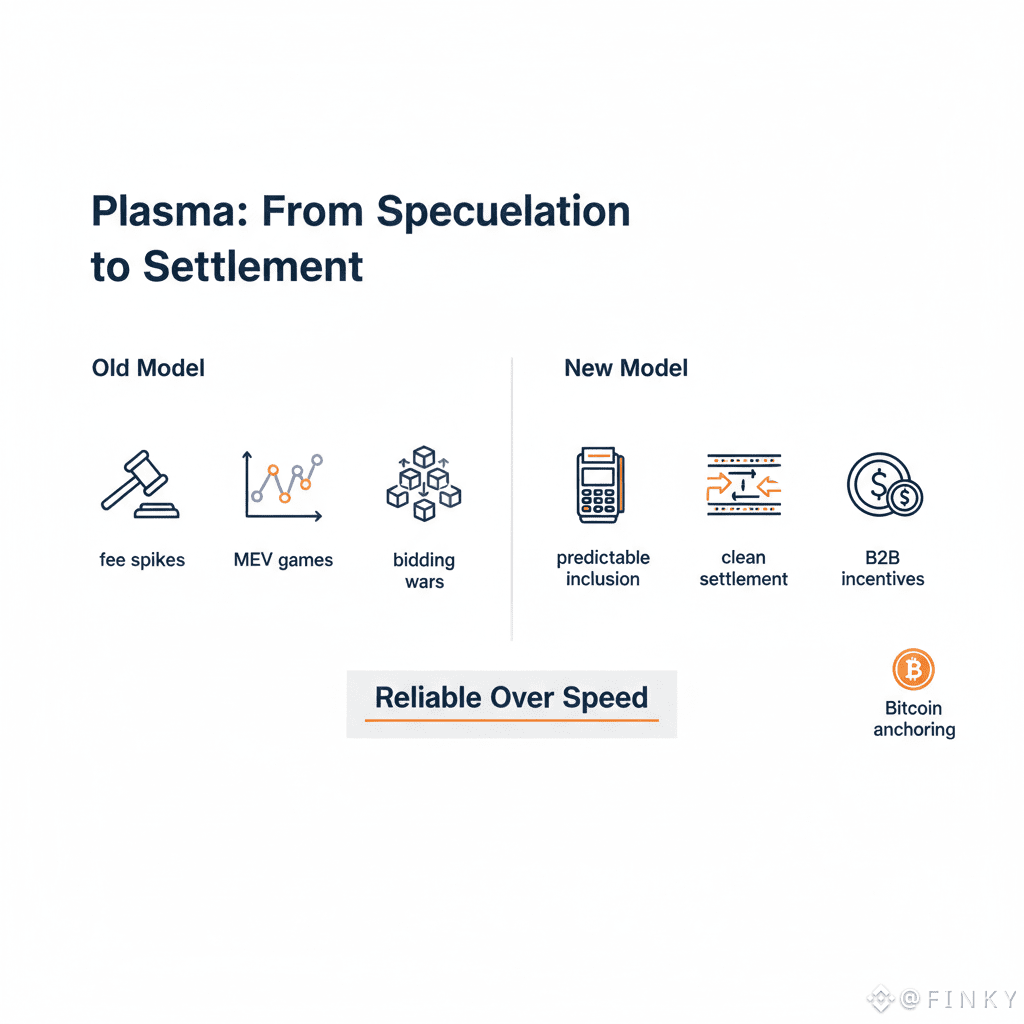
Plasma is a Layer 1 blockchain purpose-built for global stablecoin payments.”
Plasma The reason this matters is honestly simple: stablecoins already behave like a global settlement layer, but the experience often still feels like you’re doing crypto stuff instead of payment stuff. Most chains make you buy a separate gas token first, or accept fee volatility, or live with the discomfort that “confirmed” is not always the same as “final.” Plasma is trying to delete those frictions at the protocol level, not patch them with a nicer wallet UI. When a chain chooses “stablecoin-first,” it’s basically saying: we want the boring reliability that payments demand.
Plasma User reality todayWhat Plasma is trying to make feel normal“I need gas first”“Just pay fees in stablecoins (or sponsor simple transfers)”“I’ll wait a bit to be safe”“Fast BFT finality so settlement feels immediate”“My payment history is forever public”“Confidential payment direction as a supported primitive”
Plasma leans into EVM because EVM is where the builders already live. The docs describe the execution layer as powered by Reth, which matters because it signals an intent to keep Ethereum behavior and tooling familiarity instead of forcing developers into a new environment with compatibility surprises. If your goal is to bootstrap serious stablecoin infrastructure quickly, removing friction for builders is not optional—it’s survival.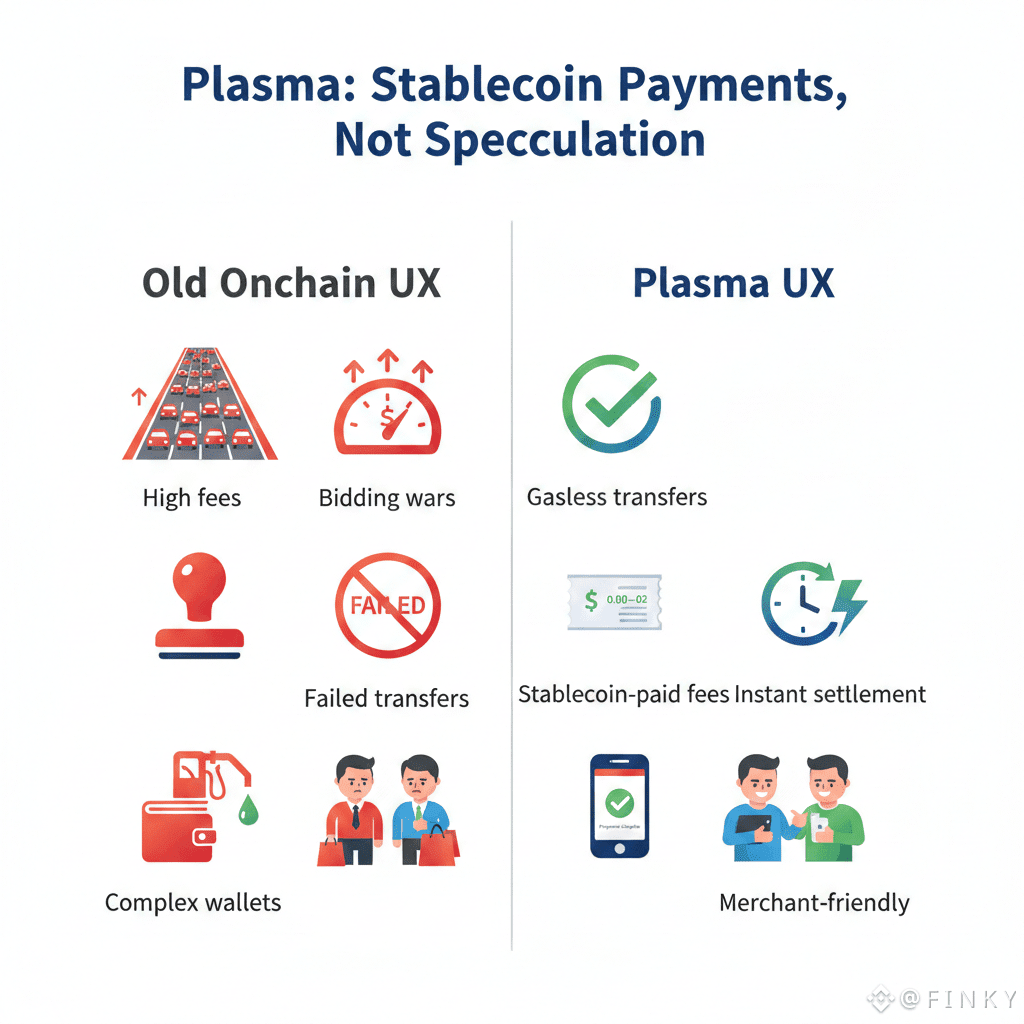
Plasma’s execution layer is powered by Reth
Then comes consensus: PlasmaBFT is presented as the mechanism that aims to make finality feel like finality. The docs describe it as a BFT approach (derived from Fast HotStuff ideas), built for low-latency confirmation and throughput. In payment psychology, “fast” is nice, but “final” is the real heartbeat. People don’t want to wonder if the chain might roll back, or if they should wait for “a few more blocks.” Plasma’s whole vibe is pushing settlement toward something that feels immediate and dependable.
Plasma The stablecoin-native pieces are where it gets especially practical. Plasma documents zero-fee / gasless USD₮ transfers through a sponsored mechanism that’s intentionally scoped (it’s not “gasless everything,” it’s “gasless stablecoin send”), with controls designed to reduce abuse. That narrowness is not weakness; it’s discipline. Sponsoring arbitrary contract calls is a wide attack surface. Sponsoring direct stablecoin transfers is a defined lane you can secure, monitor, and optimize.
The system is scoped tightly… [to] direct USD₮ transfers.
Plasma Right beside that is the idea of stablecoin-first gas. Plasma’s FAQ describes custom gas tokens and stablecoin-based fee flows so users can pay fees in the asset they already hold, instead of being forced to buy a separate volatile token just to do a basic transfer. This is one of those changes that sounds small until you watch a new user fail onboarding because “I only have USDT, why can’t I send USDT?” Plasma is trying to make that sentence disappear.
Plasma talks about Bitcoin anchoring as a neutrality and censorship-resistance enhancer. In plain terms: the chain can run fast locally, but anchor history to something widely recognized for settlement integrity. That’s not the same as Bitcoin validating every transaction in real time—anchoring is more like using Bitcoin as a strong external reference point for checkpoints so the long-horizon story of “what happened” becomes harder to dispute. Recent ecosystem explainers summarize this as periodically committing chain state/checkpoints into Bitcoin.
Plasma’s docs outline a Bitcoin bridge that mints pBTC as a representation of BTC inside the EVM environment, with a verifier network and threshold/MPC-style signing concepts for withdrawals. Bridges are always sensitive—everyone knows that—but Plasma clearly treats BTC connectivity as strategic rather than decorative. If stablecoins are the payment rail, BTC is still one of the deepest liquidity/collateral assets; connecting the two worlds can unlock more serious treasury, credit, and settlement flows over time.
Plasma leans into is confidentiality for payments. Their docs describe confidential payments as part of the stablecoin-native direction, framed more like “privacy for payments” than “a privacy chain.” That distinction matters because businesses often need discretion (payroll, supplier invoices, internal treasury moves) without stepping outside compliance realities. If Plasma can deliver confidentiality in a way that remains usable and composable, it removes one of the biggest hidden blockers to on-chain stablecoin adoption.
Plasma So what’s coming? Based on how the current documentation is written, the near-term energy seems to cluster around expanding the stablecoin-native toolkit (more robust sponsored transfer rails, deeper stablecoin fee UX), continuing to mature and harden bridge design, and iterating on confidentiality as an opt-in payment-grade feature rather than a slogan. Plasma’s own “why build” and architecture sections read like a blueprint that’s meant to be operational, not just theoretical.
Plasma And if we’re being real, the tradeoffs are the same ones every serious payment chain faces—just expressed more honestly here. Gasless transfers must be protected from spam and abuse. Bridges must be engineered like a fortress. Confidentiality must balance discretion with legitimacy. The difference is that Plasma is not pretending those issues don’t exist; it’s designing around them by narrowing scope and treating stablecoin payments as the primary job.
Plasma’s story is not “we’re the next everything chain.” It’s: stablecoins are already global money motion, and the rails should finally feel like rails. EVM equivalence so builders move fast. Fast BFT finality so settlement feels real. Gasless USD₮ transfers and stablecoin-first gas so normal users don’t bounce off the first step. Bitcoin anchoring so the neutrality narrative is stronger over time. That’s the whole picture—clean, focused, and aimed at making stablecoin payments feel inevitable.

