
$XPL is entering a phase that most crypto projects never reach: the shift from speculation to real financial infrastructure.
When I look at Plasma’s partnership with Maple, I don’t see just another “integration.” I see a strategic move toward becoming a serious settlement and yield layer for fintechs, neobanks, and institutional-grade apps.
Let’s break this down in a human way.
First, what Maple actually represents.
Maple is not built for hype. It’s built for structured, transparent, sustainable yield. That means risk-managed, reputation-based capital flows. The kind that traditional finance understands and respects.
When Plasma brings Maple into its ecosystem, it’s telling developers:
“You can now build real financial products on us — not just short-term yield games.”
That changes everything.
From my perspective, this moves Plasma closer to being a backbone for apps people will actually use every day — wallets, savings products, payment apps, treasury tools, and neobank-style interfaces.
And here’s where #plasma becomes interesting at a deeper level.
Most chains focus on incentives first.
Plasma is focusing on *infrastructure first*.
That’s a big difference.
With Maple-style yield, builders can design:
• Stablecoin savings products
• Yield-backed accounts
• Institutional-grade treasury tools
• Neobank-like financial experiences
These are not crypto-native toys. These are bridges to the real economy.
Now think about what that means for XPL.
XPL is not just a token for fees.
It becomes the economic layer securing:
• Payments
• Yield flows
• Financial apps
• Onchain settlement for real businesses
As more capital moves through Plasma-based products, demand for blockspace, security, and settlement increases. And that’s where XPL’s role deepens.
In my observation, this is how long-term value is built:
Not through hype cycles —
But through utility that institutions and builders *depend on*.
Another important point is trust.

Institutional-grade yield requires:
• Transparency
• Predictable performance
• Strong risk frameworks
By partnering with Maple, Plasma borrows credibility. It signals to fintechs and neobanks that this ecosystem is serious about compliance, structure, and sustainability.
That attracts a very different kind of capital than meme liquidity.
It attracts:
• Long-term allocators
• Product-focused builders
• Real users, not just traders
And when those people arrive, they don’t just farm and leave. They build, integrate, and scale.
From a strategic point of view, Plasma is stacking primitives:
Payments
Stablecoins
Yield
Cross-chain settlement
And now institutional infrastructure
That’s how financial networks are born.
Not fast.
Not flashy.
But durable.
My thinking is simple:
If Plasma succeeds in becoming the rails for stablecoin + yield + fintech apps, then XPL is no longer “just another L1 token.” It becomes part of the operating system for onchain finance.
And operating systems don’t need hype.
They need adoption.
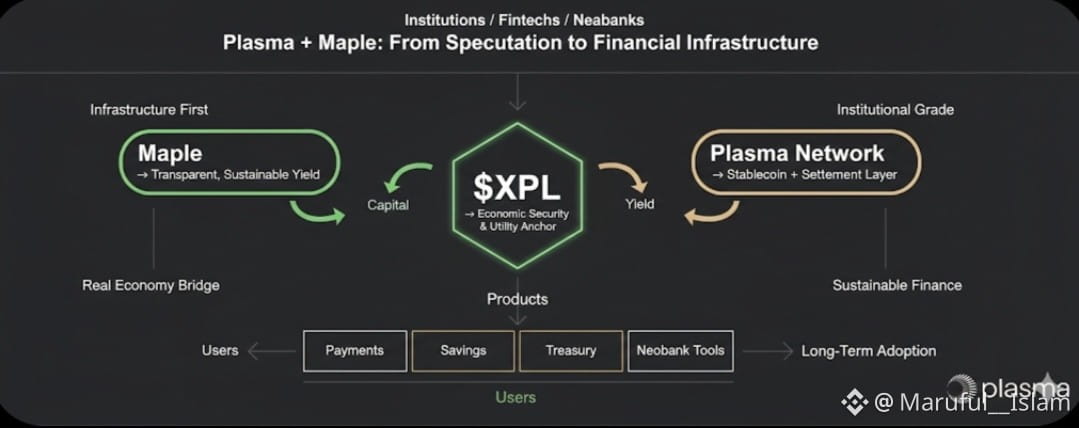
This Maple integration is one more brick in that foundation.
Quiet.
Fundamental.
Long-term.
That’s why, from my view, this is one of the most important moves Plasma has made recently — not because it pumps price today, but because it builds relevance for years.

