

Why Dusk Foundation Sees Privacy as a Core Ethical Duty
Most crypto projects treat privacy like a setting you can switch on or off—a feature shaped by whatever’s trending, what regulators want, or what users ask for. Dusk Foundation looks at privacy differently. For them, it’s not just a feature. It’s a responsibility. This belief runs through everything Dusk does: how they build their protocol, talk to regulators, and imagine the future of institutional finance.
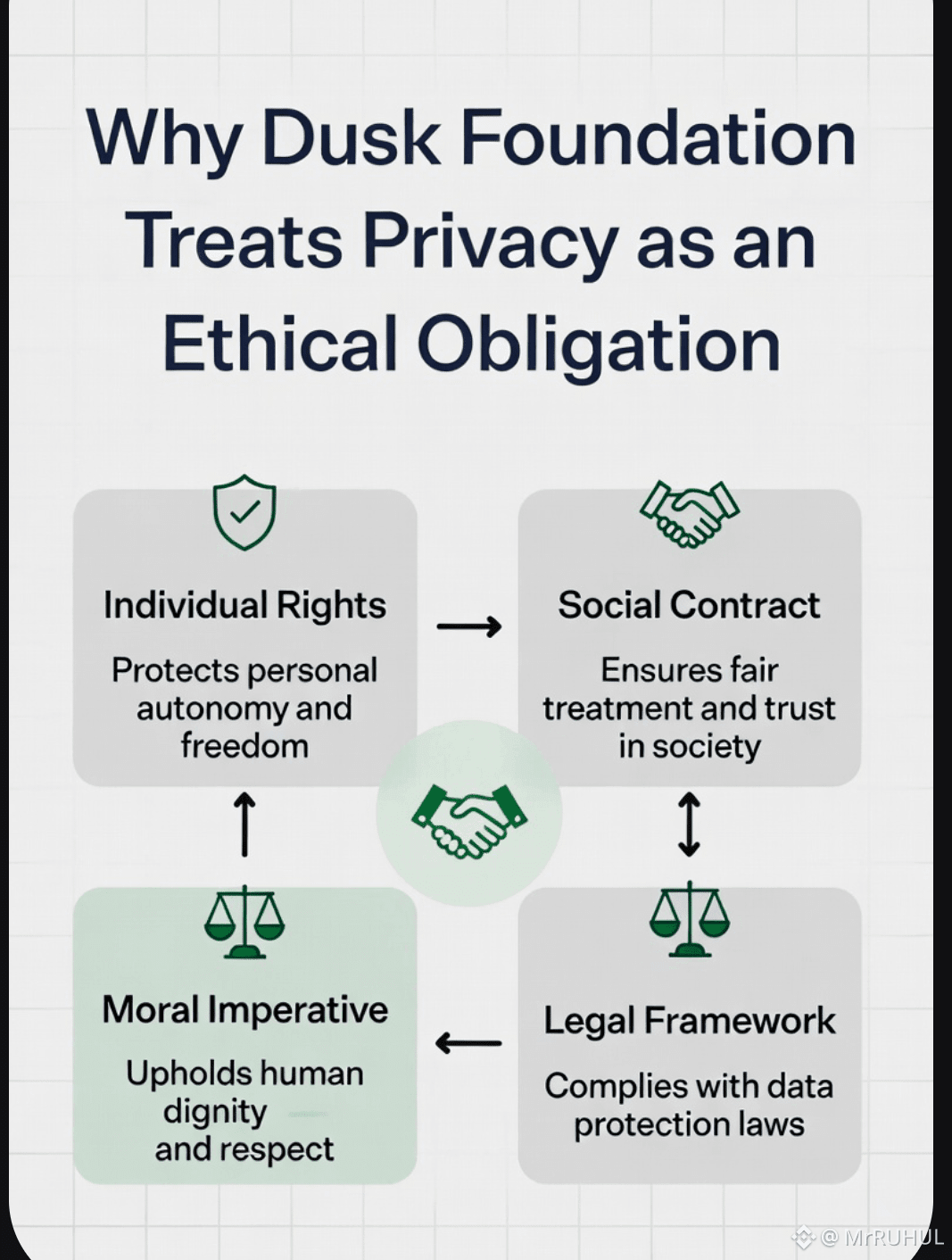
Here’s the core of Dusk’s thinking: Money equals power. If you control what people can see, you control what they can do. History is packed with examples—those with more information have used it to exploit others, shut people out, or twist markets in their favor. Privacy laws in traditional finance didn’t appear because they were convenient. They were shields against abuse—think bank secrecy, client confidentiality, all born out of real harm. Dusk wants to keep this protective spirit alive on the blockchain. They don’t buy the idea that just because a ledger is open by default, it’s automatically the right thing for finance.
Sure, public blockchains shook things up with radical transparency. That was great for early experiments and cutting down on trust issues. But exposing every transaction, every balance, every move—forever—brings a whole new set of problems. People and companies end up wide open to being tracked, profiled, or even coerced. Dusk believes it’s just flat-out irresponsible to build financial systems that make this kind of exposure normal. To them, privacy isn’t about hiding bad behavior. It’s about protecting people from systemic risk.
This is why Dusk refuses to play into the tired privacy-versus-compliance debate. You see a lot of crypto projects acting like privacy and regulation are enemies, as if anonymity is some kind of rebellion. Dusk isn’t interested in that fight. They say real privacy and proper oversight can—and should—work together. Real-world finance isn’t a choice between total secrecy or total exposure. It’s about sharing what’s necessary, and nothing more. Dusk’s zero-knowledge approach builds in confidentiality as the default, but still lets people prove they’re following the rules when the law demands it.
For Dusk, zero-knowledge proofs aren’t just a technical trick. They’re a statement of values. These proofs let users show they’re compliant without giving up sensitive details. That matches the old-school standards in finance and law—you can prove you’re solvent without showing every line in your books, or prove eligibility without handing over all your personal info. Dusk bakes these principles right into its protocol. Privacy becomes a guarantee, backed by cryptography, not just a promise from some middleman.
There’s also the question of fairness. Open ledgers tend to favor players with deep pockets—the ones who can afford fancy analytics or surveillance tools. Smaller users, retail investors, or folks in emerging markets don’t get that edge. Over time, this tilts the playing field, letting the powerful weaponize transparency. Dusk sees privacy as a way to even things out, making sure you don’t have to give up your own security just to take part.
Institutional adoption matters, too. Institutions aren’t just moving their own money—they’re responsible for other people’s assets and data. They’re bound by all kinds of legal and ethical duties. If you force them onto transparent systems, you’re making them break those promises. Dusk thinks a blockchain that institutions can’t ethically use is broken by design. Good infrastructure should fit users’ responsibilities, not force them to betray them.
Dusk’s take on privacy isn’t just about now. The financial world is getting more automated, more connected, and more complicated. Every smart contract, every vote, every on-chain identity leaves a permanent trail. Without strong privacy, future users could get judged or shut out because of something buried in their past data. Dusk sees privacy as a way to protect not just this generation, but the next.
Finally, Dusk doesn’t do privacy theater. They’re not slapping on optional privacy add-ons or using anonymity as a marketing hook. Instead, privacy is part of the network’s core DNA. Users don’t need to flip a switch or master advanced tech to stay safe. It’s just there, like how you expect your web traffic to be encrypted. Ethical systems shouldn’t make people jump through hoops just to avoid getting hurt.
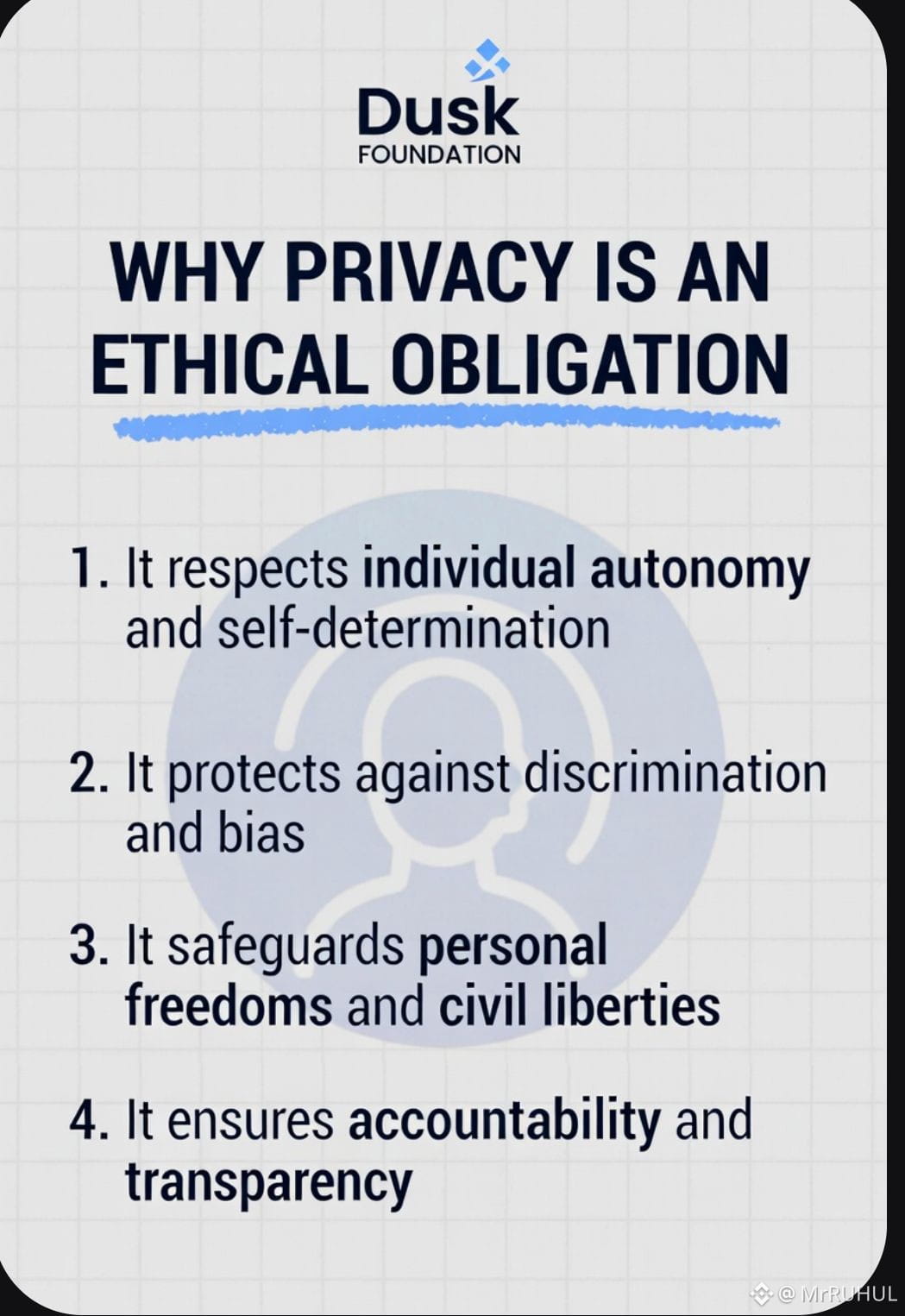
At the end of the day, Dusk Foundation’s approach to privacy is about building better financial infrastructure—one that doesn’t just copy old mistakes or chase hype, but actually protects people, balances power, and stands up to real-world challenges.@Dusk #Dusk $DUSK
