

@Plasma is engineering liquidity to move without resistance.
What matters about the integrations isn’t that #Plasma gained more integrations — it’s what kind of integrations they are, and where they sit in the money loop.
These aren’t surface-level partnerships. They operate at the pressure points of capital movement:
how liquidity enters, how it migrates between chains, how it settles at scale, and how it stays productive once it arrives.
Plasma is no longer solving “how do stablecoins exist on-chain?”
Plasma is solving how capital behaves when it’s already large.
Plasma is becoming the place where stablecoins arrive liquid.
The launch of StableFlow on Plasma addresses a problem most chains avoid: large-volume settlement.
StableFlow enables high-throughput stablecoin movement from networks like Tron directly into Plasma with minimal fees and execution slippage. This matters because Tron remains one of the largest settlement layers for USDT globally. Capital already lives there. It already moves there. And now it has a direct, efficient path into Plasma.
This is not bridging for convenience.
This is migration for scale.
StableFlow doesn’t just move assets — it preserves liquidity depth and execution quality as capital crosses environments. That’s why the pricing approaches CEX-level efficiency, something DeFi systems historically fail to maintain at size.
For builders, this changes everything. Plasma applications are no longer limited to locally sourced liquidity. They can tap into deep external stablecoin flows without fragmenting markets or degrading execution.
Plasma becomes a destination chain, not a terminal one.
Plasma is where capital launches liquid by design.
LayerZero’s role in Plasma isn’t an add-on — it’s foundational.
By integrating LayerZero as the canonical interoperability layer from day one, Plasma launched with liquidity already able to move freely across ecosystems. This is why Plasma didn’t need months or years to bootstrap deposits. Within three weeks, it became the fastest chain to surpass $10B in deposits.
That number isn’t a flex — it’s a signal.
It shows what happens when capital doesn’t encounter artificial bottlenecks at the edges of a network. When liquidity can move natively, instantly, and predictably, it doesn’t hesitate. It flows.
LayerZero turns Plasma into a liquidity-aware system. Assets don’t get trapped. Capital doesn’t silo. Applications don’t need custom bridges or isolated pools. Interoperability becomes infrastructure, not overhead.
This is what “launching liquid” actually means:
capital is free to move the moment it arrives.
Plasma is where liquidity stays productive instead of idle.
With over $1B in TVL, Plasma now ranks third among all Pendle instances.

That detail is critical, because Pendle isn’t about speculation — it’s about capital efficiency. Users deploy yield-bearing assets with clear time horizons. Institutions and sophisticated participants use it to structure returns, manage duration, and optimize yield exposure.
For Plasma to reach this level of TVL inside Pendle means one thing:
capital on Plasma isn’t sitting around.
Stablecoins aren’t parked. They’re structured. They’re segmented by risk and time. They’re actively managed.
This confirms something deeper about Plasma’s ecosystem: it attracts intentional liquidity. Money that arrives with purpose, stays because it’s productive, and compounds because the system allows it to.
Liquidity that behaves like this doesn’t chase incentives.
It settles where execution and reliability exist.
Plasma is assembling a capital flywheel.
These three developments — StableFlow, LayerZero, and Pendle — form another closed loop in Plasma’s architecture:
StableFlow ensures large pools of stablecoins can enter Plasma efficiently from dominant settlement networks.
LayerZero guarantees those assets remain liquid across ecosystems instead of becoming trapped locally.
Pendle ensures capital doesn’t stagnate once it arrives, but gets structured into productive financial positions.
This is not growth for visibility.
This is mechanical completeness.
Each piece reinforces the others. Capital enters smoothly, moves freely, and stays economically active. That’s the flywheel most chains never manage to spin.
Plasma is extending a pattern, not changing direction.
Previous Plasma articles already mapped the broader system:
custody and institutional inflow,
real-world circulation,
productive deployment,
enterprise settlement,
real asset exposure,
global spending rails.
*Previous articles on Plasma integrations can be seen here :
🔗 Plasma’s Money Loop: Institutional Capital, Infrastructure, and Global Reach
🔗 Plasma builds financial reality
🔗 Plasma 2026: The Next Layer of Real-World Money
🔗Plasma 2026: From Stablecoins to Real-World Money - The Infrastructure Revolution
These new updates don’t replace that story — they densify it.
They strengthen the liquidity layer so everything built above it operates without friction. The system becomes harder to disrupt, harder to fragment, and easier to scale.
This is how financial infrastructure matures: not through louder announcements, but through fewer failure points.
Plasma is not competing for attention.
Plasma is competing for where money chooses to live.
In 2026, the defining question won’t be which chain has the most features.
It will be which system allows capital to enter at size, move without resistance, and remain productive over time.
StableFlow answers entry.
LayerZero answers movement.
Pendle answers productivity.
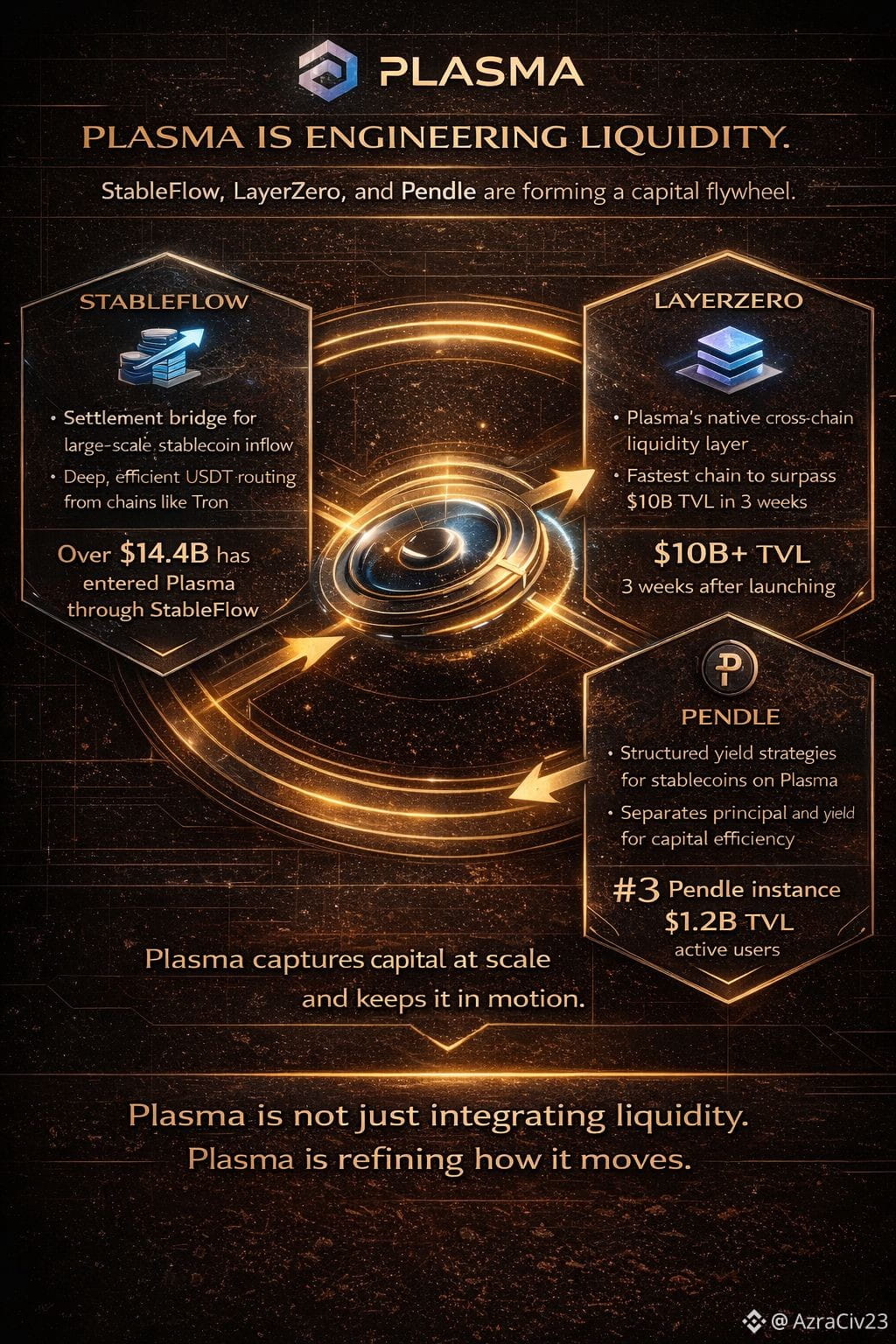
To summarise:
StableFlow
StableFlow provides a high-capacity settlement bridge for stablecoins, enabling large volumes of liquidity—especially from Tron—to move into Plasma with minimal friction. It solves the “entry at scale” problem, allowing capital to arrive efficiently without slippage or retail-style constraints. This is infrastructure for serious size, not casual transfers.
LayerZero
LayerZero is Plasma’s native interoperability layer, embedded from launch to ensure liquidity is not siloed. By making cross-chain movement a default property rather than an add-on, Plasma launched liquid from day one. This allows capital to move freely across ecosystems, creating a unified liquidity surface instead of fragmented pools.
Pendle (on Plasma)
Pendle on Plasma enables stablecoin holders to separate yield from principal, turning passive balances into actively managed capital. With over $1B in TVL and ranking among Pendle’s top deployments, it confirms Plasma’s role as a serious venue for yield-bearing stablecoin strategies—not speculative farming.
How they fit together
StableFlow brings capital in at scale.
LayerZero keeps it mobile across ecosystems.
Pendle makes it productive once it arrives.
Together, they reinforce what Plasma is becoming:
Not a place where stablecoins exist —
but a place where capital behaves like capital.
That’s the difference.
That’s the system.
That’s Plasma.

