

When I think about Dusk Network, I don’t think about hype cycles or short-term attention. I think about how financial systems behave when real money, real institutions, and real responsibility are involved. At scale, finance is never casual. It demands precision, privacy, and certainty. Dusk feels different because it starts from this reality instead of trying to ignore it.
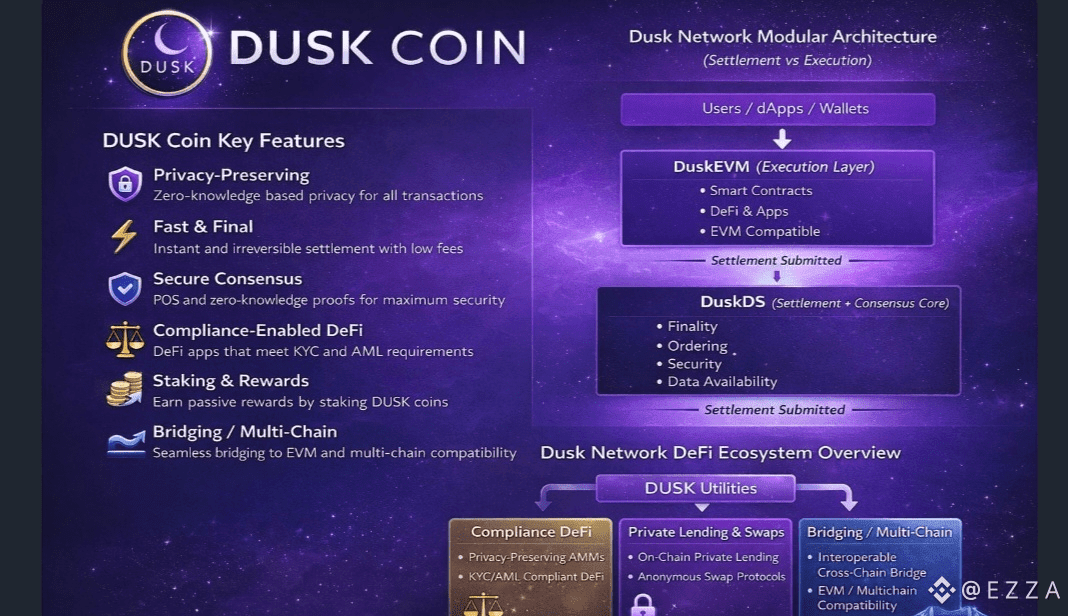
What makes Dusk stand out is its clear understanding of privacy. In most serious financial systems, privacy is normal, not suspicious. Businesses, investors, and institutions expect their transactions, strategies, and agreements to remain confidential. Dusk treats privacy as protection, not as a tool to hide wrongdoing. This distinction matters, because strong systems don’t avoid rules — they make it possible to follow them without exposing sensitive information.
Dusk is also realistic about regulation. Instead of pretending compliance will disappear, it accepts that rules are part of finance and designs around them. Identity checks, audits, and lawful access are considered from the beginning. This makes the network feel stable and future-ready, especially for institutions that cannot operate in gray areas. Regulation is not treated as an enemy, but as a constraint that must be handled properly.
Another important aspect is how Dusk supports confidential execution, not just private balances. Financial activity is built on logic — conditions, timing, rights, and obligations. These details are often more sensitive than the transaction itself. Dusk allows this logic to run correctly without exposing internal structures to the public. This is essential for markets like securities or structured products, where transparency of internal mechanics would destroy trust and competitiveness.
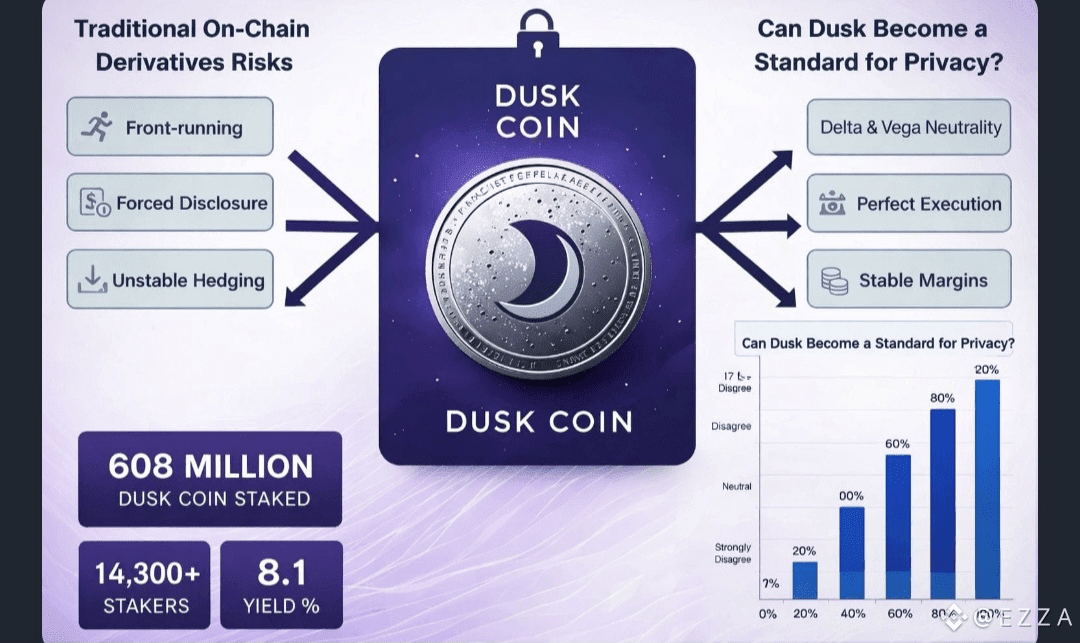
Identity on Dusk is handled with care. In finance, identity is required, but full exposure is dangerous. Dusk allows participants to prove eligibility without revealing unnecessary personal data. This selective disclosure reflects how trust works in the real world: you share what is required and protect what is personal. Systems that fail to respect this balance struggle to gain long-term trust.
When it comes to real-world assets, Dusk feels prepared rather than experimental. Tokenizing assets is not about innovation alone — it is about responsibility. Ownership rules, transfer restrictions, and reporting obligations must remain intact. Dusk is designed to carry these requirements on-chain instead of breaking them, which signals maturity and long-term thinking.
Finality is another key strength. In finance, uncertainty creates risk and cost. Slow or unclear settlements are a major weakness of traditional systems. Dusk focuses on clear, deterministic settlement, reducing ambiguity and making outcomes predictable. This reliability is critical for institutions operating at scale.
Even the role of the network token feels purposeful. It supports security, participation, and coordination within the system rather than existing purely for speculation. This makes the token feel like infrastructure, not marketing. Sustainable networks survive because incentives are aligned, not because attention is loud.
Overall, Dusk does not feel like a project chasing popularity. It feels like infrastructure being built quietly for the future. The most important systems are often unnoticed until they become essential. As blockchain moves toward real financial adoption, privacy, compliance, and reliable settlement will no longer be optional.
Dusk feels designed for that moment — a future where blockchain is trusted, regulated, and normal. It may grow slowly, but trust-based systems always do. When the industry starts asking harder questions about privacy, rules, and efficiency, networks built with these principles from the start tend to stand strong. Dusk feels like one of them.
