


In the ever-evolving landscape of blockchain technology, Bitcoin stands as the pioneering cryptocurrency that introduced the world to decentralized digital money. Launched in 2009 by the pseudonymous Satoshi Nakamoto, it remains the gold standard for many in terms of security and value storage. On the other hand, Dusk Network, launched in 2019, positions itself as a privacy-oriented Layer-1 blockchain tailored for regulated financial applications, such as tokenizing real-world assets (RWAs). While Bitcoin focuses on simplicity and robustness, Dusk emphasizes compliance-friendly privacy and efficiency. This article delves into a head-to-head comparison across three key dimensions: privacy, speed, and real-world use cases.
Privacy: Pseudonymity vs. Built-in Confidentiality
Privacy is a cornerstone of cryptocurrency appeal, but Bitcoin and Dusk Network approach it in fundamentally different ways.
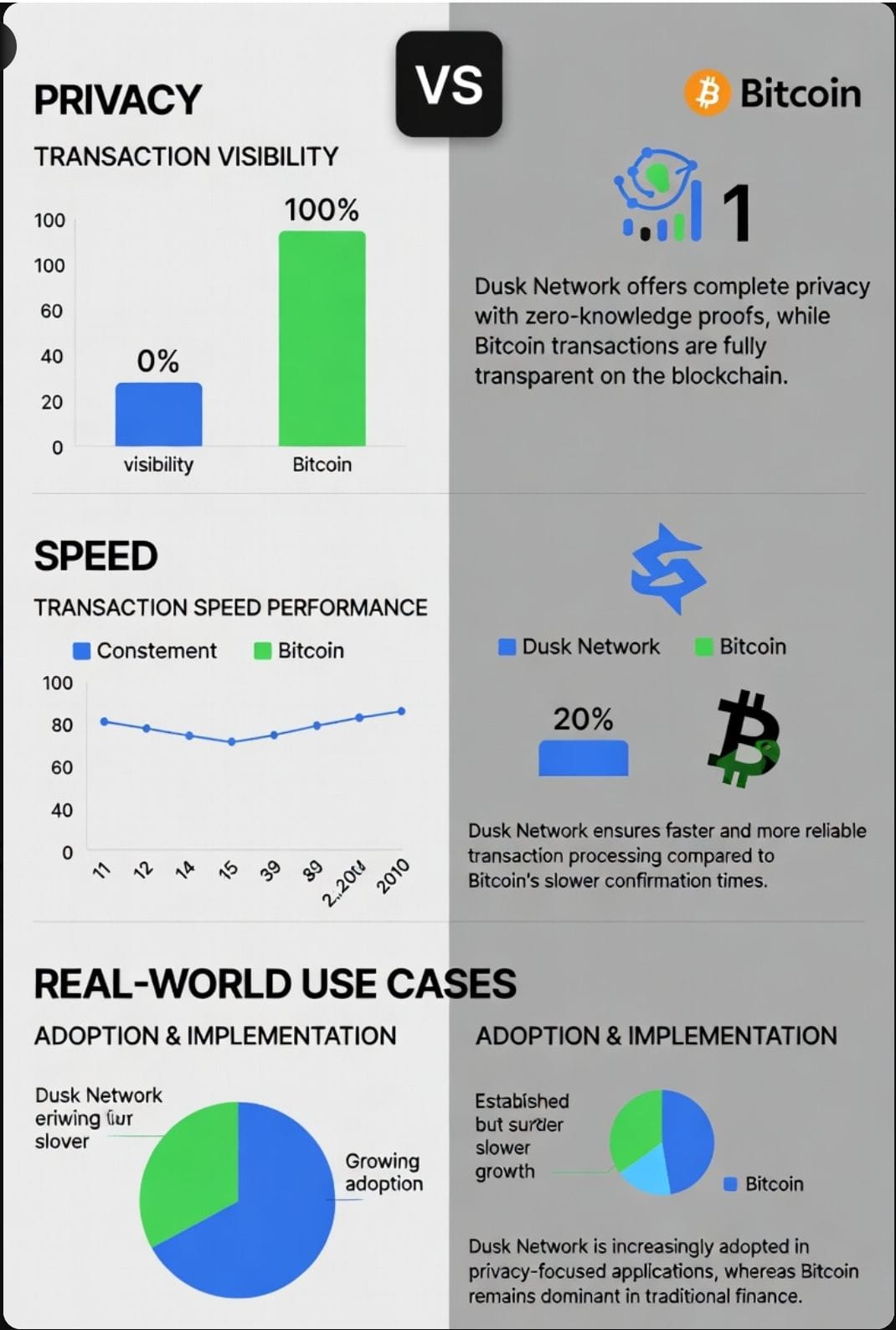
Bitcoin operates on a pseudonymous model where transactions are recorded on a public ledger, making them transparent and verifiable by anyone. Wallet addresses serve as identifiers, but they don't directly reveal real-world identities unless linked through external data. However, this transparency comes at a cost: sophisticated chain analysis tools can trace transaction histories, de-anonymizing users over time. Bitcoin lacks native privacy features like zero-knowledge proofs, meaning amounts, senders, and recipients are visible to all. Efforts like the Lightning Network add some off-chain privacy, but the core protocol remains traceable.
In contrast, Dusk Network is designed with privacy as a default. It employs zero-knowledge proofs (ZKPs), specifically ZK-PLONK for its Layer-1 and additional homomorphic encryption for compatibility with Ethereum Virtual Machine (EVM) environments. This allows for complete transaction confidentiality--hiding amounts and participant identities from the public while enabling selective disclosure for regulatory compliance. For instance, auditors or regulators can access necessary data without compromising overall privacy. This "regulated privacy" model addresses the paradox of needing transparency for compliance while protecting sensitive information, setting Dusk apart from purely anonymous coins. Unlike Bitcoin, Dusk's architecture supports privacy-preserving smart contracts, making it suitable for sensitive financial dealings where full anonymity isn't always desirable but confidentiality is crucial.
Overall, Bitcoin offers basic pseudonymity that's vulnerable to analysis, while Dusk provides robust, built-in privacy with compliance hooks, making it more advanced for privacy-conscious users.
Speed: Deliberate Slowness vs. Instant Settlements
Speed is another area where these two blockchains diverge, influenced by their consensus mechanisms and design philosophies.
Bitcoin uses Proof-of-Work (PoW), where miners compete to solve complex puzzles to validate blocks. This results in an average block time of about 10 minutes, with transaction throughput limited to around 7 transactions per second (TPS). Full confirmation can take an hour or more during network congestion, and fees spike accordingly. While solutions like the Lightning Network enable faster off-chain payments, on-chain Bitcoin transactions prioritize security over speed, reflecting its role as "digital gold" rather than a high-throughput payment system.
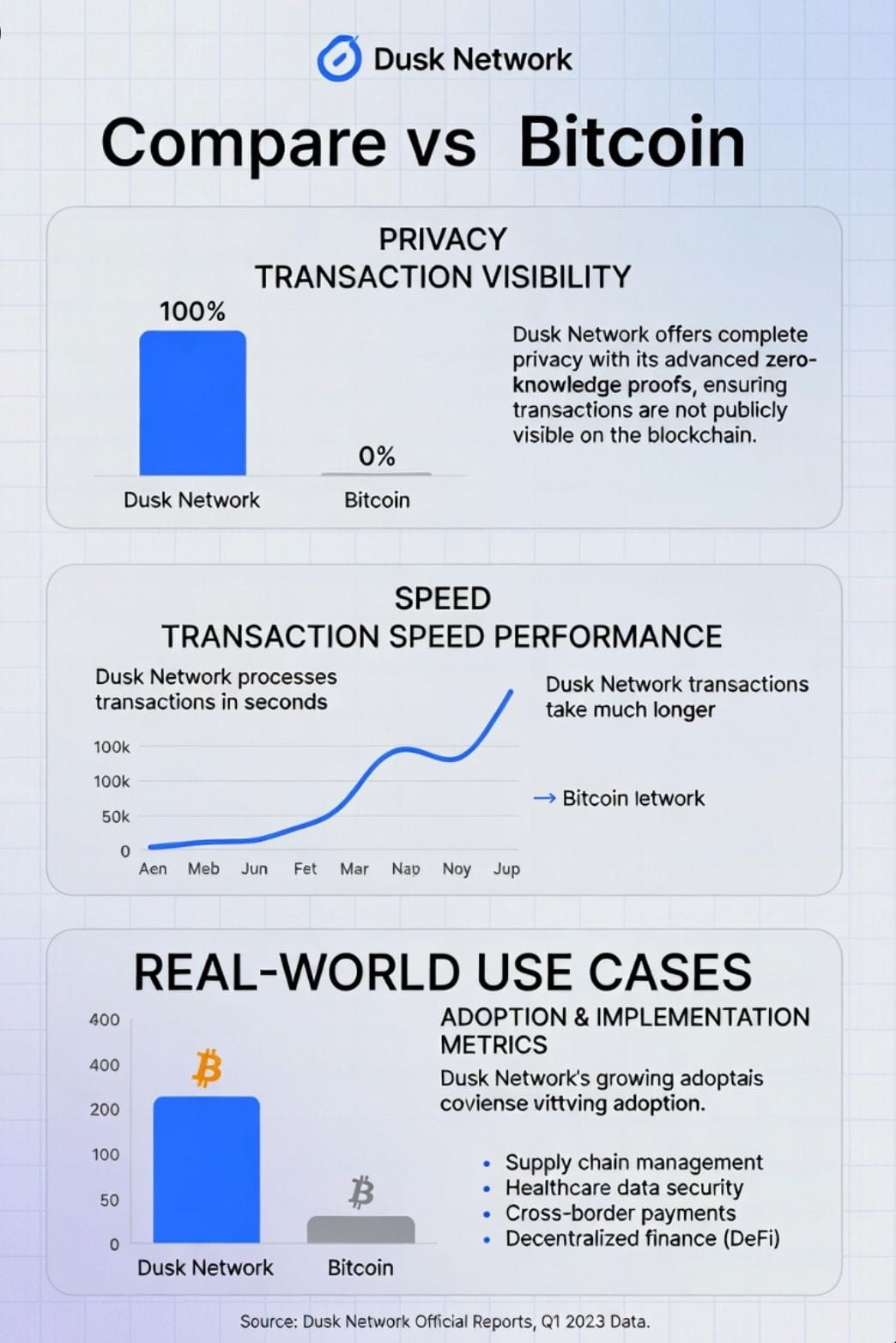
Dusk Network, however, leverages a Proof-of-Stake (PoS) variant called Segregated Byzantine Agreement (SBA), combined with Succinct Attestation for rapid consensus. This enables instant or near-instant settlements--typically under 15 seconds--without the energy-intensive mining of PoW. Dusk's design avoids issues like orphaned blocks common in PoW chains, ensuring finality and scalability. It supports higher TPS rates, making it more efficient for real-time applications. Compared to Bitcoin's deliberate slowness for security, Dusk's architecture is optimized for performance, drawing from Byzantine Fault-Tolerant protocols to achieve low-latency transactions.
In essence, Bitcoin's speed is a trade-off for unmatched decentralization and security, whereas Dusk prioritizes quick, reliable processing, ideal for time-sensitive financial operations.
Real-World Use Cases: Store of Value vs. Regulated Finance
The true value of a blockchain often lies in its practical applications, and here, Bitcoin and Dusk Network cater to distinct niches.
Bitcoin's primary use case is as a store of value and medium of exchange. It's widely adopted for peer-to-peer payments, remittances, and as an inflation hedge--often called "digital gold." Institutions like MicroStrategy and Tesla have held Bitcoin on their balance sheets, and countries like El Salvador have made it legal tender. Beyond that, Bitcoin enables basic scripting for multi-signature wallets but lacks advanced smart contract capabilities, limiting it to straightforward transactions. Its real-world impact is evident in global adoption, with over 200 million users worldwide, though scalability issues hinder everyday micropayments.
Dusk Network targets the intersection of blockchain and traditional finance, focusing on privacy-preserving applications for regulated markets. Key use cases include tokenizing RWAs such as stocks, bonds, and money market funds (MMFs), enabling compliant DeFi, institutional custody, and private smart contracts. For example, Dusk supports the issuance of security tokens with built-in compliance, allowing for confidential transactions that align with regulations like the EU's MiCA framework. It's also used for decentralized communication networks, media streaming, and even self-sovereign identities via privacy-enhanced NFTs. Real-world partnerships include integrations with financial institutions for tokenized securities and efficient settlements, outperforming traditional finance in cost and speed. Unlike Bitcoin's broad but basic utility, Dusk's focus on privacy and compliance opens doors to enterprise-level finance, such as private equity and on-chain agreements.
Bitcoin and Dusk Network represent two sides of the blockchain spectrum: Bitcoin as the secure, decentralized foundation of crypto, excelling in pseudonymity and value storage but lagging in speed and advanced privacy; Dusk as a specialized platform for privacy-centric, regulated finance with superior speed and compliance features. While Bitcoin's maturity and network effects make it indispensable, Dusk's innovations address gaps in privacy and efficiency, particularly for institutional and DeFi use cases. As the crypto space matures, both could coexist--Bitcoin as the reserve asset and Dusk as the infrastructure for confidential, real-world financial tools. Ultimately, the choice depends on whether one prioritizes timeless security or cutting-edge privacy and performance.
