

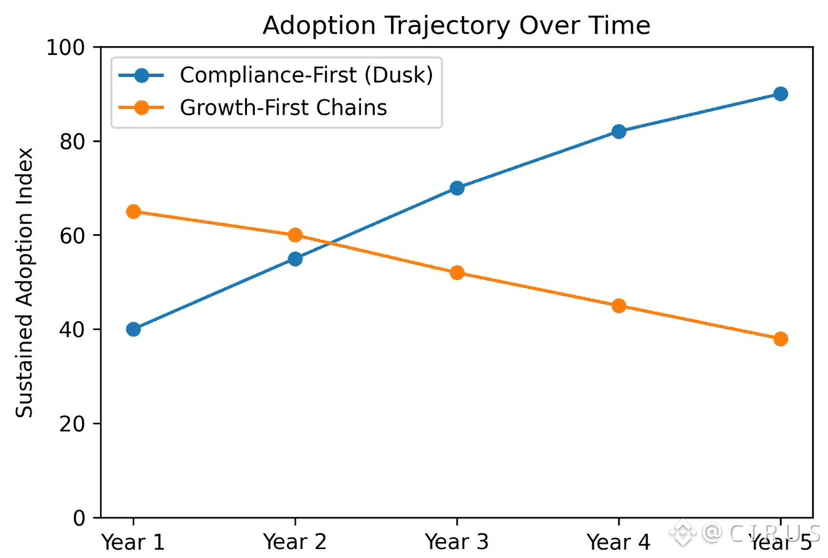
Most blockchain projects treat compliance as a future problem. The logic is simple: grow first, adapt later. In the short term, this approach often works. It allows fast experimentation, loose constraints, and rapid user onboarding. However, over time, the same lack of structure that enabled early growth becomes a source of fragility. Systems built without regulatory awareness eventually face limits that are difficult to unwind.
This is where Dusk takes a different path. Instead of viewing compliance as an external pressure, Dusk treats it as part of the core system design. This choice is not about restricting usage. It is about reducing long-term adoption risk.
Adoption risk is often misunderstood. It is not only about whether users show up. It is about whether they stay, whether institutions can participate, and whether the system can support real economic activity without constant restructuring. In many cases, the biggest adoption risk is not low usage, but usage that cannot mature.
Compliance-first design addresses this problem early. By embedding privacy, auditability, and rule enforcement at the protocol level, Dusk avoids the need to retrofit these properties later. Retrofitting is expensive, both technically and socially. Once users are accustomed to a system behaving a certain way, changing it introduces friction, distrust, and fragmentation.
From a technical standpoint, compliance-first design simplifies future development. Rules around asset issuance, transfer restrictions, and disclosure are enforced through system logic rather than ad hoc tooling. This reduces the surface area for mistakes and minimizes the need for off-chain intervention. Over time, this consistency lowers maintenance cost and operational risk.
From an adoption perspective, the benefits compound. Institutions, developers, and regulators are more willing to engage with systems that behave predictably. They do not need to guess how the protocol will react when scale increases or when scrutiny arrives. Predictability is not exciting, but it is foundational.
There is also a misconception that compliance-first systems sacrifice innovation. In practice, the opposite often happens. When rules are clear and enforced by design, developers can build with confidence. They know the boundaries of the system and can focus on product quality rather than defensive architecture.
Many early-stage chains experience rapid adoption followed by stagnation. This is often not due to lack of interest, but because the system cannot support more complex use cases without breaking assumptions made early on. Dusk reduces this risk by aligning its architecture with the realities of regulated markets from the beginning.
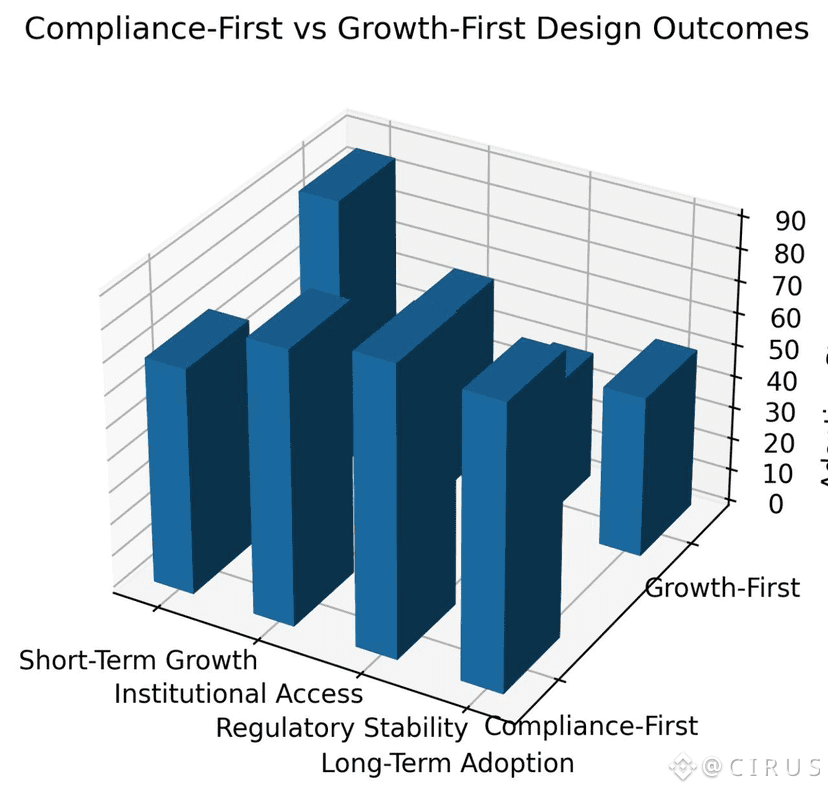
My take is that compliance-first design does not slow adoption. It changes its shape. Growth may be steadier and less explosive early on, but it is more durable. For systems intended to support real financial activity, reducing long-term adoption risk matters more than maximizing short-term metrics.
