

DUSK isn’t one of those tokens that exists mainly to “be traded.” It’s closer to infrastructure. And that difference matters, because Dusk Network is trying to solve a problem that most blockchains avoid: how do you bring privacy into on-chain finance without turning the chain into a black box that regulators and institutions will never touch?
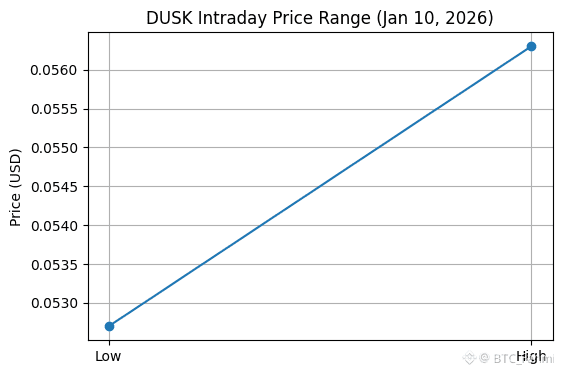
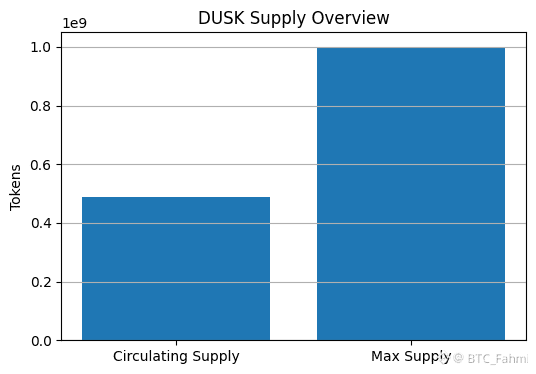
That tension, privacy versus compliance, is exactly where $DUSK becomes integral to the ecosystem. On January 10, 2026, DUSK is trading around $0.05628 (intraday range roughly $0.0527–$0.0563), with a circulating supply commonly listed around ~487M DUSK and a max supply of 1B DUSK. Those numbers are not just market trivia. They reflect the long-term incentive design behind the chain’s security, activity, and adoption path.
To understand why DUSK matters, you first need to understand what Dusk is attempting to build: a blockchain designed for confidential smart contracts, where data can remain private, while still allowing compliance-friendly workflows. Dusk’s positioning is pretty explicit: it targets regulated financial activity, tokenized assets, and institutional-grade applications where confidentiality is a requirement, not a feature request.
In that world, the token’s job is not cosmetic. It becomes the economic glue.
The most obvious function is security. Dusk’s tokenomics describe an initial supply and a long emission schedule where additional DUSK is emitted over decades primarily to reward stakers. The stated maximum supply is 1,000,000,000 DUSK, comprised of a 500M initial supply and 500M emitted over time as staking incentives. That kind of design is meant to keep validators motivated long after the early hype cycle has died out, which is critical for chains targeting serious financial use cases. Institutions don’t build on networks that might become ghost towns two years later.
But staking incentives are only the baseline. DUSK’s deeper role shows up when you connect it to the “privacy + compliance” mission.
Privacy on-chain is not just about hiding everything. Real financial markets don’t work that way. Banks, brokerages, and regulated issuers need confidentiality (customer identities, trade sizes, contractual terms), but they also need auditability, reporting, and the ability to prove things to authorities. Dusk’s narrative is essentially: you should be able to run confidential contracts, while still maintaining financial market principles and regulatory requirements.
Here’s where DUSK becomes integral: it aligns incentives for participants who support that environment. A privacy-preserving chain can’t depend on “goodwill.” It needs a token to compensate validators, enable network-level economics, and standardize value exchange across applications. In compliance-heavy ecosystems, every extra layer (privacy proofs, verification systems, compliant asset logic) adds operational cost. A native token is the practical tool for paying those costs in a consistent way.
A real-life analogy: imagine a private securities marketplace. Trades shouldn’t be public, but regulators still require reporting and the ability to verify that the trades follow rules. Now imagine trying to run that marketplace with no native economic layer, relying entirely on external incentives. Eventually, someone has to pay for the infrastructure that makes confidentiality possible. On Dusk, that “someone” is the ecosystem itself—powered by DUSK incentives and fees.
From a trader or investor perspective, this is where the long-term involvement point matters. DUSK doesn’t need mass meme adoption to justify its existence. Its potential demand comes from network usage in regulated contexts: tokenization, asset issuance, secondary market infrastructure, enterprise-grade smart contracts, and privacy-preserving finance. That’s a slower burn than typical crypto narratives, but arguably more durable if real adoption happens.
One trend worth watching is how Dusk positions itself around regulated markets and real-world assets. A number of market summaries and ecosystem writeups emphasize that Dusk is trying to merge confidentiality with compliance—essentially turning privacy from a regulatory “problem” into a feature that institutions can adopt.
My personal view (not financial advice) is that this is the only privacy thesis that has a realistic chance to scale beyond crypto-native users. Pure privacy chains often end up boxed in by exchange delistings, regulatory suspicion, or limited institutional touchpoints. Dusk is betting on a different route: “privacy with proof,” rather than “privacy with disappearance.” If that bet succeeds, DUSK becomes less like a speculative coupon and more like an essential commodity inside a specialized financial network.
Of course, the risk is equally clear: institutional adoption moves slowly, and chains building for compliance must execute with almost zero tolerance for security flaws or downtime. Traders should also be honest about volatility. With the token still far below its historical peak levels shown on major trackers, price can react sharply to news, liquidity shifts, and sentiment cycles.
So if you’re evaluating DUSK, the key question isn’t “Will it pump?” The more useful question is: does the world actually need an on-chain financial system where privacy and compliance can coexist and can Dusk become credible enough for that world? If the answer trends toward yes over the next few years, then $DUSK isn’t just integral. It’s unavoidable.
