

I’m no longer unfamiliar with the ideas promising to take Web3 to new heights by optimizing settlement on the blockchain.
Sounds about right. If the common logic is “if blockchain solves everything, then you just need to make it faster, cheaper, and more scalable,” then you simply pour money into new chains and wait for mass adoption. A simple idea—and because it’s too simple, it repeats the entire cycle over and over again. But Web3, at least from how I see it, has never been just a settlement problem. It’s a problem of authority and intent in a trustless environment.
Blockchain appeared pretty early. Over the past 10+ years, these systems have focused on recording transactions in an immutable way: transferring assets, updating state, and ensuring finality. They turn every valid action—signatures, gas, nonce—into recognized events on the ledger. It sounds correct, but the problem is this:
Blockchain records: “What has happened?”Authorization checks: “Who has a ticket to enter?”
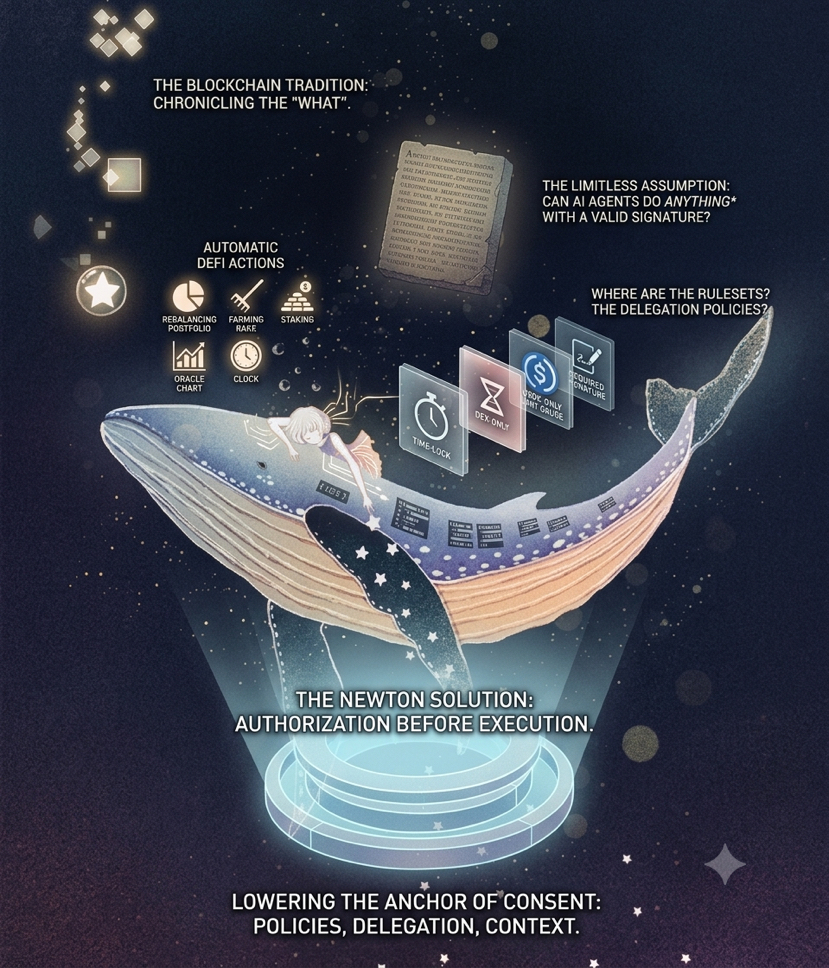
Most of the time, you only see that the transaction has been executed, the signature is correct, and the state has changed. It seems perfect, but actually it’s still after your intent has been carried out. Blockchain doesn’t prevent anything, doesn’t limit scope, and doesn’t control policy. It only confirms and records. And then there’s another layer of problems. Traditional blockchain almost assumes that “if someone has a valid signature, they can do anything.” But in reality, that’s not true—especially when AI Agents are involved. AI can automatically rebalance a portfolio, automatically farm, automatically stake, automatically claim rewards, automatically vote, automatically pay… but where are the limits? Is the AI allowed to swap assets? How many USDC is it allowed to use? Is it only allowed to trade on Uniswap or any DEX? Only allowed from 9 a.m. to 5 p.m.? Only allowed when the oracle hasn’t deviated by more than 1%? Does it need an additional owner signature?
Blockchain doesn’t show you the context of permission. It only shows you a transaction that has completed—no intent, no rules, no clearly defined delegation.
Many people look at the settlement layer and believe they have strong enough infrastructure. But when AI agents become the main actors, a simple settlement layer can easily turn into a risk of crowd behavior disguised under the “trustless execution” layer.
What I always come back to isn’t the immutability of the ledger—it’s how permission is controlled before the ledger is touched.
At least from what I’ve observed, Newton doesn’t go in the direction of competing settlement. It doesn’t try to help you “see transactions happening faster.” It seems to be trying to solve something less exciting but more important: the Authorization layer—the layer that determines permission before execution and settlement occur. It’s not the blockchain looking outward; it’s Newton looking at the policy and permissions you designed. Newton’s approach doesn’t add a new settlement chain. Data and transactions still happen on Ethereum, Solana, Base… But how execution is allowed is different. It ties directly to controlling intent, delegation, policy, and verification. You must define clearly: what the AI is allowed to do, what it’s not allowed to do, and under what conditions. And the system will enforce those rules consistently, without emotion, before the transaction touches the blockchain.
Blockchain gives you more capability to execute. Newton takes away part of that “infinite freedom” by requiring permission. It doesn’t replace your intelligence, but it limits and makes AI agents’ actions safer—or exposes whether your rules are flawed.
But I don’t think this is a perfect solution. Systems always have trade-offs. With a settlement-focused blockchain, you face the risk that “anyone can do anything if they have a key.” With an authorization layer like Newton, you face the risk that the rules are wrong or the policy is too rigid.
A model that works well in a bull market can break very quickly when AI agents scale and the market becomes highly volatile, because Web3 isn’t a linear environment. And there’s another thing. When you delegate authorization to the system, you’re also changing your role. You’re no longer just the one who signs transactions. You become the person who designs policies and rules for all the AI agents.
If the rule is wrong, the system will be wrong in a very consistent way. And sometimes that can be more dangerous than making random mistakes. So if you put these two side by side, I don’t see them as direct competing tools. One serves settlement and finality. One serves authorization and permission. One gives you the feeling that “the transaction is safe after it happens.” The other forces you to face the question: “Should this transaction be allowed in the first place?”
Which is better? I don’t think that question matters that much. What matters more is what you’re missing in the current Web3 stack.
If you’re still struggling with execution and finality, the settlement layer will always be appealing. If you’re ready for the next phase where AI agents automatically automate a large number of on-chain actions, an authorization layer like Newton Mainnet Beta is worth looking into. But worth looking at doesn’t mean you should trust it completely.
Newton may be trying to solve Trustless Authorization, while blockchain still keeps the traditional settlement approach. This difference is notable, especially when AI becomes the main actor.
In practice, everything is only truly validated when it’s used. Whitepapers, narratives, or demos don’t matter as much as whether Mainnet Beta actually enforces policy effectively, integrates well, and operates fast in a real environment.
Finally, everything still circles back to usage.
It’s not about how fast a chain is, or how good authorization sounds—it's about how long you (and your AI agents) use it, through how many market conditions, and whether it can still maintain consistent permission when everything gets chaotic.
I’m still watching Newton Mainnet Beta… especially when AI agents truly scale hard, because that’s when the real limits of narrative authorization will become clear.
And that’s also what I’m waiting to see.