
Looking back at the trajectory of Web3 gaming, we have officially moved beyond the era of "speculative farming" and into the age of Economic Infrastructure. As of April 15, 2026, the launch of Stacked by the Pixels team marks a definitive shift in how digital ownership and player incentives are managed.
The following article explores the evolution of Pixels into Stacked—a transition from a single farming simulation to a global, AI-powered LiveOps engine that is redefining the "Holy Grail" of sustainable play-to-earn.
The Stacked Revolution: How Pixels Solved the Web3 Sustainability Crisis
For years, the Achilles' heel of Web3 gaming was never the technology; it was the incentive design. While putting assets on-chain was a simple technical feat, aligning those rewards with genuine player behavior proved nearly impossible for most studios. Early models often collapsed under the weight of "value extractors"—users who played only to sell, draining the ecosystem without contributing to its growth.
The Pixels team, led by Luke Barwikowski, took a different approach. By obsessing over Return on Reward Spend (RORS), they transformed a simple 2D pixel-art game into a revenue-generating powerhouse. That obsession has now birthed Stacked, a decentralized rewards application and LiveOps engine that treats gaming economies with the precision of high-frequency trading.
1. Beyond the "Quest Board": What is Stacked?
Stacked is not just a feature; it is the connective tissue of a growing multi-game ecosystem. It serves two distinct masters: the player seeking a seamless experience and the studio seeking a profitable economy.
For the Player: Unified Sovereignty
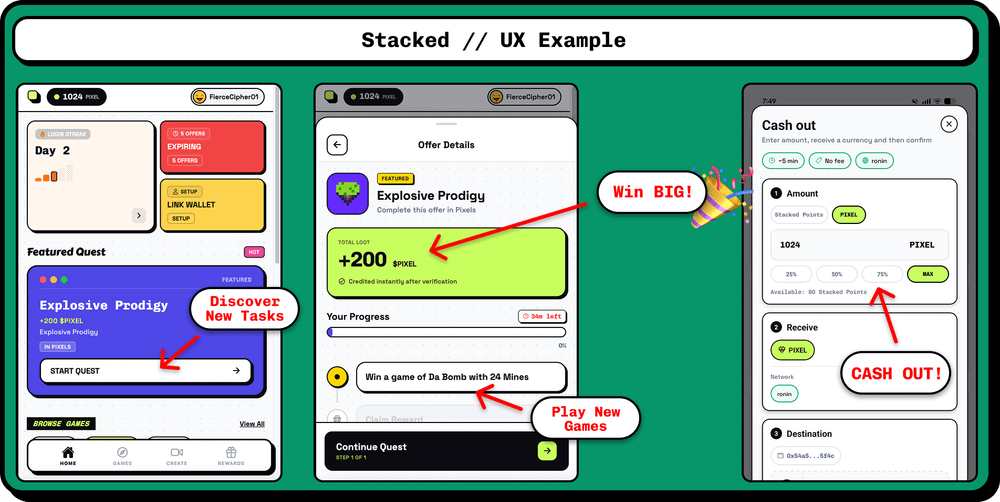
For the user, Stacked is a "one-stop shop" for the modern gamer. Instead of managing a dozen different wallets and tracking rewards across isolated discord channels, players use one app to:
Discover & Play: Access a vetted list of games, including Pixels, Pixel Dungeons, Sleepagotchi, and Chubkins.
Personalized Missions: Receive tasks tailored to their specific playstyle. A veteran harvester in Pixels won’t see the same tasks as a high-level combatant in Pixel Dungeons.
Streamlined Cash-Out: Claim rewards—ranging from $PIXEL to USDC and Stacked Points—all in one place.
Importantly, Stacked maintains a "Zero-Footprint" privacy model. Gameplay signals remain internal to the system to improve reward matching, ensuring that player data isn't sold to third-party advertisers.
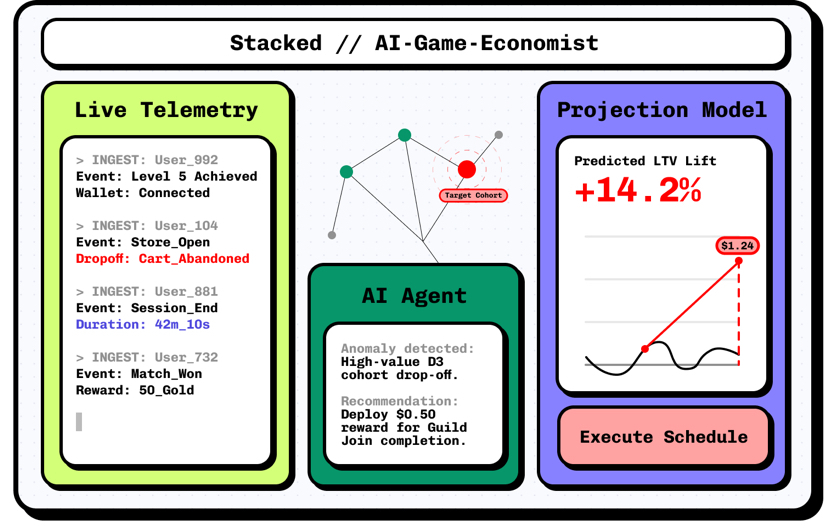
For the Studio: The AI Game Economist
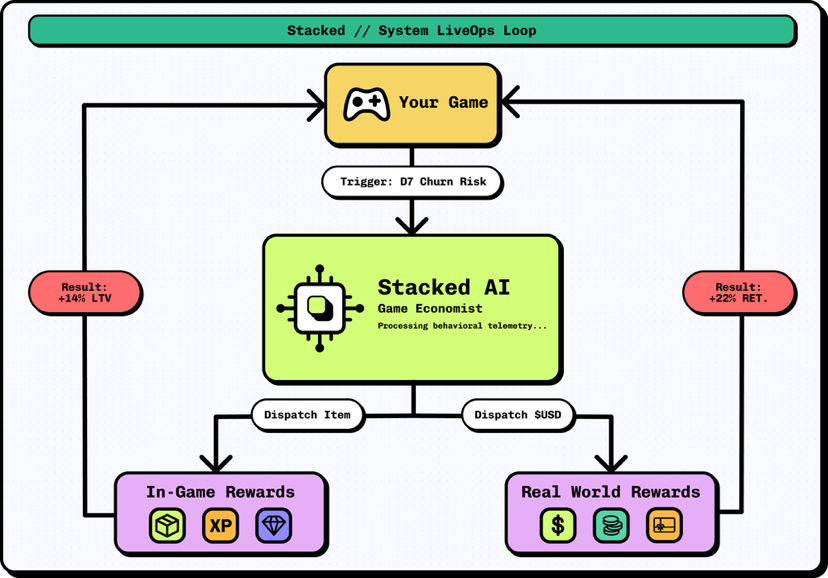
The "business-facing" side of Stacked is where the real magic happens. It is a Rewarded LiveOps enginethat provides studios with a level of control previously reserved for massive Web2 publishers like King or Supercell. At its heart lies an AI Game Economist, an agent layer that can answer complex prompts such as:
"Which mechanics correlate with long-term engagement for my top 10% of spenders?"
"Where is my reward budget leaking without lifting our key performance indicators?"
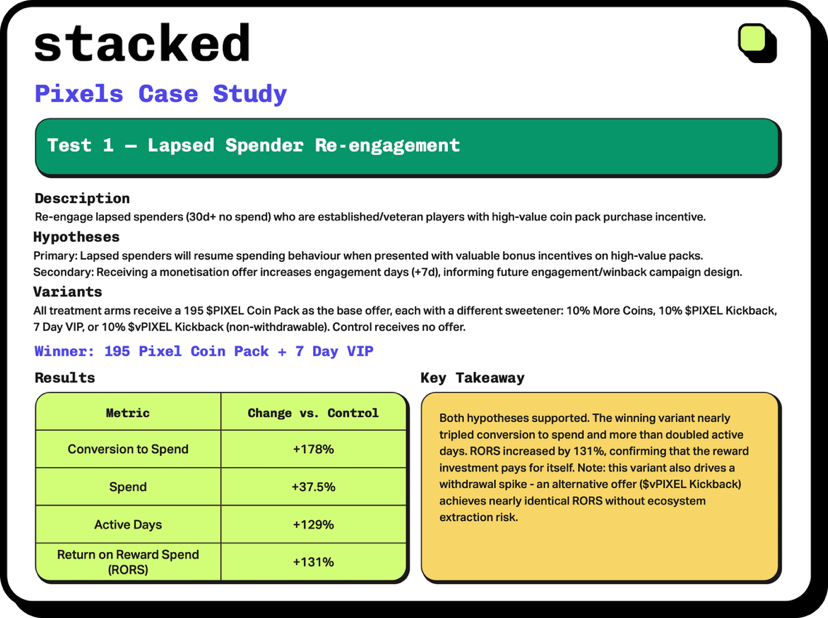
By using these AI-driven models, studios can deploy personalized re-engagement offers. In internal tests, this system led to a 178% increase in spending conversion by targeting veteran players who had been inactive for over 30 days.
2. The PIXEL Evolution: From Token to Index
As Stacked expands, the role of the $PIXEL token is undergoing a fundamental transformation. While it remains the lifeblood of the original Pixels game, it is becoming a staking-centric index asset for the entire ecosystem.
Multi-Game Staking: Users can now stake PIXEL into different game pools. This doesn't just earn yield; it directs the flow of ecosystem rewards to the most successful games. It rewards the "builders" who create fun experiences that keep stakers engaged.
The RORS Floor: The PIXEL Token’s value is increasingly tethered to the Return on Reward Spend. If the ecosystem maintains a RORS > 1.0 (meaning every $1.00 rewarded generates more than $1.00 in revenue), the token transitions from a speculative asset to a sustainable utility.
3. The "Slow Start" Strategy
The launch of Stacked is intentionally methodical. The team is starting with their "first-party" titles—games where they control the loops and understand the economics—to tighten the system before opening the floodgates to external B2B partners.
Currently, the rewards feed is focused on the Pixel ecosystem, but the roadmap for late 2026 includes Universal Accounts and EIP-7702 support, allowing Stacked to become an "invisible" layer across the broader blockchain landscape.
4. Why This Works (When Others Failed)
Stacked succeeded because it was built in production, not in a pitch deck. It was shaped by:
Millions of Players: Real-world data from over 1 million daily active users.
Proven Revenue: A framework that helped drive $25M in revenue for Pixels alone.
Bot Mitigation: Advanced fraud controls that identify "farmed" engagement versus genuine play.
Conclusion
The story of Stacked is simple: This works now. It has helped make Pixels one of the few profitable Web3 games in history. By taking those hard-earned lessons and packaging them into a platform, the Pixels team isn't just building a game anymore—they are building the operating system for the next generation of digital fun.
As we look toward the remainder of 2026, the question is no longer whether Web3 games can be sustainable, but how many will integrate with Stacked to ensure they are. The era of the "unlocked" gaming economy has truly arrived.