

The pan-European markets Stoxx 600 fell 1.2% intraday on Tuesday as President Trump’s 8 p.m. EDT deadline for Iran to reopen the Strait of Hormuz – a chokepoint through which roughly 20% of global oil supply transits – drove Brent crude toward $108 per barrel and injected a fresh geopolitical risk premium directly into European equities.
The index, returning from a four-day Easter break, opened into a market already pricing conflict escalation, with energy prices surging 2.5% on the session as traders assigned an estimated $5–$10 war premium per barrel to the front-month contract.
The transmission is direct: Europe imports approximately 60% of its energy needs, a structural dependency that makes European equities categorically more exposed to Strait of Hormuz disruption than their U.S. counterparts – and the Stoxx 600’s weighting toward energy-cost-sensitive industrials, travel names, and auto manufacturers amplifies that exposure at the index level.
The VSTOXX, Europe’s volatility benchmark, spiked approximately 15% as the deadline window narrowed.
The sections below cover the geopolitical catalyst and its transmission into European energy prices, the specific index and sector price action, and the key decision points investors are tracking into Wednesday’s session.
Trump Iran Ultimatum Sends Brent Crude Toward $110 and Unsettles European Markets
The U.S.-Israel conflict with Iran has run for six weeks since Tehran effectively closed the Strait of Hormuz in late February 2026, halting an estimated 21 million barrels per day of oil transit and stoking the kind of supply-shock inflation that European policymakers had hoped to leave behind.
Prior negotiating deadlines – set first for late March, then pushed to Monday – each failed to produce compliance, and Tuesday’s 8 p.m. EDT ultimatum carries explicit escalation language: Trump warned the U.S. would decimate every bridge and power plant in Iran within four hours of the deadline passing unmet.
JUST IN: President Trump says "the entire country [of Iran] could be taken out in one night." "And that night might be tomorrow night." pic.twitter.com/rTETwkcWG1
— BRICS News (@BRICSinfo) April 6, 2026
That threat, paired with simultaneous signals that Iranian leadership was negotiating “in good faith,” produced the precise conditions markets find most difficult to price – binary outcomes with contradictory pre-signals.
Oil prices surging on the Iran crisis have already pushed U.S. CPI readings higher, and a strike on Iranian energy infrastructure would threaten to extend that inflationary impulse well beyond current consensus forecasts.
The ECB’s previously near-certain June rate cut is now under active scrutiny – a sustained move in Brent crude above $95 reignites the energy component of eurozone CPI inflation at a moment the central bank had begun to declare victory.
Analysts at negotiating desks are pessimistic on a pre-deadline deal. Phillip Nova’s Priyanka Sachdeva noted that oil traders view prices as volatile but expect eventual resolution, having discounted prior shifting deadlines – a posture that leaves the market asymmetrically exposed if U.S. strikes materialize. Forex.com’s David Scutt characterized EUR/USD as a “sell-on-rallies play,” citing breaks below key moving averages and a sequence of lower highs since late January as the conflict has deepened the geopolitical risk discount on European assets.
Stoxx 600 Sector Rotation: Energy and Defense Outperform as Travel and Tech Lead Losses
Within the Stoxx 600’s 1.2% decline, sector rotation tracked the conflict’s economic logic precisely. European energy stocks, which have gained 15% cumulatively since the Strait closure in late February, held relative strength as Brent crude’s advance reinforced upstream earnings expectations.
Europe’s banking sector added 0.7%, supported by energy credit exposure and rate-repricing implications of sustained inflation. Defense names including Rheinmetall, BAE Systems, and Thales outperformed as conflict-adjacent positioning drew incremental allocation.
The laggards told the cost-transmission story: travel and leisure names, which carry direct fuel-cost exposure, led sector declines, while industrial names sensitive to energy input costs followed.
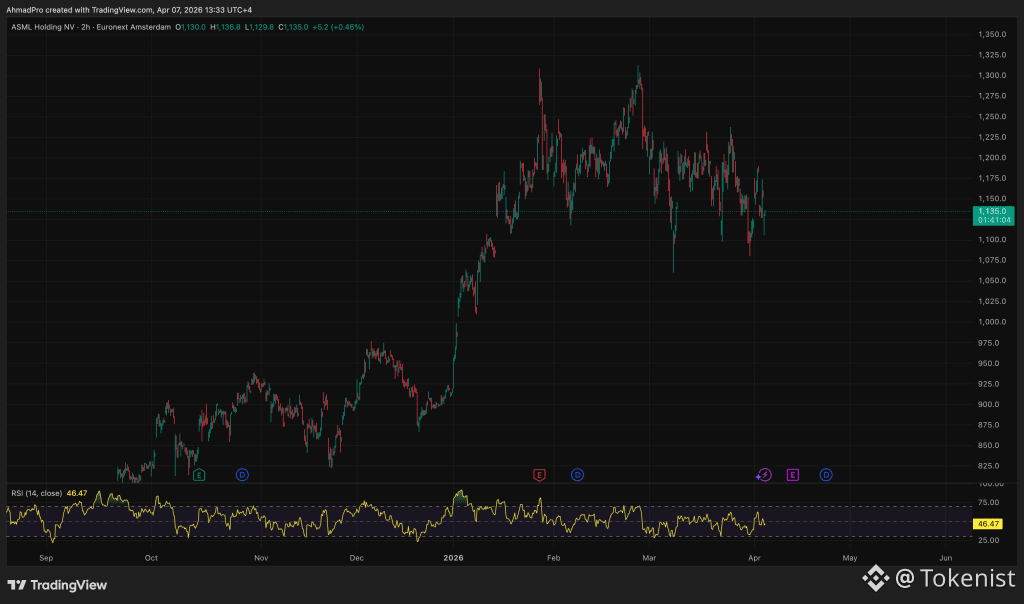 Source: Tradingview
ASML Holding N.V. dropped 4.2% on a separate catalyst – a cross-party U.S. legislative proposal for tighter China chip export curbs – adding a technology-sector drag unrelated to the Iran timeline but compounding the index’s downside. U.S. equity futures have tracked similar risk-off pressure as the Iran conflict has deepened, though European equities bear the heavier structural burden given energy import dependency.
German Bund yields ticked lower as sovereign bond prices rose, confirming a parallel safe-haven rotation into fixed income that has characterized each prior escalation point in this conflict cycle.
The post European Markets Stumble as Iran Deadline Injects War Premium into Energy appeared first on Tokenist.