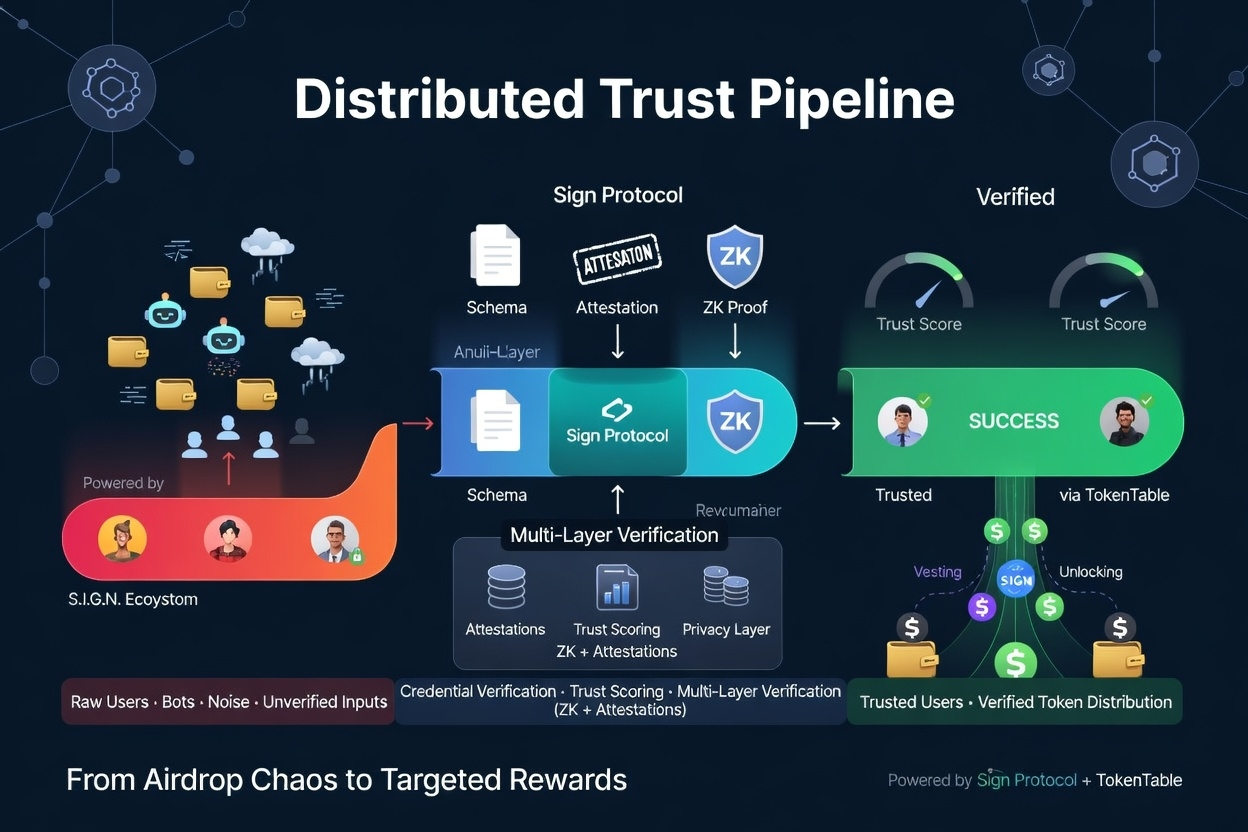
People still assume that putting an airdrop on-chain makes it fair. I’ve never been convinced. Transparency shows distribution, not whether it makes sense. Chaos can be perfectly visible.
We’ve seen this before. NFTs, DAOs, privacy coins,each promised to reshape digital economies. In practice, they struggled when real-world constraints appeared. Full transparency exposed too much. Full privacy hid too much. Systems became either impractical to use or difficult to trust.
Airdrops followed the same pattern. Open participation sounds inclusive, but without structure it turns into noise. Bots farm rewards. Metrics inflate. Real users get diluted. The problem isn’t distribution. It’s verification.
That’s where the deeper issue sits. Businesses, developers, even regulators often need to prove something is true without revealing everything behind it. Not identity in full, but eligibility, behavior, or participation. That balance,verification without exposure,is why certain infrastructure projects attract long-term capital. They solve coordination, not just visibility.
Credential-based distribution is one response to this. Instead of rewarding activity blindly, it introduces selective proof. You verify what matters, without exposing what doesn’t. Systems like Sign Protocol move in this direction, using structured credentials and controlled disclosure to make participation measurable and meaningful.
The concept is simple, but the implications are not. Privacy layers, zero-knowledge verification, and programmable disclosure allow applications to define what becomes public and what remains private. Blockchain, in this model, acts less as a broadcast layer and more as a neutral verifier.
If it works, the outcomes are practical. Better targeting of rewards. Lower verification costs. Clearer accountability between participants. A system that institutions can actually interact with, rather than observe from a distance.
But the challenges are real. Integrating these systems is complex. Standards are still evolving. Regulatory expectations are unclear. And adoption depends on whether developers are willing to build with tools that are harder, but more precise.
So the shift from airdrop chaos to targeted rewards isn’t guaranteed. It depends on whether infrastructure like Sign Protocol can make verification both usable and reliable.
If it does, this could move Web3 distribution from noisy experimentation toward something closer to real infrastructure. If not, it risks becoming another well-designed system that never quite leaves the lab.#SignDigitalSovereignInfra @SignOfficial $SIGN