

I will be honest, when I first saw Fabric Foundation mentioned in a few threads online, I assumed it was going to be another one of those projects that sounds impressive on the surface but falls apart the moment you actually read the details. Crypto has trained many of us to expect big narratives built on top of very thin foundations. So when I opened the material around Fabric, I was mostly expecting a few buzzwords about AI, robotics, and decentralization stitched together to ride the current cycle.
That expectation disappeared pretty quickly.
The deeper I looked into what Fabric is building, the more layers started to appear. The project isn’t simply trying to attach a token to robotics. It is trying to solve something much more structural: how machines operate economically once they become capable of acting independently in the physical world.
The starting point of their whitepaper actually caught my attention. It points out how quickly machine capability has accelerated in the last year alone. Benchmarks that researchers once believed would take years for AI systems to solve have been cleared in a matter of months. At the same time, large language models are already being used to generate code that allows robots to perform increasingly complex tasks. When you step back and look at that trajectory, the obvious question appears very quickly. If machines are going to act in the real world, who manages their identity, their permissions, and their economic interactions?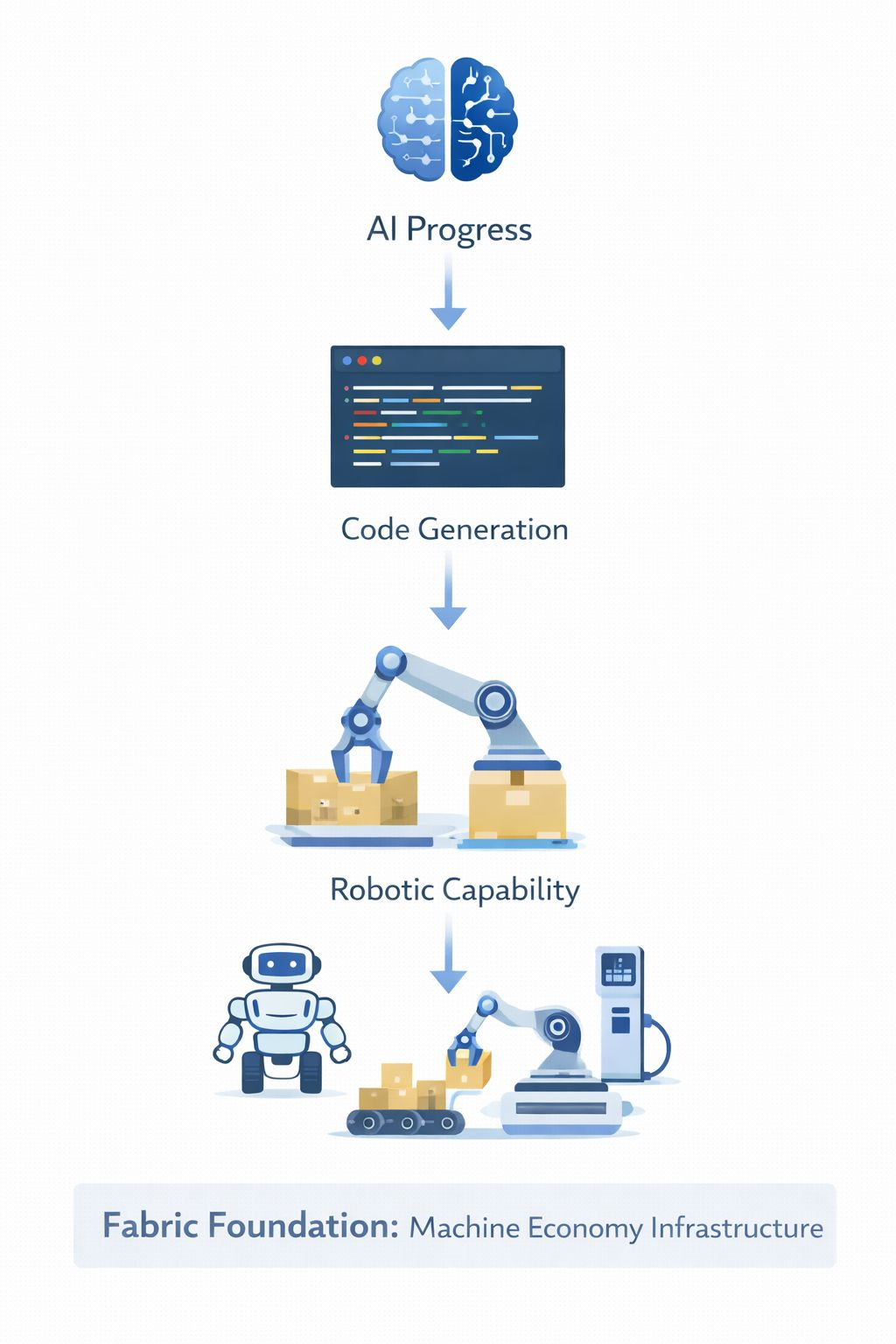 That is the problem Fabric seems to be targeting.
Underneath the protocol sits OM1, a universal operating system designed to run across robots from completely different manufacturers. Companies like UBTech, AgiBot, Deep Robotics, and Fourier are already connected through that software layer, which means machines that normally live inside separate ecosystems can run shared logic. That alone is a fairly interesting step toward interoperability, something the robotics industry has historically struggled with.
Fabric then builds the economic infrastructure on top of that environment. Instead of focusing on hardware performance, the protocol deals with identity, payments, and governance. In other words, it attempts to give machines the basic economic tools they would need if they were going to operate autonomously rather than as extensions of a single company’s internal system.
One detail that stood out to me was the concept of machine-to-machine payments. A robot running inside the network can theoretically pay for services on its own. Charging stations, maintenance systems, data services, and other infrastructure can be accessed without a human initiating the transaction. Payments settle through the network using the ROBO token, which functions as the economic medium connecting all of these activities.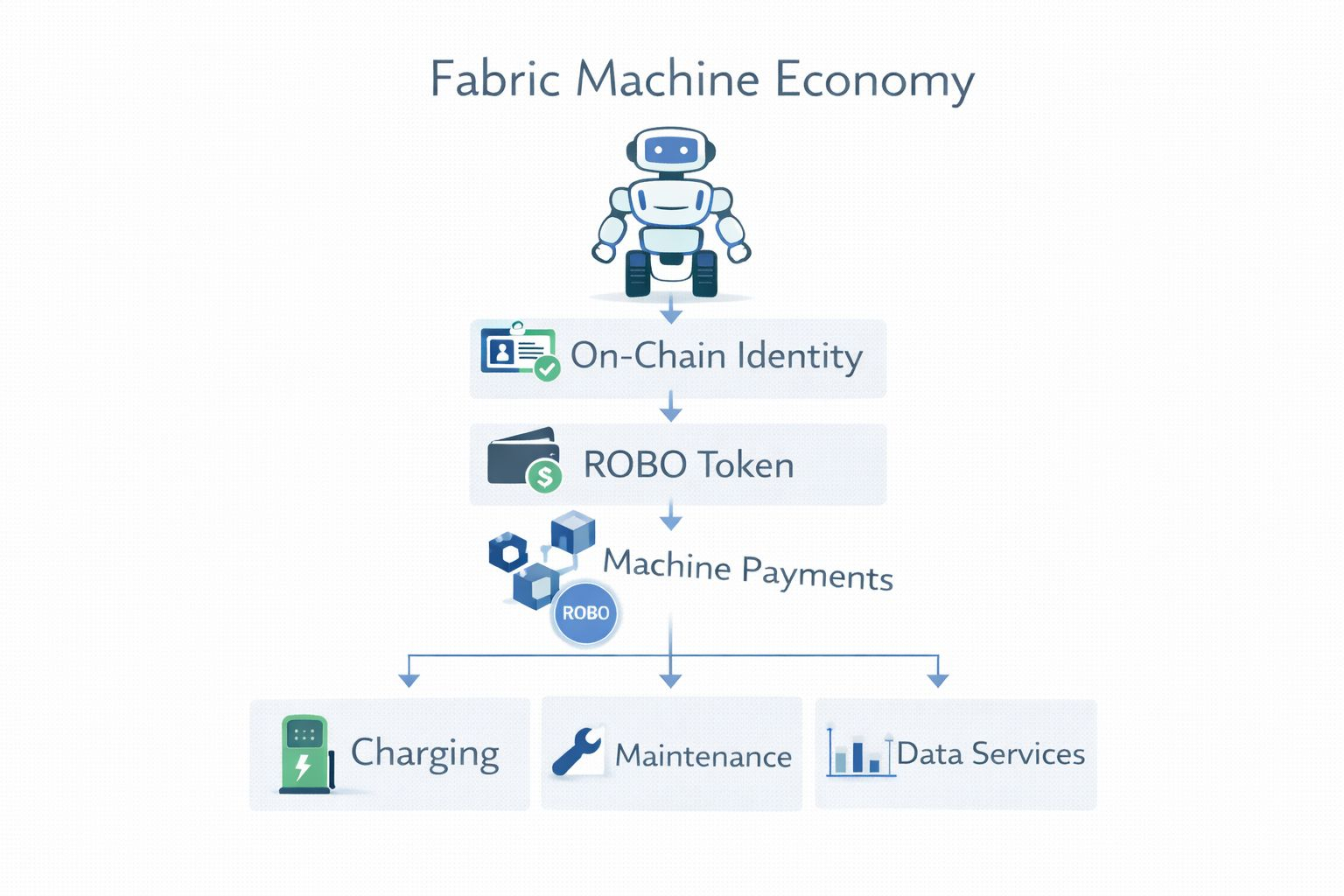 One thing that really caught my eye was the emission model. Most tokens just stick to a fixed release schedule, but Fabric takes a different route with what they call an Adaptive Emission Engine. Basically, it tweaks how many tokens get released by watching real network conditions stuff like how busy things are and how well the service is running. If things are quiet and there’s not much happening, the engine pumps out more tokens to get people involved. But if the network performance slips, it holds back on emissions to keep things running smoothly.
It is a feedback system rather than a purely inflationary schedule, which is a design choice you do not often see implemented in early stage protocols.
The token supply is fixed at ten billion, with the token generation event happening in early 2026. Listings followed quickly across several exchanges, which suggests there is already some level of market interest around the idea of a machine economy.
That said, there are still a few things I’m watching closely before forming a stronger opinion. A large portion of the token supply is locked and will unlock gradually over time, which means the long-term distribution dynamics will matter. There are also practical questions around latency and reliability when real-world robotics interacts with blockchain infrastructure. Those technical edges are not trivial.
But stepping back from those concerns, what impressed me the most is that Fabric does not feel like a token searching for a narrative. It feels like a token attached to infrastructure that someone has already been building for a while.
And in a space where many projects start with marketing and only later attempt to build technology, that difference is noticeable almost immediately.