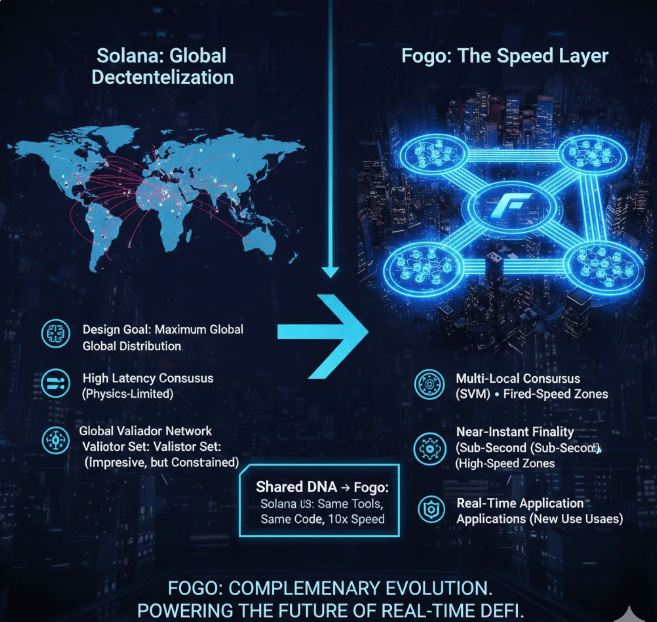
There's a question that comes up whenever someone learns about Fogo for the first time: isn't this basically just Solana? You've got the Solana Virtual Machine, Firedancer, and some shared technical DNA. What's actually different?
It's a fair question, and it deserves a straight answer rather than the defensive marketing speak that often shows up in these comparisons.
The honest answer: Fogo is built on Solana's technical foundations but solves problems that Solana hasn't solved in the same way. Understanding the relationship between the two helps clarify exactly what Fogo is bringing to the table.
The SVM: Why Compatibility Is a Feature, Not a Compromise
Fogo uses the Solana Virtual Machine as its smart contract execution environment. This means that programs written for Solana can run on Fogo without modification. The tooling, the programming languages, the deployment processes all the same.
To some observers, this looks like a lack of originality. Why not build something entirely new?
Here's why compatibility is actually the right call: developer ecosystems are enormously valuable, and they're slow to build. Solana has spent years accumulating developers, tools, libraries, frameworks, and institutional knowledge. Fogo doesn't have to rebuild all of that from scratch. Any Solana developer can deploy on Fogo immediately.
This is a strategic decision, not a technical shortcut. Network effects in software are powerful. Every tool that already works, every developer who doesn't need to retrain, every existing application that can be ported in hours rather than months these are real advantages that compound over time.
The SVM compatibility also means that Fogo benefits from the security track record of smart contract patterns that have been battle-tested on Solana. When you're building on an emerging blockchain, having access to audited, proven code patterns is genuinely valuable.
Where the Paths Diverge
Despite the shared technical foundation, Fogo and Solana are solving different problems at the infrastructure level.
Solana was designed for global decentralization with speed as a secondary concern. Its validator network is spread across the globe, which provides geographic resilience but introduces the latency that comes with a globally distributed consensus process. Solana's performance is impressive by traditional blockchain standards, but it remains constrained by the physics of a globally distributed system.
Fogo's multi-local consensus is a fundamental architectural departure. By allowing validators to be co-located in zones, Fogo achieves block times and transaction latency that simply aren't possible with Solana's global distribution model. This isn't a criticism of Solana it's a different design goal.
For Solana, maximum decentralization and global accessibility of the validator set is a core value. For Fogo, achieving the kind of performance that enables entirely new categories of application is the priority, achieved through a design that maintains decentralization through zone rotation rather than global simultaneous distribution.
Firedancer: From Solana Tool to Fogo Foundation
Firedancer started as a high-performance validator client for Solana, developed by Jump Trading's research arm. It was designed to dramatically improve Solana's throughput and reliability.
For Fogo, Firedancer isn't a performance enhancement added on top of existing architecture it's the foundation. Fogo validators run Frankendancer, the Firedancer implementation with Fogo-specific modifications, from day one. The performance characteristics that Firedancer enables aren't an upgrade that came later; they're baked into the protocol from launch.
This matters because it means Fogo's validators start in a position of technical sophistication that took Solana years to reach. The network's starting point is already highly optimized.
The Ecosystem Question: Starting Fresh vs. Starting With Something
One of the challenges for any new blockchain is bootstrapping an ecosystem. Where are the applications? Where are the users? Why would a developer build there when they could build on an established network with existing users?
Fogo's answer is the SVM compatibility, but also more than that. The protocol's speed characteristics open up application categories that don't work well anywhere else. If you want to build a real-time on-chain game, a high-frequency DeFi protocol, or an application where sub-second finality is a requirement rather than a nice-to-have, Fogo offers something no other network currently provides with the same combination of speed and EVM-level tooling familiarity.
The applications that Fogo enables aren't applications that Solana users are leaving Solana to use. They're applications that don't exist yet because the infrastructure to build them hasn't existed. That's a different kind of ecosystem building not poaching from competitors, but expanding the frontier.
The Token Economy Comparison
Both Solana (SOL) and Fogo ($FOGO) are utility tokens for their respective networks, used for transaction fees and staking. But the economic designs differ in ways that reflect the different stages of each network.
Fogo launches with a 6% annual inflation rate, decreasing to 2% over two years. This is more aggressive early inflation than Solana's current schedule a deliberate choice to ensure validators are well-compensated during the network's growth phase, when transaction volume alone might not sustain them. The inflation schedule is transparent and predictable, giving stakers and delegators a clear picture of how rewards will evolve.
The priority fee mechanism is similar in structure to Solana's but benefits from Fogo's faster processing in a network where blocks come more frequently and transactions confirm faster, the competitive dynamics around priority fees play out differently. There's less reason to pay a very high priority fee when the base processing speed is already extremely fast.
Complementary, Not Competing
The most honest framing of the Fogo-Solana relationship is that they serve partially overlapping but genuinely different use cases.
For applications that need maximum global decentralization and are willing to accept Solana's existing performance characteristics, Solana makes sense. For applications where sub-second latency is a hard requirement, and SVM compatibility is an advantage, Fogo is the answer.
Developers who know Solana can move to Fogo without relearning. Users of Solana-based applications might find their favorite protocols deploying on Fogo if performance becomes a priority. The networks share DNA but have different destinies.
That's not a weakness in the story. It's a sign that the space is maturing.