
When people talk about “the next phase” of on-chain markets, they usually mean new products: fresh perps, new collateral tricks, yet another incentive loop dressed up as innovation. Fogo is interesting for a different reason. It feels like a project that’s quietly betting the next battleground isn’t the instrument—it’s the act of trading itself. Not the philosophy of trading. The physical experience of it: the pauses, the prompts, the “wait… did it go through?”, the little delays that make on-chain markets feel like you’re trading through a foggy window.
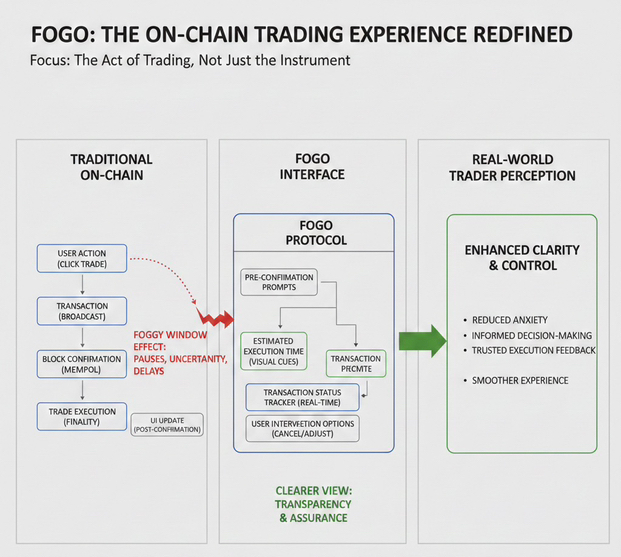
That might sound like a UX gripe until you look at what Fogo has been spending real effort on. One of the most revealing signals is something that doesn’t get hype threads: “sessions.” Fogo’s foundation has been pushing a sessions standard and tooling that’s meant to reduce repeated wallet signing, enable gas-sponsored interactions, and generally make apps feel less like a series of ceremony steps and more like a continuous session where you can actually do things without being interrupted every ten seconds. The point isn’t convenience for its own sake. The point is that every extra wallet prompt is a micro-hesitation, and hesitation is where retail users churn and where fast traders lose faith. If you want serious order flow to live on-chain, you can’t treat those interruptions as harmless. You have to treat them like a tax on participation.
That’s the first reason I think Fogo is “positioning” rather than simply “building another chain.” It’s approaching trust like a performance budget. If execution feels crisp, people forgive a lot. If execution feels uncertain, they assume the system is lying—even if it’s not. Traders don’t give you many chances to prove you’re reliable. They just move.
There’s a second tell: Fogo doesn’t flinch from vocabulary that most crypto projects avoid because it sounds too much like traditional finance. Co-location. Performance centers. “Builders next to validators.” That’s not a decentralization sermon. That’s an admission about what kind of users they want. In normal finance, co-location is a moral argument disguised as an engineering choice: you’re deciding who gets to be closer to the engine. Fogo tries to frame it as permissionless access to performance rather than a gated advantage. Whether that holds in practice depends on something unromantic: who can afford the hardware, the networking, the ops talent. A chain can be “open” and still be socially captured by the people who can run industrial infrastructure.
So if you zoom out, Fogo’s product isn’t just throughput or architecture. It’s a promise to execution-obsessed teams that their design choices won’t be punished by a sluggish base layer. That matters because a lot of the next wave of on-chain competition is going to look like this: chains trying to win not by inventing new concepts, but by making existing concepts feel like they finally belong on-chain.
The part where this gets messy—where it stops being a clean “performance story”—is token power and how it’s distributed.
Fogo’s tokenomics disclosure is unusually explicit, and the numbers are worth reading like a psychologist rather than a marketer. Core contributors are listed at 34%, institutions at 12.06%, foundation at 21.76%, community at 16.68%, launch liquidity at 6.5%, with a portion burned (2%). The piece I keep circling is the combination of “strict locks” and “foundation fully unlocked.”
Locks: contributors and investors being fully locked at TGE with long unlock schedules reduces the immediate fear of insiders dumping into early liquidity. That’s a real stabilizer, and you can feel the intent: don’t blow up trust in month one.
But then: foundation tokens being fully unlocked gives the foundation a lot of leverage from day one. Not necessarily in a sinister way. It can fund liquidity, grants, partnerships, market-making, all the stuff early ecosystems need. Still, an unlocked treasury is power. It becomes the quiet hand that can tilt the playing field toward certain apps, certain teams, certain narratives. Even if the foundation is benevolent, the ecosystem starts to adapt around what the foundation will support. People build what gets funded. They chase what gets subsidized.
Fogo tries to justify that power with a kind of venture-studio logic: the foundation funds projects, and partners commit to revenue-sharing agreements that route value back to the chain. That’s not the usual “we’ll grow and fees will magically cover everything” story. It’s closer to: we’ll underwrite the early ecosystem, then we’ll negotiate cashflows back into the treasury. As a financial model, it’s sharper than most. As a governance model, it raises a hard question: when the base layer is also a deal-maker, where does neutrality live?
And here’s where the data puts Fogo in an awkward but revealing position right now.
On centralized venues, the token already trades with meaningful volume. You can see the liquidity and the listings footprint. That matters because it creates a sense of legitimacy: “people are trading this, therefore it’s real.”
On-chain, the numbers (at least the public dashboards people track) still look early. Stablecoin footprint is modest and concentrated. DEX volume looks small compared to what you’d expect if the chain were already functioning as a major trading venue. That gap is the story. Fogo has attention and liquidity around the token, but it’s still in the phase of earning habitual on-chain flow.
And that’s the moment where projects either crystallize into something durable—or they don’t. Because it’s easy to mistake a liquid token for a liquid ecosystem. They’re not the same. One can exist without the other for a long time.
What gives Fogo a fighting chance is that the ecosystem it highlights isn’t a random grab-bag. A lot of the featured projects are obsessed with execution mechanics: hybrids of order books and concentrated liquidity, batch auctions, designs that explicitly try to reduce “toxic” flow and the invisible tax that professional order flow can impose on everyone else. This is not retail-friendly marketing. It’s niche, almost wonky market-structure work. That’s usually a sign of a certain kind of builder culture—people who care about matching, latency, adverse selection, and how trades actually get filled.
And if you believe the next phase of on-chain markets is about execution, those are the builders you want.
But there are real weaknesses, and they’re not cosmetic.
One, co-location and performance talk can spook communities. Even if the intent is fairness, it can read like the chain is inviting the same “infrastructure aristocracy” that crypto has always pretended it was replacing. If the perception takes hold that Fogo is optimized for a narrow class of players, that will show up in governance participation and long-term legitimacy.
Two, token distribution creates future political gravity. Long unlock schedules are stabilizing early, but cliffs and unlocks are also future events that market participants obsess over. For a trading-focused chain, you want predictable rules and predictable governance. If governance ever looks like it’s sliding into professional blocs—insiders, market makers, foundation-aligned partners—then “fast” won’t save you. Liquidity leaves when people feel the rules can be bent.
Three, there’s a temptation to over-optimize for exchange narrative. If a token is liquid on big venues early, the ecosystem can become addicted to the easy metrics: listings, APR campaigns, marketing allocations, short bursts of attention. Meanwhile, the hard work—getting real on-chain volume, sticky users, deep stablecoin liquidity—moves slower and gets less applause.
So when I say Fogo is “quietly positioning,” I don’t mean it’s secretly dominating. I mean it’s building the kind of infrastructure you only notice when you don’t have it: the stuff that smooths interaction, the stuff that keeps traders from bouncing off the product, the stuff that makes on-chain trading feel less like a ritual.
If Fogo succeeds, the win won’t look like a single dramatic milestone. It’ll look like boring habits forming. People opening an app, placing trades, moving size, coming back the next day—not because an incentive program pulled them in, but because execution felt clean and predictable. That’s the kind of growth that doesn’t trend… and then suddenly it’s everywhere.
If it fails, it’ll fail in a familiar way: the token stays tradable, the narrative stays alive, but the chain never becomes the venue it wants to be. The most active market remains the one where people trade FOGO itself on someone else’s rails, while the on-chain layer stays “promising.”
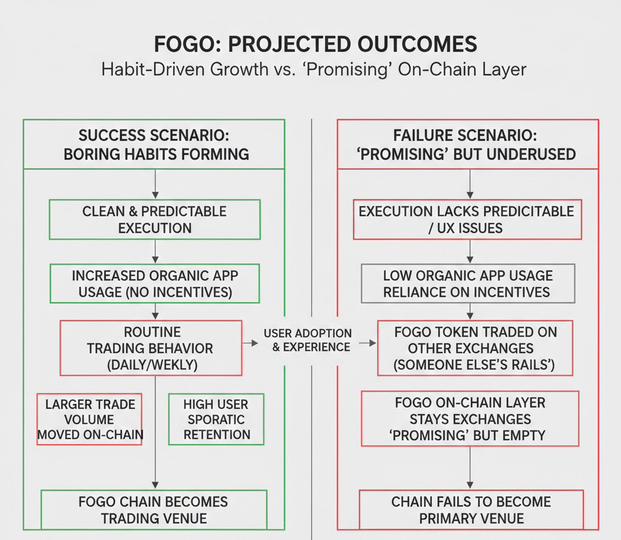
Fogo’s bet is basically this: in the next phase, markets won’t reward the loudest ideology. They’ll reward the venue that feels most like a venue. That’s a brutally practical thesis. It also means the project will be judged on things people can’t hand-wave away: daily volume that isn’t manufactured, liquidity that sticks around, governance that stays legible, and an ecosystem where the foundation’s power helps the network grow without quietly becoming the network.
