
The Web3 infrastructure stack is evolving from siloed blockchains into a modular decentralized cloud where specialized protocols solve specific bottlenecks.
I’ve been watching the interplay between Fluence (FLT), DeXe (DEXE), Theta Network (THETA), and The Graph (GRT), and it feels like we are witnessing the assembly of a complete decentralized AI and compute stack.
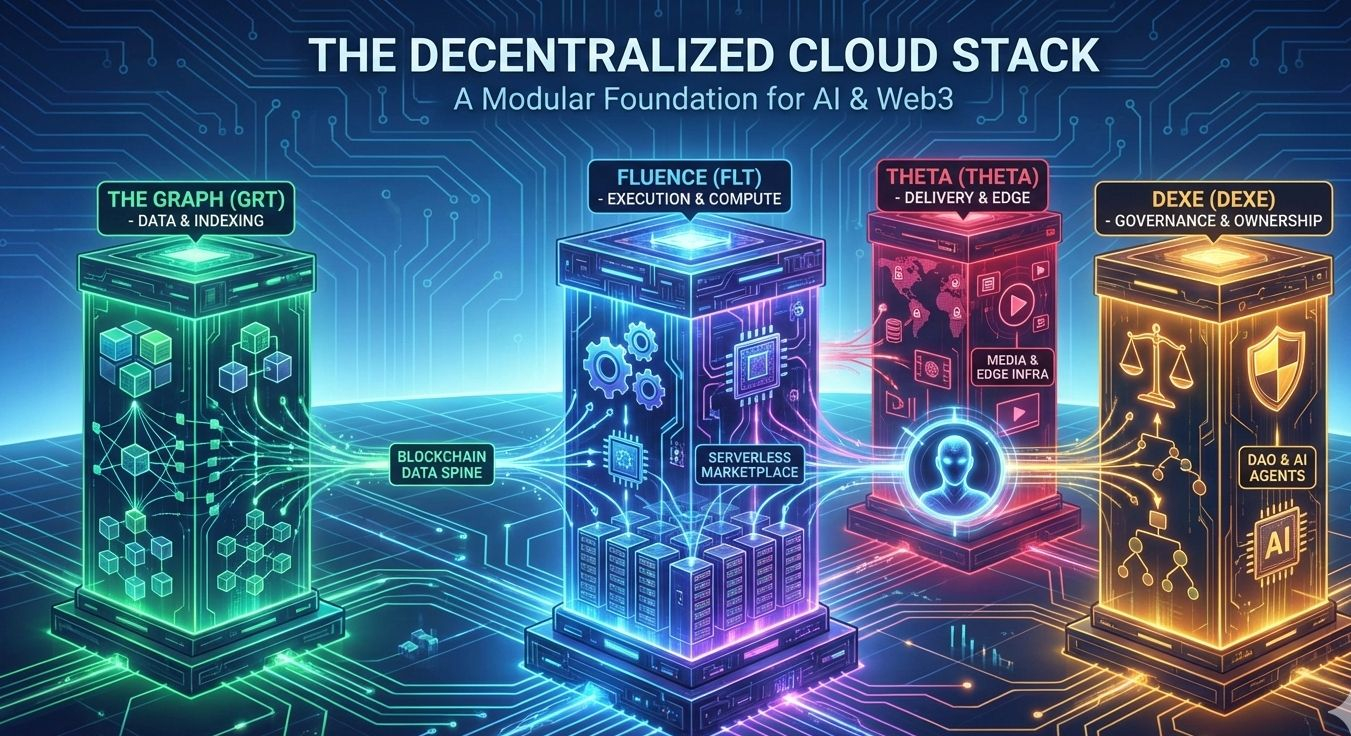
None of these projects are just another L1. Instead, they are tackling the specific infrastructure needs of a modular Web3 world:
The Graph (GRT): Acts as the data spine, turning raw blockchain data into queryable subgraphs so apps can read Web3 data without running their own indexing stacks.
DeXe (DEXE): Focuses on governance rules and ownership, providing the tooling for DAOs and AI agents to make transparent, accountable decisions through on-chain rules.
Theta Network (THETA): Targets bandwidth and delivery, using its Edge Network to handle video streams and AI tasks at the edge.
Fluence (FLT): Serves as the execution engine, a decentralized serverless marketplace that aggregates professional compute capacity.
🧠 Why Fluence Stands Out in the DePIN & AI Narrative
Fluence fits into the current landscape not as a standalone experiment, but as the general-purpose compute leg that plugs into these other layers. Here is why its approach is significant:
Professional DePIN: Instead of relying on retail GPUs in basements, Fluence aggregates excess capacity from professional data centers, emphasizing reliability and verifiability.
True Cloudless Serverless: Developers deploy services rather than managing machines. This mirrors Web2 serverless convenience but operates within an open marketplace, removing the Big Tech tax and vendor lock-in.
The Execution for AI Agents: As AI agents become more prevalent, they need a trusted layer to run off-chain logic. Fluence provides the execution engine that turns indexed data from The Graph and governance rules from DeXe into actual actions.
🤝 The Bigger Picture: Modular Synergy
What I’m noticing is a shift from vertical to modular. These projects together sketch a composable pattern: The Graph supplies the data, DeXe supplies the governance rules, and Fluence supplies the compute power to run the logic.
Fluence’s mission is to be a resilient, verifiable alternative to centralized providers. In the age of AI and agents, this mission is a bet that data-heavy applications will eventually require compute that isn't fully controlled by a handful of hyperscalers.


