Fogo, and it is not because speed sounds cool. It is because once you have shipped anything real on chain, you learn that users do not experience blockchains as throughput charts. They experience them as waiting, uncertainty, and the weird moments where what they saw on screen and what the chain finalized do not line up.
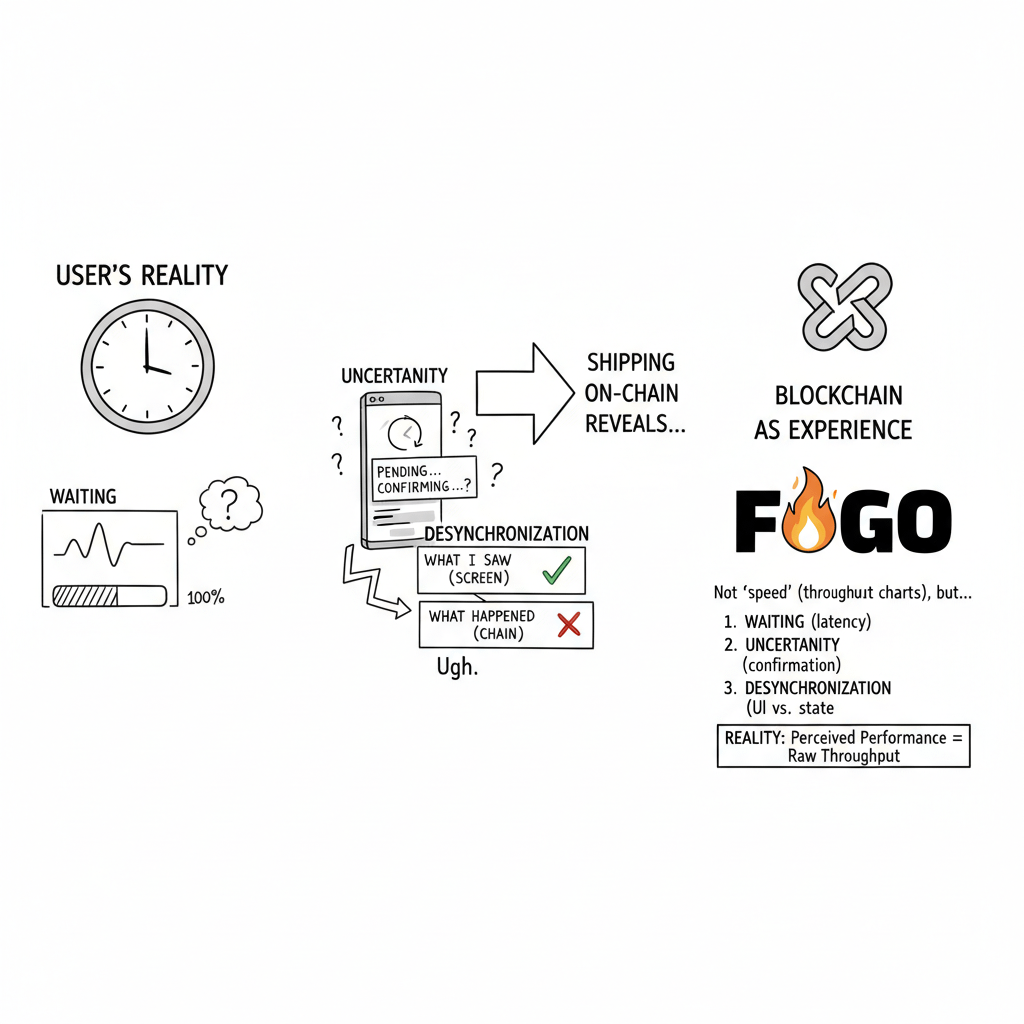
That gap is usually not about correctness. It is about time.
If you have ever built a trading flow, a liquidation engine, an auction, or even something as simple as a fast in app action that should feel instant, you start caring less about average confirmation and more about the bad moments. The slow tail. The spikes. The times when the network is busy and everything feels inconsistent. The truth is that the worst few percent of delays define the product more than the best case numbers do. Builders feel that pain early, because they are the ones getting the bug reports and the angry DMs when something settles late or behaves strangely under load.
Fogo gets attention because it starts from an almost uncomfortable premise: the world is not a clean diagram. Messages do not teleport. Distance matters, routing matters, jitter matters, and the slowest link in the chain can dominate the whole experience. Most projects talk around that and then try to out benchmark it. Fogo leans into it and basically says, if you want predictable performance, you have to design for the messy reality instead of pretending it is noise.
What makes this more interesting is that it is not trying to reinvent how developers write apps from scratch. The pull for builders is the SVM angle. If you can stay close to the Solana style execution environment and tooling, you remove a big psychological barrier. Teams do not want to rebuild everything just to test a new network. They want the smallest possible migration cost so they can focus on product and users.
But the real hook is not compatibility by itself. It is the attempt to make time behavior more consistent by narrowing variance and making locality a deliberate part of the system.
This is where the whole validator zones idea matters. If the active consensus set is organized in a way that reduces the worst communication paths, you can shrink the ugly tail that drags confirmation and makes apps feel random. Builders immediately understand why that is attractive. It is the difference between designing for a stable environment and designing around chaos.
At the same time, any builder who has been through enough cycles will pause and ask the uncomfortable questions, because the tradeoffs are obvious once you stare at them.
If only a subset is active at a time, who ends up dominating those active periods. How are zones composed. Can zone selection slowly tilt toward a small group of operators who can afford the best infrastructure. What happens when the active zone has a regional issue, a routing issue, or just correlated downtime. Even if nobody is malicious, correlation can still break things in a way that a more globally spread system might absorb.
Then there is the performance standardization side. From a product standpoint, it makes sense. When you let a network include a wide range of validator setups, the slowest and least optimized ones can end up defining the pace at the worst moments. If you want tight latency, you have to reduce that variance.
But there is a price. If everyone relies on the same high performance implementation, you can create a monoculture. And monocultures are efficient until they are not. One ugly bug or one weird edge case can become a shared failure instead of an isolated one. So you get a cleaner experience day to day, but you also accept the risk that failures may be more correlated when they happen. Builders do not need fear to understand this. They just need to remember how outages actually play out.
Where Fogo feels most builder coded is how it talks about the kinds of apps that care about timing. Not vague web3 everything, but the parts that break first when latency is messy: order books, liquidations, auctions, real time market flows. If you are building those things, you are tired of designing around uncertainty. You are tired of explaining to users why their fill price slipped or why their position got liquidated at a moment that felt unfair. A chain that tries to reduce tail latency is basically saying, we want that class of app to behave more like a real system and less like a science experiment.
Still, it is worth being honest about one thing that gets oversold in this whole space. Lower latency does not magically remove MEV problems. It can reduce certain types of chaos, sure, but it can also intensify competition. If the environment becomes faster and more predictable, the advantage of being slightly faster can become even more valuable. That can pull in sophisticated actors who invest heavily in networking and execution. So the question is not does low latency remove extraction, the question is does the architecture change the distribution of advantage enough that markets behave better for normal users.
The Sessions concept is another place where builders will love it and security people will immediately get nervous. Session keys make it possible to build flows that feel modern, especially on mobile, because users do not have to keep approving every tiny action with full authority. That is exactly the kind of convenience that helps adoption.
But convenience primitives also become popular targets. A stolen session key does not need to drain a full wallet to cause damage. It just needs enough permission to make a bad trade, approve a route, or move assets in a narrow window. And users tend to underestimate session risk because it feels temporary. If Sessions becomes common, the quality of defaults and the clarity of what is authorized will matter a lot. The biggest danger is not one cinematic exploit. It is lots of small losses that slowly poison trust.
Then there is the part builders often ignore until it hits them in the face: liquidity and incentives.
A chain can be technically strong and still feel dead if liquidity is thin. Thin liquidity breaks order books, makes slippage painful, and turns the best apps into bad experiences. Incentives can help bootstrap liquidity, but incentives are not loyalty. When rewards fade or token unlocks start, you can get sudden selling pressure and sudden liquidity exits. That matters because it affects everything downstream, staking value, validator economics, ecosystem budgets, and the general mood that determines whether builders keep shipping or start looking elsewhere. Even if the chain is stable, the environment can still become unstable.
Regulatory exposure sits in the background of all of this. When a network becomes known for high speed financial activity, it draws attention in a way that slower, messier ecosystems sometimes avoid. That does not mean disaster is guaranteed. It just means builders should assume that policy pressure will show up somewhere, especially around apps that look like market infrastructure, leverage, or retail trading. Pressure rarely hits the base layer first. It tends to hit interfaces, service providers, liquidity providers, and anything that touches compliance boundaries. But it can still reshape the ecosystem.
So when people ask why builders are watching Fogo, I think the clean answer is this: it is trying to make on chain time behave more predictably without forcing builders to abandon the SVM world they already know. That is a practical bet, and it speaks directly to the pain points teams actually deal with after launch.
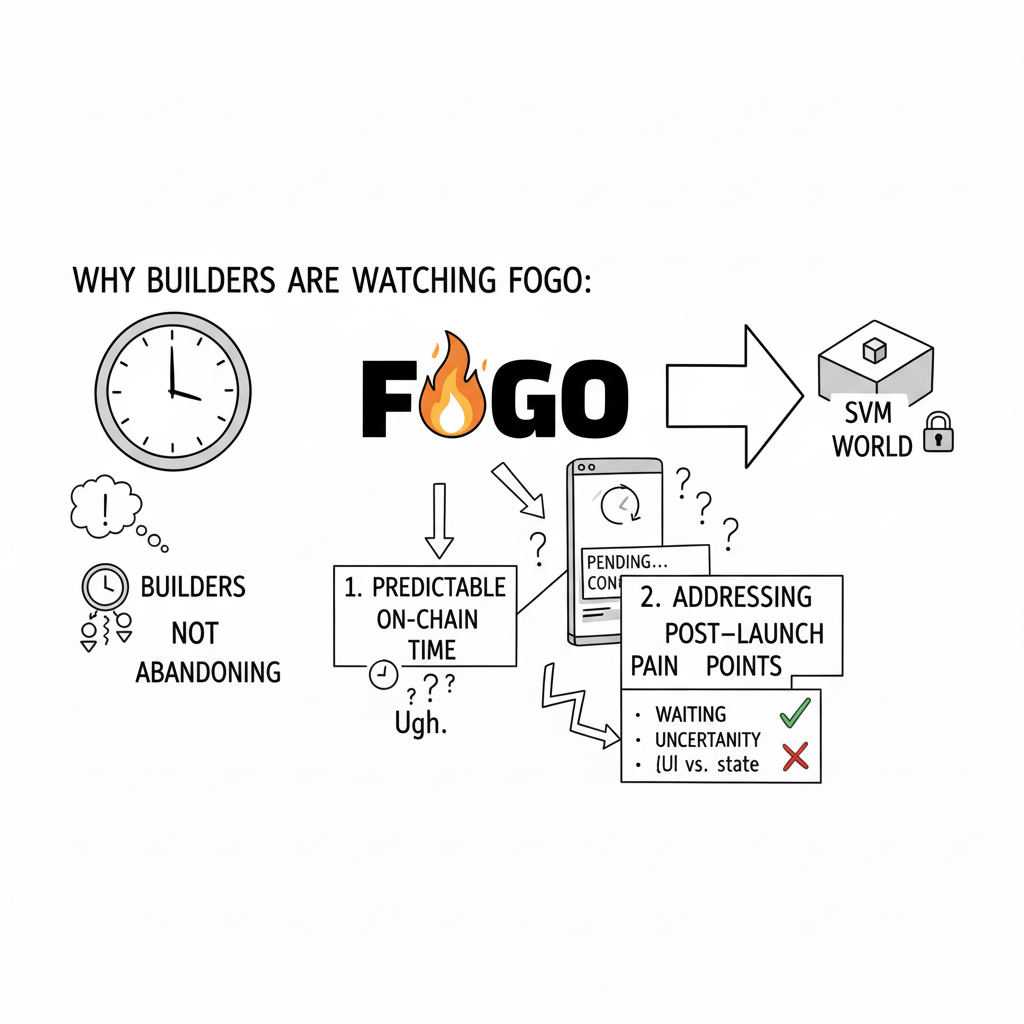
And the reason the attention is serious is because the tradeoffs are not hidden. Locality and zoned participation can change decentralization dynamics. Performance enforcement can increase correlated failure risk. Session convenience can widen the security surface. Liquidity schedules can create pressure points that affect the whole ecosystem. None of those are automatic deal breakers. They are the real checklist items a builder should watch.