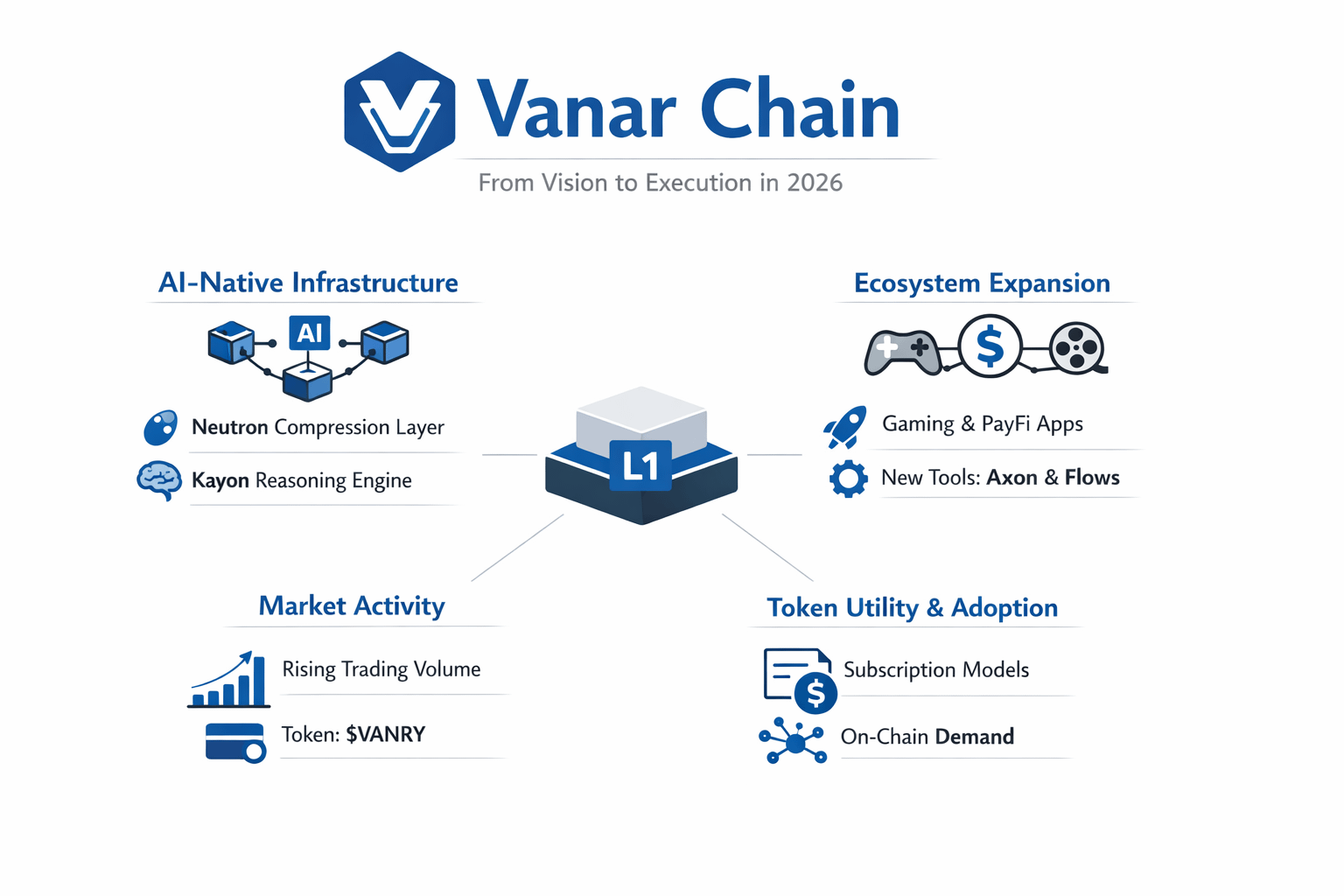
Vanar Chain is entering a more decisive phase in 2026. What began as a thesis around AI-native blockchain infrastructure is now transitioning into live products, ecosystem activation, and clearer token utility. The focus is no longer on theoretical positioning — it is on operational rollout.
At its core, Vanar is an EVM-compatible Layer 1 designed to handle more than transactions. The architecture integrates intelligence directly into the protocol stack, aiming to support gaming, entertainment, PayFi, and data-driven applications that require contextual logic, not just state changes. This positioning differentiates it from traditional L1s that primarily compete on throughput and gas efficiency.
One of the most important developments is the activation of its AI-native stack. Components such as Neutron and Kayon are central to this structure. Neutron functions as a semantic compression layer, converting raw data into structured, lightweight “seeds” that can live on-chain efficiently. Kayon operates as a reasoning layer, enabling contextual interpretation of that data. Together, they represent an attempt to move blockchain infrastructure closer to intelligent automation rather than passive record-keeping.
This shift matters because most chains store information but do not interpret it. Vanar’s model suggests a different approach: encode meaning at the infrastructure level. If executed effectively, this could reduce reliance on fragmented off-chain systems and create programmable workflows that are context-aware.
Beyond the core stack, the roadmap signals continued expansion. Products like Axon and Flows are positioned as extensions that could enable automation frameworks and intelligent process execution across industries. While detailed specifications remain limited, their inclusion indicates that Vanar’s strategy extends beyond protocol engineering into applied utility layers.
From a market perspective, $VANRY has experienced renewed trading activity amid broader crypto volatility. As a smaller-cap asset, it remains sensitive to macro conditions, but recent volume patterns suggest continued engagement from participants monitoring infrastructure-focused narratives. More importantly, the long-term trajectory depends less on short-term price swings and more on whether usage demand materializes from the AI toolset.
Token utility is where the next phase becomes critical. If tools like Neutron evolve into subscription-based or usage-metered services, this could establish a recurring demand mechanism tied directly to on-chain activity. That would shift the token from purely speculative exposure toward infrastructure-backed consumption. The effectiveness of this model will depend on developer onboarding and ecosystem traction.
Strategically, Vanar continues to position itself at the intersection of AI, entertainment, and financial workflows. Previous institutional visibility in finance-focused events signals that the project is attempting to align with enterprise and payment innovation, not just retail Web3 narratives. That broader orientation may prove important if regulatory clarity and institutional experimentation accelerate through 2026.
However, execution risk remains. AI-integrated blockchain systems are technically complex. Adoption requires not only performance reliability but also clear documentation, tooling support, and developer incentives. Competing L1 ecosystems are also evolving quickly, and differentiation must translate into tangible deployment, not just architecture diagrams.
In practical terms, Vanar’s success over the next 12–18 months will likely hinge on three measurable factors: real application launches built on its AI stack, sustained on-chain activity driven by those applications, and clear economic alignment between network usage and $VANRY demand. Without these, the infrastructure narrative may struggle to convert into durable growth.
In summary, 2026 marks a transition year. Vanar Chain is no longer operating solely on conceptual ambition. Core components are live, roadmap layers are forming, and the token economy is approaching a utility inflection point. Whether this evolves into a defensible AI-native ecosystem will depend on consistent execution, ecosystem partnerships, and measurable usage.
For now, the direction is clear: Vanar is attempting to redefine what a Layer 1 can do by embedding intelligence directly into the protocol layer. The coming quarters will determine whether that thesis translates into sustained adoption and infrastructure relevance.