

Let me explain Vanar the way it finally made sense in my own head.
Most Layer-1 chains try to impress you with numbers. Faster blocks. Higher throughput. Lower fees. It often feels like a race to post bigger specs.
But the longer I watch Vanar, the more it feels like they are playing a different game entirely.
Instead of asking, “How do we attract more traders?” the real question seems to be:
How do we make blockchain disappear into the background while people just enjoy the product?
That mindset changes everything.

Think of Vanar Like Electricity in a Busy City
Nobody wakes up excited about electricity.
People care about what electricity allows them to do — watch a game, play online, stream content, join events, hang out with friends. The power grid only becomes visible when it fails.
This is the lens through which Vanar starts to make sense to me.
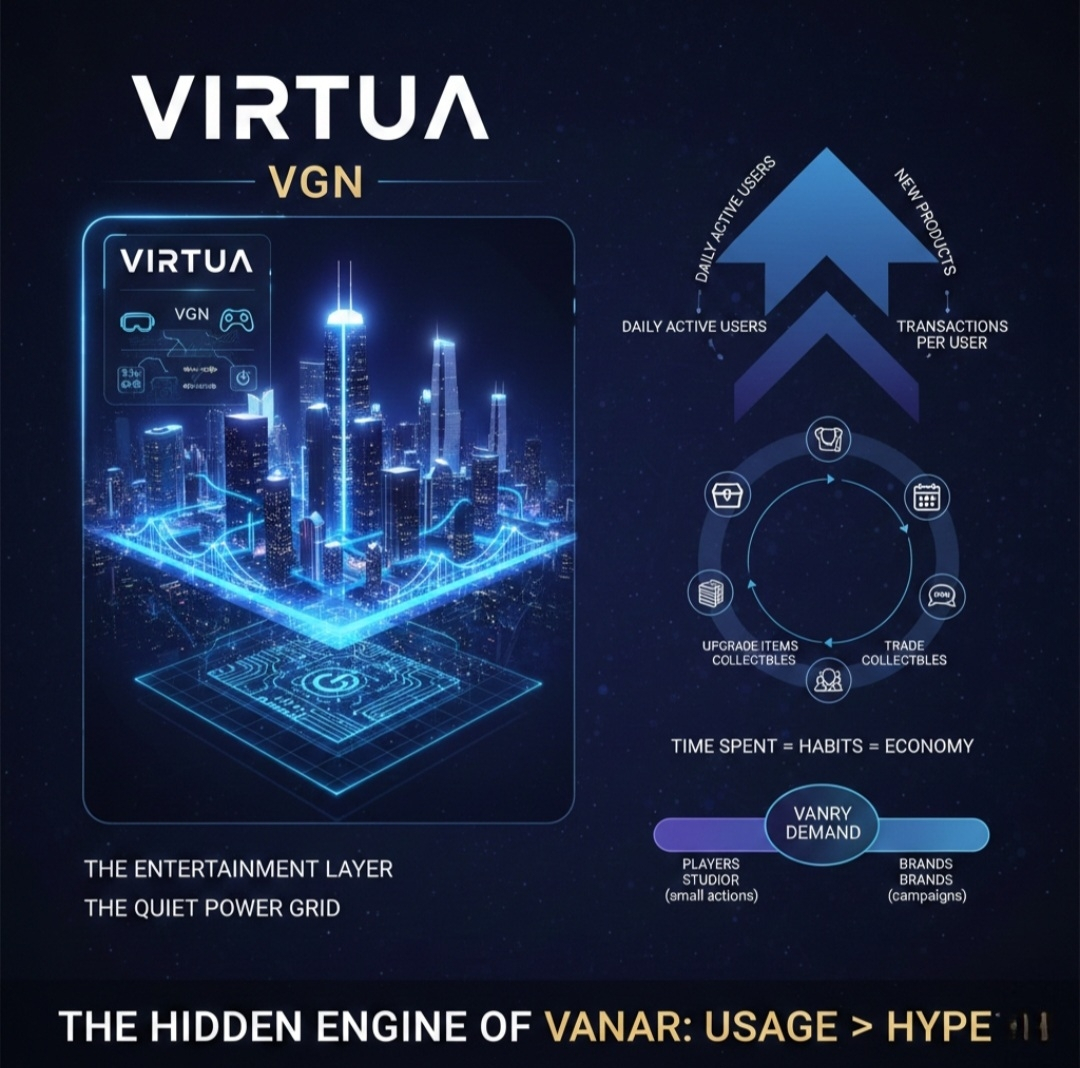
Virtua and VGN are like the entertainment districts — the places where people actually spend time. Vanar itself is trying to be the quiet power grid underneath, making sure everything keeps running smoothly without users needing to think about wallets, gas, or technical friction.
If that model works, VANRY demand doesn’t need hype to exist. It comes from usage that happens naturally.
Why Virtua and VGN Are the Real Story
When a chain focuses heavily on gaming, metaverse experiences, and interactive products, it is signaling something important.
It is not primarily chasing traders.
It is chasing attention and time spent.
And in consumer economies, time spent is extremely powerful because it creates habits. People don’t just show up once. They come back to:
claim rewards
upgrade items
trade collectibles
join seasonal events
check what’s new
follow where their friends are active
These are small actions, but they repeat. And repetition is what turns activity into an economy.
A DeFi spike can be loud but temporary. Entertainment loops, if they work, can run quietly for months or years.
The Part Many People Miss About Token Demand
One thing I’ve learned watching consumer platforms is this:
The user enjoying the experience is not always the one paying the infrastructure cost.
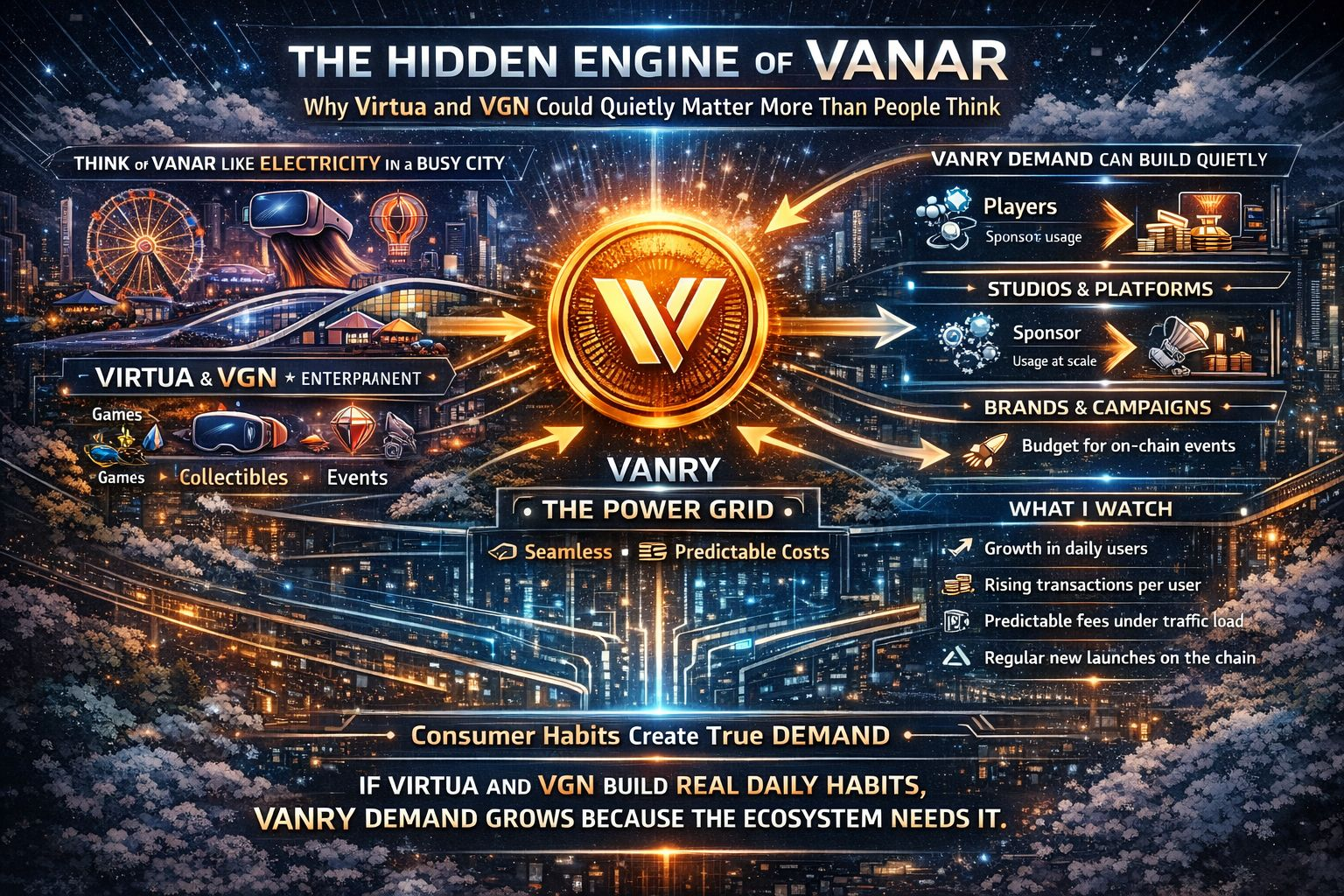
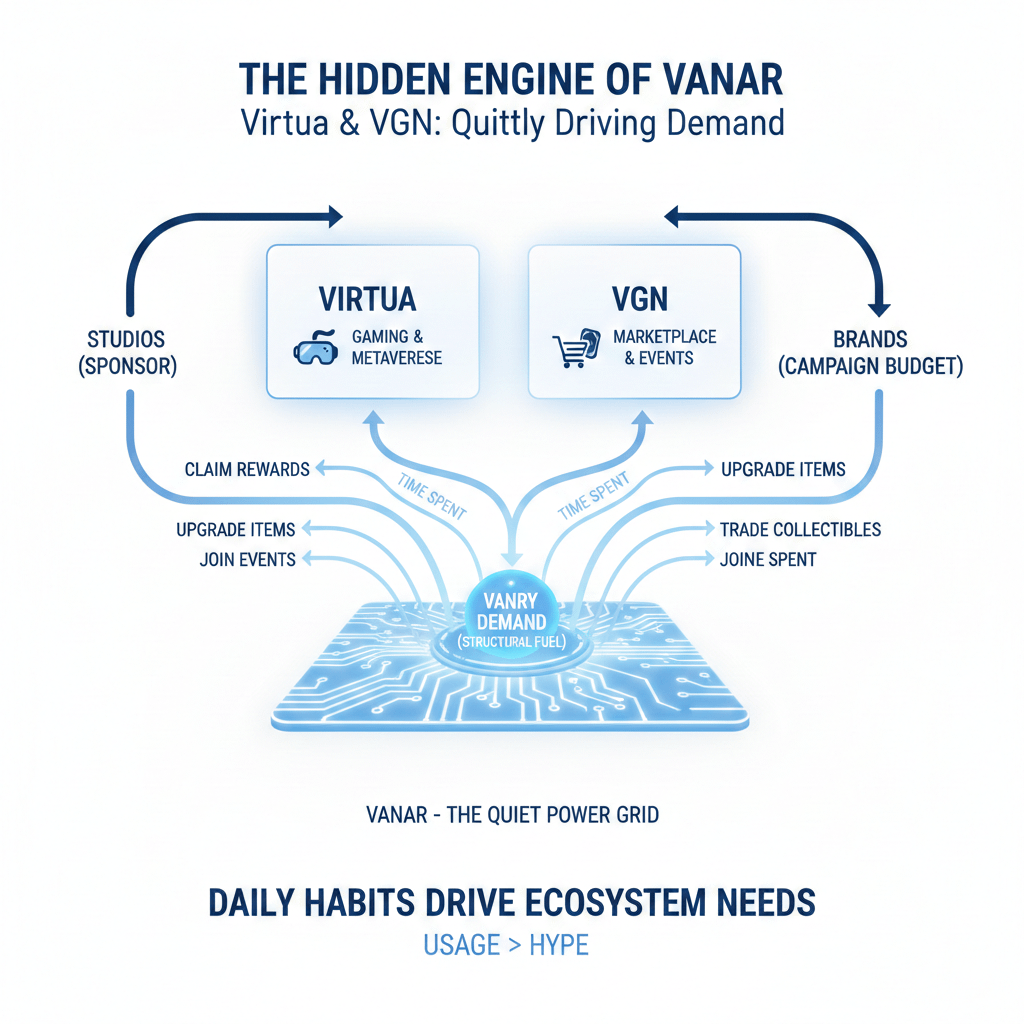
On Vanar, VANRY demand can come from different directions at the same time.
Sometimes it’s the player making small actions inside a game or marketplace.
Sometimes it’s the studio that wants the experience to feel smooth and is willing to sponsor transactions so users don’t feel friction.
Sometimes it’s a brand running a campaign and budgeting for on-chain engagement the same way they would budget for ads.
This is important because it means Vanar doesn’t need every end user to become crypto-native for the token to matter. The demand can build quietly behind the scenes as products scale.
What I Personally Watch Instead of Marketing Claims
I’ve become a bit skeptical of big narratives in this space. What I trust more are usage patterns.
If Vanar’s consumer strategy is really working, the signals should start to appear in the data over time:
Are daily active users returning consistently?
Are transactions per user slowly increasing?
Are fees staying predictable during busy moments?
Are new products continuing to launch on the network?
Does activity look steady rather than spiky?
To me, a healthy consumer chain should start to look less like a trading frenzy and more like a busy online game that never really goes quiet.
Where the Model Still Needs to Prove Itself
To be fair, this approach is not risk-free.
Consumer chains always face one big challenge: demand leakage.
If too much abstraction happens and the core token is no longer meaningfully required behind the scenes, the ecosystem can grow while the token story weakens.
The strongest version of Vanar’s model will be the one where:
users feel almost zero friction
but studios, platforms, and large-scale products still need VANRY consistently as the fuel for running their economies
If that balance holds, the demand becomes structural instead of emotional.
My Bottom Line
When I zoom out, Vanar’s real bet is very simple but very ambitious.
They are not trying to win a speed contest.
They are trying to build a system where people keep playing, collecting, trading, and showing up — and the blockchain just quietly keeps everything moving underneath.
If Virtua and VGN succeed in creating real daily habits, VANRY demand will grow not because people are told to buy it, but because the ecosystem keeps needing it every single day.
