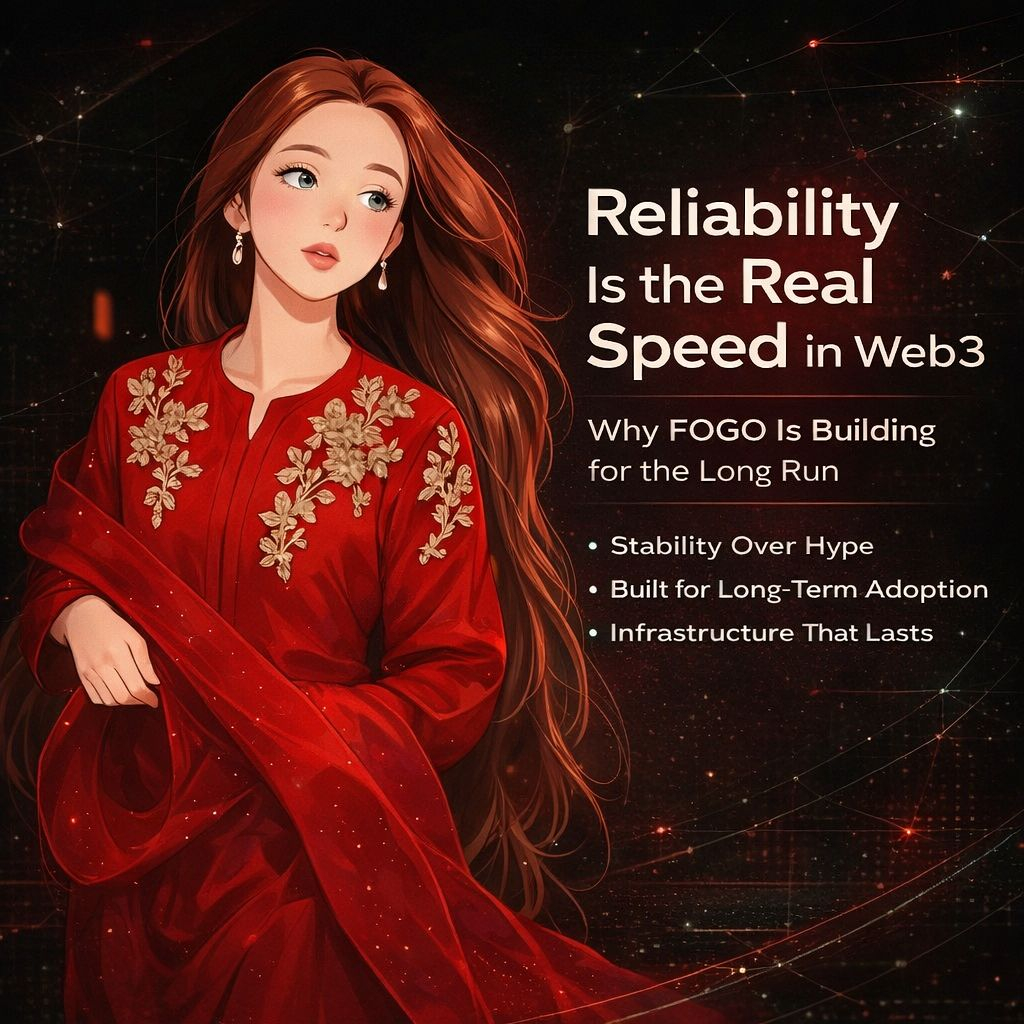
Most chains talk about speed like it’s the only thing that matters. Faster transactions. Lower latency. Higher TPS. It sounds impressive. But if we look at real-world systems — banks, payment networks, cloud providers — the ones people trust every day are not just fast. They are reliable.
And that’s the difference
Speed without reliability is just a short sprint. Real adoption is a marathon. That’s where @Fogo Official is positioning itself, with $FOGO at the center of its infrastructure design.
In Web3, we’ve seen what happens when networks push for extreme performance but forget stability. Congestion spikes. Fees become unpredictable. Validators struggle. Users lose confidence. Developers hesitate to build long term. A chain can be technically fast, but if it cannot remain stable under pressure, that speed doesn’t help much.
Reliability means something simple: the network works when people need it most.
It means transactions don’t fail during peak usage. It means fees don’t suddenly explode. It means builders can design applications without worrying that infrastructure will break under growth. This is not flashy work. It doesn’t create overnight hype. But it creates something stronger — trust.
@Fogo Official is approaching infrastructure with this mindset. Instead of chasing headlines about raw speed numbers, it is building steady, scalable architecture designed for consistent performance. That steady approach may look slower at first glance. But over time, it compounds.
Fogo plays a key role in this design. A token should not exist just for speculation. It should have purpose inside the network — aligning incentives, securing operations, and supporting long-term participation. When a token is integrated into infrastructure rather than just market narratives, it becomes part of the system’s foundation.
Think about how the internet evolved. Early days were messy. Many projects promised revolutionary speed or new protocols. But the winners were the ones that built dependable systems developers could rely on year after year. Infrastructure wins quietly before it wins loudly.
The same pattern is repeating in Web3.
If decentralized networks want to support gaming, digital economies, AI systems, or financial tools, they need more than bursts of performance. They need predictable execution. Businesses cannot build serious applications on unstable ground. Users will not store value or identity on platforms that fail during stress.
This is why focusing on reliability is not boring — it is strategic.
A steady chain attracts builders who care about longevity. It attracts communities that want durability. It creates an ecosystem where growth feels organic rather than forced. Over time, that kind of environment becomes more valuable than temporary spikes.
Of course, no infrastructure is perfect. Every network faces scaling challenges, governance decisions, and market cycles. The difference is in philosophy. Are you building for the next headline? Or for the next decade?
@fogo’s direction suggests a long-term view. Instead of promising unrealistic outcomes, it focuses on strengthening the core. That approach may not trend every week. But foundations rarely trend — they support everything else. #Fogo #fogo
And in that process, fogo becomes more than just a ticker. It becomes part of a broader infrastructure vision aimed at sustainable Web3 growth.
Maybe the real lesson is simple.
In crypto, speed gets attention. Reliability earns adoption.
The projects that understand this early are often the ones still standing when the noise fades. So the real question isn’t how fast a chain can go today. It’s whether it can still perform tomorrow, next year, and through the next cycle.
Because in the end, real growth doesn’t come from sprinting. It comes from building something that lasts.$NAORIS $CLO