


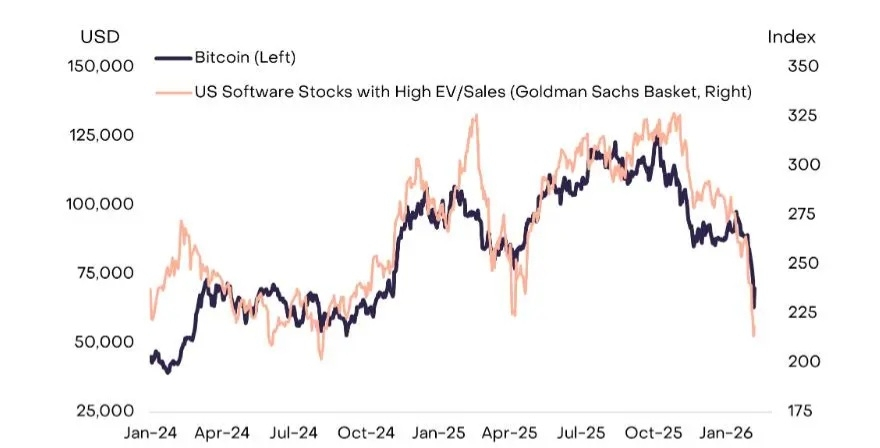
Bitcoin correlation with tech stocks is once again in focus after analysts found that BTC continues to move more closely with technology equities than with precious metals like gold. The finding reinforces the growing perception that Bitcoin is currently trading as a high-beta risk asset rather than a traditional safe-haven hedge.
Recent market data shows that Bitcoin’s price action increasingly mirrors movements in tech-heavy indices such as the Nasdaq. When technology stocks rally on improved liquidity conditions or positive earnings momentum, Bitcoin often follows. Conversely, when rate fears or macroeconomic headwinds pressure growth equities, BTC tends to decline in tandem.
This evolving bitcoin correlation with tech stocks has significant implications for portfolio allocation, risk management, and the broader narrative surrounding Bitcoin’s role in the global financial system.
Data Shows Bitcoin Moving With Nasdaq, Not Gold
While Bitcoin was originally marketed as “digital gold,” empirical market behavior suggests otherwise in the current cycle. During periods of geopolitical tension or inflation-driven gold rallies, Bitcoin has not consistently moved in parallel with precious metals.
Instead, BTC has demonstrated stronger alignment with equity markets—particularly technology and growth sectors. When investors rotate into risk assets amid improving liquidity expectations, both Nasdaq and Bitcoin often experience synchronized upside momentum.
This persistent bitcoin correlation with tech stocks highlights a structural shift in how institutional and retail investors categorize the asset. Rather than functioning purely as a hedge against monetary debasement, Bitcoin appears to be trading more like a speculative growth instrument.
Liquidity Conditions and Interest Rate Sensitivity
One of the primary drivers behind bitcoin correlation with tech stocks is global liquidity. Technology equities and cryptocurrencies are both highly sensitive to monetary policy expectations. When central banks adopt accommodative policies or signal potential rate cuts, liquidity expands and capital flows into higher-risk assets
On the other hand, tightening financial conditions—such as rising Treasury yields or hawkish Federal Reserve rhetoric—tend to compress valuations across growth assets. Bitcoin, similar to tech stocks, faces downside pressure in such environments.
This shared sensitivity to macroeconomic variables explains why bitcoin correlation with tech stocks has remained elevated throughout multiple market phases. Yield movements, inflation data, and forward guidance now influence BTC price action almost as much as on-chain fundamentals.
Institutional Flows Reinforce the Pattern
The integration of Bitcoin into traditional finance has accelerated in recent years, particularly with the introduction of spot Bitcoin ETFs in the United States. Institutional capital now treats Bitcoin as part of a broader risk allocation strategy.
Asset managers frequently bundle Bitcoin exposure alongside technology equities within growth-oriented portfolios. Quantitative models based on volatility targeting and risk-on/risk-off frameworks further strengthen bitcoin correlation with tech stocks, as capital flows shift simultaneously between equities and crypto.
As a result, Bitcoin’s market structure increasingly reflects that of public equities. Correlation spikes during periods of macro-driven volatility, especially during U.S. trading hours when both markets experience peak liquidity.
Market Reaction
The market has reacted to this renewed focus on bitcoin correlation with tech stocks by adjusting strategic positioning. Traders are paying closer attention to U.S. macroeconomic releases, including inflation reports, employment data, and Federal Reserve statements.
Intraday volatility often mirrors equity market openings. Sharp moves in Nasdaq futures frequently precede or coincide with significant Bitcoin price swings. Derivatives traders are also leveraging correlation dynamics to hedge exposure or construct relative value strategies between crypto and equity indices
However, correlation is not static. In extreme stress events or crypto-specific catalysts, Bitcoin can temporarily decouple. Nonetheless, the prevailing trend indicates that bitcoin correlation with tech stocks remains a dominant structural theme
#BitcoinGoogleSearchesSurge #MarketCorrection
