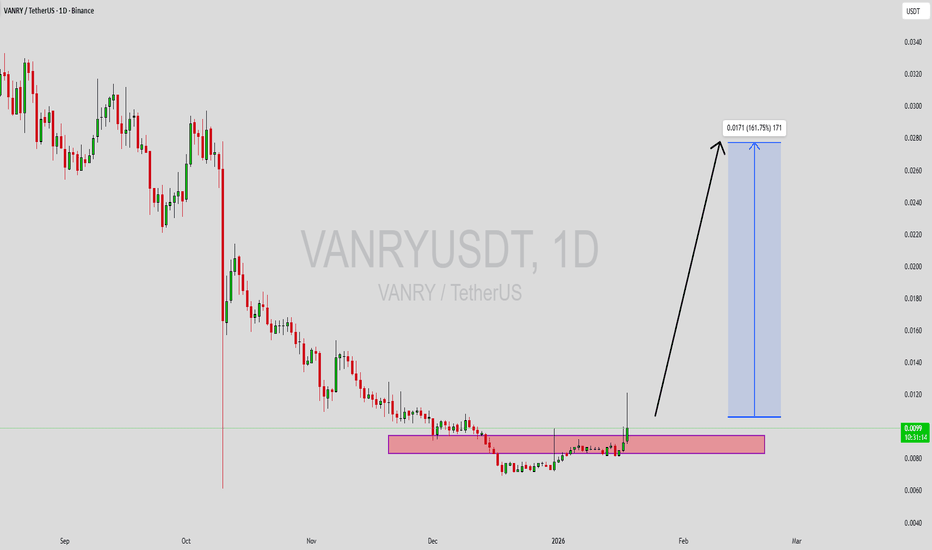
**$VANRY** (Vanar Chain) remains a compelling low-cap AI-native Layer-1 blockchain in early 2026, trading around **$0.006** with a market cap of approximately **$13-14M**. It emphasizes PayFi, tokenized real-world assets (RWA), on-chain AI agents, gaming, and metaverse applications through its modular 5-layer stack. Recent developments include the January 2026 launch of its AI-native infrastructure, positioning it for intelligent Web3 apps, though it faces volatility in a competitive L1 space. Price predictions for end-2026 vary from ~$0.005 to $0.016, depending on adoption and market conditions.
Here are **three similar or related coins** in the Layer-1 / utility space, focusing on AI, RWA, gaming, or high-performance chains:
1. **SUI** (Sui) — A scalable Layer-1 with object-centric model for parallel processing, excelling in gaming, high-throughput apps, and real-world use cases. It shares Vanar's focus on low-cost, fast transactions and ecosystem growth in consumer-facing sectors.
2. **AVAX** (Avalanche) — Known for custom subnets, it's a top pick for RWA tokenization, institutional DeFi, and gaming. Its flexibility supports tailored chains, aligning with Vanar's RWA and modular ambitions.
3. **SOL** (Solana) — High-performance L1 dominating consumer apps, payments, gaming, and NFTs with massive throughput. It often gets compared in speed-focused narratives, though larger scale.
Always DYOR, check real-time charts (e.g., on CoinMarketCap or CoinGecko), and consider risks in volatile markets!
### Vanar Chain ($VANRY): An AI-Native Layer-1 Pushing Boundaries in 2026 (approx. 520 words)
In the evolving crypto landscape of February 2026, **Vanar Chain** ($VANRY) stands out as an ambitious AI-native Layer-1 blockchain that has transitioned from its earlier gaming/metaverse roots (as Virtua/TVK) into a more comprehensive infrastructure play. With a current price hovering near $0.006 and a modest market cap of $13-14 million, Vanar remains under-the-radar compared to giants like Solana or Sui, yet it targets high-growth intersections: PayFi (payment finance), tokenized real-world assets (RWA), on-chain AI agents, gaming, and intelligent applications.
Launched as a fully EVM-compatible chain, Vanar differentiates through its 5-layer architecture. The base modular L1 provides scalability and security, while upper layers like Neutron (AI data compression), Kayon, and upcoming components (Axon and Flows) enable default intelligence for Web3 apps. This setup allows developers to build agentic workflows, automate on-chain actions, and integrate AI directly without relying on off-chain models—addressing a key pain point in blockchain usability.
A major milestone came in January 2026 with the rollout of its AI-native stack, aimed at powering "intelligent by default" applications. This positions Vanar at the convergence of AI and blockchain, a narrative gaining traction amid broader market interest in decentralized AI. Tools like myNeutron have shifted to subscription models, driving real utility for $VANRY as gas fees, payments, and staking rewards increase on-chain activity.
Vanar's focus on RWA tokenization shines through partnerships (e.g., Nexera) and emphasis on verifiable on-chain data for assets like legal documents or financial proofs. This reduces off-chain risks, making it appealing for tokenized climate solutions, carbon credits, and brand integrations. Gaming and metaverse elements persist, but the chain pivots toward broader real-world adoption, including predictable low fees for daily use.
Price predictions reflect cautious optimism. Sources like Changelly forecast averages around $0.013-0.016 by end-2026 (potential 80-150% ROI in bullish scenarios), while more conservative models hover near $0.005-0.012. Volatility remains high due to low liquidity and competition from established L1s.
Challenges include crowded Layer-1 space (e.g., Solana's consumer dominance, Avalanche's RWA subnets, Sui's gaming speed), past price drops from highs, and the need for sustained developer traction. Yet, with no major unlocks and full circulation, Vanar offers cleaner tokenomics than many peers.
For investors eyeing next-gen utility plays, $VANRY represents a high-risk, high-reward bet on AI-blockchain fusion. If adoption accelerates—via more AI tools, RWA pilots, or gaming hits—its small cap could yield outsized gains. As always, monitor ecosystem updates, volume, and broader market sentiment before diving in. The chain's vision of an "intelligent universe" for AI agents could make it legendary if executed well in 2026 and beyond. 🚀