

There is a pattern that repeats across blockchain cycles. A new network launches with impressive technical credentials, deep liquidity integrations, and immediate access to sophisticated financial tooling. Traders arrive quickly. Total value locked climbs. Metrics look healthy. From inside the industry, momentum appears undeniable.
Yet outside crypto, almost nobody notices.
The problem is not capability. DeFi-first chains are often extremely capable. The issue is orientation. They are built around the needs of participants who already understand wallets, slippage, collateral ratios, liquidation thresholds, yield curves. They optimize for people fluent in crypto.
Mainstream users are rarely fluent.
When someone enters the space for the first time, they are not asking how to maximize capital efficiency. They are trying to understand where assets live, how transactions confirm, what risks are invisible, and whether mistakes are reversible. The cognitive load is high before financial complexity even appears.
Now place that person inside an ecosystem whose primary achievements are leverage loops and cross-protocol composability. It is not surprising they hesitate.
To insiders, these features are powerful. To newcomers, they are intimidating.
This mismatch creates a ceiling. Growth happens rapidly among professionals and then slows when expansion requires different assumptions about user knowledge. Incentives can delay the slowdown, but they rarely remove it.
Eventually, participation density stops widening.
What is interesting about @Vanarchain is that its center of gravity appears elsewhere. The network seems to begin from the idea that most future participants will not arrive as traders. They will arrive through applications, services, entertainment, AI systems, identity layers, commerce flows.
They will interact with blockchain indirectly.
Indirect interaction changes design priorities. Instead of asking how to expose more financial primitives, builders ask how to hide them when unnecessary. Interfaces become simpler. Abstractions grow stronger. Execution moves closer to what users expect from everyday software.
The goal becomes familiarity.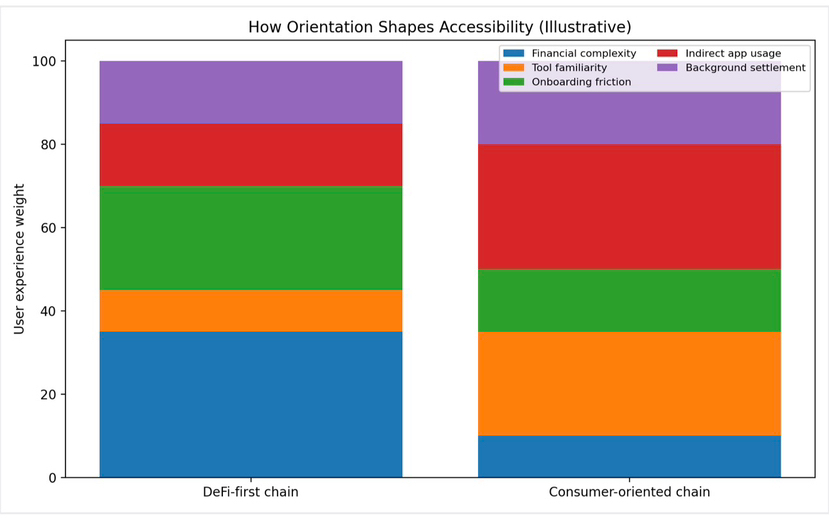
This does not mean finance disappears. Value transfer remains fundamental. But it becomes background infrastructure rather than foreground activity. The majority of users may never open a lending dashboard, yet they still rely on settlement guarantees provided by the chain.
Finance becomes plumbing.
DeFi-first environments often struggle with this transition because their culture is shaped by visibility of capital. What can be measured easily becomes what is celebrated. TVL, yields, leverage these metrics are legible to the community, so they dominate attention.
But mainstream adoption is not always visible in those terms.
A person using a game, an AI service, or a consumer application may create enormous long-term value while interacting with DeFi only indirectly or not at all.
The history of technology adoption suggests that invisible infrastructure scales further than explicit tooling. Users prefer outcomes over mechanics. They want things to work without understanding every layer beneath them.
This is normal.
Vanar’s positioning increasingly reflects that reality. Instead of demanding that new participants internalize crypto logic, the chain appears to adapt to external expectations. Accounts behave more like familiar digital identities. Transactions align with recognizable workflows. Complexity still exists, but it is less exposed.
Exposure is optional, not mandatory.
This orientation may appear less dramatic in early metrics. Financial activity often grows faster than consumer behavior. But longevity tends to favor systems that reduce friction rather than advertise sophistication.
Lower friction widens participation.
Another constraint for DeFi-centric chains is volatility of engagement. Traders are mobile. Capital moves where conditions improve. Loyalty is thin because opportunity cost is explicit. When yields compress, liquidity migrates.
Consumer ecosystems behave differently. Users who build habits around applications tend to remain longer. They form attachments not only to returns but to experiences.
Retention becomes emotional as well as financial.
This is why infrastructure intended for mainstream audiences must consider more than throughput and cost. It must consider predictability, recoverability, trust signals, and integration with non-crypto expectations.
Those properties require deliberate architecture.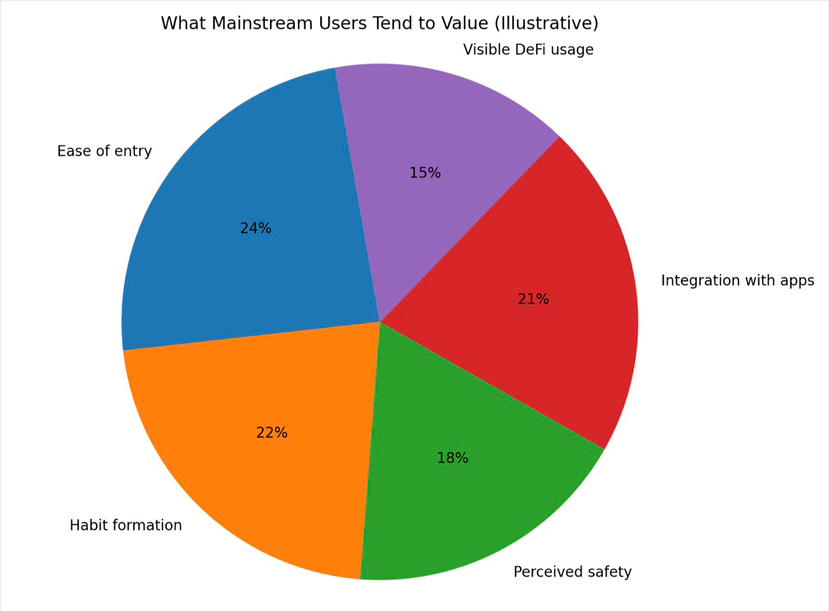
Vanar’s approach suggests an awareness that the next wave of growth might arrive from outside the current community. If so, the winning platforms will be those capable of welcoming people who never planned to become DeFi specialists.
They will not demand transformation. They will enable participation.
Of course, DeFi remains essential. It provides liquidity, price discovery, coordination. But its role may evolve from headline act to supporting framework. Successful chains will integrate financial capability without making it the only reason to exist.
Balance matters.
After observing multiple cycles, it becomes clear that technical brilliance alone rarely guarantees mass adoption. Usability, cultural alignment, and reduction of fear are equally powerful variables.
People enter new systems cautiously.
Vanar seems to be betting that mainstream growth comes from embedding blockchain into environments users already value. When adoption is a byproduct of doing something enjoyable or useful, resistance declines.
Utility invites repetition.
Whether this strategy succeeds will depend on execution. Abstracting complexity is difficult. Maintaining security while simplifying interfaces is harder. Skepticism is reasonable.
Yet acknowledging the problem is already progress.
If DeFi-first chains sometimes plateau because they speak primarily to insiders, networks that speak to everyone else may have room to expand further. The opportunity lies in translation.
Vanar is trying to translate.
In the long run, platforms that make participation feel natural rather than technical may accumulate broader communities. Financial power remains underneath, but it no longer demands attention.
For mainstream users, that might be exactly the point.