


Aster price is being tested by resistance, as activity from large investors and volume in perpetual contracts both go up.
On Tuesday, Aster went up more than 7%, and is now at a long-term resistance line.
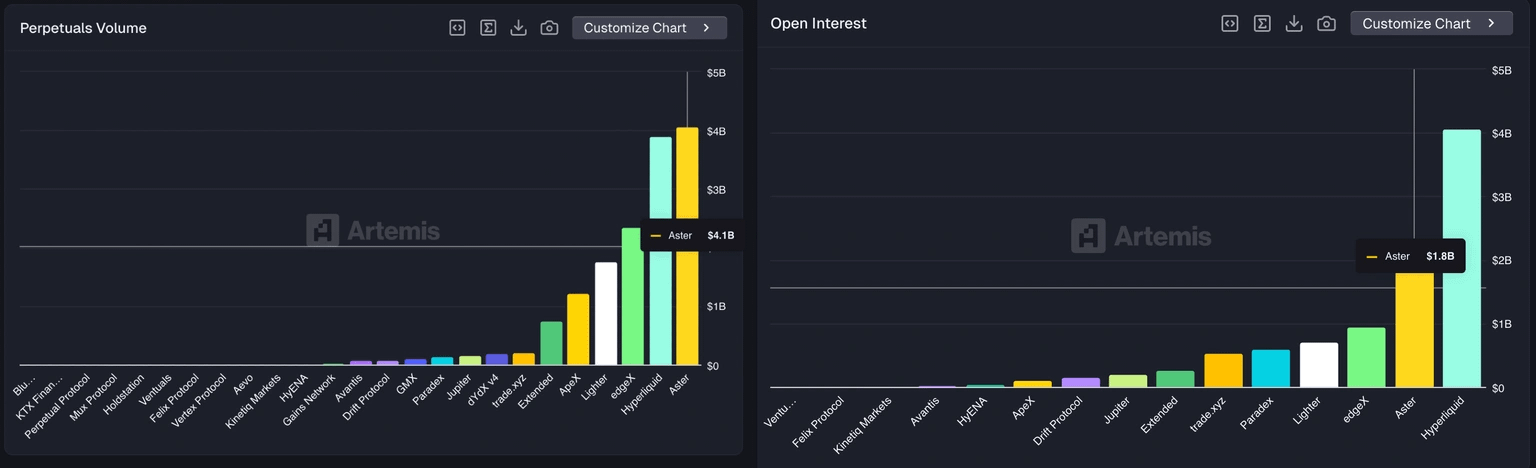
Over the last 24 hours, Aster has done $4.1 billion in perpetual contract volume – more than Hyperliquid.
Data from the blockchain shows that wallets holding a lot of cryptocurrency have added over 170 million ASTER. Aster (ASTER) was up over 7% when this was written, on Thursday, and went over its 200-period Exponential Moving Average (EMA) on the four-hour chart, while also hitting a long-term resistance line on the daily chart. The exchange, which focuses on perpetual contracts, had $4.1 billion in volume in the last 24 hours, beating the $3.9 billion of its competitor, Hyperliquid. Investors with large amounts of crypto – often called ‘whales’ – are helping Aster to recover, by getting more than 170 million tokens in the last five days.
Whales are backing Aster as perpetual volume comes back.
Aster, a decentralised exchange (DEX) that has support from investors such as YZi Labs, has got the attention of ordinary traders in the last 24 hours, and is making competition with Hyperliquid more intense. Information from Artemis shows Aster did $4.1 billion in perpetual volume, which was more than the $3.9 billion done by Hyperliquid in the last 24 hours. However, at the same time, the Open Interest of Hyperliquid – the value of contracts that are still open on the platform – was $4.1 billion, which was more than the $1.8 billion Open Interest of Aster. The rise in perpetual contract volume shows a short-term rise in interest from ordinary traders, and is increasing income and fees. However, the difference in Open Interest puts Hyperliquid a long way ahead of Aster among DEX users.
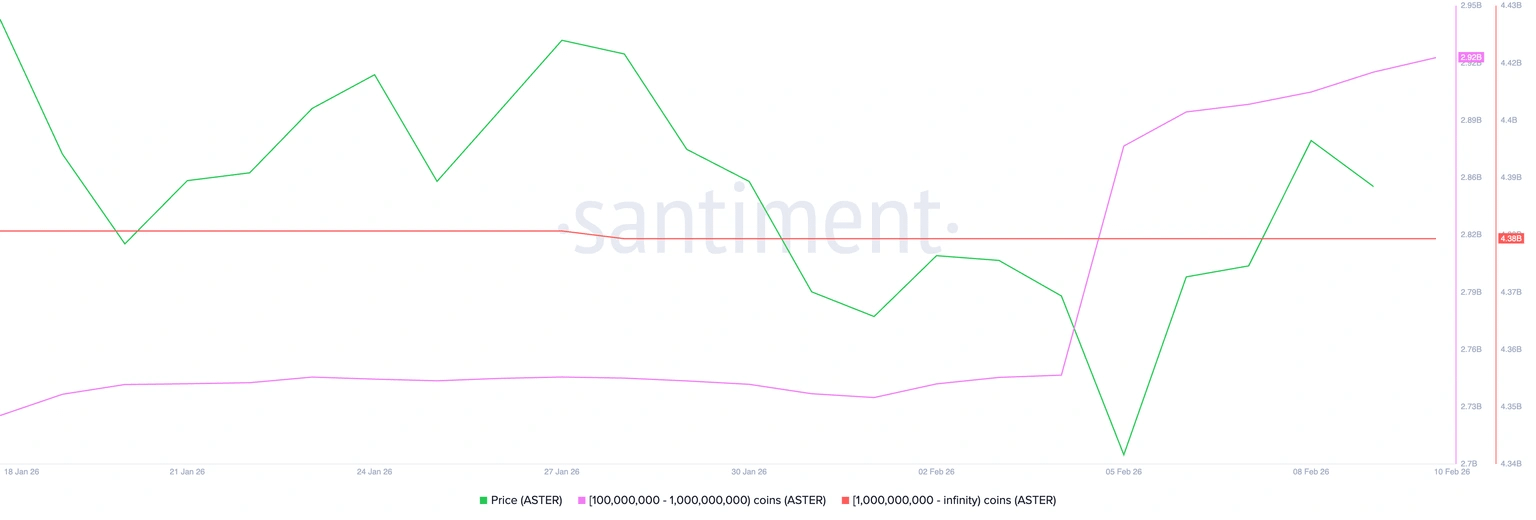
Looking at the blockchain, the way ASTER is supplied shows that whales – those with 100 million to 1 billion tokens – are again interested, with this group increasing their holdings to $9.22 billion from $9.75 billion on Thursday, supporting the V-shaped recovery in ASTER.
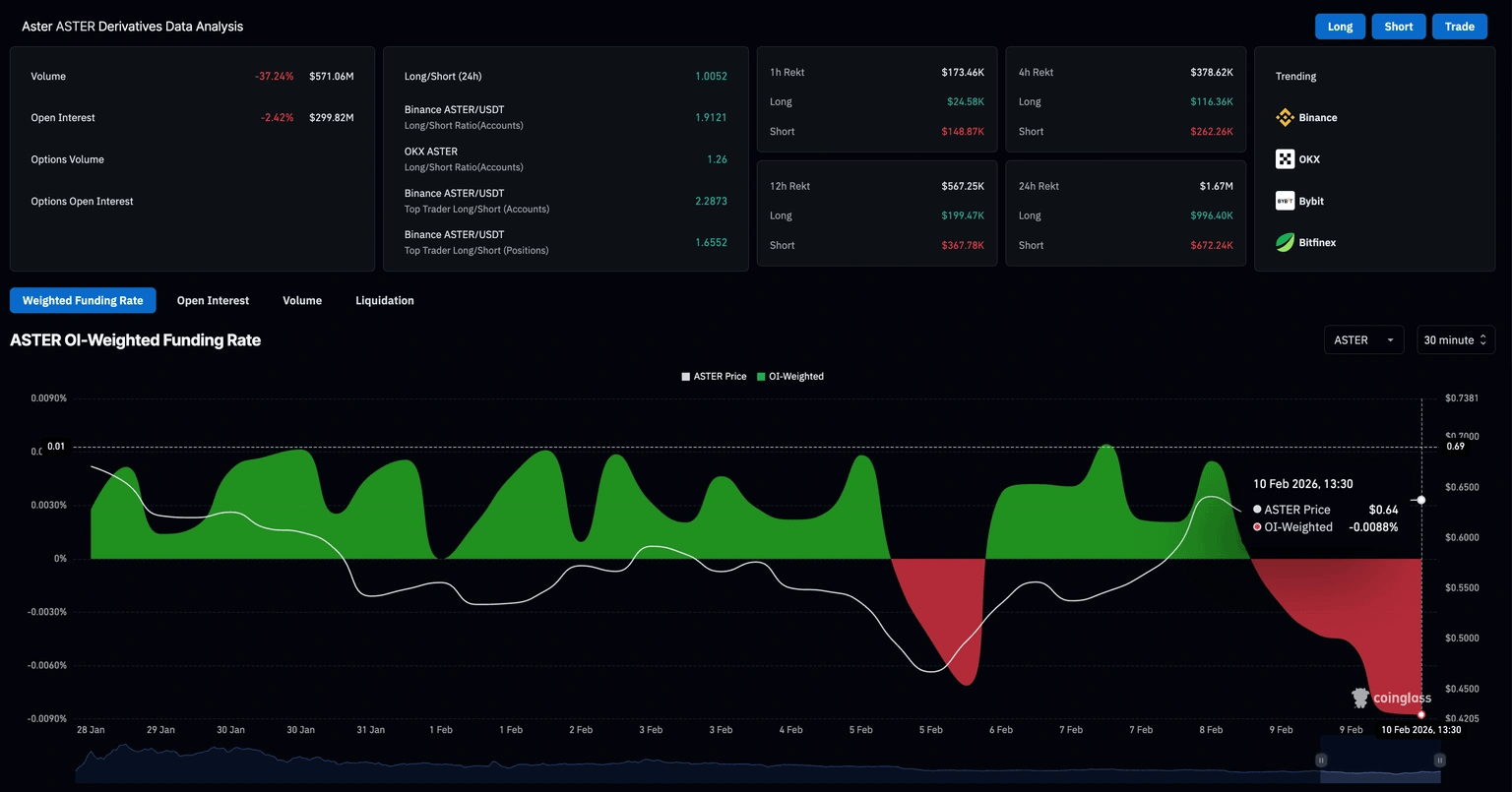
However, data from derivatives show that demand for ASTER from ordinary traders is behind the interest from whales. According to CoinGlass, Aster futures Open Interest (OI) is $299.82 million, down 2.42% in the last 24 hours – which shows a fall in the value of outstanding derivative contracts on all exchanges. At the same time, the OI-weighted funding rate fell to 0.0088% on Tuesday, showing that traders are feeling negative, and money is going out.
Usually, when whales buy and ordinary traders do not, it shows that any cryptocurrency asset will go up a lot.
Aster gets closer to a key resistance breakout
Aster is trading at over $0.630 at the time of writing, on Thursday, and is testing a key resistance line that links the highs of October 7 and November 19 on the daily chart. A clear close above $0.630 would confirm that the resistance line has been broken, and would open the way for further rises.
On the four-hour chart, ASTER goes over the 200-period EMA at $0.637, and the 50-period EMA is still going upwards, showing that there is a short-term feeling that prices will go up. However, another key resistance comes up on this time frame, going from $0.698 (the low of January 26) to the R1 Pivot Point at $0.718.
If ASTER goes past this area, it could make the rise go on to the R2 Pivot Point at $0.812.
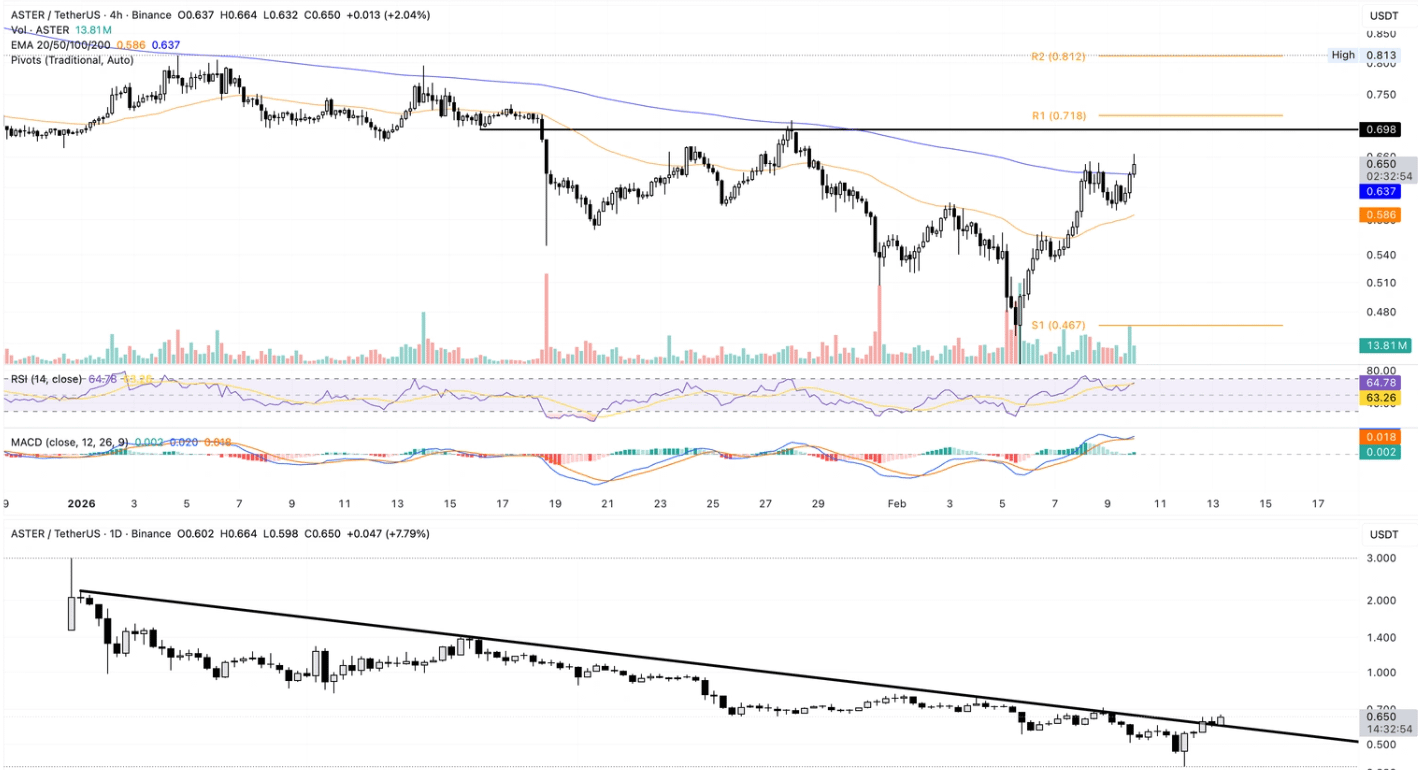
The technical indicators on the four-hour chart show that prices are going up. The Relative Strength Index (RSI) at 64 shows a lot of buying pressure, with further rises before getting to the overbought area. At the same time, the Moving Average Convergence Divergence (MACD) goes off its signal line, showing that prices are going up again.
ASTER/USDT multi-frame chart.
On the other hand, the 50-period EMA at $0.586 is a key support, and then a deeper area at the S1 Pivot Point at $0.467.
#Aster #altcoins #WhaleDeRiskETH #BinanceBitcoinSAFUFund #WhenWillBTCRebound $ASTER