


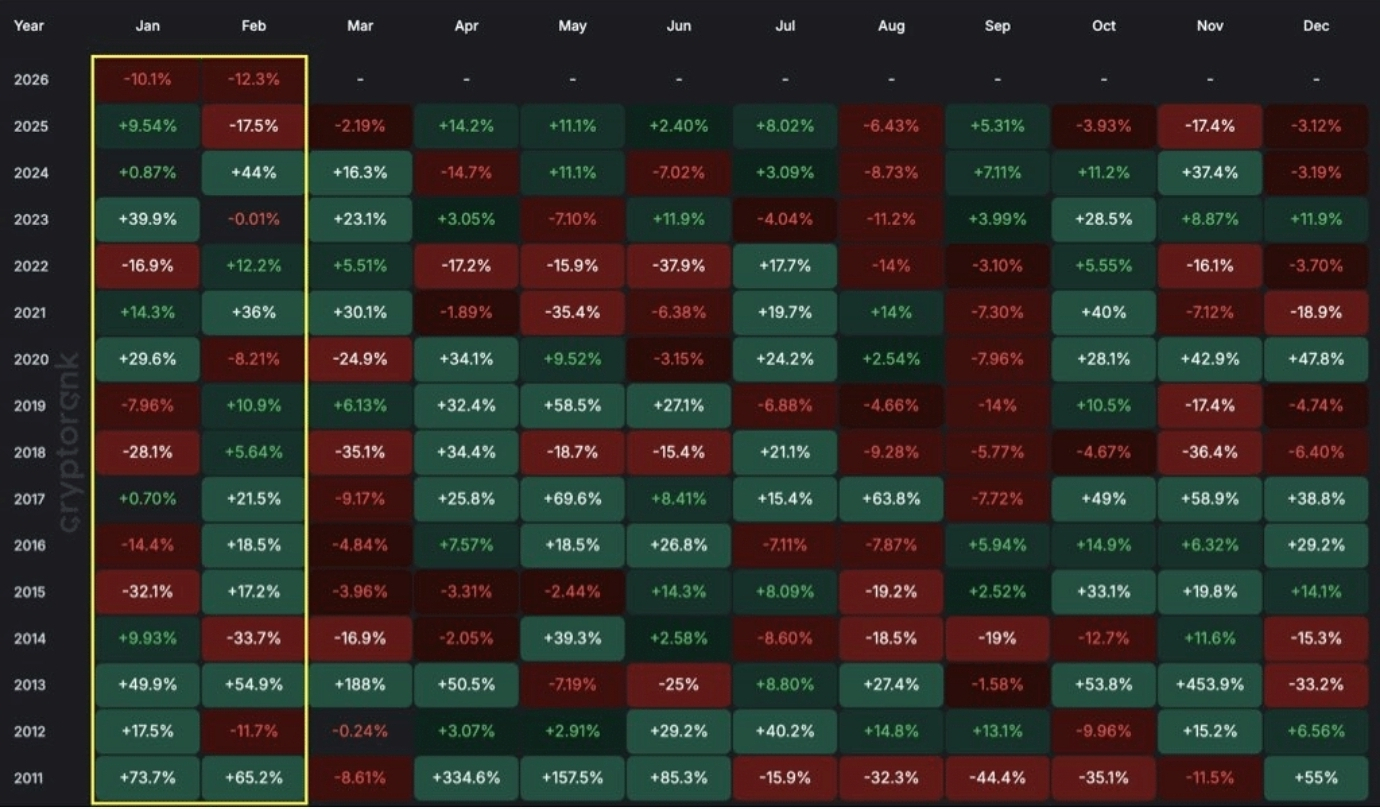
Bitcoin is showing signs of stability this month, supported by a seasonal trend, since historically it has never recorded losses in both January and February consecutively.
Key Points
Bitcoin has fallen 12.55% in February, following a 10.16% drop in January, testing a long-standing seasonal pattern.
Historically, February has rebounded after a losing January (observed in 2015, 2016, 2018, 2019, 2022).
Extreme pessimism prevails: the crypto Fear & Greed Index hit 5 (lowest ever), and Bitcoin’s RSI at 15 signals oversold conditions.
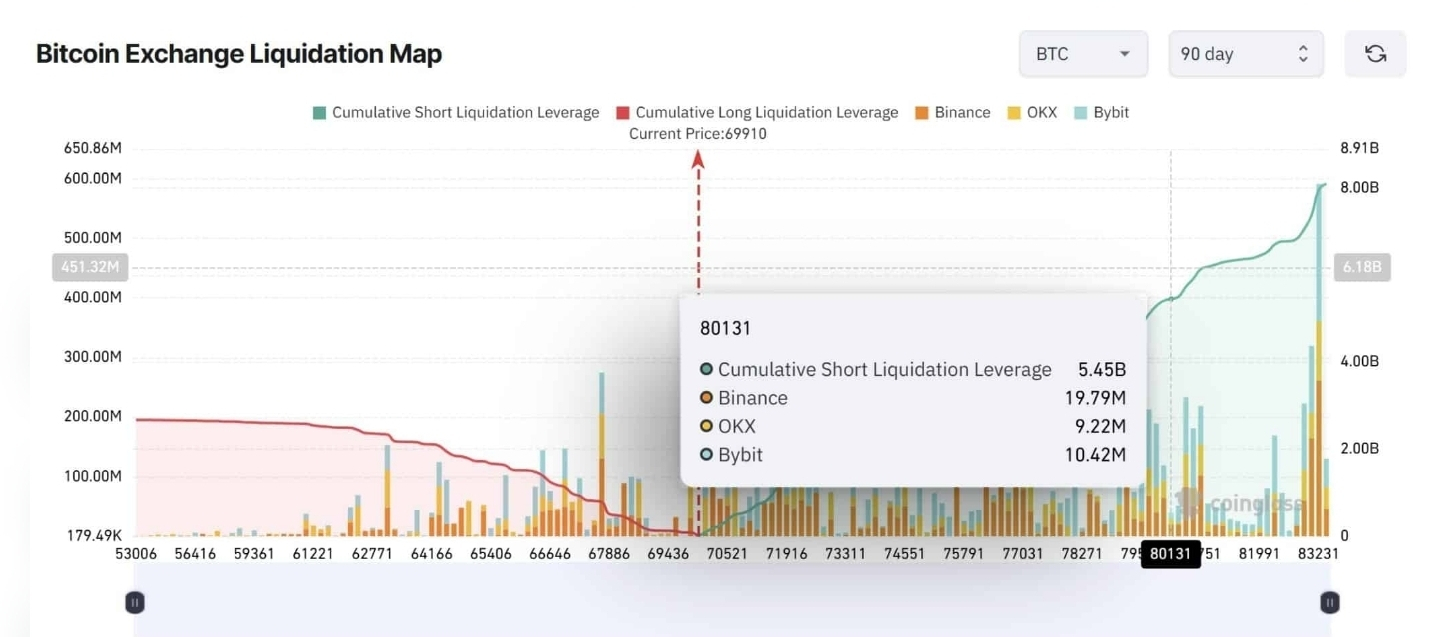
Short positions totaling $5.45 billion could be liquidated if Bitcoin rises to around $10,000, potentially triggering a short squeeze.
Bitcoin trades well below the 50-day ($87K) and 200-day ($102K) moving averages, limiting immediate upside.
Key support levels remain near $60K, with longer-term Fibonacci levels around $57K–$42K guiding potential downside.parapharse it
Historical Trends Put February in Focus
For reference Bitcoin is hovering around $68,789, down 12.55% so far in February. In January, it also recorded losses, dropping 10.16% over the month.
As a result, this back-to-back weakness has caught traders’ eyes since it goes against historical trends. Data shows that when Bitcoin ended January lower, February usually saw a rebound, as seen in 2015, 2016, 2018, 2019, and 2022.
This makes February a crucial month. If Bitcoin posts a second straight monthly loss, it would be the first time both January and February fell, breaking a long-established seasonal pattern.
Short-Term Price Action Shows Early Stabilization
Amid this situation, Bitcoin surged past $71,000 on Monday after sentiment took a big hit. The rebound happened during widespread pessimism in crypto, which often signals a potential short-term pause or stabilization.
In this scenario, some traders believe that high fear in the market might help Bitcoin hold the $60,000 area, seen as an important yearly support. Others warn that low liquidity and bearish futures positions could limit gains in the short term.
Extreme Fear Highlights Oversold Conditions
Market sentiment has reached unusually low levels. Michaël van de Poppe, founder of MN Capital, pointed out that the Crypto Fear & Greed Index fell to 5, marking its all-time low. At the same time, Bitcoin’s daily RSI dropped to 15, indicating the asset is heavily oversold.
Van de Poppe likened the current market to the 2018 bear market and the March 2020 COVID-19 crash. From these similarities, he suggested that Bitcoin might stabilize and start recovering without needing to drop back to $60,000 right away.
Liquidation Data Favors an Upside Squeeze
Looking past sentiment, derivatives data also point to a potential rebound. CoinGlass data shows that about $5.45 billion in short positions could be liquidated if Bitcoin climbs roughly $10,000.
In comparison, a move back to $60,000 would trigger about $2.4 billion in liquidations. This imbalance suggests upward price movement could force short sellers to close positions, potentially accelerating a rally through a short squeeze.
Indeed, such liquidation dynamics often play a decisive role during periods of heightened volatility.
Technical Structure Remains a Limiting Factor
Even with favorable seasonal and sentiment factors, Bitcoin’s overall technical picture is still weak. CryptoQuant data indicates it is trading far below major moving averages.
The 50-day moving average stands near $87,000, while the 200-day average is close to $102,000. This wide separation reflects an ongoing corrective phase following the previous rally.
Also, CryptoQuant’s Price Z-Score is at -1.6, showing Bitcoin is trading below its average. In the past, setups like this have usually resulted in longer consolidation rather than an instant trend reversal.
Derivatives Markets Signal Continued Caution
Derivatives activity further underscores ongoing caution. Crypto analyst Darkfrost noted that monthly net taker volume dropped sharply to -$272 million.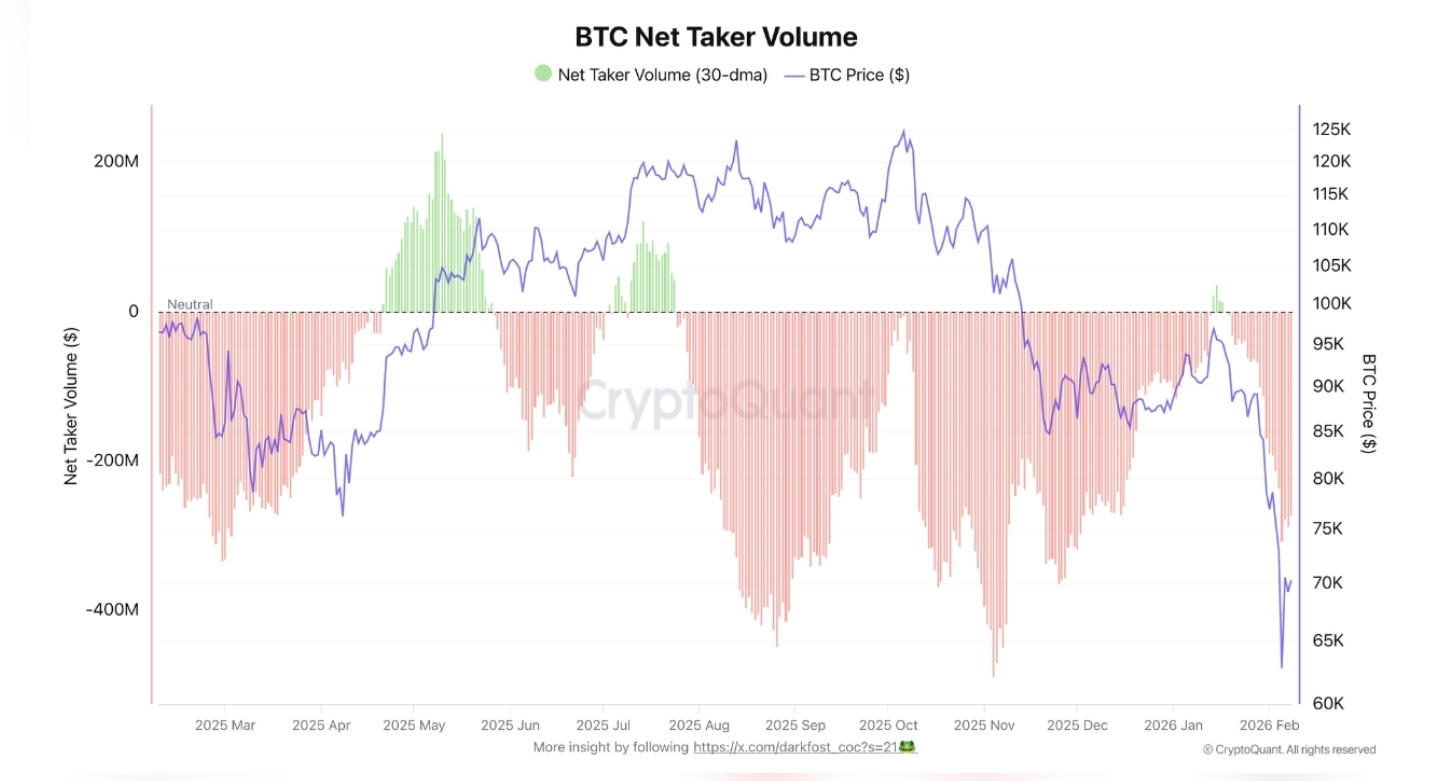
At the same time, Binance’s taker buy-sell ratio dropped below 1, showing that selling is currently stronger than buying. Futures trading still dominates over spot activity, meaning a lasting price increase will likely need more spot market demand. Without that, any recovery could stay fragile.
Longer-Term Levels Stay in Focus
Looking further ahead, Bitcoin investor Jelle highlighted past trends with Fibonacci retracement levels. In previous cycles, bear market lows often appeared below the 0.618 retracement level.
In the current cycle, that level is positioned near $57,000, with deeper downside projections extending toward $42,000 if historical patterns repeat. For now, however, these levels serve as longer-term reference points rather than immediate targets.
As February unfolds, attention remains fixed on whether Bitcoin can uphold its historical tendency toward recovery.
