

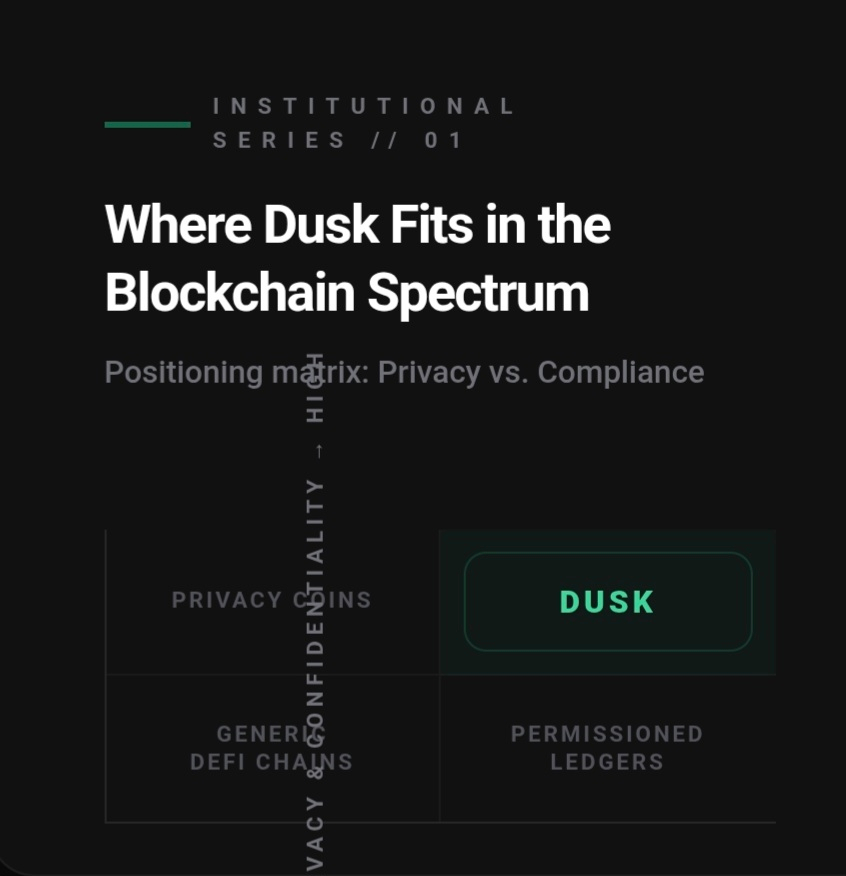
Dusk is a purpose-built layer-1 blockchain that blends confidential transactions with on-chain compliance. Unlike pure privacy coins or generic DeFi platforms, Dusk is designed as a regulated finance infrastructure. Its modular architecture separates settlement from execution (the DuskDS base layer and an EVM execution layer), and it natively supports both shielded and transparent transactions. This enables tokenized securities, real-world assets (RWAs), and even regulated stablecoins to be issued on-chain with privacy and legal compliance built in. In Dusk’s own words, it is “the privacy blockchain for financial applications… a new standard for compliance, control, and collaboration”.
Modular Architecture: DuskDS and DuskEVM
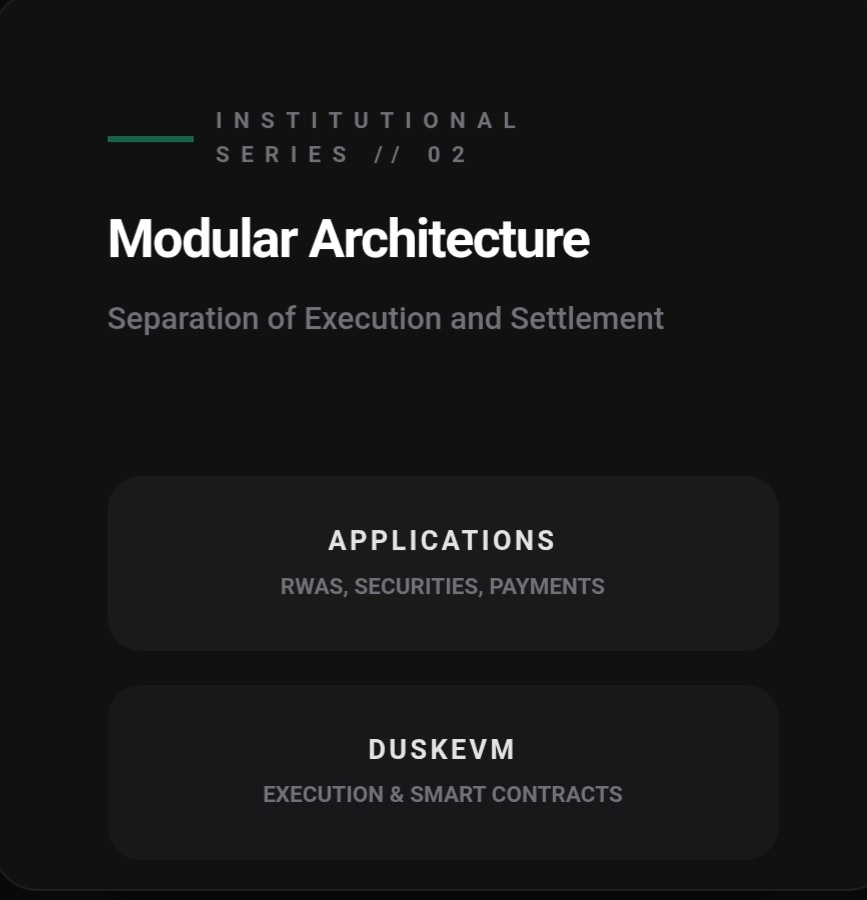
Dusk uses a three-layer modular stack. At the base is DuskDS, a PoS settlement layer (consensus, data availability, finality) that enforces institutional-grade security and privacy. On top of DuskDS sits an EVM-compatible execution layer (DuskEVM) for smart contracts and DeFi. A future privacy VM (DuskVM) layer will support fully private applications. By decoupling layers, Dusk can optimize each for its task: DuskDS uses a novel Succinct Attestation PoS (with fast finality for settlement) and a peer-to-peer Kadcast network for efficient messaging, while DuskEVM reuses Ethereum tooling for rapid integration. All layers share a single native token (DUSK) and a trustless native bridge, so assets and value move between them without custodians or wrapping.
For developers, this means existing EVM dApps can migrate with minimal changes. The architecture explicitly supports real-world asset use cases: for example, it “becomes the primary venue for DeFi and compliant apps” while a separate privacy layer handles high-confidentiality workloads. Dusk’s Zedger/Hedger protocols (UTXO-based asset issuance on DuskDS and an equivalent engine on DuskEVM) enable full lifecycle management of security tokens with embedded compliance rules (dividends, voting, transfer caps, etc.). A built-in identity framework (Citadel) adds selective privacy for identity data, so KYC/AML checks can be done via on-chain credentials without leaking personal details. All told, Dusk’s components “meet institutional standards for privacy, regulatory compliance, and secure interactions with regulated assets”.
Native Token and Security Model
The DUSK token is the backbone of the network. It is used for staking in the PoS consensus, for paying transaction fees, and for governance. At launch, an initial 500 million DUSK were distributed; the remaining supply (up to 1 billion) will be emitted over decades to reward validators. According to the official economic design, DUSK “serves as an incentive for consensus participation and as its primary native currency”. Practically, this means DUSK holders can become node provisioners (by staking), securing the network via Dusk’s Succinct Attestation protocol. In turn, validators earn DUSK rewards – supporting a predictable, long-term security budget suited to multi-decade assets.
Every transaction consumes gas denominated in DUSK (priced in a unit called LUX). Fees paid by users are split between the consensus pool and any smart-contract activity on DuskEVM. As the docs note, DUSK is also “used for staking… rewards to consensus participants… payment of network fees…and for deploying dApps or services on the network”. Finally, DUSK underpins an on-chain governance mechanism: token holders (especially stakers) can vote on protocol upgrades, parameter changes, and treasury allocation. In a privacy-sensitive system like Dusk, this governance role is essential – allowing the community and validators to jointly balance privacy features and compliance requirements over time.
Privacy by Design: Phoenix and Moonlight
A key innovation of Dusk is its dual transaction model on DuskDS. Users can send value either via public transactions (Moonlight) or shielded transfers (Phoenix). Moonlight transactions work like a normal account model – sender, recipient, and amount are all visible on-chain. Phoenix uses zero-knowledge proofs (PLONK/ZK) so that amounts and parties are hidden. Dusk’s Transfer Contract enforces consistency for both modes. Crucially, Phoenix is built with selective transparency: funds are held as encrypted notes, and all transfers are provably valid without revealing details, yet holders can reveal or audit them using viewing keys if authorized (for regulators or audits).
This selective-transparency approach means Dusk is private by default but compliance-ready. Unlike blockchains that are fully transparent, Dusk gives institutions the cryptographic privacy they need; unlike pure privacy coins, it does not permanently hide transactions from legitimate oversight. As Dusk’s documentation explains, every completed Phoenix transaction is final and settled on-chain with legal certainty, while still keeping sensitive data confidential. In practice, an institution can issue security tokens that trade privately, yet still prove to an authority that all regulatory rules (KYC, transfer limits, etc.) were followed. This “privacy with structure” is a core Dusk design goal: to keep “balances, ownership registries, and asset movements… confidential” while satisfying compliance.
Focus on Regulated Assets, Not Generic Privacy
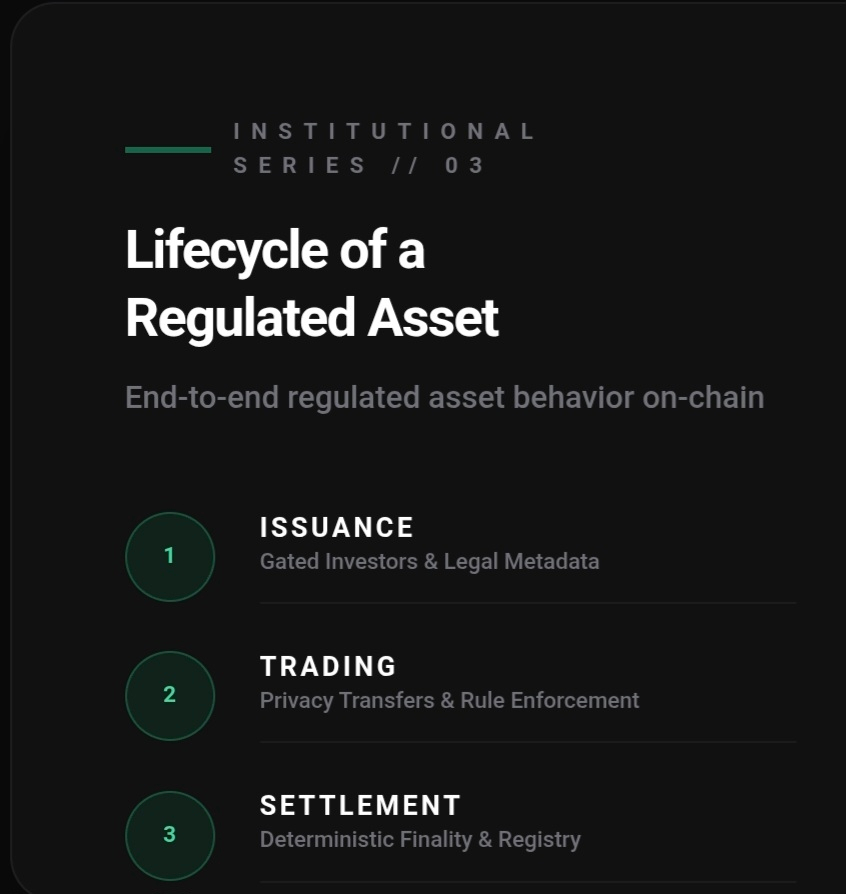
Dusk is not a typical crypto privacy token or a permissionless DeFi chain. Instead, it aims to function as infrastructure for regulated finance. This sets it apart from Monero, Zcash or other privacy-first coins (which only support anonymous payments) and from DeFi chains without built-in compliance. As one early release put it, Dusk’s smart-contract platform (RUSK) enables private applications “in a way that sets Dusk aside from existing privacy blockchains such as Monero and Zcash”. Likewise, Dusk collapses trading, settlement, custody and record-keeping into a single on-chain workflow, rather than bolting compliance on top afterward. Regulators get the assurances they need (auditable records, forced transfers, identity gates, etc.) at the asset level, not via off-chain promises. In short, Dusk is “finance using blockchain”, with “control at the asset layer”.
Unlike DeFi-first platforms, Dusk integrates EU legal frameworks from day one. It aligns with MiCA rules (payment tokens, regulated assets, utility tokens) and supports features like forced transfers for court orders and on-chain governance for dividends and amendments. These design choices are intentional: Dusk is being built as a Decentralized Market Infrastructure, explicitly to serve banks, exchanges, and fund managers. In fact, its tokenomics and long emission schedule are tailored to “assets with multi-decade lifecycles” like bonds and funds. This infrastructure-first clarity – privacy plus accountability – is Dusk’s strategic niche in the RWA/tokenization space.
Institutional Integrations and Partnerships
Dusk’s road map emphasizes real-world collaborations. Its key partners include regulated exchanges, custodians, and fintechs building on or into Dusk. Notably, the Dutch SME stock exchange NPEX (AFM-regulated) is tokenizing securities on Dusk. In a recent announcement Dusk explained that NPEX-listed equities and bonds will move on-chain under strict rules. To bridge Dusk’s private ledger with other networks, Dusk is adopting Chainlink’s CCIP cross-chain protocol and data standards. As the Chainlink partnership release states, this lets tokenized assets on DuskEVM move securely between chains, and makes DUSK itself transferable to networks like Ethereum and Solana via Chainlink’s Cross-Chain Token (CCT) standard. Official Dusk docs also list Chainlink alongside NPEX and custody provider Cordial as ecosystem partners.
Cross-chain compliance: Dusk and NPEX are integrating Chainlink CCIP and oracles so that regulated European securities can flow on-chain and be composable across ecosystems. Chainlink DataLink and Data Streams will feed official NPEX market data on-chain, making Dusk/NPEX official publishers of verifiable price feeds.
Dusk is also building payment rails with regulated stablecoins. In collaboration with NPEX and Dutch fintech Quantoz, Dusk will host EURQ, a MiCA-compliant digital euro (an “Electronic Money Token”). Dusk is one of only three blockchains to support EURQ, and uniquely the only one built for native RWA issuance. The EURQ integration is a keystone for Dusk Pay, the on-chain payments product aimed at fast, cheap, compliant money transfers. With EURQ onboard, investors on Dusk’s on-chain stock exchange get actual euros (not just algorithmic tokens), and even retail users can pay with EURQ in decentralized apps. Dusk’s blogs highlight that these partnerships will bring “€300M of assets on-chain” via NPEX and stablecoin rails.
Other partnerships reinforce this institutional focus. In April 2025 Dusk announced a collaboration with 21X (a DLT-TSS licensed platform) for tokenized market infrastructure. 21X will combine trading and settlement on-chain, and is authorized to use a public blockchain for securities. The Dusk-21X alliance includes integrating 21X’s stablecoin reserve management with Dusk’s confidential platform. Similarly, Cordial Systems provides self-custody (Cordial Treasury) to institutions like NPEX; Dusk is integrating this as “Dusk Vault” to let clients control keys in a regulated way. Games/gaming can also plug into Dusk: the studio PlayMatika plans to use Dusk Pay for player payments.
Tokenized Securities, EURQ and Chainlink Oracles
Together, these integrations demonstrate Dusk’s real-world traction. Securities issuance, stablecoins, and oracle data are coming on-chain under Dusk’s compliance umbrella. For example, Dusk’s native token standards (XSC) allow securities to enforce identity-gated ownership and transfer limits. Covenants like “only accredited investors” or “one-vote-per-citizen” can be encoded at the protocol level. Chainlink oracles ensure that pricing or regulatory data (like market prices or treasury rates) is delivered securely on-chain. In short, Dusk combines on-chain privacy (via ZK proofs) with on-chain regulation (via approved identities and audit trails).
By contrast, most DeFi chains lack these asset-level controls, and most privacy coins lack programmability. Dusk’s architecture specifically aims to “bring the entire [financial] system onto the Dusk blockchain” in a compliant way. It envisions things like on-chain stock exchanges, tokenized bond markets, and regulated private lending pools – all under one licensed umbrella. This is why its ecosystem lists NPEX, Quantoz, Cordial and Chainlink as core partners. Each new integration (NPEX equities, EURQ stablecoin, cross-chain bridges) adds another piece of infrastructure for capital markets to operate natively on-chain.
Recent Developments and Roadmap Progress
Dusk’s public rollout has accelerated in 2024–25. After multiple testnets (DayBreak in 2022, DayLight in 2023), the mainnet launched in January 2025. That milestone kicked off a wider roadmap of institutional features. In mid-2025 Dusk announced a shift to its current modular stack (“multilayer architecture”) and introduced Hedger, a new privacy engine for DuskEVM (combining homomorphic encryption with ZK proofs). Hedger lets Solidity contracts offer confidential transfers and obfuscated order books – tailor-made for regulated markets. Under this update, DUSK remains the sole token but takes on layer-specific roles: staking and governance on DuskDS, gas on DuskEVM, and gas for private apps on DuskVM.
By late 2025 Dusk’s ecosystem continued growing. The native token was listed on Binance US in October 2025, opening the U.S. market to Dusk’s compliance-focused finance. The team also outlined Q1 2025 goals like launching Dusk Pay (real-euro payment circuits), Lightspeed (an EVM Layer-2 bridge), advanced hyperstaking, and a beta of Zedger for asset tokenization. Beyond that, the ongoing buildout includes custody tools (Dusk Vault), developer APIs, and more regulated DeFi primitives. All these moves are guided by partners’ needs: as Dusk emphasizes, it’s building “what people need, not what we think is cool”.
In sum, Dusk’s positioning as “privacy-preserving and compliance-first” is backed by tangible integrations and technology. Its deep on-chain privacy tools (ZK Phoenix), identity frameworks (Citadel), and modular EVM compatibility set it apart from standard chains. And the growing real-world onramps – from NPEX securities to digital euros – underscore its focus on regulated finance, not just crypto-native use cases. These facts are confirmed by official sources and partnerships: Dusk’s whitepapers and blogs, NPEX announcements, Chainlink press, and on-chain documentation all paint a consistent picture of an infrastructure-driven blockchain designed for the institutional age.