

I am Jia. I want to talk about something that people usually do not include in presentations. It is actually very important for a blockchain product to be successful with real users: the time, between when you do something and when you find out if it worked.
It is not about how something takes. It is not about how much stuff can happen at the time. What matters is how it feels when you do something. It is done. There is a space between when you click a button and when you can trust that it really worked. You do not need to check if it worked.
In the way of doing things this space is filled with spinning wheels, pop-up messages that say everything is okay and green checks that mean yes it is done.. When people are playing games or going to events, in the metaverse or getting rewards right away you can not stop and wait for these things.
The moment is already. People are already talking about it. If the system says to the user wait and make sure everything is okay then the experience is not good anymore. The feeling of doing something and having it work is broken.
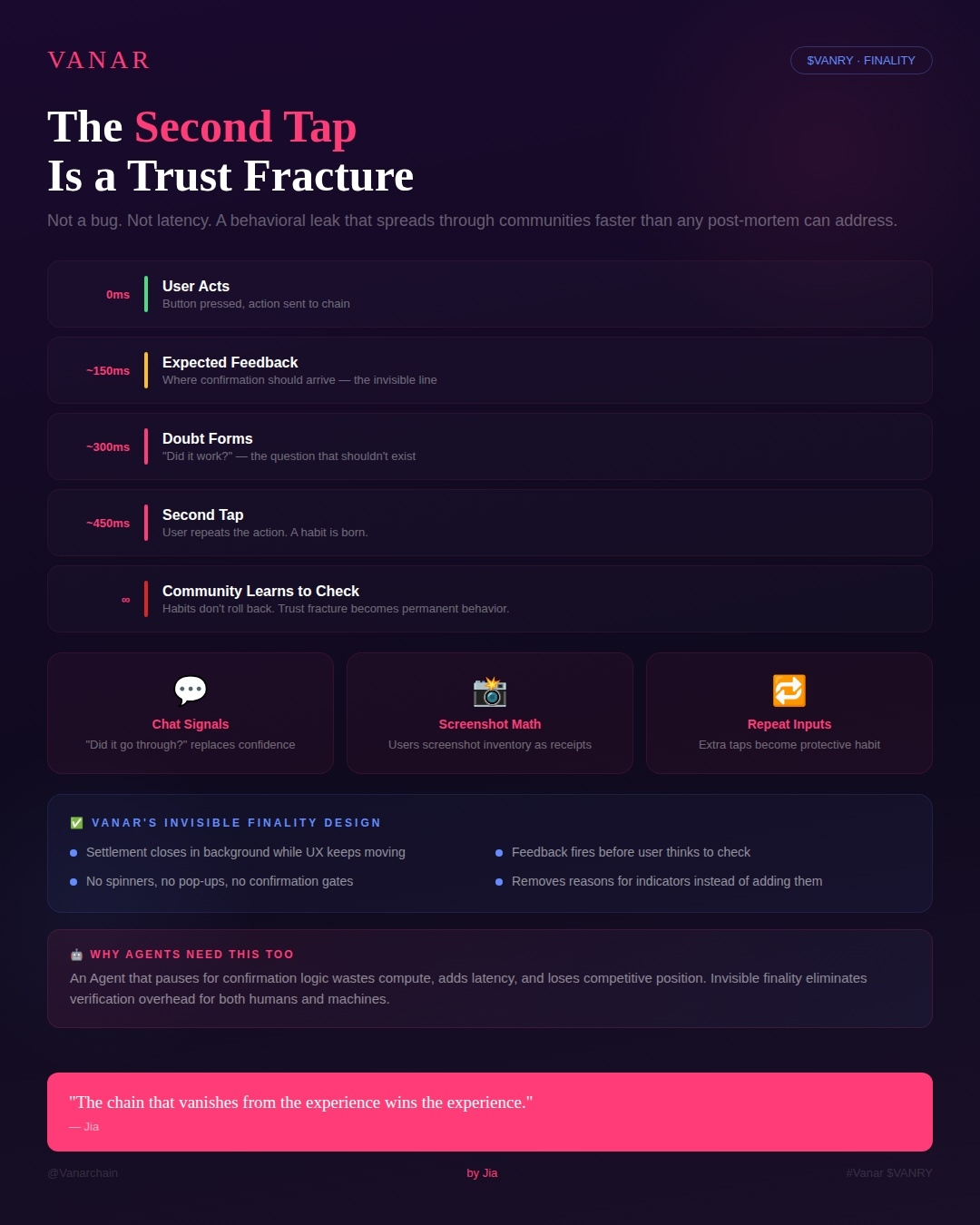
I call it the Second Tap Problem. This problem happens when I get feedback a little slow. It is not slow enough to make me think something is wrong.. It is slow enough to make me wonder if everything is okay. I tap the claim button. Then I wait for a very short time. If I do not see anything happen away I tap the claim button again. I do this because the system makes me feel like something might not be working right. I tap the button again because I am not really sure if it worked the time. That second tap is not me saying something is broken. The Second Tap Problem is me losing a trust, in the system.. When people lose trust in the system it can spread to other people very quickly. The Second Tap Problem can spread through a community of people faster than anyone can figure out what is going on and fix it.
When you watch people playing games live you will see something that always happens. This thing happens when you do not have to think about if something worked or not. You just keep playing the game because you know it worked. Nobody says "did that work?" to their friends who are playing with them. Nobody takes a picture of the things they have in the game to make sure they really got them. The players just keep going because they do not have to stop and think about it. The fact that nobody is worried is what the game is supposed to do. The goal of the game is to make sure people do not have to wonder if things are working or not.
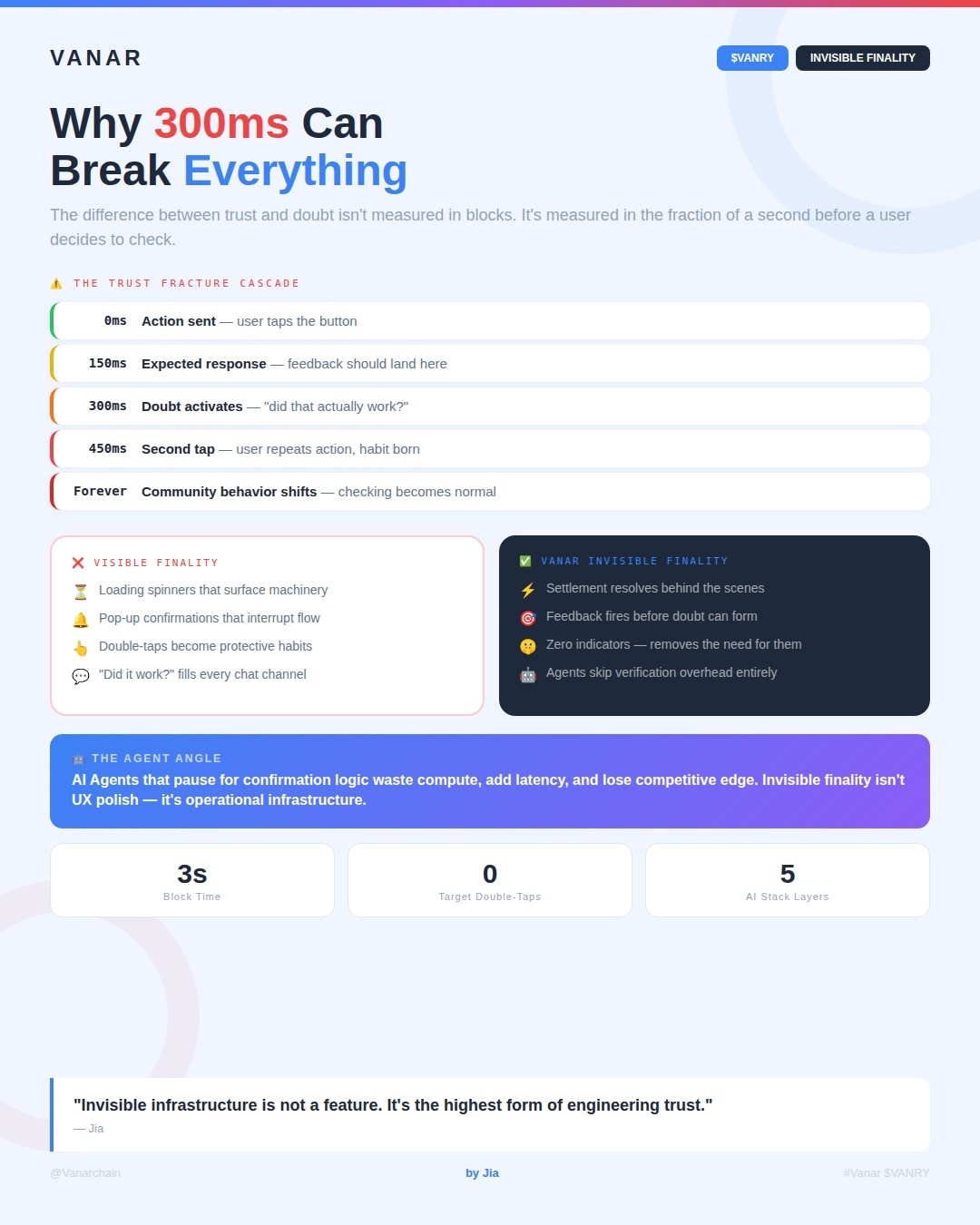
On Vanar the buildings and structures are really something to see. The chain is like a process that gets sorted out while you are still having an experience that keeps going. In the background things like settlements are being taken care of. At the time in the foreground you get feedback that tells you what is happening. The thing is, nothing tells you to slow down and make sure everything is okay with both the background and foreground things.
In the Virtua metaverse environment things can get a little crazy. Actions are happening on top of each other while the state of things is already changing. For example someone can get a reward while another thing is still working on the moment. A trade can be finished while the chat is already talking about it. The system has to be done before you can even think about whether you want to ask questions about it. The Virtua metaverse environment and Vanar are, like this because the experience and the chain and the system all have to work.
The kind of engineering work needed for this is really tough. Most people do not see it. I have been in meetings where everything looked good. The logs were normal the latency was fine and the throughput was healthy.. Something still did not feel right. People were clicking buttons twice. The chat was filled with questions about timing. They were not upset. They were just curious.. Being curious is actually worse than being upset because when people are curious it means the system is teaching them that they need to double check things sometimes. Once people learn this it becomes a habit. They start doing checks. This causes delays. The system is making people do work like clicking buttons twice and this is causing tiny delays. The engineering work for this is about the system and how it affects the people who use it like the people in the meeting who were curious, about the timing. These things that people do on a platform they might seem like nothing at first but then they start to change how the whole community uses the platform. Behavioral hedges are, like that they appear to be harmless. Over time they define how an entire community interacts with the platform and that is what makes behavioral hedges so important to think about.
What makes this matter beyond gaming is the Agent economy. The Agent economy is important because in 2026 AI Agents are doing more, than carrying out transactions. They are taking part in real time environments where small delays can add up quickly. If an Agent has to check and confirm its actions because the system does not automatically confirm them this means the Agent has to do extra work. This extra work means the Agent has to use computer power, which costs more money and takes more time. This defeats the purpose of using automation in the place. An Agent that stops to check if its action was successful is an Agent that will fall behind its competitors. The Agent economy relies on Agents being able to act efficiently.
Vanars approach does not include things that confirm something is true. It actually removes the reasons we need these confirmations in the place. Vanars approach gives us feedback that's so tight we feel like something is complete before we even think to question it. The chain is not given credit for helping to settle things. The chain is only blamed for making it clear that a settlement has been reached. This uneven way of looking at things is the idea behind Vanars approach. Vanars approach is, about this imbalance.
The real test is not if something is fast when we try it out. The test is if people using it feel like something is missing when they are in the middle of doing something. If the answer is no if nobody stops and thinks about it nobody tries to do something nobody asks a question, about it then the system has done what it is supposed to do by not getting in the way of the people using the system.
Invisible infrastructure is not something that people notice. It is the way to show that the engineering is trustworthy. When people and machines need to work smoothly the thing that makes everything easy to use is the one that people do not even see. The invisible infrastructure is what makes it all work without any problems. Invisible infrastructure wins when it makes the experience better, for people and machines.
