

The US federal budget deficit is projected to reach 1.9 trillion USD in fiscal year 2025, approximately 2.4 times the figure of 5.66 trillion yuan (equivalent to 780 billion USD) for China.
According to Reuters, the US Treasury has recorded a deficit of 1.15 trillion USD in the first five months of the fiscal year (from October to February), marking a 38% increase compared to the same period last year.
The US Congressional Budget Office (CBO) estimates that the annual deficit will account for 6.5% of GDP, significantly higher than the 50-year average of 3.8%, due to soaring social welfare costs and borrowing interest rates.
Specifically, interest payments on debt have reached 396 billion USD in the first five months of the fiscal year, while federal revenue growth has nearly stalled, at around 1% compared to the previous year.
Meanwhile, China's Ministry of Finance has set a budget deficit target of 4% of GDP for 2025, the highest in over three decades.
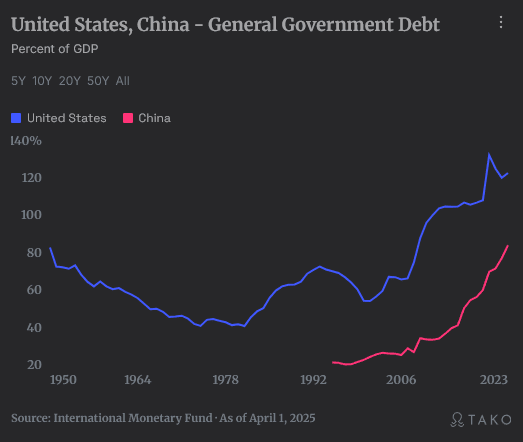
Comparison of the US vs. China's budget deficit | Source: TAKO
Although nominal figures are smaller, adjusted estimates from Fitch Ratings suggest that China's actual deficit could reach 8.8% of GDP when including off-budget loans.
This increase reflects Beijing's deliberate shift towards infrastructure investment, expanding subsidies, and mitigating the impact of the prolonged real estate market downturn, according to China's Government Work Report.
The rapid increase and enormous scale of US public debt are raising debates about the sustainability of the USD's status as the global reserve currency.
Bitcoin and its global role in the context of rising public debt
CEO BlackRock, Larry Fink, recently warned that the increasing deficit of the US could erode trust in the USD, opening up opportunities for alternative financial instruments like Bitcoin. With its fixed supply and decentralized nature, Bitcoin is increasingly seen as a hedge against the devaluation of fiat currency.
In light of these concerns, the idea of using Bitcoin as a strategic reserve asset is gaining increasing attention among policymakers. President Donald Trump once signed an executive order to establish a National Bitcoin Reserve Fund using seized assets from criminal cases, viewing digital assets as a tool to strengthen financial capability.
However, the adoption of Bitcoin still faces many challenges. Price volatility and an unclear regulatory environment continue to be significant barriers. For example, the European Central Bank (ECB) has dismissed the idea of including Bitcoin in foreign exchange reserves, with President Christine Lagarde asserting that this will not happen during her tenure.
As US public debt accelerates, far exceeding China's growing fiscal imbalance, discussions about diversifying reserve sources – particularly regarding Bitcoin – are likely to continue heating up.
Bitcoin proponents emphasize its deflationary properties and independence from central banks. Meanwhile, opposing arguments related to the instability and legal risks of Bitcoin are becoming increasingly weaker.
Increasing instability in global monetary policy is driving demand for new financial protection measures against systemic risks. And in the process, Bitcoin may become an important solution.
Disclaimer: This article is for informational purposes only and is not investment advice. Investors should do their own research before making any decisions. We are not responsible for your investment decisions.


