
Why do I say this? Look at the four points below.
Any bull market in capital markets requires a continuous influx of incremental funds to sustain it. However, the various sources of incremental funds in the cryptocurrency market have now dried up:
1. Altcoins have collapsed. This round of the cryptocurrency bull market did not generate new hot altcoins to successfully attract incremental funds from outside, and there hasn't even been a decent rotation of altcoins. The traditional source of incremental funds that attracted funds into the cryptocurrency market and ultimately flowed into Bitcoin is gone.
2. The American stock market's Bitcoin spot ETF has changed from a net inflow in the past to a continuous net outflow. In the past month, at 10:30 PM Beijing time on each trading day, Bitcoin has almost consistently plummeted, largely due to the fact that as soon as the American stock market opens, the Bitcoin spot ETF begins unloading, dragging down the entire cryptocurrency market. After the stock market closes, it rebounds, but the next evening, as soon as the stock market opens again, it starts unloading, dragging the market down again.
3. The penny-pinching Trump is not willing to spend a dime. A significant factor in this round of the cryptocurrency bull market was Trump’s claim during his campaign that he would include Bitcoin as part of the U.S. government's reserve assets. Market participants thought that the U.S. government would spend money to buy Bitcoin and take it off their hands! But in reality, Trump just talked a good game without actually planning to spend a dime to purchase Bitcoin to increase the reserve. So this last hope supporting the bull market has been shattered.
4. The U.S. has reduced tariff increases globally, lowering the Federal Reserve's interest rate cut expectations. This round of the cryptocurrency bull market began in December 2022, when U.S. inflation peaked and started to decline. The market anticipated that the Federal Reserve would begin a series of interest rate cuts, which would benefit all capital markets and thus ended the previous year-long bear market in the cryptocurrency sector. However, with Trump recently taking office and starting to impose tariffs globally, the market anticipates this will lead to rising domestic prices and inflation in the U.S., which will force the Federal Reserve to halt its interest rate cuts, and in extreme cases, there is a possibility of rate hikes. This has had a huge impact on the stock market and the cryptocurrency sector, with the Nasdaq continuously breaking below the 120-day and 200-day moving averages, which has also led to a significant decline in the cryptocurrency market.
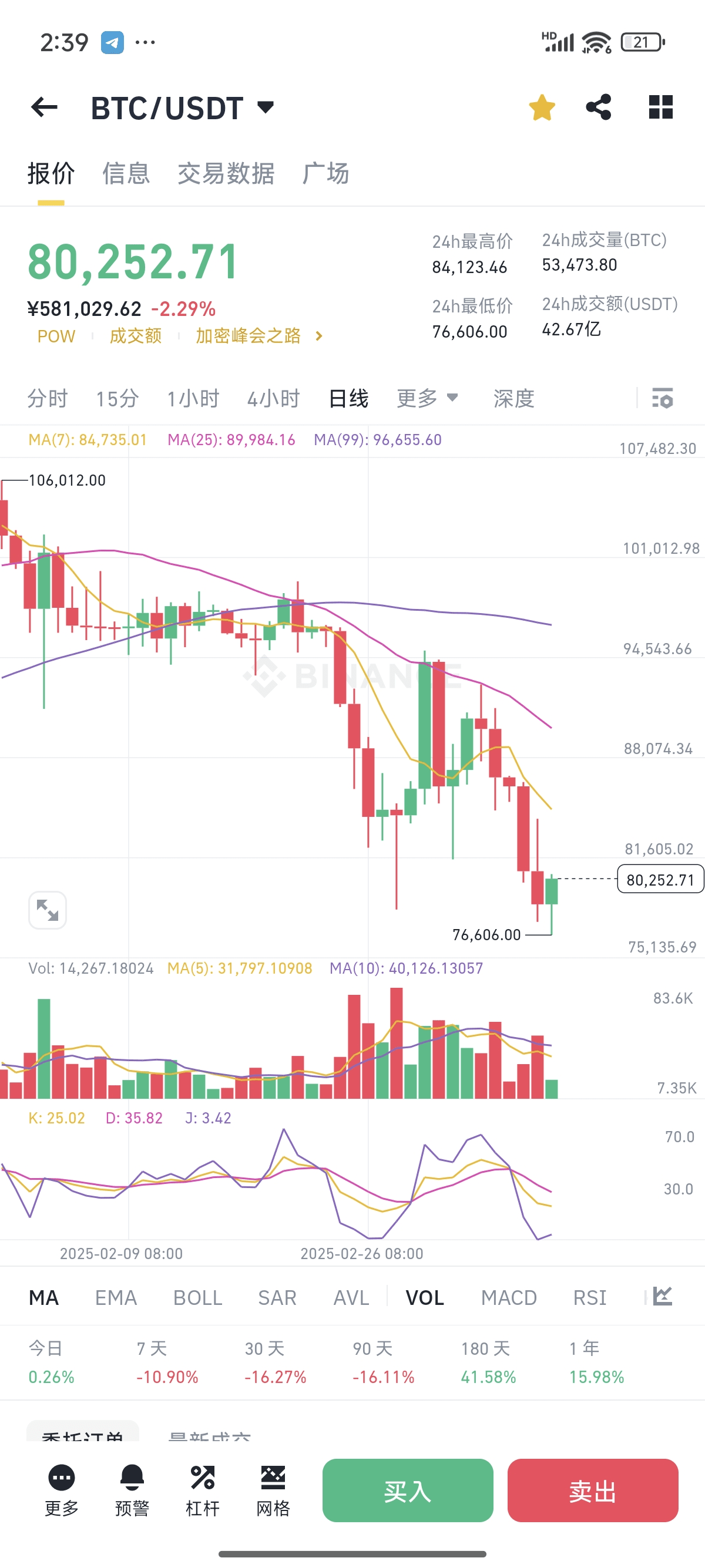
Based on the above factors, it is highly likely that this round of the cryptocurrency bull market has ended. A wise man does not stand under a dangerous wall; going with the trend is the best choice. Of course, from a long-term perspective, Bitcoin is still in the process of expanding consensus and increasing participants, but most of the dividends should have already been released. The cycle continues, and going with the trend is the way to go.