
There is a difference between a crypto platform offering trading services and a company trying to become part of the broader financial system.
That difference is becoming more visible in Brazil.
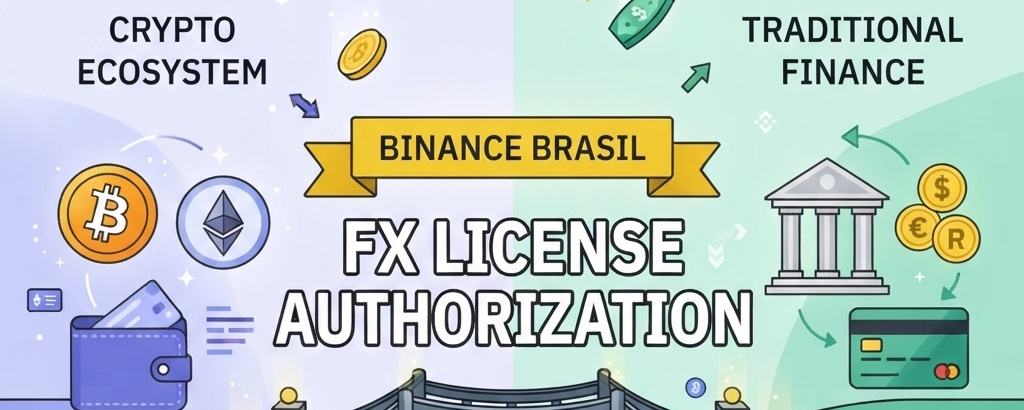
Binance Brasil's latest authorization from the Central Bank of Brazil allows its local entity to operate as a foreign-exchange broker, adding another regulated activity to its existing local permissions. On the surface, it looks like another licensing announcement. But I think the more interesting story is what this says about the direction crypto companies are taking.
The industry is slowly moving beyond the question of how to attract people into crypto. It is starting to focus on how digital asset services can fit into the financial activities people already depend on.
And that transition may be more difficult than it looks.
Crypto companies are starting to think differently
For years, much of the crypto industry's attention was focused on new tokens, trading volumes, blockchain networks, and market cycles. The competition was largely about attracting users, offering more products, and building faster platforms.
That hasn't disappeared. But another layer of competition is emerging.
Companies are now looking at payments, currency exchange, financial infrastructure, and regulated services. These areas aren't as exciting as a new token launch, but they could have a much bigger impact on how people interact with digital asset platforms over time.
Getting there, however, requires more than technology.
Financial services depend on trust, operational reliability, customer verification, compliance, and the ability to work within rules that can change. A platform might have millions of users, but expanding into regulated financial activities introduces responsibilities that cannot simply be solved by having a good app.
That's why Binance Brasil's FX authorization caught my attention. It's not just another addition to a list of services. It reflects the growing importance of financial infrastructure in the crypto industry's next phase.
Why Brazil is an interesting market
Brazil is an important market to watch because digital financial services already play a significant role in how people interact with money.
For a company operating in crypto, that creates an interesting opportunity. The potential isn't necessarily limited to attracting people who already trade digital assets. It also involves connecting different financial activities in ways that customers may find useful.
But opportunity and execution are two very different things.
A competitive market can attract companies looking to expand, yet it also raises customer expectations. People want services that are reliable, easy to use, and worth the effort of switching from something they already know.
Regulatory approval can open the door to new activities, but it doesn't guarantee that customers will use them. The company still has to make the service useful, competitive, and sustainable.
That's the part of the story that deserves more attention than the headline itself.
What the FX license actually changes
Binance Brasil already had local authorization related to securities brokerage and electronic money issuance. The new foreign-exchange authorization adds another regulated activity to its Brazilian operations.
That distinction matters because financial permissions are not interchangeable.
Being authorized to conduct one activity doesn't automatically allow a company to offer every other financial service. Different activities come with different responsibilities, rules, and boundaries.
The FX authorization should also not be confused with unlimited permission to offer every product available through Binance globally. Regulatory permissions depend on the relevant entity, activity, and local framework.
For the company, expanding its regulated capabilities could create more opportunities. But it also means managing a wider range of responsibilities.
And there's a trade-off here that is easy to overlook: more regulated services can create more business opportunities, but they also increase the operational burden of maintaining compliance, infrastructure, reporting, and customer trust. Those costs and responsibilities have to be justified by actual demand. A license can make expansion possible without making expansion profitable.
That's the difference between obtaining permission and building a business that works.
Cross-border transfers are where things get interesting
One area worth watching is the relationship between foreign exchange and international transfers involving digital assets.
Cross-border payments have traditionally involved multiple institutions, currencies, processes, and compliance requirements. Digital assets introduce another way for value to move between systems, which is part of the reason they continue to attract attention in this area.
However, making a transaction technically possible doesn't automatically make it simple from a regulatory perspective.
Institutions still have to consider who is sending funds, who is receiving them, the purpose of the transaction, and the requirements that apply. Customers may care about convenience, but financial institutions and regulators also care about transparency and accountability.
Binance has introduced additional information requirements for certain international crypto transfers involving Brazilian users, reflecting the country's evolving regulatory environment.
The new FX authorization is relevant to this wider financial-services development, but it doesn't mean every transfer rule or product changes automatically.
The interesting part is how these different pieces of infrastructure eventually work together—and whether that creates a noticeably better experience for customers.
Crypto and traditional finance are meeting in the middle
I think this is where the bigger industry story becomes clearer.
Crypto was often presented as an alternative to the existing financial system. The conversation was about building something different, removing intermediaries, and creating new ways to move value.
Today, the picture is more complicated.
Crypto companies are seeking regulated financial permissions. Traditional institutions are exploring digital assets. Regulators are building frameworks to accommodate new technology while maintaining oversight.
Neither side is simply replacing the other.
Instead, they are increasingly interacting, competing, and sometimes depending on each other.
That could make financial services more connected over time. But it also means crypto platforms may begin to look more like traditional financial companies in the way they operate.
And that raises an interesting question: as crypto becomes more integrated into regulated finance, what exactly will make these platforms different from the financial institutions they once challenged?
The license is the beginning, not the result
The authorization gives Binance Brasil another opportunity to expand its regulated activities. But the real outcome will depend on what happens next.
Will customers find the new services useful? Can the company deliver them efficiently? Will the additional financial capabilities create enough demand to justify the costs and responsibilities? And how will the regulatory environment evolve?
Those are the questions that matter beyond the announcement.
The crypto industry has spent years talking about adoption, often measuring it through users, trading activity, and market growth. Perhaps the next phase will be judged differently—not by how many new tokens people discover, but by whether digital asset platforms can build services that people genuinely find useful in their everyday financial lives.
Binance Brasil's FX authorization is one development in that direction. The license itself isn't proof that the transition will succeed, but it gives us another example of where the industry is trying to go.
Do you think crypto entering regulated financial infrastructure is its natural next step—or could it eventually lose the very identity that made it different?