The real test is what people do with stablecoins!
I think Celo's latest developments deserve a closer look. Most stablecoin networks compete around dollar liquidity, transaction costs and transfer speed. Celo is attempting something slightly different: connecting digital dollars with local currencies, payment applications and onchain foreign-exchange markets. That could give the network a more practical role in everyday financial activity. But I want to understand whether this growing infrastructure can create lasting economic value rather than simply expanding the number of assets available onchain.
1. MiniPay: Adoption Beyond Wallet Creation
One of Celo's strongest distribution channels is MiniPay, the self-custodial wallet developed by Opera.
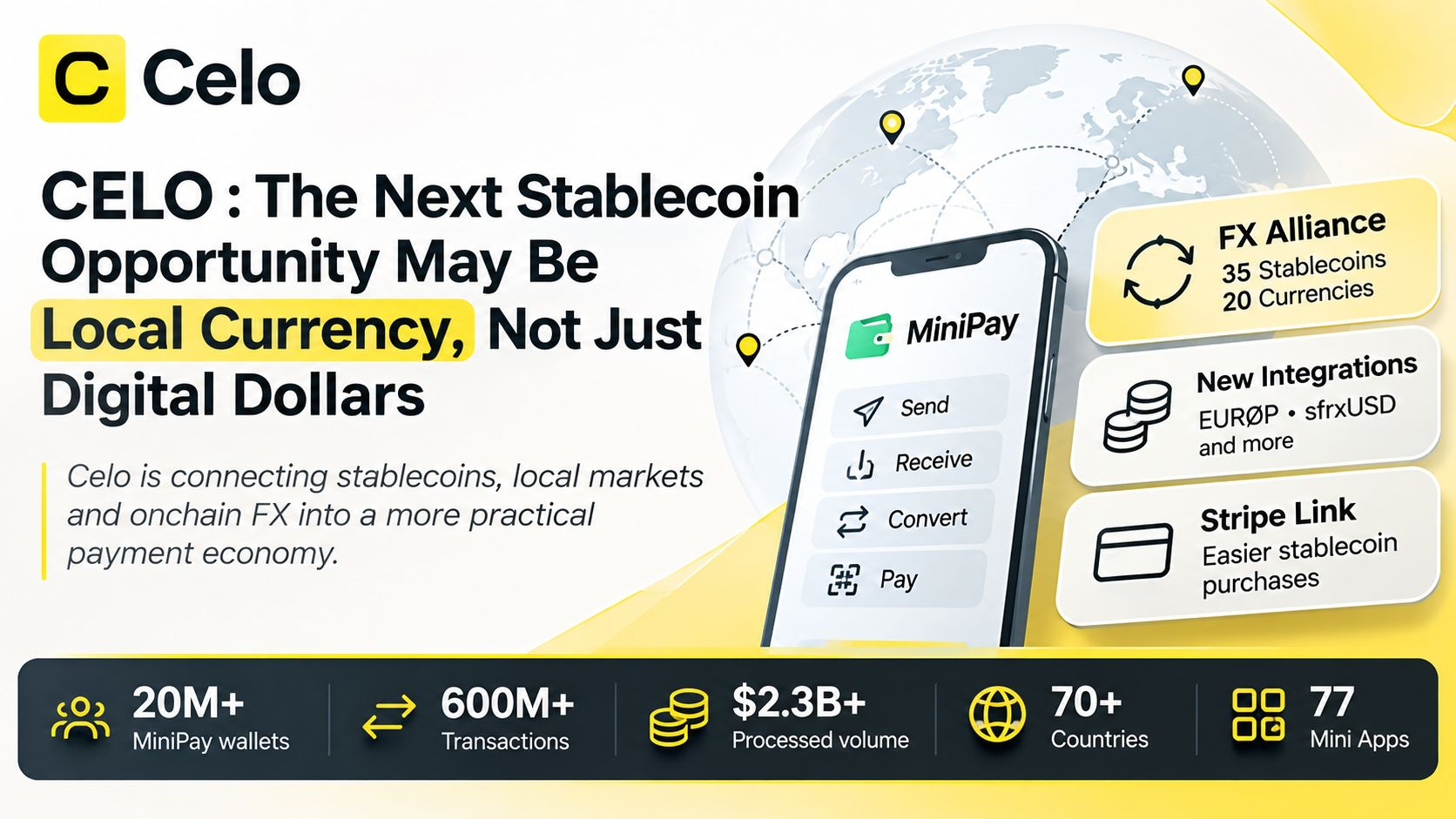
Its Q3 2026 update reported more than 20 million wallet activations, over 600 million transactions processed and approximately $2.3 billion in cumulative transaction volume across more than 70 countries. The ecosystem also reported 77 active Mini Apps.
These figures suggest that Celo has established meaningful distribution for stablecoin applications. However, I would not treat wallet activations as equivalent to active users. The more useful indicators are recurring payments, user retention, transaction frequency and how much activity comes from genuine transfers rather than internal or automated operations.
2. The FX Alliance: Connecting Local Currency Markets
The November 28 announcement is probably the most interesting recent development.
Celo introduced its FX Alliance, bringing together stablecoin issuers, payment providers, wallets and liquidity participants. The initial ecosystem includes 35 stablecoins across 20 currencies, with 11 new stablecoins added during 2026.
Think about a business receiving money from another country. It may receive a stablecoin representing one currency but need to settle expenses in another. Traditionally, that conversion can involve multiple intermediaries, banking hours and additional costs.
Celo wants to make these currency conversions possible directly between local-currency stablecoins through onchain markets, including outside traditional financial-market hours.
Founding participants include Opera, Frax, Schuman Financial, VNX Global, Ripio, IDRX, cNGN, Minteo and Textile FX.
What matters here is not simply the number of participants. The real test will be whether they bring sufficient liquidity to make these currency markets useful for actual payments.
3. New Stablecoin Integrations Add Another Dimension
The expansion is not limited to the FX Alliance.
On November 28, Schuman Financial announced plans to deploy EURØP, its euro-backed stablecoin, on Celo. It is described as the 36th stablecoin launching on the network and is issued under Europe's MiCA regulatory framework by an authorised electronic money institution.
Frax also announced the expansion of its stablecoin and asset suite onto Celo on November 24, including sfrxUSD.
These integrations could broaden the types of financial activity available on the network. Euro-denominated liquidity, dollar stablecoins and regional currencies serve different users and payment requirements.
However, the availability of additional stablecoins does not automatically create meaningful liquidity. Their adoption will depend on exchange depth, redemption access, distribution and the applications that actually use them.
4. Making Stablecoins Easier to Access
Another development worth watching is MiniPay's integration with Link by Stripe.
Announced on November 12, the integration allows eligible MiniPay users in Europe and the United States to purchase stablecoins using familiar payment methods, including cards, Apple Pay and Google Pay.
MiniPay also announced an upgrade to Stripe-owned Privy wallet infrastructure on November 19, intended to simplify account access while retaining self-custodial functionality.
I think these developments address an important problem. A stablecoin wallet is only useful if people can enter the ecosystem without complicated onboarding and move funds into applications they understand.
Still, easier access is only the first step. Whether users continue holding, transferring and spending stablecoins will determine the actual value of these integrations.
5. Does This Activity Create Economic Value for Celo?
This is where I would be more cautious.
According to DefiLlama's November 29 data, Celo had approximately $163.9 million in stablecoin market capitalization, $12.7 million in DeFi TVL and close to $1 million in daily transactions.
The same dashboard reported approximately $2,822 in 24-hour chain fees and $2,358 in chain revenue.
These figures reveal an important distinction. A network can facilitate substantial stablecoin activity without generating equally substantial fee revenue.
Celo's revenue mechanism directs net sequencer revenue to the Community Fund, with the stated mechanism supporting CELO buybacks. However, gross fees, Ethereum posting costs and the OP Stack revenue share must be accounted for before assessing the actual amount available.
More stablecoin transfers are encouraging, but sustainable economics require recurring activity that generates sufficient net revenue.
6. Bullish and Bearish Considerations 🟢🔴
Bullish considerations 🟢
- MiniPay provides an established distribution channel across more than 70 countries.
- The FX Alliance connects local-currency stablecoins with a broader payment opportunity.
- New stablecoin integrations expand the network's available financial assets.
- Stripe integrations could simplify stablecoin onboarding and funding.
- Direct currency conversions could support remittances and international business payments.
- Network revenue creates a potential connection between usage and CELO buybacks.
Bearish considerations 🔴
- Wallet activations do not establish long-term user retention.
- The number of supported stablecoins does not demonstrate sufficient market liquidity.
- FX markets need competitive spreads and reliable redemption infrastructure.
- Stablecoin adoption does not automatically translate into demand for CELO.
- Current network revenue remains relatively small compared with the scale of the broader payment narrative.
- Competition from established payment networks and other stablecoin ecosystems remains significant.
My View
I think Celo's most interesting opportunity is becoming infrastructure for the movement of money between local currencies, rather than competing only on cheaper stablecoin transfers.
MiniPay has already established meaningful distribution, while the FX Alliance introduces a more ambitious direction: connecting those currencies through accessible, around-the-clock markets.
But I would not confuse infrastructure development with proven economic success. The next important evidence will come from actual currency-pair volumes, liquidity depth, recurring payment activity and net network revenue.
If those indicators improve together, Celo could develop a more differentiated position in the global stablecoin economy.
For now, the direction is interesting. The real question is whether people and businesses will use these markets consistently enough to make the infrastructure economically sustainable.
That's what I will be watching.👀
Key Figures
20M+ — MiniPay wallet activations
600M+ — MiniPay transactions processe
$2.3B+ — MiniPay cumulative processed volume
70+ — Countries reached by MiniPay
77 — Mini Apps reported in the Q3 update
35 — Stablecoins initially trading across the FX Alliance
20 — Currencies represented in the FX Alliance
11 — Stablecoins added during 2026, as of November 28
36th — EURØP's planned position among Celo stablecoin deployments
$163.9M — Celo stablecoin market capitalization
$12.7M — DeFi total value locked
~1M — Daily transactions
$2,822 — 24-hour chain fees
$2,358 — 24-hour chain revenue
Q1 2027 — Target for the FX Alliance public dashboard
$CELO #CELO #Binance #CeloEcosystem #BNB #Blockchain