


Few tests in crypto hit harder than a ~$6.3–6.34 billion hot-wallet incident. When headlines like that break, every trader asks the exact same questions: Are user funds protected? How fast can recovery actually happen? And what changes after the dust settles?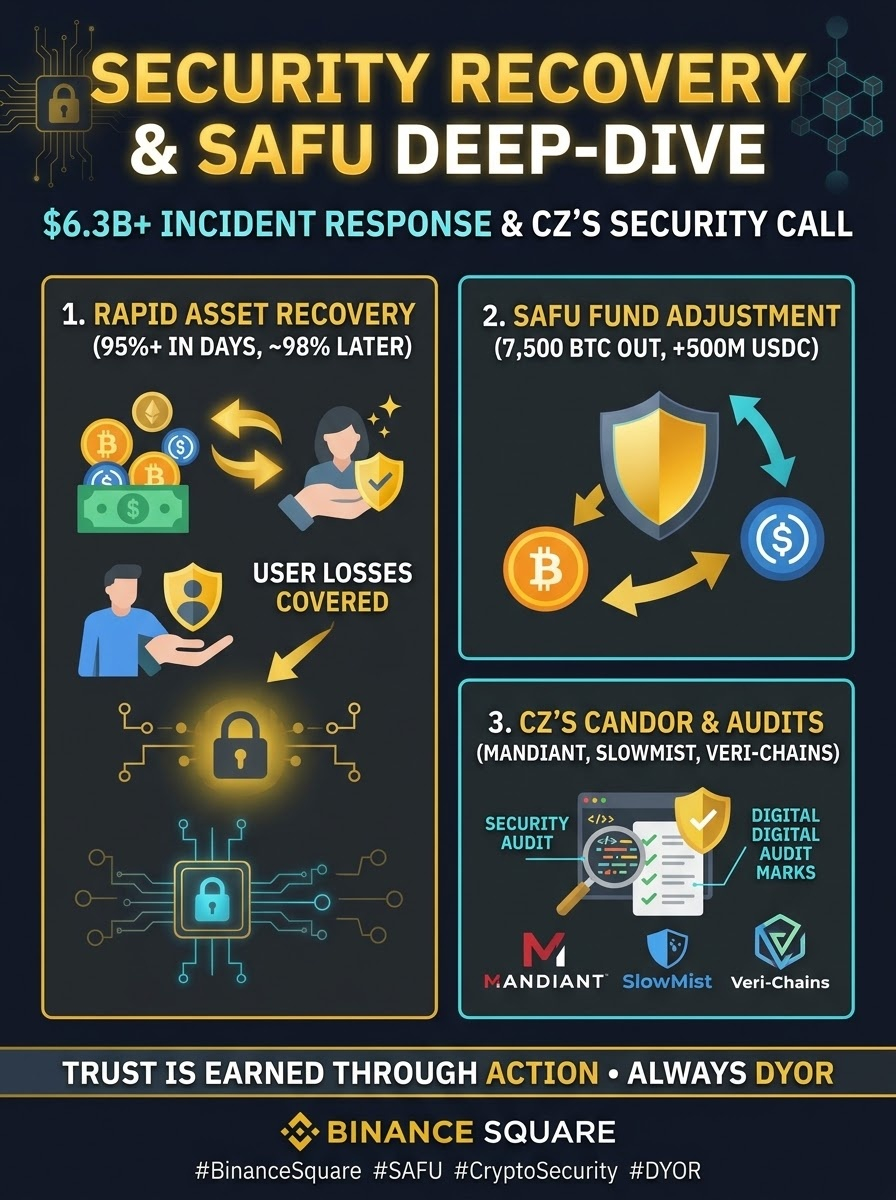
Following October’s incident and the subsequent recovery push, the story on Binance Square has centered on three pillars: rapid asset replenishment and SAFU adjustments, CZ’s blunt assessment of leadership focus, and independent third-party security reviews.
1. Covering User Losses & Rapid Asset Replenishment
In high-stress exchange incidents, speed and transparency shape market confidence immediately:
User protection commitment: Binance moved to fully cover impacted user losses rather than passing the hit onto users.
Fast replenishment pace: Most affected assets were replenished quickly—reported at 95%+ within days, and later cited around ~98% as recovery progressed.
2. Adjusting the SAFU Fund: 7,500 BTC Out, 500M USDC In
The SAFU (Secure Asset Fund for Users) mechanism has been a major focus for traders analyzing balance-sheet resilience:
Moving 7,500 $BTC out while adding 500M $USDC highlights active treasury and liquidity management—balancing volatile asset holdings with dollar-denominated stability during recovery and operational outflows.
For users watching SAFU, the key takeaways are reserve backing, liquidity composition, and clear reporting on how protection reserves are deployed and replenished.
3. CZ’s Candor & Push for an Industry Security Alliance
What made this narrative especially notable was CZ speaking openly that leadership had lost focus on security beforehand—a rare moment of public self-criticism that sparked intense debate across the community.
Alongside that candor, CZ has pushed for a broader industry security alliance—arguing that threat actors share tactics and infrastructure across platforms, so defenders need stronger shared intelligence and security standards across the ecosystem.
4. Independent Third-Party Security Reviews
Internal promises only go so far after a major incident; external scrutiny is what helps rebuild trust over time. Independent reviews involving security firms such as Mandiant, SlowMist, and Verichains point to a push for outside verification, root-cause findings, and hardening controls before and after operational rollouts.
Key Lessons & How Traders Can Approach "Is It Safe Now?"
Don’t rely on slogans—track verification: Look at concrete milestones like asset replenishment progress, external audit/review findings, and operational stability over time.
Practice personal security hygiene: Even on major venues, enable strong 2FA/passkeys, verify withdrawal addresses carefully, and use self-custody for long-term holdings you don’t actively trade.
Size risk for tail events: Tail-risk events happen in every cycle. Position sizing and avoiding over-leverage remain your best defense regardless of venue.
For informational and educational purposes only—not financial advice. Crypto assets carry substantial security, market, and operational risks; always do your own research (DYOR).
After a $6.3B+ incident, rapid replenishment, and CZ’s call for an industry-wide security alliance, what matters most to you when deciding where to keep funds—fast reimbursement, independent audits, or self-custody? Drop your take below 👇
#BinanceSquare #SAFU🙏 #CryptoSecurity #BTC #USDC #dyor $BTC $USDC

