"1 million satellites" sounds like a chip-demand supercycle. It isn't — not yet.
The FCC just authorized SpaceX's Starmind: up to 1 million orbital compute satellites for AI. Read the fine print: SpaceX must launch just ONE satellite by November 2033, 100,000 by 2035, half by 2038. A million is a license ceiling, not a launch plan.
Do the launch math. SpaceX plans about 60 Starlink V3 satellites per Starship flight. One million satellites means roughly 16,700 Starship flights. At 100 flights a year — a cadence Starship has never come close to — that is 167 years of launches. The bottleneck was never chips. It is rockets.
The chips are already counted, on the ground. SpaceX's $44B Vera Rubin financing, priced November 20 — the largest GPU financing ever — buys terrestrial GPUs, not orbital ones. Nvidia's "exclusive supplier" role was a verbal line on an August earnings call, not a disclosed contract with volumes. The first Starmind satellite is targeted for 2027, with no operational service date at all.
And SpaceX isn't even first to orbital compute. Google flew an experimental TPU satellite in October and got the first AI response generated in orbit.
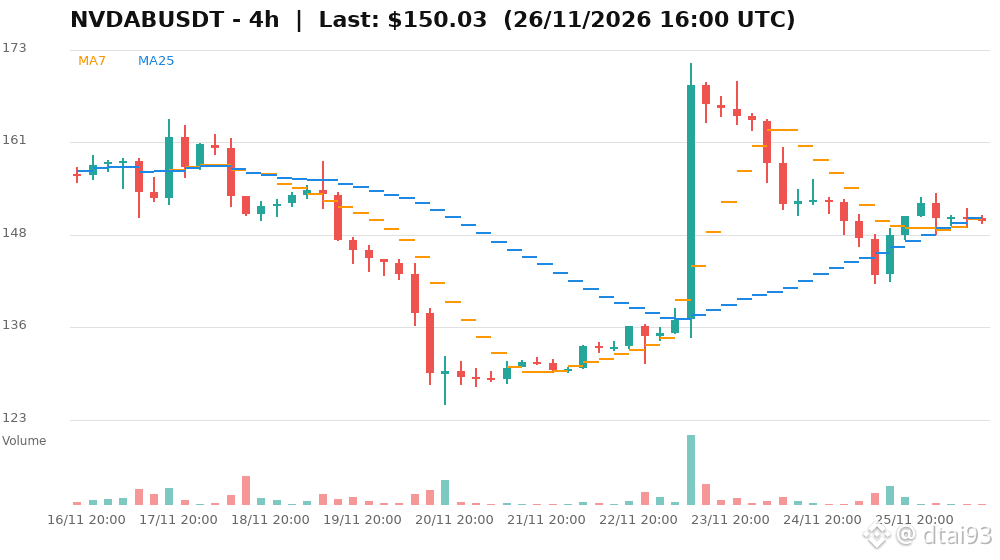
So the near-term trade isn't chip demand. It is launch monopoly: only SpaceX can attempt this at scale. Nvidia already got paid for the terrestrial buildout. Orbital adds roughly zero chip volume before 2028 — while Nvidia's tokenized shares sit at $150.03 after falling 3.9% to $149.30 on Wednesday in the AI premium repricing.
The story to watch is the rockets, not the headline number.
This is my personal opinion, not investment advice. DYOR.
Disclaimer: This content is for informational purposes only, not investment advice. I am not responsible for any losses incurred.
$NVDA $NVDAB