


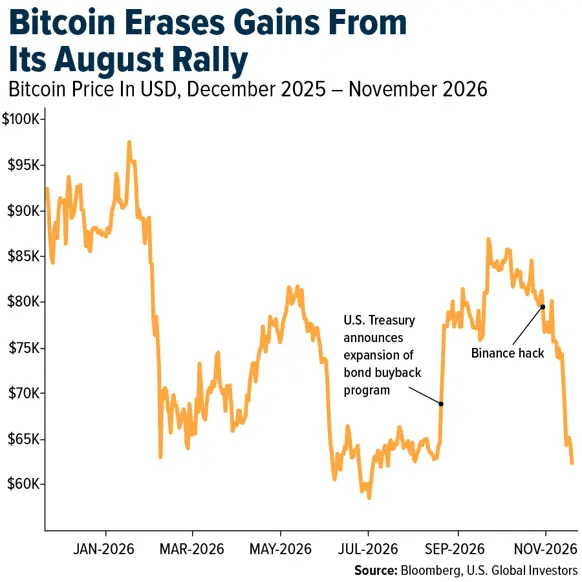
Bitcoin has fully erased the gains from its August rally. After failing to hold the $64,000 level, the spot price traded near $61,000 on 24 November 2026—roughly 49% below its all-time high—following a combination of AI-equity risk-off, a more hawkish Federal Reserve tone, and the after-effects of the late-October Binance hack. According to Talos, the value of buy and sell orders sitting within 1% of the mid-price has fallen nearly 38% from its pre-hack peak. In this environment, large prints are more likely to move the market, and the quality of liquidity matters more than the headline price.
Against that backdrop, the institutional plumbing of crypto continues to advance. The following SWOT frames the key developments for traders who already understand order-book dynamics, ETF flow transmission, and stablecoin settlement mechanics.
Strengths
Circle has expanded its institutional USDC distribution channel in Asia through DBS. Eligible clients can now mint and redeem USDC with near-instant settlement against U.S. dollars on a 24/7 basis. For desks that already route significant Asia-to-U.S. dollar flow through Singapore, this reduces the operational friction of moving between bank balances and on-chain stablecoin inventory outside traditional banking hours.
Wells Fargo reported 49.6 million shares of the iShares Bitcoin Trust (IBIT) as of 30 September 2026, valued at $2.35 billion at that time—more than double the 24.4 million shares held at the end of June. The position is held primarily on behalf of clients through its advisory and clearing units and equates to indirect exposure of roughly 28,000 BTC. While the subsequent price decline has reduced the mark-to-market value, the share-count increase still reflects continued allocation capacity among large U.S. wealth platforms.
In Singapore, the Monetary Authority of Singapore issued S$100 million (approximately $77.5 million) of four-week tokenized MAS bills natively on its Singapore Dollar Test Network and settled the auction in wholesale CBDC. Five primary dealers submitted bids totaling more than twice the amount offered. The bills can be used as collateral for interbank borrowing on the same network. This is still a pilot-scale issuance, but it demonstrates that a high-quality, short-duration sovereign instrument can now be created and settled entirely on-chain without a subsequent tokenization step.
Weaknesses
U.S. spot Bitcoin ETFs recorded $582.2 million in net outflows on 19 November, their third consecutive session of withdrawals. November’s cumulative redemptions have reached nearly $3.5 billion versus roughly $500 million in October. Sustained outflows of this magnitude remove a consistent bid that had previously absorbed spot selling; when combined with thinner spot order books, the transmission from ETF creations/redemptions into the underlying market becomes more direct.
Hyperscaler Data (formerly a Bitcoin miner) raised approximately $74 million by liquidating its entire Bitcoin treasury and has stated it still requires another $74.8 million to complete its Michigan AI data-center project. The company has disclosed substantial doubt about its ability to continue as a going concern. The episode underscores the capital intensity of converting mining infrastructure into AI facilities and the willingness of some operators to sell core holdings to fund that transition. Additional miner-to-AI conversion sales remain a latent supply factor.
Opportunities
Hyundai Card and JPMorgan completed a proof-of-concept on the Kinexys platform in which AI agents compared foreign-exchange quotes and initiated simulated transfers between overseas subsidiaries. The Hyundai Card agent monitored balances, selected a quote, and instructed the Kinexys agent to execute; the bank agent verified identity and mandate before proceeding. No live funds moved, but the exercise tested the governance layer—digital identity, explicit mandates, exception handling, and audit trails—required for agent-driven treasury operations. If scaled, this architecture could automate a meaningful share of multinational corporate cash management currently handled by human treasury desks.
Separately, the Hong Kong Monetary Authority and Swift are working with HSBC, Standard Chartered, and Bank of China to connect Swift’s blockchain ledger with Hong Kong’s Project Ensemble. Successful integration would give participating banks a path to settle cross-border payments in multiple currencies on a 24/7 basis, potentially reducing the weekend and holiday liquidity gaps that still exist in traditional correspondent banking.
Coinbase is also reported to be preparing proprietary event contracts for U.S. retail and institutional clients. Its existing Kalshi partnership generated more than $200 million in annualized net revenue in the third quarter. Internalizing the contract layer would allow Coinbase to retain a larger share of that revenue stream rather than sharing it with the partner.
Threats
In Brazil, where stablecoins accounted for roughly 80% of reported crypto transaction volume last year, lawmakers and industry groups have asked the central bank for clarity after an official linked stablecoin activity to money laundering. Broad restrictions could disrupt legitimate cross-border payment corridors and raise compliance costs for fintechs that rely on those rails.
In the United States, the Senate passed a bipartisan bill that would explicitly prohibit federally registered exchanges from listing contracts tied to war, terrorism, assassinations, or individual deaths. The measure now moves to the House. While many of these restrictions already exist in regulation, codifying them in commodities law reduces the scope for interpretive flexibility and may limit the addressable market for certain event-contract products.
Finally, Inca Digital identified $518 million in transactions involving wallets linked to illicit actors through Sky’s stablecoin system, including approximately $102 million connected to North Korean actors. A court-ordered freeze of pooled USDC reserves held by the system could impair redemptions for legitimate holders of DAI and USDS, which together exceed $8 billion in market value. Traders holding or using these tokens as collateral face an operational risk that is not fully priced into current spreads.
Trading Implications
The near-term price path is more sensitive to liquidity conditions than to the absolute level of institutional interest. With order-book depth still impaired post-hack and ETF outflows persistent, any incremental selling—whether from miner conversions, basis trades unwinding, or macro risk-off—can produce outsized moves. Conversely, the continued expansion of 24/7 stablecoin rails and tokenized collateral instruments improves the ability of desks to manage inventory and financing across time zones.
Key variables to monitor:
Restoration of spot order-book depth (Talos and similar metrics) back toward pre-hack levels.
Whether November ETF outflows stabilize or accelerate into month-end.
Further live deployments of agent-driven treasury flows on platforms such as Kinexys.
Any formal guidance from Brazil’s central bank on stablecoin usage.
Progress on the Swift–Project Ensemble connection and additional MAS bill issuances.
The institutional infrastructure is advancing, but it is advancing against a thinner spot market. For now, liquidity remains the binding constraint.
BRIAN TRUONG (Kitco News)
👉TRADE/HOLD $BTC HERE👇
