
How the historic AI sell-off could reshape Wall Street, global liquidity and the cryptocurrency market.
What happens when a company delivers triple-digit revenue growth, yet investors rush to sell its shares? Nvidia is facing exactly that situation. And the consequences could extend far beyond Wall Street.
Nvidia’s decline is no longer just a debate about the valuation of a technology company. It raises much bigger questions about global investor confidence, geopolitical competition, and the movement of institutional capital.
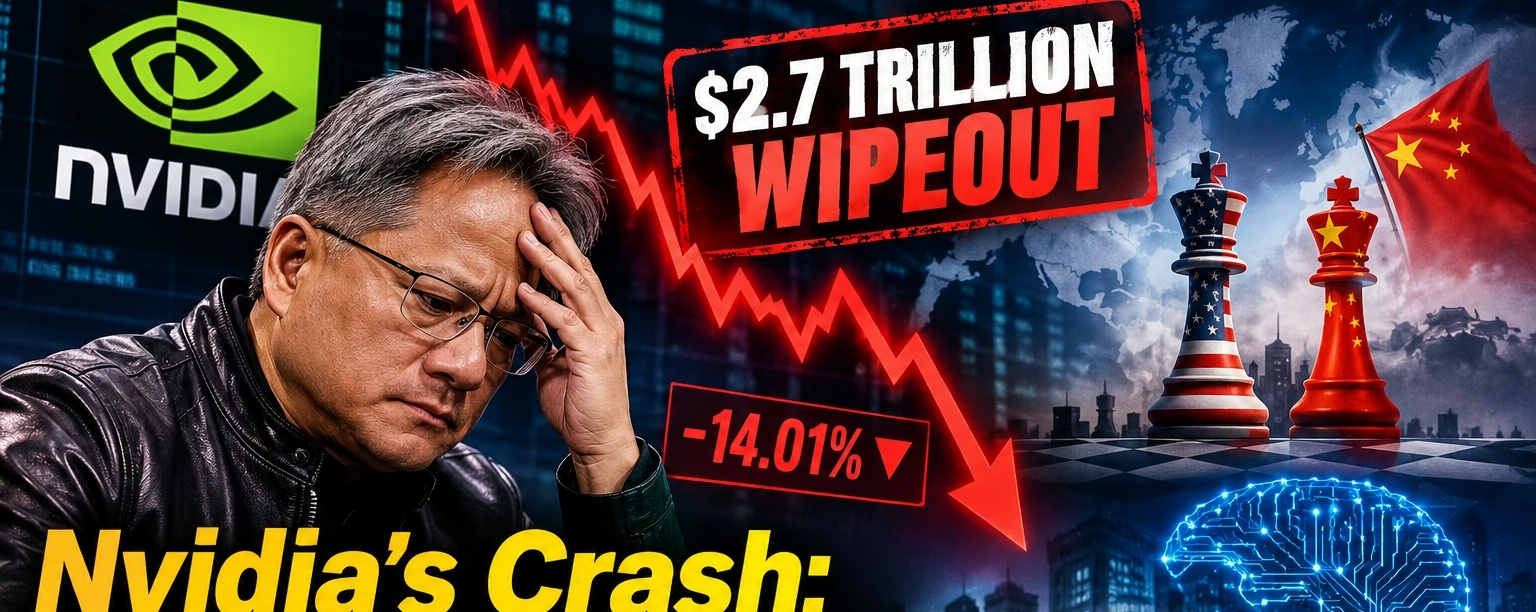
In just 45 days after its October 6 peak, Nvidia reportedly lost approximately $2.7 trillion in market value. On November 20, its share price fell to around $125.53, marking a 14.01% decline in a single trading session.
The most striking part? The company had just reported 103% year-over-year revenue growth. Its business was expanding, yet investor confidence in its stock was deteriorating.
That contradiction reveals an important signal about the current market.
1. $NVDA : Strong Earnings, Weak Market Confidence
Nvidia reported $115.8 billion in revenue for the third quarter of FY2027. Its Data Center division generated $107.6 billion, while management projected approximately $130 billion in revenue for the following quarter.
Under normal circumstances, results like these would strengthen investor confidence. But the market is no longer looking only at current earnings. Investors are questioning how sustainable this growth will be.
Leadership uncertainty has added another layer of concern. Jensen Huang’s reported departure and Colette Kress taking over as interim CEO have raised questions about the company’s future direction.
However, leadership uncertainty alone cannot explain the scale of the sell-off.
Investors are also questioning whether the enormous spending on AI infrastructure will generate sufficient returns quickly enough to justify current valuations.
There is an important distinction here: a strong company is not automatically a good investment at every price.
When market expectations move too far ahead of business fundamentals, even impressive earnings may fail to prevent a sharp correction.
2. Washington vs. Beijing: The Geopolitical Battle Behind AI
Understanding Nvidia’s future requires understanding the technological rivalry between the United States and China.
Semiconductors are no longer simply commercial products. They have become critical assets for national security, military capabilities, and economic influence.
Washington is using restrictions on advanced semiconductor exports to limit China's access to sensitive computing technology. Beijing, meanwhile, is investing heavily in domestic chip production and its own AI infrastructure.
Nvidia sits at the center of this competition.
But geopolitics creates a difficult situation for global technology companies. Even when a company has superior products and strong demand, political decisions can restrict its access to major markets.
Restrictions on sales to China, tighter export regulations, and technological sanctions could all change Nvidia’s future revenue outlook.
For investors, this matters because a single government policy can sometimes have a greater impact on a company's valuation than an entire quarter of financial results.
3. The Biggest Market Warning Since the AI Rally Began
Since 2023, AI investment has become one of the biggest drivers of global equity markets.
The growth of companies such as Nvidia, Microsoft, Alphabet, and Amazon has pushed technology valuations to extraordinary levels.
But investors are now asking a difficult question: Will the enormous spending on AI infrastructure actually generate the profits the market expects?
On November 20, the Nasdaq Composite fell 5.28% in a single session. The S&P 500 also entered correction territory, while technology and semiconductor stocks faced significant selling pressure.
The situation carries some similarities to the Dot-com Bubble of 2000 and the interest-rate-driven market downturn of 2022.
However, there is an important difference. Today's leading AI companies have substantial operating businesses and real revenue streams.
The problem is not necessarily the future of AI technology. The real question is how much investors should pay today for profits that may take years to materialize.
4. Why the AI Sell-off Matters for Bitcoin and Crypto
When major selling begins on Wall Street, its impact rarely stays confined to traditional financial markets.
Large asset managers, hedge funds, and institutional investors may hold technology stocks, Bitcoin, Ethereum, and other risk-sensitive assets within the same portfolios.
When these investors decide to reduce exposure to risk, they may sell more than just Nvidia shares. Bitcoin and altcoins can also experience capital outflows.
Three areas deserve particular attention.
Bitcoin (BTC): If technology stocks continue falling, Bitcoin could face additional selling pressure. High leverage and liquidation events could make the decline more severe.
Ethereum ($ETH ): Reduced market liquidity could put pressure on Ethereum and other major altcoins. However, network activity and underlying demand will continue to influence their longer-term performance.
Anthropic ($ANT ): New competition in the AI industry could influence Nvidia's future market position and investor expectations. However, the performance of one emerging AI company cannot determine the outlook for the entire industry.
There is also another side to this situation.
If AI valuations stabilize and dollar liquidity improves, cryptocurrency markets could attract fresh capital. Institutional investors may gradually return to risk-sensitive assets.
However, Bitcoin should not automatically be treated as a safe haven during every financial crisis. During the initial phase of market stress, it can fall alongside other risk assets.
5. From Political Decisions to Your Investment Portfolio
For ordinary investors, the easiest way to understand the impact of international politics is to follow the chain of events.
Geopolitical Tension → Export Restrictions → Corporate Revenue Uncertainty → Institutional Selling → Liquidity Pressure → Stock and Crypto Volatility.
Federal Reserve policy, US Treasury yields, and dollar liquidity play important roles throughout this process.
If interest rates remain elevated for longer, investors may become less willing to hold risk-sensitive assets.
On the other hand, expectations of lower interest rates and improving liquidity could support both equity and cryptocurrency markets.
This is why watching Bitcoin charts or Nvidia's share price alone is not enough.
Investors should also monitor US policy decisions, the bond market, and institutional capital flows.
6. Investment Strategy: Buy the Dip or Wait for Confirmation?
A 47.5% decline in Nvidia's share price does not automatically make it a bargain. At the same time, every market correction should not be treated as the beginning of a long-term collapse.
In my view, three areas deserve close attention.
- NVDA: Watch whether selling pressure begins to ease, whether AI infrastructure spending remains strong, and whether the new leadership can restore market confidence.
- BTC: Monitor key support levels, spot ETF capital flows, and changes in open interest.
- ANT: Evaluate competitive developments in the AI industry, business growth, and market valuation.
From an investment perspective, entering positions gradually is more sensible than committing all available capital at once.
Maintaining sufficient cash reserves, avoiding excessive leverage, and defining stop-loss levels in advance are equally important.
Final Perspective: Follow the Capital, Not the Hype
Nvidia's decline offers an important lesson: even a fundamentally strong business can lose significant market value when financial conditions deteriorate.
The long-term potential of the AI industry remains intact. But benefiting from that potential requires more than identifying promising companies. Valuation and timing matter just as much.
The same principle applies to Bitcoin and the broader cryptocurrency market.
My position is straightforward: Don't buy simply because prices are falling, and don't sell everything out of fear. Wait for evidence of market stabilization before committing capital.
What's your strategy? Are you buying the Nvidia dip, waiting for Wall Street to stabilize, or shifting your attention toward Bitcoin and crypto? Share your analysis in the comments.



#NvidiaLoses$2.7TrillionInMonthAndAHalf #AnthropicPlungesTowardIPOPriceonDay2 #Geopolitics #CryptoAnalysis #altcoins