
#whatinvestmentsignalsdo13ffilingsreveal?
SEC Form 13F filings disclose quarterly long equity positions from institutional investment managers with at least $100 million in qualifying assets under management (AUM).
FinBrain
While 13F filings represent a backward-looking snapshot—reflecting holdings at the end of the previous quarter—analyzing overall portfolio adjustments reveals several critical structural signals.
Medium
Core Investment Signals Revealed by 13F Filings
1. Conviction Levels via Position Sizing
High-Conviction Bets: When a fund allocates a significant percentage (e.g., 5% to 10%+) of its total portfolio to a single stock, it signals strong conviction in that position.
Stock Alarm Pro
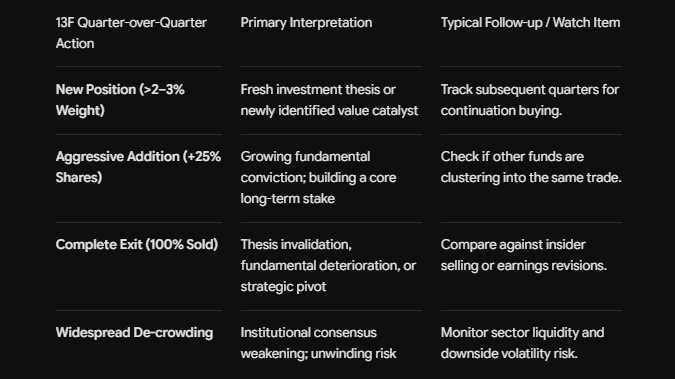
Position Trimming vs. Complete Exit: Reducing a position by 10–20% often signals routine profit-taking or portfolio rebalancing, whereas a complete liquidation (exit) signals a loss of confidence in the underlying thesis.
2. Sector Rotations and Emerging Trends
Institutional Clustering: When multiple top-tier managers simultaneously initiate or expand stakes in specific sectors or sub-industries (e.g., cybersecurity, semiconductors, energy), it highlights a broader thematic shift or macro thesis.
Macro Exposure Shifts: Aggregating total equity allocations across major institutions reveals whether money managers are taking a "risk-on" (increasing equity exposure) or "risk-off" (building cash reserves or defensive positioning) stance.
3. Crowded Trade & Liquidation Risks
High Institutional Overlap: If a specific stock appears as a major position across dozens of prominent funds, it indicates a crowded trade.
Medium
De-crowding Signals: When multiple funds quietly trim a widely held stock across consecutive quarters, it signals potential selling pressure and structural unwinding ahead.
Medium
4. Contrarian Accumulation vs. Capitulation
Dip Buying (Accumulation): If a stock's market price declines while total institutional share ownership increases, it signals smart-money contrarian accumulation.
Capitulation: If both the stock price and institutional share count drop rapidly, it signals broad institutional abandonment.
Key Data Fields & Signal Interpretations
Key Limitations to Keep in Mind
45-Day Reporting Lag: Filings are due within 45 days after quarter-end. Positions may have already been closed or modified by the time the data becomes public.
Long Positions Only: 13F filings exclude short positions, cash holdings, physical commodities, bonds, foreign-listed stocks, and derivatives (except basic put/call disclosures). A long stock position might be completely hedged against short positions or options that do not appear in the filing.
Manager Strategy Differences: High-turnover quantitative funds (e.g., high-frequency trading desks) generate noise in 13F data. Data is most actionable when tracking fundamental, long-only investors with long holding horizons.