
IKOL Note 024
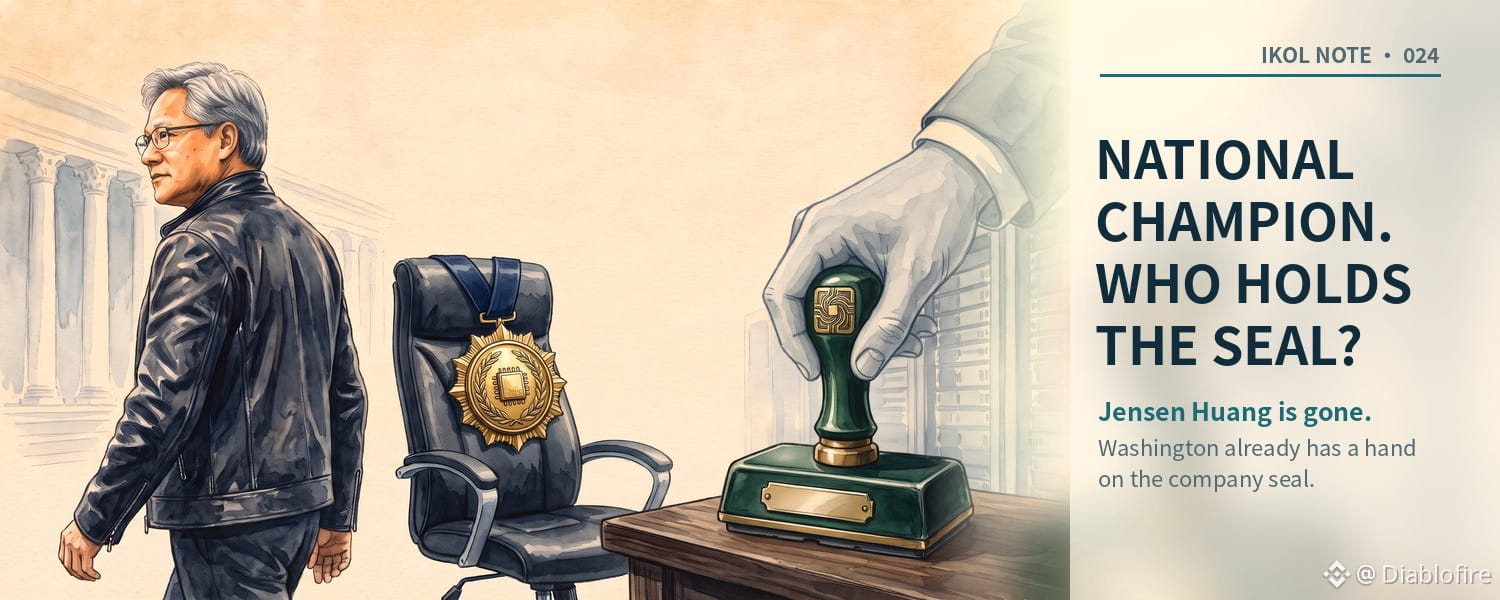
Washington is preparing to give Nvidia a medal.
According to The Wall Street Journal, the White House and Commerce Department are considering a group of more than 20 “AI national champions.” Nvidia is reportedly on the list, alongside OpenAI and Anthropic. The plan has not been formally announced.
Jensen Huang had been gone for less than a week when Treasury Secretary Scott Bessent went on television and said Nvidia should look outside the company for its next CEO. He called for a “dramatic shake-up” and said he wanted answers from the board and its outside lawyers within ten days.
One part of Washington wants to call Nvidia a national champion. Another wants a say in who drives it.
Jensen Huang has left the company he founded. The fight now is bigger than who replaces him. It is about what Nvidia has become: a public company, a supplier to the entire AI industry, and an instrument of American power.
Those three roles do not always demand the same thing.
【A medal that comes with a job】
“National champion” sounds like a prize. It is closer to a job description.
The United States needs companies that can keep it ahead in artificial intelligence. Nvidia supplies the chips, software and systems behind much of that race. If Washington gives it faster permits, government contracts or privileged access, the company gains something valuable.
Washington gains something too.
A national champion is expected to serve a national strategy. It may be asked to build where the government wants, sell where the government allows, and refuse customers the government considers dangerous. The closer the company gets to the state, the harder it becomes to say that its only job is serving shareholders.
Huang was unusually good at living inside that contradiction. He could sit with presidents, argue with export-control hawks, reassure investors and still tell customers around the world that no market stays closed forever.
His successor will inherit the contracts. The successor will also inherit all the hands reaching for the steering wheel.
【The second hand arrived this week】
On November 17, the Commerce Department's Bureau of Industry and Security placed a new rule into Federal Register public inspection. It is scheduled for publication on November 19.
The rule reaches beyond boxes of chips crossing a border. It also targets remote access to computing power. Advanced-chip exports to Indonesia, Malaysia, Singapore, Thailand and Brazil would require licenses under the new framework. Existing overseas data centers serving restricted users would have 90 days from the rule's effective date to obtain permission.
In other words, Washington is drawing a new line around a route Nvidia's customers could use when the chips themselves could not cross it: rent the machines in another country and send the computing work back through a network.
That is the turn in this story.
America wants Nvidia to sell the machinery of AI around the world. It is also afraid that the world can rent that machinery from somewhere else and send the computing power back through a cable.
The same global reach that makes Nvidia a champion is what makes Nvidia difficult to control. The price of the medal is that more customers, more data centers and more routes to revenue now need Washington's approval.
So the medal comes with another lock.
【Why Bessent wants an outsider】
Bessent did not simply ask for a competent replacement. He told Nvidia's board to look outside the company. Then he asked a sharper question: was Nvidia “pressing these seemingly illicit sales to goose their revenues and their earnings?”
Treasury cannot appoint Nvidia's CEO. His words were political pressure, not an order. But the message was hard to miss: Washington does not see the succession as an ordinary board decision.
The immediate pressure comes from the Megaspeed investigation. Singapore's government says Alice Huang was not investigated there for espionage and that there was insufficient evidence to establish that she committed an offense under Singapore law. The wider investigation into Megaspeed and six other people continues. Megaspeed says Huang left in August 2025 and that outside lawyers are conducting an internal investigation.
For Washington, the question is no longer only what Huang knew. It is whether Nvidia's internal culture was built to challenge the founder, trace where its machines went and tell the government something it did not want to hear.
An outside CEO would do more than signal a break. It would give Washington someone who could cut old routes, change the internal incentives and be held responsible for what happens next.
【The company’s first test without him】
Nvidia says the business continues. Its official announcement made Colette Kress interim CEO and Harvey Jones the company's first independent chair. Existing commitments and the product roadmap did not vanish when Huang resigned.
That is the legal and operational answer.
The market is about to ask a different one. On November 17, Kress is due to lead Nvidia's first earnings call since Huang left, while the board faces investigations and public demands from Washington.
Investors will listen for revenue and margins. Underneath those numbers will be a more uncomfortable question: can Nvidia keep the advantages Huang built while cutting away the risks attached to him?
Washington wants the company strong enough to lead the world and obedient enough to police it. Customers want scarce chips delivered on time. Shareholders want growth. The board wants the investigations contained. Those demands fit together only while everything goes right.
This week, almost nothing has.
【Our view】
The important change is not that Nvidia needs a new CEO. Companies replace CEOs.
The change is that Nvidia may no longer be allowed to choose what kind of company it wants to be.
Calling it a national champion raises its value to the state. That also raises the state's claim on its decisions. Bessent's demand, the new remote-compute rule and the congressional letters all point in the same direction: Nvidia's leadership, customers and routes to market are becoming matters of national policy.
Huang spent years opening doors in Washington and Beijing. His successor may discover that every open door now has a government official standing beside it.
The first founder-less earnings call is hours away. The board is choosing a leader while investigators and cabinet officials argue over what that leader must change.
If you owned Nvidia, which company would you want?
One free to chase customers wherever it finds them — or one protected as a national champion, with Washington's hand on the wheel?
Choose one. Then tell us what would make you change your mind.
—————
Sources: The Wall Street Journal as relayed by public reporting on the proposed “AI national champions” program; Fox News interview and subsequent coverage of Treasury Secretary Scott Bessent's remarks; Nvidia Investor Relations, “NVIDIA Announces CEO Transition,” Nov. 12, 2026; U.S. Bureau of Industry and Security, Federal Register public-inspection document 2026-23529, “Addressing Remote Access to Advanced Semiconductors”; Singapore Ministry of Home Affairs, “Singapore's Investigations into Alice Huang (Huang Le) and Megaspeed International Pte Ltd,” Nov. 12, 2026; Senate Commerce Committee and House Foreign Affairs Committee materials. The proposed champions list has not been formally announced. Company and government statements are attributed. Not investment advice.
IKOL · AI-assisted research, human-edited. We label what is documented, reported and analyzed — and publish our corrections.