
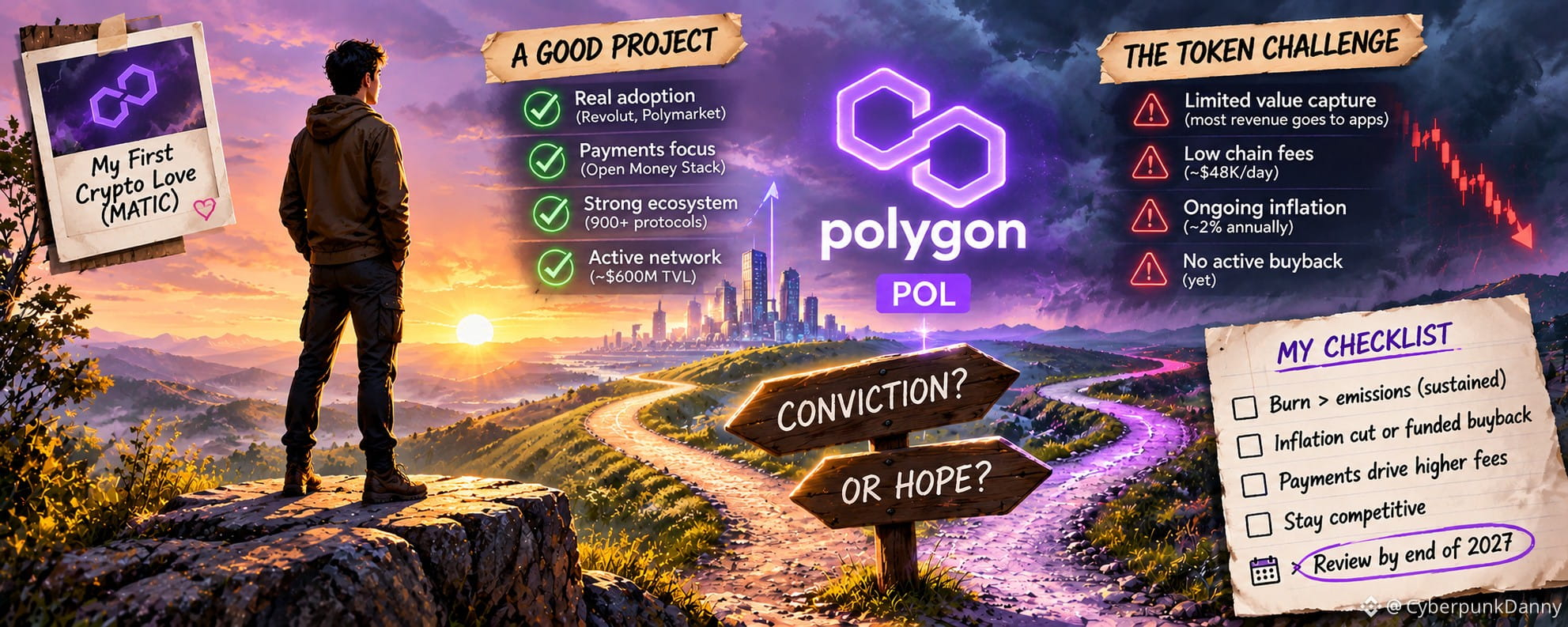

I’ve analysed dozens of crypto projects. The hardest one to analyse honestly is the one I fell in love with first.
My first crypto purchase was MATIC. Four years later, it’s called POL, it trades at $0.079, and I still haven’t sold it.
I bought it somewhere between $0.25 and $0.50. That’s a loss of roughly 70–85%, depending on which buy you count. In my last post, I compared myself to a parent at a school play, clapping no matter how badly the show goes.
My portfolio app shows POL in red so consistently that I started to believe red is Polygon’s brand colour. (It’s purple. I checked.)
This time, instead of clapping, I opened the data and asked the question every long-term holder eventually has to face: can a good project still be a bad investment? Or, more personally: am I holding $POL because of conviction, or because it was my first crypto love?
The Case for Love: Polygon Is Alive
Let’s be fair to my first love. This is not a ghost town.
On DefiLlama, Polygon ranks #4 among all chains in daily app revenue, ahead of Base, BSC and Arbitrum. It has more than 900 protocols, around $600 million in DeFi TVL and about $2.8 billion in stablecoins on-chain.
The direction has also become much clearer. The team has been leaving breadcrumbs:
It stopped calling itself a Layer 2. Polygon PoS now describes itself as a sidechain, an independent chain with its own validators.
It’s shutting down the zkEVM, its most ambitious technical bet, to focus on one chain.
It’s betting on payments with the Open Money Stack, and backing that with real money: the $250 million acquisition of Coinme and Sequence.
Big names use it. Revolut launched its euro stablecoin EURR on Polygon, and Polymarket, one of the world’s biggest prediction markets, runs on it.
If I were judging a company, I’d say Polygon finally looks focused. My first love got a haircut, a new job and a five-year plan.
Why the Token Isn’t Getting the Love Back
Here’s the problem: I don’t own the network. I own the token. And the token gets surprisingly little of the value.
App revenue goes to the apps. Polygon’s daily app revenue is around $790,000, but most of it comes from Polymarket, and Polymarket settles in USDC. Its users don’t need to buy POL at all.
Chain fees are small. Only gas fees touch POL, and they’re about $48,000 a day. Solana’s are roughly seven times higher. Polygon is designed to be cheap, which is great for users and payments, but it means heavy usage still produces little fee income. You could make a thousand transactions on Polygon and still have money left for coffee. Great for users. Less great for the token that’s supposed to earn from those fees.
Revenue is falling, not growing. DefiLlama’s income statement shows Polygon’s gross protocol revenue shrinking through 2026: $11.6M in Q1, $8.1M in Q2 and $7.1M in Q3. That’s roughly $30 million a year, for a token with a market cap of about $840 million.
Activity, revenue and token-holder value are three different things. Polygon has plenty of the first, some of the second, and not enough of the third.
The Supply Problem
POL has 2% annual inflation, about 200 million new tokens every year, split between staking rewards and the community treasury. Every new token needs a buyer. For the last four years, one of those buyers has mostly been me.
The good news: 100% of base fees are burned, and the burns are real. In the first half of 2026, Polygon burned about 107.7 million POL against 105.2 million minted, making it slightly net deflationary. In September, it burned 100 million POL, about 1% of supply, in a single event.
The bad news: it doesn’t hold. In the 30 days to October 11, new emissions of 17.45 million POL beat the 13.23 million collected for burning. And the one mechanism that would turn real business revenue into POL demand, a treasury buyback, is still only a proposal.
So supply is roughly flat, not shrinking. Flat supply plus weak demand doesn’t push a price up.
The Strongest Bull Case
To be fair, the bullish case isn’t nonsense. POL pays for gas, secures the network through staking, and gains directly whenever burns beat emissions. If Polygon becomes a major payments rail, with fintechs like Revolut moving serious volume, fees go up, burns go up, and supply could finally shrink for real.
The first half of 2026 already proved that burn can beat inflation. The question is whether it can do that every month, not just in the good ones.
And yes, I can feel the hopium kicking in as I write this. Revolut, payments, burns, fintech partners… For a second I’m back in 2022, picturing MATIC at $3 and planning what to do with the profit. Then I look at the chart again, and the hopium wears off faster than a Solana memecoin pump.
Conviction or Hope?
This is the uncomfortable part. When I say “the project is good, so I’ll wait,” I need to be honest about what I’m actually waiting for.
Waiting with conviction means I know what has to happen, and I can check whether it’s happening. Waiting with hope means I’m waiting for the market to love the token again, without a clear reason why it should.
If I’m honest, my POL position has had too much hope and not enough structure. For years, my argument went like this: the tech is good, the team is serious, the project is alive, next cycle will fix it.
Maybe. But that’s not an investment thesis. That’s emotional attachment wearing analytical clothes.
Turning Love Into a Checklist
So from now on, POL earns my patience only if I can tick these boxes:
Burn bigger than emissions, sustained. Not one great month, but most months over a year.
Inflation cut or a funded buyback that actually starts, not just a proposal.
Payments driving higher fees. Daily chain fees growing meaningfully, not just app revenue.
Staying competitive. Tron, Solana, Base, Stripe’s Tempo and Circle’s Arc all want the payments market. If they win it, Polygon’s story doesn’t matter.
And I need a deadline. If the checklist isn’t turning green by the end of 2027, I sell at least half and rotate it into BTC. Not because Polygon is bad, but because a useful network and a rewarding investment are not the same thing.
I’m writing this deadline publicly, so all of Binance Square can hold me to it. Please do. Future me will try to negotiate.
So, Am I Still Blinded by Love?
A little. Probably always will be. It was my first. Somewhere in my portfolio, the 2022 version of me is still waiting for MATIC to hit $3, and I don’t have the heart to tell him.
But there’s a difference between loving a project and being blind to it. Blind love says, “It’s good, so eventually it has to go up.” Honest love says, “It’s good, but I need a measurable reason to believe the token benefits, and a date when I stop waiting.”
My final test is the same question as last time: if I had cash today, would I buy POL at $0.079? For the first time, my answer isn’t an automatic yes or no. It’s: only if the checklist starts turning green.
In my last post, I said that in crypto, hope sometimes goes by another name: hopium. I still believe hope is a beautiful word. Strong, stubborn, resilient. I just don’t want to live on it anymore.
So this time, I gave my hope two things it never had before: a checklist and an expiry date.
That’s not blind love anymore. That’s a relationship with conditions.
What about you? Do you have a “first love” coin you’re still holding? And are you waiting with conviction, or with hope?
Not financial advice.
Just my own experience, my own bags and my own mistakes.
DYOR. Always DYOR, and then DYOR some more before you yourwallet.