
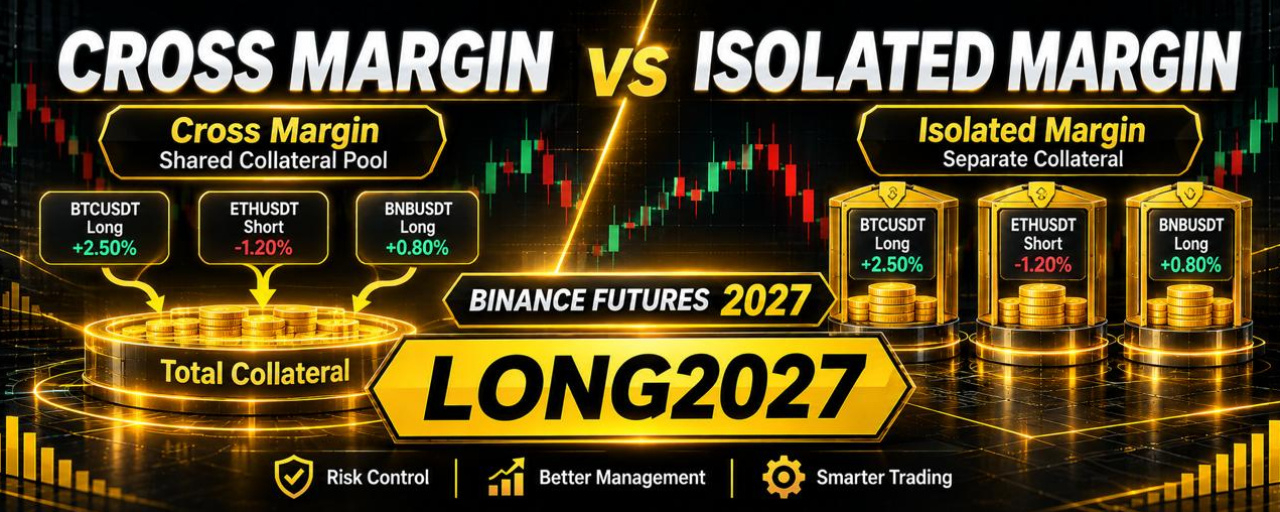

In Binance Futures, choosing Cross Margin or Isolated Margin is not just a preference in the trading interface. It determines how collateral is allocated, how losses affect available margin, and how much of your Futures balance may be exposed when a position moves against you.
The distinction becomes especially important when several positions are open at the same time.
Cross Margin allows eligible positions to share a margin balance. Isolated Margin assigns a separate margin balance to an individual position. Neither mode removes liquidation risk. The difference is where the risk is concentrated and how much collateral can be used to support the position.
Understanding this distinction is essential before opening multiple BTC, ETH, or altcoin Futures positions in 2027.
1. What Is Cross Margin on Binance Futures?
Cross Margin is a margin mode in which eligible open positions share available margin from the same asset balance.
For example, if you trade multiple USDT-margined contracts in USDⓈ-M Futures, the available USDT balance can support positions using Cross Margin. In COIN-M Futures, collateral sharing is based on the relevant asset, such as BTC for BTC-based contracts.
This means the margin supporting one position is not necessarily limited to an amount manually assigned to that specific trade.
The main advantage is flexibility. If one position has an unrealized loss while another has an unrealized profit, the shared margin balance can reflect the combined effect of those positions.
However, this flexibility creates a risk that traders sometimes underestimate.
A losing position can consume part of the shared collateral buffer that might otherwise support other open positions.
Cross Margin should therefore be understood as shared collateral exposure, not as a safety mechanism.
2. What Is Isolated Margin on Binance Futures?
Isolated Margin assigns a dedicated margin balance to a specific position.
Instead of relying on a shared collateral pool, the position has its own allocated margin. Other positions do not automatically use that isolated margin balance to support their exposure.
For example, imagine a trader has 1,000 USDT available in the Futures wallet and opens two positions:
- BTCUSDT position with 100 USDT of allocated isolated margin.
- ETHUSDT position with 150 USDT of allocated isolated margin.
The remaining balance is not automatically added to either isolated position.
If the BTC position deteriorates, its allocated margin is the collateral pool associated with that position. The ETH position has a separate margin allocation.
This separation can make position-level risk easier to understand and control.
However, Isolated Margin does not mean that a trade cannot lose its allocated collateral. If the position reaches its liquidation conditions, the allocated margin can be depleted through the liquidation process.
Traders can also manually add or remove margin from an eligible isolated position. Adding margin increases the collateral supporting that position, while removing margin can reduce its liquidation buffer.
3. The Main Difference: Shared Collateral vs Dedicated Collateral
The distinction can be summarized in one question:
Can the collateral supporting one position also be used to support another position?
In Cross Margin, eligible positions sharing the same asset margin balance can draw on that shared pool.
In Isolated Margin, each position has its own allocated margin balance.
Consider a simplified example.
A trader has 1,000 USDT in a USDⓈ-M Futures account and opens two positions.
Position A: BTCUSDT
Position B: ETHUSDT
Under Cross Margin:
Both eligible Cross positions use the shared USDT margin balance. If BTC generates a substantial unrealized loss, the account's available margin can decrease, potentially reducing the buffer available to support ETH as well.
Under Isolated Margin:
The trader allocates 100 USDT to BTC and 150 USDT to ETH. The BTC position's margin is separated from ETH's margin. A loss affecting the BTC position does not automatically consume ETH's isolated margin allocation.
These figures are only an illustration of collateral allocation. They are not liquidation-price calculations. Actual liquidation depends on position size, entry price, Mark Price, maintenance margin, leverage, fees, and other applicable risk parameters.
4. Why Cross Margin Can Create Portfolio-Level Risk
Cross Margin can be useful when a trader intentionally manages several positions as one portfolio.
But it can also create a hidden connection between trades that appear unrelated.
Imagine holding:
- A BTCUSDT long position.
- An ETHUSDT long position.
- A SOLUSDT short position.
Each position may have a separate trading thesis. One may be based on a breakout, another on a hedge, and another on a short-term reversal.
Yet, when eligible positions share Cross Margin collateral, their risk is not completely independent.
If BTC moves sharply against the account, the resulting unrealized loss can reduce the shared margin balance. That reduction may leave less collateral available to absorb volatility in ETH or SOL.
This creates a portfolio-level question:
How much of the account's shared collateral is exposed to the combined movement of all open positions?
A trader who evaluates each position independently may underestimate the total risk.
The correct approach is to monitor account-level margin health, not just the liquidation price of the trade currently receiving attention.
5. Why Isolated Margin Does Not Automatically Mean Lower Trading Risk
Isolated Margin can help limit collateral exposure at the individual-position level, but it does not automatically make a trading strategy safer.
There are several reasons.
First, the trader can still open an oversized position. Separating collateral does not correct poor position sizing.
Second, a position can still be liquidated if its allocated margin becomes insufficient.
Third, traders may repeatedly add margin to losing positions. This can turn an initially limited-risk trade into a larger capital commitment.
Fourth, isolated positions can still incur trading fees, funding payments, slippage, and liquidation-related costs.
The important distinction is between controlling where collateral is exposed and controlling how much market risk is taken.
Isolated Margin helps with the first. Position sizing, leverage discipline, and exit planning are still required for the second.
6. How Leverage Interacts With Cross and Isolated Margin
Leverage and margin mode are related, but they are not the same setting.
Leverage determines the initial margin requirement for a given position size. Margin mode determines how collateral is allocated and shared.
For example, two traders can open positions with similar notional exposure and use the same leverage while choosing different margin modes.
Their collateral arrangements can still be different.
A common mistake is assuming that selecting 10x leverage means the maximum loss is automatically limited to one-tenth of the position value.
That is not a complete description of Futures risk.
The actual outcome depends on the position's price movement, maintenance margin requirements, fees, funding, liquidation mechanics, and the selected margin mode.
A useful way to separate the concepts is:
- Position size determines market exposure.
- Leverage affects the initial margin requirement.
- Margin mode determines how eligible collateral supports positions.
- Maintenance margin and account equity influence liquidation risk.
For a deeper explanation of the costs that can accumulate around a Futures position, read:
Binance Futures Trading Costs Explained: Trading Fees, Funding Rates and Liquidation Costs in 2027
https://www.binance.com/en/square/post/383591210067971
7. How Liquidation Works Differently in Cross and Isolated Margin
Liquidation is not triggered simply because the Last Price touches a number displayed on the chart.
Binance Futures uses Mark Price for liquidation calculations. A position becomes subject to liquidation when the available collateral is no longer sufficient to meet the applicable maintenance margin requirement.
The margin mode changes how the available collateral is assessed.
In Cross Margin, the shared margin balance can support eligible positions. This means the liquidation risk of one position can be affected by the broader account's available margin and unrealized PnL.
In Isolated Margin, the position's own allocated margin is central to its liquidation calculation.
There is also an important detail in Hedge Mode.
Binance's Futures liquidation documentation explains that long and short positions of the same symbol share the same liquidation price when they are in Cross Margin Mode. If both positions are in Isolated Margin Mode, they can have different liquidation prices depending on the margin allocated to each position.
This is one reason why margin mode and position mode should not be treated as interchangeable settings.
For a detailed explanation of Mark Price and Last Price, including why liquidation can occur even when the chart's last traded price appears not to have reached the displayed liquidation level, see:
Binance Futures Mark Price vs Last Price: Why Your Stop-Loss May Not Prevent Liquidation in 2027
https://www.binance.com/en/square/post/383895795195979
8. Can You Add More Margin to an Isolated Position?
Yes. Binance provides an option to adjust the margin balance allocated to an eligible Isolated position.
A trader can add margin to increase the collateral supporting the position. This can move the liquidation price farther from the current market price, depending on the position and applicable risk parameters.
However, adding margin should not be confused with reducing the underlying market exposure.
If a trader adds 100 USDT to a losing position without changing its size, the position remains the same size. The trader has simply committed more collateral to support it.
Removing margin works in the opposite direction. It reduces the collateral allocated to the position and may bring liquidation closer.
The amount that can be added or removed is subject to Binance's margin calculations and account conditions. It is not always possible to withdraw the full displayed isolated margin balance.
A practical rule is to decide in advance how much capital a position is allowed to consume. Otherwise, repeated margin additions can weaken the original risk limit.
9. Can You Switch Between Cross and Isolated While a Position Is Open?
Binance's published instructions state that margin mode changes apply to the selected contract, rather than automatically changing every contract in the account.
The same instructions state that users cannot switch the margin mode while there are open orders or positions for that contract.
This is important when preparing a trade.
Before opening a position, check the selected contract and confirm whether Cross or Isolated is active. Do not assume that changing the setting for one symbol changes the margin mode for every other symbol.
Also remember that Cross Margin sharing is restricted by asset type. It should not be interpreted as every asset in every Futures wallet automatically becoming one universal collateral pool.
10. Cross Margin, Isolated Margin and Multi-Assets Mode
Another setting that can cause confusion is Multi-Assets Mode.
Margin Mode and Asset Mode are different concepts.
Cross or Isolated determines how margin is allocated to positions.
Single-Asset or Multi-Assets determines how eligible assets are used within USDⓈ-M Futures.
Binance's documentation states that Multi-Assets Mode supports Cross Margin Mode only. If open positions are in Isolated Mode, they must be switched to Cross before Multi-Assets Mode can be enabled.
This matters because traders may see several settings in the Futures interface and assume they all control the same risk mechanism.
They do not.
A trader should understand the difference between:
- Margin Mode: Cross or Isolated.
- Asset Mode: Single-Asset or Multi-Assets.
- Position Mode: One-Way or Hedge.
- Leverage: the leverage configured for the contract.
Each setting changes a different part of the trading system.
11. A Practical Checklist Before Choosing a Margin Mode
Before opening a Futures position, consider the following questions:
1. Am I trading one position or managing several positions together?
2. Do I want eligible positions to share collateral?
3. Would a large unrealized loss in one position affect the margin buffer available to my other positions?
4. How much collateral am I willing to allocate to this specific trade?
5. Have I checked the Mark Price and liquidation price?
6. Do I understand the maintenance margin requirements for the position size?
7. Am I using Single-Asset or Multi-Assets Mode?
8. Have I checked whether the selected contract is actually set to Cross or Isolated?
These questions are more useful than choosing a margin mode simply because one option appears more popular.
12. Frequently Asked Questions
Is Cross Margin safer than Isolated Margin?
Neither is universally safer. Cross Margin can provide a larger shared collateral buffer, but losses in one eligible position can reduce the margin available to support others. Isolated Margin separates collateral by position, but the allocated margin can still be lost through liquidation.
Does Isolated Margin protect my entire Futures balance?
It separates the collateral allocated to an isolated position from other positions. It does not eliminate trading risk, fees, funding costs, or the possibility of losing the margin assigned to that position.
Can Cross Margin prevent liquidation?
No. Shared collateral may provide more room before liquidation, but a sufficiently large loss across the account can still cause liquidation.
Does Cross Margin use every asset in my Binance account?
No. Cross Margin sharing is subject to the relevant Futures account and asset rules. For example, Binance documents sharing between positions using the same type of asset. Multi-Assets Mode is a separate USDⓈ-M setting with its own requirements.
Can I add margin to an Isolated position after opening it?
Binance provides an adjustment function for eligible isolated positions. The amount that can be added or removed depends on the account's available margin and applicable calculations.
Does changing leverage automatically change Cross to Isolated?
No. Leverage and margin mode are separate settings. Changing one does not automatically change the other.
Can two Hedge Mode positions have different liquidation prices?
They can have different liquidation prices when both are in Isolated Margin Mode, depending on the margin allocated to each. In Cross Margin Mode, Binance documents that long and short positions of the same symbol share the same liquidation price.
13. Final Perspective: Margin Mode Is a Collateral Decision
Cross Margin and Isolated Margin are not simply two different ways to display leverage.
They represent two different approaches to collateral management.
Cross Margin connects eligible positions through a shared margin balance. This can make portfolio-level capital use more flexible, but it also means that losses can affect the collateral buffer supporting other positions.
Isolated Margin separates collateral by position. This can make individual trade risk easier to define, but it does not prevent liquidation or compensate for excessive exposure.
The important question is not which setting is always better.
It is whether the collateral structure matches the way the trader actually manages risk.
A trader managing several positions as one portfolio needs to understand the combined effect of unrealized PnL and shared margin. A trader who wants a defined collateral allocation for each position needs to understand how isolated margin can be adjusted and how liquidation affects that allocation.
In Futures trading, the position is only one part of the risk. The collateral supporting it is the other.
Further Reading: Binance Futures Risk Management Series
Binance Futures Trading Costs Explained: Trading Fees, Funding Rates and Liquidation Costs in 2027
https://www.binance.com/en/square/post/383591210067971
Binance Futures Mark Price vs Last Price: Why Your Stop-Loss May Not Prevent Liquidation in 2027
https://www.binance.com/en/square/post/383895795195979
Binance Futures Stop-Loss Guide 2027: Stop-Market vs Stop-Limit, Trigger Prices and Execution Risk
https://www.binance.com/en/square/post/384255698781984
Binance Futures Referral Code 2027: LONG2027 for USDT-M and COIN-M Trading Fees
https://www.binance.com/en/square/post/382080858570766
Official Binance References
How to Switch Between the Cross Margin and Isolated Margin Modes
https://www.binance.com/en/support/faq/detail/360038075852
How to Adjust Margin Balance in Cross/Isolated Margin Mode
https://www.binance.com/en/support/faq/detail/360038447311
Binance Futures Liquidation Protocols
https://www.binance.com/en/support/faq/detail/360033525271
How to Switch between Single-Asset and Multi-Assets Modes
https://www.binance.com/en/support/faq/detail/de2681ac63714c7d84a685967f7c1a53
Educational Disclaimer: This article is for informational purposes only and does not constitute financial or investment advice. Futures trading involves substantial risk and may result in the loss of your allocated collateral. Binance product rules, supported features, and regional availability may change. Always review the current trading interface and applicable Binance documentation before placing an order.