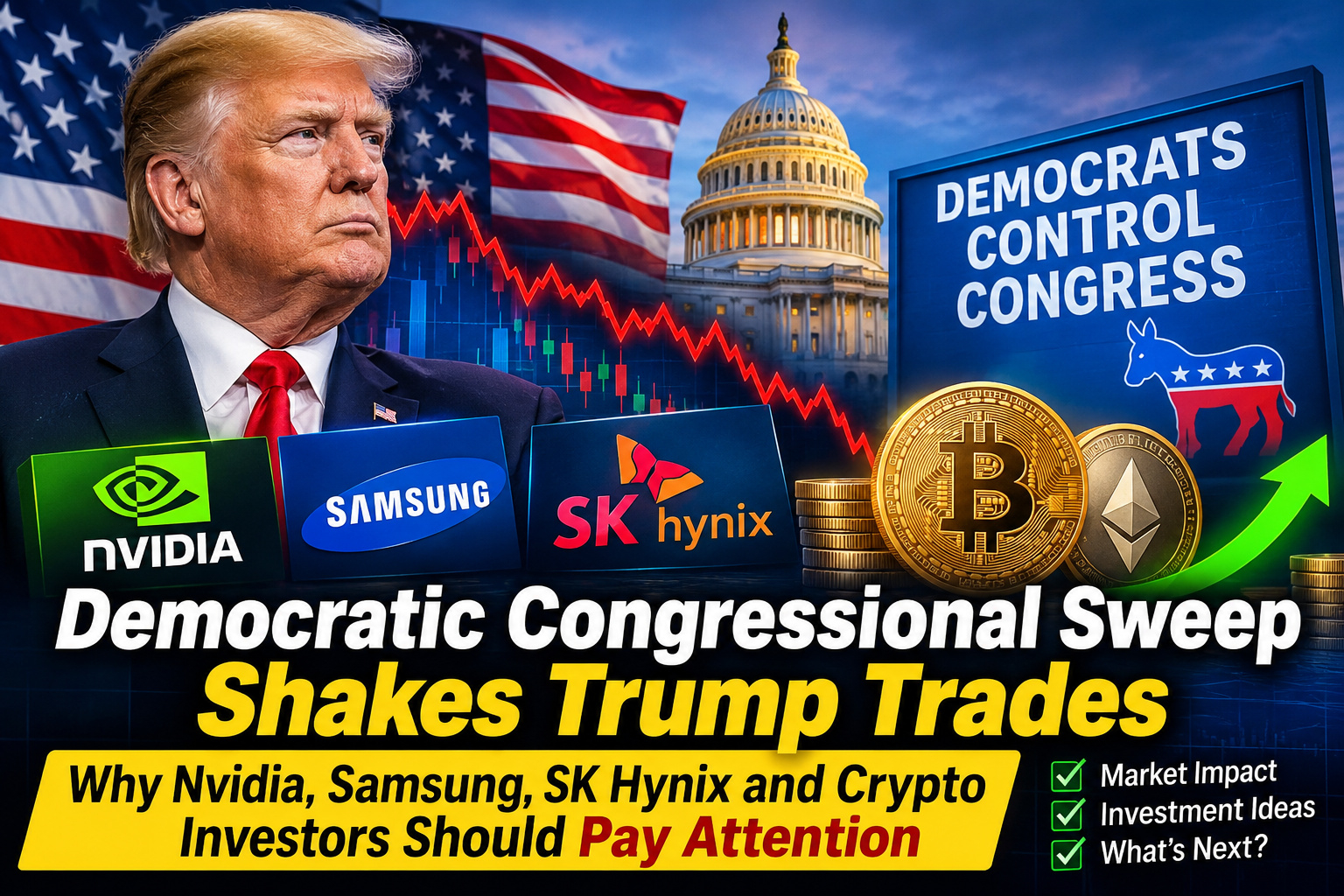

Washington's political power shift could reshape the AI investment landscape, challenge Trump's economic agenda and change how institutional investors position themselves across semiconductors and crypto. The real question is: where will the smart money move next?
The US political landscape has entered a new phase. Democrats have won control of both the House of Representatives and the Senate, creating a fresh political challenge for President Donald Trump during the final two years of his administration.
For investors, this is more than an election result. It introduces new uncertainty around technology policy, government spending, trade relations and crypto regulation.
Markets are already reassessing the risks. AI-related equities, semiconductor stocks and cryptocurrencies could face changing investor expectations as Washington's political balance shifts.
But one question matters more than the headlines: Will this political change damage the AI and crypto investment cycle, or simply create opportunities for investors who understand the bigger picture?
1. Washington's Political Shift: Why Investors Should Care
Since Trump's return to the White House in 2025, markets have been pricing in expectations of business-friendly policies, deregulation, tax incentives and stronger investment in AI infrastructure.
That environment helped support valuations across major technology companies.
Now, the political equation has changed.
A Democratic-controlled Congress can increase government investigations, scrutinise federal spending and challenge the administration's policy priorities. It can also make new legislation more difficult to pass.
However, investors should understand one important distinction: Trump remains president and retains executive authority, including veto powers and significant influence over trade and foreign policy.
This means the existing economic agenda will not automatically disappear.
Instead, the market may have to deal with more political confrontation, regulatory uncertainty and slower legislative progress.
Historically, divided government has not always been negative for equities. Corporate earnings, interest rates and economic growth still carry considerable weight.
2. AI Investment Faces a Political Reality Check
The AI industry could be particularly sensitive to this development.
Building AI infrastructure requires enormous capital. Data centres, advanced processors, high-bandwidth memory and electricity networks all depend on long-term investment commitments.
Democratic lawmakers may push for greater scrutiny of AI safety, energy consumption, environmental impact and data-centre development.
For the market, this creates a potential challenge.
The concern is not that AI demand will suddenly disappear. It is whether regulatory pressure, infrastructure costs or approval delays could slow the pace of expansion.
That distinction matters.
When investors price AI companies for years of rapid growth, even a modest change in future spending expectations can trigger significant valuation adjustments.
3. Three Semiconductor Stocks Investors Should Watch
The political shift does not affect every semiconductor company in the same way. Their competitive positions, earnings quality and exposure to AI demand will matter.
NVIDIA ($NVDA): Still at the Centre of the AI Economy
NVIDIA remains one of the most important companies in the global AI infrastructure market.
Its business is closely tied to hyperscaler spending, advanced computing demand and the expansion of AI data centres.
Political uncertainty could influence future infrastructure investment expectations. But NVIDIA's long-term prospects are not determined by Washington alone.
Investors should focus on four factors:
Demand for AI accelerators and computing infrastructure.
Capital expenditure from major cloud providers.
US-China semiconductor export restrictions.
Gross margins and future earnings growth.
Investment outlook: A politically driven correction should not automatically be treated as a fundamental breakdown. If AI demand and earnings remain strong, a valuation pullback could offer opportunities for disciplined investors.
Samsung Electronics ($005930): The Memory and Manufacturing Opportunity
Samsung has a strategically important position in the global semiconductor supply chain.
Its exposure to memory chips, advanced manufacturing and AI-related hardware connects its performance to the broader technology investment cycle.
If data-centre expansion slows, demand expectations for memory products could come under pressure.
However, the long-term growth of AI computing also creates opportunities for Samsung, particularly in advanced memory and high-bandwidth memory (HBM).
The key factors to monitor are HBM competitiveness, manufacturing execution, memory pricing and profit margins.
Investment outlook: Samsung offers exposure to more than just AI processors. Its ability to capture a larger share of the advanced memory market will be particularly important for its investment case.
SK Hynix ($000660 / $SKHY ): A Strategic Player in AI Memory
SK Hynix has become one of the most important companies in the AI memory supply chain.
Its high-bandwidth memory technology is closely connected to advanced AI accelerators. Its relationship with NVIDIA further strengthens its position in this market.
The company's third-quarter 2026 results reportedly showed revenue of approximately 104.6 trillion won and operating profit of 83.3 trillion won.
It also reported expanding HBM4 sales and long-term agreements covering more than half of its 2027–2028 production capacity.
These numbers highlight why investors continue to pay attention to the company.
Political uncertainty may influence share prices, but it does not immediately eliminate existing customer commitments or the underlying demand for advanced memory.
Investment outlook: SK Hynix offers substantial exposure to AI infrastructure growth. However, investors should watch memory pricing, customer concentration, production capacity and whether AI capital expenditure can sustain its current pace.
The important point is simple: short-term volatility and long-term business fundamentals are not the same thing.
4. Why Crypto Investors Should Also Pay Attention
The political shift in Washington could have consequences beyond traditional technology stocks.
The cryptocurrency industry has increasingly benefited from expectations of regulatory reform, institutional participation and a more supportive policy environment under Trump.
A Democratic-controlled Congress could bring greater scrutiny to several areas:
Crypto exchange compliance and consumer protection.
Stablecoin regulation and reserve transparency.
DeFi oversight and financial-market safeguards.
Political connections involving crypto businesses.
The respective regulatory responsibilities of the SEC and CFTC.
But greater scrutiny does not automatically mean an anti-crypto policy.
Clearer and more consistent regulation could eventually make the industry more attractive to institutional investors.
The immediate problem is uncertainty over the direction and timing of future legislation.
For Bitcoin and Ethereum investors, the bigger indicators remain institutional capital flows, liquidity, Treasury yields, dollar strength and regulatory developments.
A political headline alone is not enough to establish a long-term bearish trend.
5. US-China Competition: The Geopolitical Risk Behind Semiconductor Stocks
Semiconductors are no longer just commercial products. They are strategic assets tied to national security, economic competitiveness and technological leadership.
The United States wants to maintain its advantage in advanced computing and AI infrastructure.
China, meanwhile, is working to reduce its dependence on foreign technology and strengthen its domestic semiconductor industry.
South Korea sits in a strategically important position in this competition.
Companies such as Samsung and SK Hynix are essential parts of the global semiconductor supply chain.
If Washington introduces tighter export restrictions, companies operating across international markets could face additional costs and uncertainty.
However, competition between Washington and Beijing could also encourage more investment in domestic chip manufacturing, advanced memory and alternative supply chains.
For investors, geopolitical competition creates two possibilities: higher operating risks and new investment opportunities.
6. Where Could Institutional Capital Move?
When political uncertainty increases, large investors often reconsider concentrated positions and reassess risk.
Several possible capital-flow scenarios deserve attention.
AI and technology stocks: Regulatory concerns could trigger selective profit-taking, especially in companies whose valuations depend on uninterrupted infrastructure expansion.
Semiconductor companies: Short-term volatility may increase, but businesses with strong earnings, technological advantages and established customer demand could remain attractive.
US Treasuries: Expectations of slower fiscal expansion could support government bonds. However, inflation and government borrowing remain important variables.
Gold: Political uncertainty, geopolitical tensions and a weaker dollar could increase demand for defensive assets.
Cryptocurrency: Regulatory uncertainty could weigh on sentiment initially. On the other hand, clearer rules could encourage greater institutional participation over time.
These are potential scenarios, not guaranteed outcomes. Actual capital allocation will depend on earnings, liquidity and policy developments.
7. The Investor's Roadmap: How Politics Reaches Your Portfolio
The connection between political decisions and investment performance follows a clear chain:
Political power shift in Washington
↓
Greater congressional oversight and potential legislative gridlock
↓
Uncertainty around AI incentives, data-centre development and crypto regulation
↓
Changes in corporate investment and spending expectations
↓
Repricing of semiconductor, technology and digital-asset valuations
↓
Institutional portfolio adjustments and changing capital flows
The important detail is timing.
Markets usually react to expectations first. The actual impact on corporate earnings and cash flows may take months or even years to become visible.
Investors who understand this difference are less likely to make emotional decisions based on headlines.
8. Five Developments Worth Watching
Over the coming weeks, investors should pay close attention to:
Whether Democratic lawmakers introduce new investigations or legislative proposals targeting AI and cryptocurrency.
Whether major data-centre markets face additional regulatory restrictions or approval delays.
Whether NVIDIA, Samsung and SK Hynix maintain their earnings outlook and AI-demand expectations.
Whether US Treasury yields and the dollar continue weakening or reverse their initial moves.
Whether institutional Bitcoin and Ethereum investment flows recover despite political uncertainty.
These developments will offer a much better indication of market direction than political headlines alone.
Final Market Outlook: Opportunity or Warning?
The Democratic congressional sweep does not mean the end of Trump's economic agenda. Nor does it signal the end of the AI or cryptocurrency investment cycle.
What it changes is the political risk surrounding these industries.
$NVDA , $SAMSUNG and SK Hynix remain strategically important to the global AI supply chain. Their long-term investment potential will depend on technological leadership, earnings growth and actual customer demand.
For crypto, the bigger question is whether increased political scrutiny eventually produces regulatory clarity or prolonged uncertainty.
My view is that investors should avoid reacting emotionally to the initial market volatility.
Watch valuations, institutional capital flows, earnings quality and liquidity. Do not confuse a political correction with a fundamental change in business performance.
The next phase of the market could reward selective positioning rather than indiscriminate exposure to AI and crypto.
Political power can change market sentiment overnight. But sustainable investment returns still depend on fundamentals.
What Do You Think?
Will the Democratic congressional sweep create a meaningful headwind for NVIDIA, Samsung and SK Hynix, or could the resulting market volatility offer long-term buying opportunities?
And what about Bitcoin and the broader crypto market? Will tighter political scrutiny hurt institutional adoption, or could clearer regulation eventually bring more capital into the industry?
Share your market outlook in the comment



#USMidterms-WhatAreMarketsExpecting? #Binance #uselections #Geopolitics #CryptoAnalysis